How Things Last
Part One: Two Envelopes
My husband was careful with money his whole life. Thomas Whitford was a hardware store owner from a small town in North Carolina who saved every receipt, darned his own socks, and drove the same Ford pickup for nineteen years. He used to say that a man shows you who he is by what he does with a dollar when nobody’s watching.
So when he died, there was no lawyer reading a will in a wood-paneled office, no dramatic surprise heir, no family fighting over the silverware. There were just two envelopes, sealed with his handwriting on the front, sitting in the top drawer of his desk. One said Jared. The other said Leah.
He’d arranged everything before he went. That was Thomas.
My name is Leah Whitford. I’m sixty-seven years old. Until the afternoon my husband died, I believed losing him would be the most painful thing I ever lived through.
I was wrong.
We opened the envelopes three weeks after the funeral, at the kitchen island in my son’s house in Charlotte. It was a big new house in a gated subdivision called Ballantyne Reserve, with white quartz counters and pendant lights and a refrigerator with a screen on the door that showed the weather. I’d been living in the guest room for most of a year, since Thomas went into hospice, because it was twenty minutes from the facility, and our own house two hours away in Wilkesboro was too far to drive back and forth every day.
During those months, I’d cooked their dinners. Washed their clothes. Picked up their dry cleaning. Run their errands. Cleaned up after my daughter-in-law’s dinner parties, which happened most weekends, while I sat by my husband’s bed in hospice every afternoon and every evening holding his hand.
I never asked for anything in return. That’s what mothers do.
Part Two: The Penthouse
My son, Jared, opened his envelope first. He’s forty-two, a regional sales manager for a medical device company, tall like his father, with Thomas’s jaw but not his patience. He unfolded the letter and read it, and his face changed.
“The Miami penthouse,” he said quietly.
Behind him, his wife let out a squeal that made me jump.
Vanessa is thirty-eight. She’s beautiful in a sharp, polished way, with dark hair always blown out sleek and nails done every other week and clothes that I suspect cost more than my car. She runs an Instagram account about interior design with forty thousand followers, and she does what she calls “brand partnerships,” which as far as I can tell means companies send her free throw pillows.
She threw her arms around Jared’s neck from behind and kissed his cheek.
“Oh my God,” she said. “Oh my God, babe. Brickell. Floor-to-ceiling windows. That ocean view.” She was already pulling out her phone. “I’m going to completely redo it. All white. Maybe some brass accents. It’s going to be the best content I’ve ever posted.”
The penthouse was a two-bedroom unit on the thirty-eighth floor of a glass tower in the Brickell neighborhood of Miami, with marble floors and a balcony overlooking Biscayne Bay. Thomas bought it in 2015 as an investment, after he sold the hardware store. He’d rented it out to executives on short contracts. I’d only been there twice.
It was exactly the kind of address Vanessa loved to post about.
Then it was my turn.
I opened my envelope. Thomas’s familiar square handwriting on a single sheet of yellow legal paper, and a small brass key taped to the bottom of the page.
The cabin on Grandfather Mountain is yours, Leah. Everything in it. Key’s attached. — T.
The cabin. A little two-bedroom log cabin on twelve acres near Linville, in the Blue Ridge Mountains, about three hours northwest of Charlotte. Thomas’s grandfather built it in 1952. We went there every summer when Jared was small, before it got too run-down. The last time I’d seen it was fifteen years ago. The roof leaked. The porch was rotting. There were mice in the walls and a family of raccoons living under the floor.
For two years before he got sick, Thomas had driven up there almost every weekend. Just keeping the place from falling down, he always said.
Part Three: “Stinking Old Woman”
For a moment, nobody in the kitchen said anything.
Then Vanessa burst out laughing.
“Of course!” she said. “Of course the old woman gets the old shack!”
She laughed so hard she had to hold on to the back of Jared’s chair.
I looked at my son. I waited for him to say something. To tell his wife that wasn’t funny. To defend his mother, three weeks after she buried his father.
Jared stared down at his shoes.
“Honestly,” Vanessa said, wiping her eyes, still laughing, “it suits you perfectly. A smelly old cabin for a stinking old woman.”
She said it like a joke. She always said things like a joke. At thirty-eight, my daughter-in-law had perfected the art of making cruelty sound like a punch line, so that if you objected, you were the one who couldn’t take a joke.
Jared still didn’t look up. That was the part that broke my heart. Not what Vanessa said. What my son didn’t.
Vanessa wasn’t finished.
“Well, Leah,” she said, smoothing her hair, “since you’ve got your own place now, we’ll need the guest room back.”
I blinked. “What?”
“I’m turning it into a home gym,” she said. “I’ve already ordered a Peloton. It’s coming Thursday. So you should probably pack tonight.”
“Tonight?” I said.
“Unless,” Vanessa said sweetly, “you think we should put our whole lives on hold because you can’t manage yours.”
Jared shifted in his chair. He cleared his throat.
“Mom,” he murmured, still not looking at me. “Maybe it’s better this way. You know. A fresh start.”
Something inside me collapsed. I felt it go, like a beam giving way in an old barn.
I could have reminded him of the nights I sat up with him when he had croup at three years old, steaming up the bathroom so he could breathe. Of the college tuition Thomas and I paid, every penny of it, so he could graduate from UNC without a dollar of debt. Of the down payment on this very house, which Thomas wrote a check for eight years ago. Of the years of babysitting other people’s dogs and covering his car payments when he lost his first job.
Instead, I folded my husband’s letter in half and put it in the pocket of my cardigan.
“Fine,” I said.
Vanessa looked almost disappointed. I think she’d been hoping for tears.
I went upstairs and packed two suitcases. Everything I owned that was there: my clothes, my reading glasses, Thomas’s wristwatch, the photograph of the two of us on our wedding day in 1981. I left the house key on the kitchen counter beside the screen on the refrigerator door, which was showing a forecast of rain.
Then I walked out the front door to my car.
Nobody followed me.
Part Four: The Mountain Road
I drove northwest out of Charlotte on Highway 321 as the sun went down. Past Gastonia and Hickory and Lenoir, the land rising slowly, the flat red clay of the Piedmont giving way to rolling hills, then the dark wall of the Blue Ridge against the evening sky.
By the time I turned off onto the narrow two-lane road that winds up the side of Grandfather Mountain, it was full dark. The trees pressed close on both sides. Fog hung between the pines in long gray ribbons, drifting across the road in my headlights. I drove twenty miles an hour, gripping the wheel, my heart pounding every time I came around a blind curve.
The closer I got, the more anxious I became.
I pictured the cabin as I last saw it fifteen years ago. Peeling paint on the log walls. Broken windowpanes patched with cardboard. A sagging porch. Damp furniture covered in mouse droppings. A roof that leaked onto the kitchen table whenever it rained.
I pictured myself sleeping in my car that night. Or in a motel in Linville. Sixty-seven years old, a widow of three weeks, thrown out of my son’s house with two suitcases, driving up a mountain in the fog toward a shack full of raccoons.
I’d never felt so alone in my life.
The gravel road to the cabin is a quarter mile long, winding up through the trees from the paved county road. I almost missed the turn in the fog. When I found it, I saw that the old wooden gate Thomas’s grandfather had built was gone. In its place stood a heavy iron security gate, black, mounted on stone pillars, standing wide open.
I drove through it slowly. The gravel crunched under my tires. New gravel, I realized. Smooth and even.
Then my headlights swept across the clearing at the top of the hill.
I slammed on the brakes.
Part Five: The Cabin
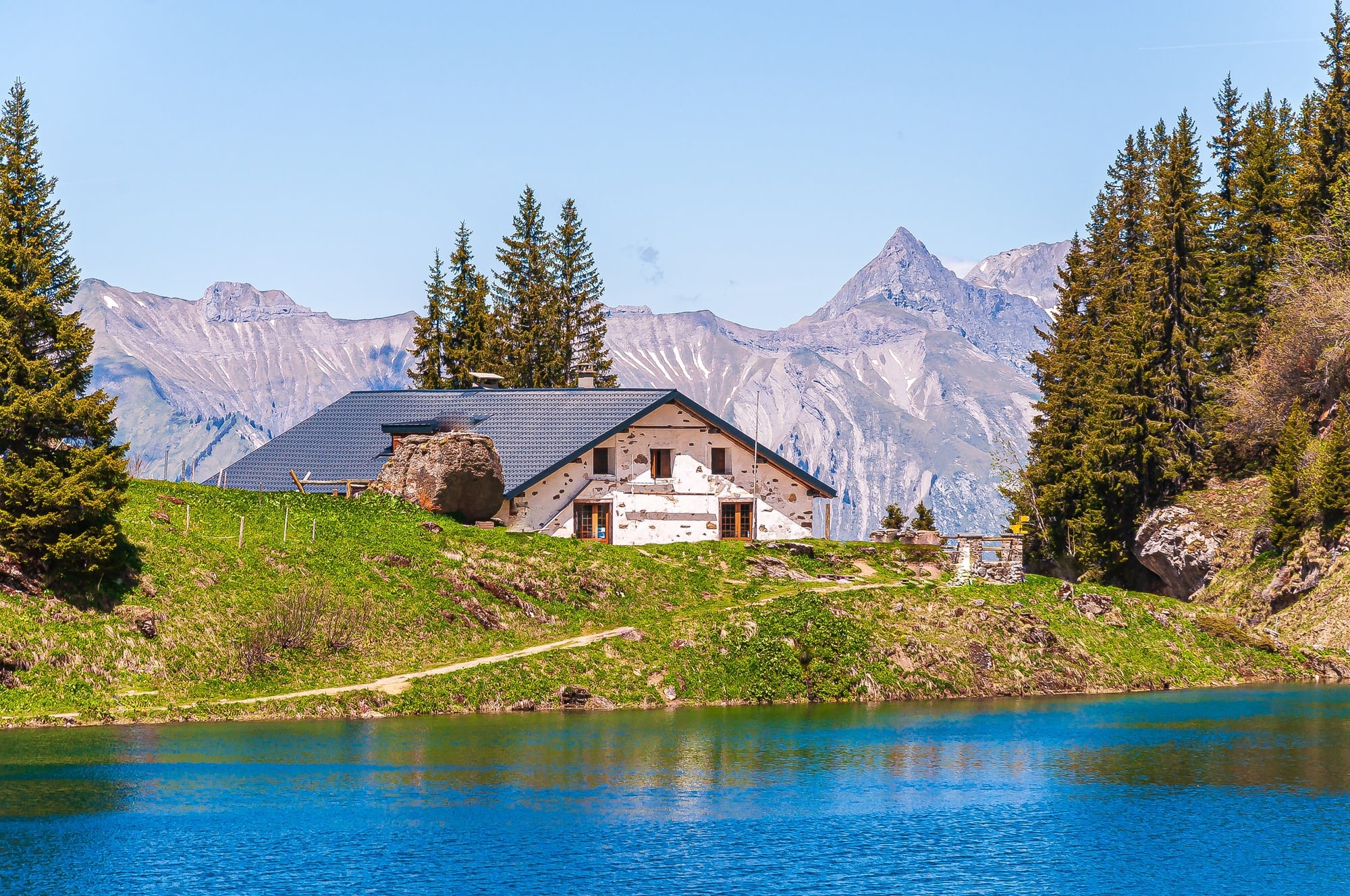
The cabin was beautiful.
The old log walls had been stripped and treated and stained a warm honey color that glowed under a row of automatic porch lights that came on as my car pulled up. A broad wooden porch wrapped all the way around the front and down one side, with new cedar railings and two rocking chairs. The tin roof was new, dark green, shining wet in the fog. Warm yellow light spilled out through windows so clean they looked like they weren’t there.
I sat in my car with my hands shaking on the steering wheel.
The brass key Thomas had taped to the bottom of my letter fit the front door perfectly. It turned smoothly in a lock that wasn’t there fifteen years ago.
I pushed the door open. I stepped inside.
And I nearly dropped my suitcase.
A towering stone fireplace filled one whole wall of the living room. River rock, gray and brown and rust-colored, rising all the way to the peak of the vaulted ceiling. In front of it sat two deep leather sofas the color of saddle leather and a coffee table made from a single slab of walnut, its live edge still showing the shape of the tree. Thick wool rugs covered the wide-plank pine floors.
The kitchen beyond was new. Stainless steel appliances. Custom cabinets in pale hickory. A deep white farmhouse sink under a window that looked out into the dark trees. A butcher-block island. Copper pots hanging from a rack.
Everything smelled faintly of cedar and woodsmoke.
I walked from room to room in a daze, turning on lights.
Double-paned windows. Thick insulation in the walls. I could feel it, the way the cold stayed outside. A modern mud room by the back door with hooks and a bench. A new bathroom with a claw-foot tub. A second bedroom with a quilt on the bed I recognized: my grandmother’s wedding ring quilt, which I’d thought was lost in a move years ago.
Out the back door, under a security light, I saw a greenhouse. Glass panels and a cedar frame, with raised beds inside already planted with seedlings. Beside it, a shed with a bank of batteries and an inverter, connected by cables to a row of solar panels on the south slope of the roof.
This wasn’t the neglected cabin everybody had laughed about.
Thomas had rebuilt it. Board by board. Every weekend for two years. Into a magnificent mountain home.
And he’d done it without saying one word to me.
Part Six: The Notebook
I went into the master bedroom last.
It was simple and warm. A big bed with a cedar headboard. A rocking chair by the window. A wood stove in the corner with a stack of split kindling beside it, ready to light.
On the bedside table, under a brass reading lamp, lay a leather-bound notebook.
My name was stamped across the cover in gold letters. LEAH.
I sat down on the edge of the bed and opened it.
Inside was Thomas’s handwriting. Two years of it, page after page in his careful square print, dated and organized like the ledgers he kept at the hardware store for thirty-one years.
He’d listed every improvement. Every expense. Every payment.
March 2022. New roof, standing-seam metal. $18,400. Paid in full.
June 2022. Log restoration, stripping and sealing. $11,200. Paid in full.
September 2022. Solar array, 12 panels, battery backup. $26,000. Paid in full.
April 2023. Kitchen. Cabinets by Dale Hensley, hickory from his own woodlot. $34,000. Paid in full.
On the last page, he’d written a summary.
Cabin: debt-free. Land: debt-free. Solar: paid off, will cover 90% of electric. Well pump: new. Septic: new. Property taxes: prepaid five years through Watauga County. Homeowner’s insurance: prepaid three years.
Total cost of keeping this place, per month, after taxes and insurance run out: about $180.
Leah, you’ll never have to worry.
And beneath that, in slightly shakier handwriting, dated six weeks before he died:
Jared and Vanessa care about how things look. You care about how things last. Watch what happens next.
P.S. Check the remote on the key ring by the door. And look in the gun safe in the closet. Combination is our anniversary. There’s one more thing.
I sat on the edge of my husband’s bed with the notebook in my lap and cried. For the first time since the funeral, I really cried, the deep, shaking kind, for a long time.
Thomas had known. Maybe not everything. But enough.
Part Seven: The Safe
When I could see again, I went to the bedroom closet. There was a small gray gun safe in the corner, the kind with a digital keypad. Thomas never owned a gun in his life. I’d never seen this safe.
I punched in our anniversary. 06-20-81.
It clicked open.
There was no gun inside. There was a manila envelope, thick, sealed, with FOR LEAH — IF THEY COME written across the front.
And on top of it, a small USB flash drive on a key ring.
I opened the envelope at the kitchen island under the copper pots.
Inside were three things.
The first was a letter from a neurologist at the Wake Forest Baptist Medical Center in Winston-Salem, dated four months before Thomas died. I remembered that appointment. Thomas had insisted I go. Just a routine check, Leah. For my peace of mind. Humor a dying man. The neurologist had run me through a battery of memory tests and scans. The letter said, in formal language, that I was cognitively healthy, with no signs of dementia or impairment, fully capable of managing my own affairs.
I didn’t understand why Thomas would leave me that. Not yet.
The second was a legal document. Thick, stapled, with a gold seal from a law firm in Boone. The Thomas and Leah Whitford Irrevocable Trust. I’d never seen it before.
I flipped through it. I’m not a lawyer, but I read it twice, and on the second time through I understood.
The Miami penthouse wasn’t Jared’s. Not exactly.
Thomas had placed it into the trust a year before he died. Jared was named as the occupant, with the right to live in it or rent it out, as long as he paid all expenses: the HOA fees, property taxes, insurance, maintenance. But he couldn’t sell it. He couldn’t borrow against it. He couldn’t transfer it to anyone.
The sole trustee, with full authority over the property, was me.
The third thing in the envelope was a note in Thomas’s handwriting, folded around the USB drive.
Leah — Watch this when you’re ready. It’s for Jared too, someday. You’ll know when. — T.
Part Eight: The Video
I found an old laptop of Thomas’s in the desk in the second bedroom. I plugged in the flash drive. There was one file on it, a video.
I pressed play.
It was Thomas.
He was sitting in the rocking chair by the bedroom window of the cabin, the one I’d just passed. He was thinner than I remembered, his face gray and hollow, a few weeks before he went into hospice. He was wearing his old red flannel shirt and his reading glasses pushed up on his forehead. Behind him, through the window, the mountains were blue and gold in autumn.
He looked into the camera for a long moment. Then he smiled. The crooked, tired smile I’d loved for forty-three years.
“Hey, Leah,” he said. “If you’re watching this, I’m gone, and you’re at the cabin. So I guess you’ve seen what I’ve been up to all these weekends.” He laughed a little. “Surprise.”
Then his face got serious.
“I need to tell you something,” he said. “And I need you to listen, even though you won’t want to hear it.”
He took off his reading glasses and rubbed his eyes.
“Last spring,” he said, “when I was in the hospital in Charlotte for the first round of chemo, I couldn’t sleep. One night around midnight, I went out to the vending machines down the hall. And I heard Vanessa in the family waiting room, on the phone with her father.”
He looked down at his hands.
“She was talking about you,” he said. “About what would happen when I died. She said, Once Thomas is gone, we’ll get Leah declared incompetent. She’s sixty-seven. She forgets things. Daddy can help with the paperwork. We’ll get guardianship, sell the cabin and her house in Wilkesboro, and put her in a facility. The money will cover the penthouse for years.”
I put my hand over my mouth.
“And her father,” Thomas said, “Howard, the one who used to be a real estate lawyer before he lost his license, he said, Get documentation. Pictures. Show she can’t live alone. Show the property’s unsafe. Then we file.”
Thomas shook his head slowly.
“I didn’t say anything,” he said. “I didn’t confront them. I’m a sick old man, and it would have been my word against theirs. And Jared…” He stopped. “Jared wasn’t on that call. I don’t think he knew. I hope he didn’t. But I’ve watched him for ten years, Leah. He goes along. Whatever she wants, he goes along. Just like he did as a boy, with whoever was loudest.”
“So I made some arrangements,” Thomas said.
He held up a finger.
“One. The neurologist. You’re as sharp as you were at thirty. Now there’s a letter that proves it, from a doctor at Wake Forest, so nobody can ever say otherwise.”
A second finger.
“Two. The penthouse goes in a trust. Jared can live there if he pays for it. But he can’t sell it or borrow against it, and you’re the trustee. They want that penthouse because it looks good. Let’s see if they can afford what it costs.”
A third finger.
“Three. This cabin. I fixed it up so you’d never have to worry. No debt. Taxes paid. Solar for the power. It costs almost nothing to keep. If they ever come up here with cameras and folders, trying to prove it’s unsafe and you can’t live alone…” He smiled. “Well. Let them try.”
Then his face softened.
“I’m sorry I didn’t tell you, sweetheart,” he said. “I didn’t want you to spend my last months hurt and angry at our son. I wanted you to have those months with me. And I didn’t want to be wrong about Jared.” His voice cracked. “I still hope I’m wrong about Jared.”
He looked into the camera.
“There’s a remote on the key ring by the door,” he said. “For the gate. If they ever come up that driveway uninvited, close it. Not to lock them in. They can always get out. The gate opens automatically from the inside. Close it so nobody else comes up behind them while you deal with it. And Leah…”
He smiled one more time.
“Don’t let anybody tell you that you stink, or that you’re old, or that you can’t manage your own life. You managed mine for forty-three years. I love you.”
The video ended.
Part Nine: The HOA Bill
My phone rang at eleven o’clock that night. Vanessa.
I let it ring.
A text came seconds later.
Miami HOA bill is $3,500. Due Friday. Transfer the money NOW.
No apology. No Did you make it up the mountain safely? Just a demand, the way she’d make a demand of a bank.
I opened my banking app. Jared and I still shared a joint savings account that Thomas had set up for family emergencies when Jared was in college. There was thirty thousand dollars in it. Fifteen thousand was mine, from my teacher’s pension. I’d taught fourth grade at Wilkesboro Elementary for twenty-nine years. The other fifteen had come from Thomas, and now, I supposed, belonged to the estate, which mostly meant Jared.
I transferred my fifteen thousand into my own savings account.
Then I sent one message.
I’ve withdrawn my $15,000 from the joint account. The rest is yours. Manage it well.
Jared called within thirty seconds.
“Mom! What are you doing? We need that money!”
“For what?” I asked.
“The HOA!” he said. “It’s thirty-five hundred dollars! And the property taxes on the penthouse are eleven thousand, due in November. And the insurance. Do you know what flood insurance costs in Miami?”
“I’m sure it’s expensive,” I said. “A luxury HOA fee isn’t an emergency, Jared.”
“Dad always paid it!”
“Your father is gone,” I said quietly. “The penthouse is yours to live in now. So are the bills.”
Then there was a scuffle, and Vanessa’s voice came on the line.
“Put that money back,” she said. Her voice was shaking with fury. “Put it back right now, or you’ll never see us again. Do you understand me? Never.”
I looked out the kitchen window at the moonlit trees, silver in the fog.
“You already threw me out, Vanessa,” I said.
“He’s your son!”
“Yes,” I said. “And he’s a grown man.”
I ended the call.
Part Ten: Jared
The next morning, I was in the greenhouse behind the cabin with my sleeves rolled up, transplanting tomato seedlings into the raised beds, when I heard tires on the gravel.
Jared’s silver Lexus came slowly up the driveway through the open iron gate. He parked beside my old Honda. He got out wearing a tailored navy suit and Italian loafers, totally wrong for the mountains. His face was furious.
He walked straight toward the greenhouse without looking at the cabin.
“Mom,” he said. “You need to sell this place.”
“No,” I said. I didn’t stop transplanting tomatoes.
“Vanessa ran the numbers,” Jared said. “We can’t afford the penthouse. The taxes, the insurance, the HOA, the maintenance. It’s ninety thousand dollars a year, Mom. We can’t do it.” He ran his hand through his hair. “So here’s what makes sense. You sell this cabin. Get a little apartment in Charlotte near us. Give us the money from the sale, and we’ll use it to cover the penthouse.”
“No, Jared,” I said.
His face hardened. He looked just like his father did when a supplier tried to overcharge him, except Thomas’s anger was always fair.
“Why are you being so selfish,” Jared said, “about a worthless old shack?”
I set down my trowel. I wiped my hands on my apron. I walked past him out of the greenhouse, up the back steps, and opened the back door of the cabin.
“Come inside,” I said.
He followed me in, still talking. Something about property values and the market in Watauga County. Then he stepped into the living room and stopped.
He saw the stone fireplace rising to the vaulted ceiling. The leather sofas. The walnut coffee table. The wide-plank pine floors, glowing in the morning light. The kitchen with its hickory cabinets and copper pots.
His mouth fell open.
“Mom,” he said slowly. “What… how much is all this worth?”
“Enough,” I said, “that I’m not selling it.”
“But Dad…” Jared looked around the room like he’d never seen it before. “Dad said he was just patching the roof. Keeping it from falling down.”
“He rebuilt it,” I said. “Every weekend for two years. With his own hands and a carpenter named Dale Hensley from down the mountain. For me.” I looked at my son. “He paid off every dime before he died. The taxes are prepaid for five years. The solar panels pay for the electricity. It costs me a hundred and eighty dollars a month to live here.”
Jared stared at me.
“Your father,” I said, “gave me a home I can afford to keep. He gave you a lifestyle you can’t afford to maintain.”
He didn’t say anything for a long time. He stood in the middle of the living room in his navy suit and Italian loafers, looking at the fireplace his father had built.
Then he turned around and walked out without another word. I heard the Lexus start. I heard the gravel crunch as he drove away, down the hill and out through the iron gate.
I didn’t tell him about the trust. Or the video. Not yet.
Thomas said I’d know when.
Part Eleven: Two Weeks
For two weeks, the mountain was quiet.
I planted the rest of the tomatoes in the greenhouse, and the peppers, and three kinds of lettuce. I learned how to read the solar controller in the shed, with its little screen showing how many kilowatt-hours the panels made each day. I learned how to light the wood stove in the bedroom without filling the room with smoke. I met Dale Hensley, the carpenter, when he drove up the mountain in his pickup on a Tuesday morning to check on the place. He was seventy-one, with a white beard and hands like tree roots.
He stood in the kitchen and ran his hand along the hickory cabinets he’d built from his own woodlot.
“Thomas talked about you the whole time,” Dale said. “Every weekend. Leah this, Leah that. Leah likes the morning light, so put a window over the sink. Leah’s knees are bad, so put the dishwasher up high.” He shook his head. “I’ve built a lot of kitchens, Mrs. Whitford. Never built one with that much love in it.”
I slept better on that mountain than I had in years. I went to bed when it got dark and woke up at dawn to birdsong. I drank my coffee on the porch in the rocking chair, watching the fog lift off the valley. In the evenings, I read by the fire.
Nobody needed me to cook their dinner or wash their clothes or pick up their dry cleaning. Nobody laughed at me in my own kitchen.
For the first time since Thomas got sick, I felt like a person again.
Part Twelve: The SUV
On a Saturday morning at the end of the second week, a black Range Rover came up my driveway through the open iron gate.
I was sitting on the porch in my rocking chair, in my faded blue plaid shirt and my gardening apron, drinking coffee and shelling a bowl of early peas. I watched it come slowly up the gravel and stop beside my Honda.
Vanessa climbed out of the driver’s side. Designer sunglasses. A cream-colored pantsuit. Her dark hair pulled back in a sleek, tight ponytail. She looked around at the cabin, the porch, the greenhouse, the mountains, with an expression I can only describe as appraising.
Her parents got out of the back.
Her mother, Celeste Brandt, was sixty-five, small and frosted-blond, in a Chanel jacket, carrying a large leather handbag in the crook of her arm like a shield. Her father, Howard Brandt, was sixty-eight, tall and heavy and silver-haired, in a golf shirt and pressed khakis. He was carrying a leather folder.
I’d met them maybe six times in eight years. At the wedding. A few Christmases. Thomas’s funeral, where Howard had spent most of the reception on his phone.
Vanessa reached back into the Range Rover and pulled out an overnight suitcase with a monogram on it. She rolled it across the gravel to the bottom of my porch steps.
“We’re here to audit this property,” she announced. “We’ll be staying the weekend.”
I didn’t get up from my rocking chair. I kept shelling peas.
“No,” I said. “You won’t.”
Vanessa laughed. That same laugh from Jared’s kitchen.
“You don’t get to decide that, Leah,” she said. “Jared’s the heir. This is family property. We have every right to see what condition it’s in.” She glanced at her father. “Daddy’s going to take some pictures. For the records.”
Howard Brandt lifted his leather folder slightly. He smiled at me. It was the smile of a man who’d spent his career getting people to sign things.
I set my bowl of peas down on the porch beside my rocking chair.
I reached slowly into the pocket of my gardening apron.
I’d been carrying it every day for two weeks. Since the night I found Thomas’s notebook. A small black remote on the cabin key ring, with two buttons. One for the gate. One for the cameras.
At the far end of my gravel driveway, a quarter mile down the hill, the heavy iron gate on its stone pillars stood wide open.
Vanessa stepped onto the bottom porch step, smiling as if she’d already won. Behind her, her parents watched me in silence.
I raised the remote.
And I pressed the button.
Part Thirteen: The Gate
Far down the hill, through the trees, came a low mechanical hum. Then the heavy iron gate swung slowly shut on its hinges and closed with a deep metallic clang that echoed off the mountainside.
Vanessa spun around.
“What was that?” she said. “Did you just… did you lock us in?”
“No,” I said calmly. “The gate opens automatically from the inside whenever a car comes down the driveway. There’s a sensor. You can leave any time you want.” I set the remote on the arm of my rocking chair. “I closed it so nobody else comes up behind you while we talk.”
Howard Brandt looked down the hill toward the closed gate. Then back at me. His smile had thinned.
“And the other button?” he asked. “What does that one do?”
“That one,” I said, “turns on the porch camera.”
I pointed up at the corner of the porch ceiling. A small black dome, almost invisible against the cedar boards. A tiny red light had just come on.
“My husband installed it,” I said. “It records video and audio. It uploads to a cloud account my lawyer in Boone can access.” I folded my hands in my lap. “So whatever you came here to say, Howard, you might want to say it carefully.”
Part Fourteen: The Folder
Nobody said anything for a long moment. A blue jay screamed in the oaks. Somewhere down the mountain, a dog was barking.
Then Howard stepped forward. He opened his leather folder with the practiced air of a man who’d done it a thousand times in a thousand conference rooms.
“Mrs. Whitford,” he said smoothly. “Leah. I think you’re upset. Grief does that. It’s perfectly understandable.” He took out a sheaf of papers. “We’re only here because we’re worried about you. A woman your age, alone on a mountain, three hours from the nearest hospital. After a terrible loss. It’s not safe.”
He held up the papers.
“Vanessa and Jared would like to help,” he said. “This is a durable power of attorney. And a medical directive. If you’ll just sign these, Jared can manage your affairs for you. Your finances, your property. So you don’t have to worry about anything.” He smiled. “And we’d like to take a few photographs of the property while we’re here. For documentation. In case it becomes necessary to involve the court.”
“Involve the court,” I repeated. “For what?”
Howard’s smile didn’t waver. “Guardianship,” he said gently. “Only if it becomes necessary, of course. If you’re not able to manage on your own.”
Celeste nodded sympathetically from behind him, clutching her handbag.
Vanessa smirked.
I looked at the papers in Howard’s hand for a long time. Then I reached into the other pocket of my gardening apron.
I took out a folded envelope. White, with the gold seal of Wake Forest Baptist Medical Center in the corner. I’d been carrying it every day for two weeks too.
I held it out.
“Before you take any pictures,” I said, “you might want to read this.”
Part Fifteen: Wake Forest
Howard took the letter. He unfolded it. He read it.
I watched his face. A thing I learned in twenty-nine years of teaching fourth grade: you can always tell when someone’s reading something they didn’t expect. Their eyes stop moving smoothly. They go back to the top and read it again.
Howard read it three times.
To Whom It May Concern: Mrs. Leah Whitford, age 67, was evaluated in our Memory and Cognitive Disorders Clinic on the date above. Comprehensive neuropsychological testing, MRI imaging, and clinical assessment reveal no evidence of dementia, cognitive impairment, or decline. Mrs. Whitford scored in the 94th percentile for her age group on memory and executive function. In my professional opinion, she is fully competent to manage her personal, medical, and financial affairs. — Dr. Anjali Reddy, M.D., Ph.D., Department of Neurology.
Howard lowered the letter slowly. He looked at me.
“Where did you get this?” he asked quietly.
“My husband made the appointment,” I said. “Four months before he died. He insisted. He said it was for his peace of mind.” I looked at Vanessa. “Now I know why.”
Vanessa’s face had gone pale under her makeup. “That doesn’t mean anything,” she said quickly. “Doctors can be wrong. You’ve been forgetting things. You forgot to buy the almond milk twice in January.”
“I was spending fourteen hours a day at my husband’s hospice bed,” I said. “I’m sorry about the almond milk.”
Part Sixteen: The Trust
Then I took out the last thing from my apron pocket. Thomas’s trust document, folded in thirds, with the gold seal from the law firm in Boone.
“Howard,” I said. “You’re a lawyer. Or you were. You might find this interesting.”
He took it. He started reading. Then he stopped. He went back to the first page.
I watched the color drain out of his face.
“What?” Vanessa said. “Daddy, what is it?”
Howard didn’t answer. He kept reading. When he got to the end, he lowered the document and stared at the floorboards of my porch.
“The penthouse,” he said slowly. “It’s in an irrevocable trust.”
“So?” Vanessa said.
“So it isn’t Jared’s,” Howard said. His voice was flat. “Not outright. He can live there. He can rent it. But he can’t sell it. He can’t borrow against it. He can’t transfer it.” He looked up at me. “And the trustee, with full authority over it, is Leah.”
Vanessa stared at her father. Then at me.
“That’s impossible,” she said. “Thomas gave it to Jared. In the letter. It said the Miami penthouse.”
“It did,” I said. “Thomas gave Jared the right to live in it. And the responsibility of paying for it.” I folded my hands in my lap. “He never said Jared could sell it.”
“You,” Vanessa said, and her voice was shaking. “You knew this whole time. You let us… you let me plan the redecorating. You let me post about it. Forty thousand followers saw me announce our new Miami penthouse.”
“I didn’t know until two weeks ago,” I said. “I found it in a safe in this cabin. With a video from my husband.”
Howard looked up sharply. “A video?”
Part Seventeen: Thomas Speaks
I’d brought the laptop out onto the porch that morning. I’d been planning to watch the video again, the way I’d watched it every night for two weeks. It was sitting on the little side table beside my rocking chair.
I opened it. I turned the screen toward them. I pressed play.
Thomas appeared on the screen, thin and gray, in his red flannel shirt, in the rocking chair by the bedroom window. Behind him, the mountains were blue and gold.
“Last spring,” he said, “when I was in the hospital in Charlotte for the first round of chemo, I couldn’t sleep. One night around midnight, I went out to the vending machines down the hall. And I heard Vanessa in the family waiting room, on the phone with her father.”
Vanessa went completely still.
“She said, Once Thomas is gone, we’ll get Leah declared incompetent. She’s sixty-seven. She forgets things. Daddy can help with the paperwork. We’ll get guardianship, sell the cabin and her house in Wilkesboro, and put her in a facility.”
Celeste Brandt made a small sound and put her hand over her mouth.
“And her father, Howard, the one who used to be a real estate lawyer before he lost his license, he said, Get documentation. Pictures. Show she can’t live alone. Show the property’s unsafe. Then we file.”
Howard Brandt stood perfectly still on the gravel at the bottom of my porch steps, holding his leather folder with the power of attorney inside it.
On the screen, my husband looked straight into the camera.
“If they ever come up here with cameras and folders, trying to prove it’s unsafe and you can’t live alone…” Thomas smiled. “Well. Let them try.”
I paused the video on his face.
Part Eighteen: The Silence
Nobody spoke for a long time.
The red light on the porch camera glowed in the corner of the ceiling. The blue jay screamed again in the oaks.
Howard closed his leather folder very slowly. He put it under his arm.
“Celeste,” he said quietly, without looking at his wife. “Get in the car.”
Celeste didn’t move. She was staring at the frozen image of Thomas on my laptop screen.
“Howard,” she said. Her voice was very small. “You told me she was confused. You told me Jared asked for help. You said it was for her own good.”
Howard didn’t answer.
“You said Thomas wanted it this way,” Celeste said. “You told me Thomas asked you to look after her finances.”
She turned and looked at her husband.
“You lied to me,” she said.
Vanessa was standing on my bottom porch step with her monogrammed suitcase beside her. Her sunglasses were pushed up on her head now. Her face was white.
“That video,” she said. “It’s out of context. Thomas was on chemo. He was confused. He misheard.”
“Then I suppose we could play it for a judge,” I said, “and let her decide.”
Vanessa’s mouth closed.
Part Nineteen: “Leave My Son Out of It”
“Does Jared know?” I asked her quietly.
She looked at me.
“About the phone call in the hospital,” I said. “About the guardianship. About today. Does my son know you’re here with a power of attorney and a camera?”
Vanessa didn’t answer for a long time.
“He thinks we’re here to talk you into selling,” she said finally. “He doesn’t know about the papers.”
She lifted her chin.
“He doesn’t know about any of it,” she said. “So leave him out of this.”
“I’d love to leave him out of it,” I said. “He’s my son. I’ve been trying to leave him out of it his whole life.” I looked at her. “But you brought him into it the day you laughed in my face in his kitchen. And he stared at his shoes.”
I stood up from my rocking chair for the first time. My knees cracked. I didn’t care.
“You can leave now,” I said. “All three of you. The gate will open when you get to it.”
Vanessa looked at me for a long moment. At my faded plaid shirt and my gardening apron with dirt on it. At the bowl of peas by my rocking chair. At the cabin behind me, the honey-colored logs and the green tin roof and the porch my husband built.
“This isn’t over,” she said.
“It is for today,” I said.
She grabbed her monogrammed suitcase and dragged it back across the gravel to the Range Rover. Howard was already in the passenger seat. Celeste got in the back slowly, like a woman much older than she was. She looked at me through the window as they drove away. She didn’t look angry. She looked like someone who’d just found out she’d been married to a stranger.
At the bottom of the hill, the iron gate swung open for them on its sensor. Then it swung shut again behind them with a deep, final clang.
Part Twenty: The Phone Call
Jared called at nine o’clock that night.
I almost didn’t answer. Then I did.
He didn’t say anything at first. I could hear him breathing.
“Mom,” he said finally. His voice was rough, like he’d been crying. “Celeste called me.”
I didn’t say anything.
“Vanessa’s mom,” he said. “She called me an hour ago. She told me everything. The power of attorney. The guardianship. The hospital phone call. The video.” He stopped. “She told me Dad knew.”
“Is it true?” Jared asked. “Did they really go up there with papers to have you declared incompetent?”
“Yes,” I said.
“And Dad heard them? In the hospital? Last spring?”
“Yes,” I said.
There was a long silence on the line.
“Mom,” Jared said, and his voice broke completely. “I didn’t know. I swear to God, I didn’t know. She told me we were going to talk you into selling. That’s all. That was bad enough. But the guardianship…” He was crying now. “She was going to put you in a home. For a penthouse.”
Part Twenty-One: The Video for Jared
He drove up the mountain the next morning.
He was alone. No suit this time. Jeans and an old UNC sweatshirt and sneakers. The gate opened when I pressed the button from the porch. I watched his Lexus come up the hill slowly, carefully, the way his father used to drive.
He got out and stood at the bottom of my porch steps. He looked older than he had two weeks before. He hadn’t shaved.
“Mom,” he said. “Can I come in?”
I made him coffee. We sat at the kitchen island under the copper pots his father had hung. Then I opened Thomas’s laptop and turned it toward him.
“Your father made this,” I said. “He said it was for you too, someday. He said I’d know when.”
I pressed play.
Jared watched the whole thing without moving.
He watched his father in the red flannel shirt in the rocking chair, thin and gray and smiling. He heard about the hospital phone call. He heard about the trust. He heard about the cabin.
And he heard the part I’d paused on the porch the day before. The part Vanessa and her parents hadn’t seen.
“And Jared wasn’t on that call. I don’t think he knew. I hope he didn’t. But I’ve watched him for ten years, Leah. He goes along. Whatever she wants, he goes along. Just like he did as a boy, with whoever was loudest.”
“I’m sorry I didn’t tell you, sweetheart. I didn’t want to be wrong about Jared. I still hope I’m wrong about Jared.”
When the video ended, my son put his face in his hands at the kitchen island and wept.
I put my hand on his back, the way I used to when he was three years old with croup, in a steamy bathroom at three in the morning. I didn’t say anything. I just let him cry.
“He knew,” Jared said finally, through his fingers. “He knew I’d stare at my shoes.”
“He hoped you wouldn’t,” I said.
“I did, though,” Jared said. “In the kitchen. When she called you a stinking old woman. I just sat there.” He lifted his head. His eyes were red. “Why didn’t I say anything, Mom? Why didn’t I ever say anything?”
I thought about it for a long time.
“Because it was easier,” I said. “It’s always easier to go along. To let the loudest person decide.” I looked at him. “Your father wasn’t loud. He never was. But he always knew what was right, and he did it quietly. Even when it was hard. Even when he was dying.”
I nodded at the room around us. The fireplace. The hickory cabinets. The window over the sink where the morning light came in.
“He did all this without saying a word,” I said. “Because he knew how things would turn out. He just hoped he was wrong.”
Part Twenty-Two: What Jared Did
Jared filed for divorce in August.
He told me about it on the phone. Vanessa had moved back in with her parents in Myrtle Beach. Celeste had filed for divorce from Howard the same month. Jared said Celeste called him twice afterward to apologize, and the second time she’d cried so hard he couldn’t understand her.
Howard Brandt received a letter from the North Carolina State Bar in September. Somebody had sent them a copy of my porch camera footage. Jared never told me who. The State Bar opened an investigation into the unauthorized practice of law, since Howard’s license had been suspended in 2019. I don’t know how it ended. I never asked.
Jared couldn’t afford the penthouse. He’d known that since the day he read his father’s letter, if he was honest with himself. Ninety thousand dollars a year in taxes, insurance, and HOA fees on a sales manager’s salary, with a divorce coming.
He came up the mountain in October and sat at the kitchen island with me and asked me, as trustee, to sell it.
The penthouse sold in December for a little over two million dollars. The trust was very specific about what happened next. Thomas had thought of everything. Half the proceeds went to me, as trustee, to be held for my lifetime. The other half went into a separate account for Jared, to be released to him in equal installments over ten years.
So he learns to manage it, Thomas had written in the margin of the trust document, in pencil. Instead of managing to spend it.
Part Twenty-Three: The Greenhouse
Jared sold the big house in Ballantyne Reserve. He rented a small two-bedroom apartment in Boone, at the foot of the mountain, forty minutes from the cabin. He transferred to his company’s office in Asheville. He started driving up to see me every Saturday.
The first few Saturdays, he didn’t know what to do with himself. He’d sit at the kitchen island and drink coffee and check his phone. He’d ask if I needed anything, and I’d say no, and he’d sit there looking lost.
Then, on the fourth Saturday, he followed me out to the greenhouse.
I handed him a trowel and a flat of tomato seedlings.
“Your father planted these beds,” I said. “The spring before he got sick. He built the frame himself, out of cedar. Dale Hensley helped him with the glass.”
Jared looked at the trowel in his hand. “I don’t know how to plant tomatoes, Mom,” he said.
“I know,” I said. “I’ll show you.”
So I showed him. How deep to dig the hole. How to pinch off the bottom leaves and bury the stem deep, so it grows roots all along it and stands up strong. How to firm the soil around it with your fingers, gently. How to water at the base, not the leaves.
He was terrible at it at first. He planted them too shallow, and they flopped over. He overwatered them. He knocked over a whole flat of pepper seedlings with his elbow.
But he came back the next Saturday. And the next. By June, he had his own row of tomatoes in the greenhouse. Brandywines, the kind his father liked best. He’d stand in the greenhouse doorway on Saturday mornings with his coffee, looking at them, the way his father used to look at a well-organized shelf at the hardware store.
Part Twenty-Four: The Notebook
In July, Jared found the leather notebook on my bedside table. He picked it up. He looked at me.
“Can I read it?” he asked.
“Go ahead,” I said.
He sat on the edge of my bed and read every page. Every improvement, every expense, every payment, in his father’s careful square handwriting. When he got to the last page, he stopped.
Jared and Vanessa care about how things look. You care about how things last. Watch what happens next.
He read it for a long time.
“He was right,” Jared said quietly. “That’s exactly what I was. Somebody who cared how things looked.”
He closed the notebook.
“The house in Ballantyne,” he said. “The Lexus. The suits. The penthouse. Vanessa’s Instagram.” He shook his head. “I was so busy making everything look like a successful life that I forgot to build one.”
He looked out the bedroom window at the mountains, blue and gold in the summer evening.
“Dad spent two years building this,” he said. “Board by board. And never told anybody. Never posted a single picture.” He almost laughed. “He didn’t care what it looked like. He just cared that it would still be standing when he was gone.”
Part Twenty-Five: The Gate
It’s spring again now. A year since Thomas died.
The cabin still stands on top of the hill, honey-colored logs and green tin roof, with smoke from the chimney on cold mornings. The greenhouse is full of seedlings. The solar panels on the south slope of the roof catch the sun every day and turn it into the electricity that runs my lights and my refrigerator and the little radio I listen to in the evenings.
It costs me a hundred and eighty dollars a month to live here. I’ve never been so rich in my life.
Last Saturday, Jared drove up the mountain at eight in the morning, the way he does every week. I watched him come through the iron gate at the bottom of the hill from my rocking chair on the porch.
He got out of his car. Not the Lexus. He sold that in the fall. An old Ford pickup, a 2008 F-150 with a hundred and sixty thousand miles on it, which he bought from Dale Hensley for four thousand dollars. It’s the same model his father drove for nineteen years.
He came up the porch steps carrying a box of doughnuts from a bakery in Boone and two cups of coffee. He handed me one. He sat down in the other rocking chair. The one his father built.
We sat there for a while, not saying anything, watching the fog lift off the valley.
“Mom,” Jared said finally. “Can I ask you something?”
“Of course.”
“That day,” he said. “When Vanessa and her parents came up here. When you pressed the button on the remote. Were you scared?”
I thought about it.
“No,” I said. “I wasn’t scared.”
“Why not?”
I looked out at the iron gate at the bottom of the hill, standing closed on its stone pillars in the morning light.
“Because your father built that gate,” I said. “And he built this cabin. And he made that video and wrote that notebook and set up that trust. All of it, quietly, without saying a word, while he was dying.” I smiled. “When I pressed that button, I wasn’t alone. He was right there with me.”
I took a sip of my coffee.
“Some people build things to look good,” I said. “Your father built things to hold.”
Jared didn’t say anything for a long time. He sat in his father’s rocking chair with his coffee, looking down the hill at the gate.
Then he reached into the pocket of his jacket. He took out something small and black.
It was the remote. The spare one. I’d given it to him at Christmas, along with a key to the cabin.
He turned it over in his hands.
“I never use it,” he said. “When I come up. I always call you from the bottom of the hill. So you can open it for me.”
“Why?” I asked.
He looked at me.
“Because it’s your gate, Mom,” he said quietly. “It’s your house. I spent too many years acting like everything of yours was already mine. Now I wait for you to let me in.”
I didn’t say anything. I couldn’t.
I reached over and took my son’s hand. His father’s hand, big and square, with dirt under the fingernails from the greenhouse.
And we sat there together on the porch of the cabin Thomas built, rocking in the chairs he made, drinking coffee in the morning light, while the fog burned off the mountain and the iron gate at the bottom of the hill stood closed and quiet, the way he’d built it to.

Adrian Hawthorne is a celebrated author and dedicated archivist who finds inspiration in the hidden stories of the past. Educated at Oxford, he now works at the National Archives, where preserving history fuels his evocative writing. Balancing archival precision with creative storytelling, Adrian founded the Hawthorne Institute of Literary Arts to mentor emerging writers and honor the timeless art of narrative.