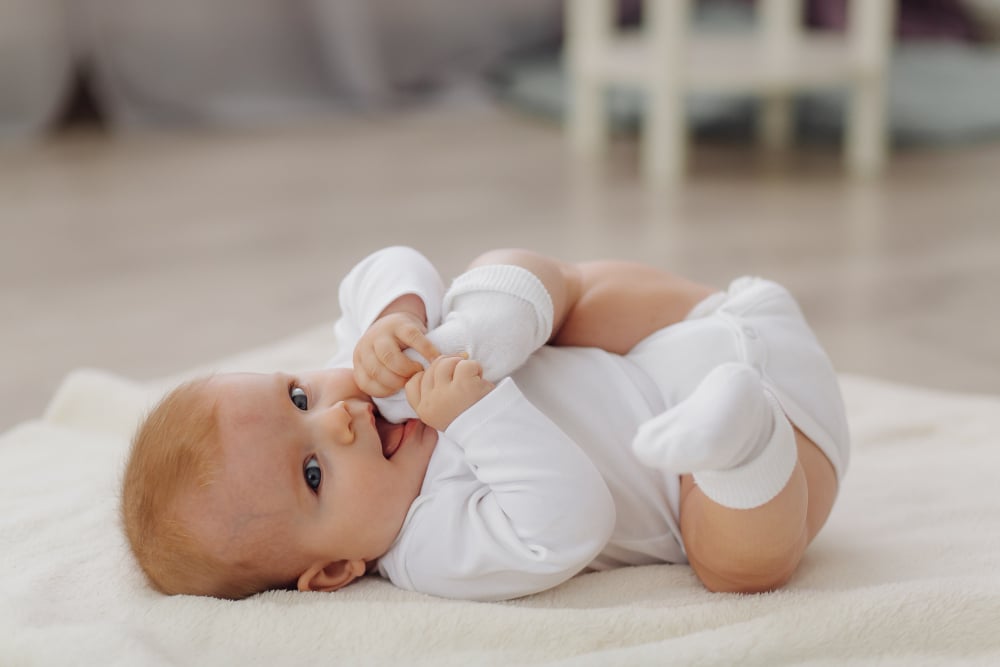
The nurse slid one finger under Charlotte’s hair and lifted it.
Wet, it reached all the way to her shoulders.
The nurse looked up at the doctor and laughed.
“That’s seven pounds,” she said, “including the hair.”
I was lying back against the hospital pillows. Shaking. Everything in my body was shaking. My legs. My hands. My jaw. Nobody tells you about that part. You think you’ll cry, or laugh, or say something beautiful. Instead your teeth chatter like you’ve been pulled out of a frozen lake.
Mason was standing beside the bed with his phone up, taking pictures.
He took about forty of them. He showed me later. In most of them, my thumb covered half of her face. That’s the one he likes best. He says it’s the most honest picture he’s ever taken. A baby, a thumb, and a lot of hair.
“She’s ready for her first haircut,” another nurse said.
She was younger. Ponytail of her own. Pink scrubs with little cartoon bears on them.
She held up a soft hair tie for me to see. A tiny one. The kind they use on preemies to keep their IV lines out of the way.
“Can I?” she said.
I nodded.
I watched her fingers. Very careful. She gathered a few strands from the top of Charlotte’s head. Wet and dark and fine as thread.
She wrapped the tie around them twice.
The ponytail stood straight up.
Like a little palm tree. Like a sprout. Like an exclamation point.
Mason lowered his phone for that one.
I saw him do it. He put the phone down against his leg and just looked. With his own eyes. Like he needed to see it without a screen in the way.
His face did something I’d never seen before.
The nurse took the tie out after a minute. She smoothed Charlotte’s hair back down.
She handed me the tie.
“For the baby book,” she said.
I tucked it into the pocket of my hospital gown.
Then she laid Charlotte back on my chest.
The room went quiet after that.
The doctor finished up. The nurses gathered their things. Somebody dimmed the lights. Someone else said, “We’ll be back in an hour to check on you, Mom.”
Mom.
And in the quiet, my fingers started shaking worse.
I tried to tuck the blanket under Charlotte’s feet. I couldn’t do it. My hands wouldn’t hold the corner. It kept slipping loose.
Mason reached over.
He folded the corner back for me. Tucked it under her tiny feet.
Then he left his hand there. Flat on top of mine.
He left it there until my fingers stopped shaking.
I should tell you about Mason.
We met eight years ago at a hardware store.
I was in the paint aisle, trying to choose between two colors of white for my apartment. Swiss Coffee and Alabaster. I’d been standing there for twenty minutes.
He was standing next to me, trying to choose between two kinds of wood screws.
“They’re the same,” he said, without looking up.
“What?”
“The whites. They’re the same. I worked here in high school. They mix them from the same base. The only difference is the name.”
I looked at the two paint chips.
“That’s horrible,” I said.
He finally looked at me.
“I know,” he said. “I’ve been carrying that around for fifteen years.”
We got married two years later in his mother’s backyard.
He’s quiet. Mason. Steady. He’s a high school chemistry teacher. He fixes everything in our house before I even notice it’s broken. He reads cereal boxes at breakfast. All of them. Every word. Even the ingredients.
He makes me laugh in a way that sneaks up on you. He’ll say something so dry and so quiet that you don’t get it until three seconds later.
I thought I knew everything about him.
I knew which tooth he chipped in fourth grade. The left front one, on the monkey bars at Lincoln Elementary. I knew the name of every dog he ever had. Rufus. Biscuit. Mr. Pickles. A beagle named Tuesday who ate a whole pound of butter and lived.
I knew he was allergic to cantaloupe. I knew he cried at the end of every single dog movie, even the ones where the dog lives.
I knew his father left when he was nine. That they didn’t talk anymore.
I thought I knew everything.
His mother is Margaret.
She’s sixty-eight. Small and neat. Short gray hair. Cardigans with little pearl buttons. She retired from the post office three years ago after thirty-five years.
She’s always been kind to me. Careful. A little formal. She sends birthday cards a week early so they won’t be late. She knits. Hats, mostly. She knitted Charlotte six of them while I was pregnant. In every color.
She writes everyone’s name on everything.
On Tupperware she sends home with us. On the coffee cups when she brings coffee. On the little paper tags on Christmas presents, in round, careful handwriting, with a tiny drawing next to each name.
Mine always has a little sun.
I asked her about it once. Our first Christmas.
“Why a sun?”
She thought about it.
“Because you came in,” she said, “and the room got brighter.”
I’ve never forgotten that.
There were a few strange things about Margaret.
I noticed them over the years. I didn’t think much about them.
She never had a mirror in her front hallway. Most people do. A little one by the door, so you can check your hair before you leave. Margaret had a framed print of a lighthouse there instead.
She never sat facing the mirror at restaurants. If there was a mirror on the wall, she’d ask to switch seats.
When we went to Mason’s cousin’s wedding, all the women crowded into the bathroom to fix their makeup. Margaret did hers in her car. In the little mirror on the sun visor. With the door closed.
And there was a room at the end of the hall in her house that was always closed.
“Just storage,” Margaret said once, when I asked.
I never asked again.
Margaret came to the hospital about an hour after Charlotte was born.
She was carrying two paper cups of coffee from the cafeteria. Her coat was still buttoned.
She’d written our names on the cups herself, with a pen from her purse. Mason. And Sandra. With a little sun next to mine.
She set both cups down on the tray table. She didn’t take her coat off.
Then she leaned over the bed and looked at Charlotte.
I watched her face.
I’d imagined this moment for nine months. Margaret meeting her first grandchild. I thought she’d cry. Or smile. Or say oh, look at her the way grandmothers do.
She didn’t do any of those things.
She looked at Charlotte’s face. Then her eyes moved up.
To the hair.
And she went very still.
“That hair,” she said, “needs to come off today.”
I laughed.
Because the nurse had just said something almost exactly like it. She’s ready for her first haircut. I thought Margaret was making the same joke.
But Margaret wasn’t laughing.
She pressed two fingers against her coat collar. Right at the hollow of her throat. Like she was holding something in.
“In our family,” she said, “we cut it before they see themselves.”
She looked at Mason when she said it.
Not at me. At Mason.
“A baby with hair this long, I mean,” she added. Quickly. Like she’d said too much.
I looked from her to Mason and back.
“See themselves where?” I asked.
Margaret leaned closer.
Close enough that I could smell her perfume. Something old-fashioned. Powdery. Like roses kept in a drawer.
“In a mirror,” she said.
Her voice dropped. So low I could barely hear it over the beeping of the monitors.
“Otherwise,” she said, “they carry the sorrow of someone before them.”
Mason’s phone had gone dark in his hand.
He was still staring at the black screen. Like there was something on it.
There wasn’t.
“Margaret,” I said. “That’s ridiculous.”
I said it quietly. I didn’t want to be rude. But I was exhausted and sore and I had a brand-new baby on my chest, and I didn’t have the energy for superstitions.
Margaret didn’t look at me.
Mason started to step back from the bed.
She caught his arm.
“Tell her,” Margaret said, “what happened to your sister.”
The room went quiet.
I looked at my husband.
I’d been married to Mason for six years.
I knew which tooth he’d chipped. I knew every dog. I knew he hated cantaloupe and cried at dog movies.
I could not remember him ever, once, in eight years, mentioning a sister.
“Mason?” I said.
He looked away.
At the window. At the door. At the floor.
“Mom,” he said. “Stop.”
His voice was very quiet.
Margaret let go of his arm.
She looked toward the door. Like she was checking to see if anyone was listening.
Then she turned back to me.
“Promise me,” she said. “Promise me you’ll cut it before she goes home.”
I pulled the blanket back from Charlotte’s mouth. It had crept up over her chin.
It gave me something to do with both of my hands.
“I’m not cutting her hair,” I said.
Margaret stood there for a moment.
Then she picked up both coffee cups. Like she was going to leave with them.
She stopped.
She set them back down on the tray. Carefully. Side by side. Names facing out.
And she left.
My coffee stayed on the tray until it went cold.
I didn’t drink it.
I kept looking at Mason. Waiting for him to say something. To explain.
He walked around the bed. He sat down in the chair by the window.
He looked at the coffee.
“Do you want me to warm that up for you?” he asked.
I didn’t answer.
I just looked at him.
He got up anyway. He took the cup. He went out into the hall to find the microwave.
He was gone for fifteen minutes.
When he came back, the coffee was hot. He set it down on the tray.
He didn’t say anything about his sister.
And I was too tired to ask.
That night, in the hospital, I couldn’t sleep.
Charlotte was in the little plastic bassinet beside my bed. Mason was asleep in the pull-out chair, folded up like a pocketknife, his feet hanging off the end.
I lay there in the dark and listened to her breathe.
Tell her what happened to your sister.
I thought back over eight years.
Every holiday. Every birthday. Every Sunday dinner at Margaret’s.
I tried to remember a single photograph of a little girl.
I couldn’t.
I remembered the closed door at the end of Margaret’s hallway.
Just storage.
In the morning, Mason went home to shower and get a few things.
“I need my slippers,” I said. “My feet are killing me. These hospital socks are like sandpaper.”
“The blue ones?”
“The blue ones. Under the bed. My side.”
He was gone for almost three hours.
When he came back, he had the slippers in a plastic grocery bag. He took them out and knelt down and put them on my feet himself.
I remember I kissed the inside of his wrist when he stood up.
I don’t know why. It was just there.
Later, it bothered me that I could remember doing that.
Two days later, we brought Charlotte home.
It was a bright, cold morning in March. The kind where the sun is out but you can still see your breath.
Mason drove home at twenty-five miles an hour. On the highway. With his hazard lights on.
“Mason. People are honking.”
“Let them honk,” he said. “I have precious cargo.”
I laughed so hard my stitches hurt.
At home, I took her straight upstairs to change her.
I moved slowly. Everything hurt. The stairs felt like a mountain.
Our bedroom looked different.
Mason had washed the sheets. The bed was made. Tight corners, the way he does it. He’d opened all the blinds, and the room was full of light.
My slippers were side by side on the floor under the bed. Lined up perfectly. Toes pointed out.
I almost cried at the sight of them.
I laid Charlotte down on the bed.
I turned around to get a diaper from the dresser.
And I looked up.
Above the dresser, two hooks stuck out of the wall.
Just two little brass hooks. Empty.
Between them was a square of paint that looked almost new. Lighter than the rest of the wall. Brighter. Like a window into what the wall used to look like before six years of sunlight faded it.
The mirror was gone.
I’d used that mirror every single morning for six years.
To put on my makeup. To check my outfit. To see if my hair was sticking up in the back.
Below the empty square, on top of the dresser, there was still a little drop of lotion. Dried now. A small white spot.
I’d meant to wipe that up before we left for the hospital. I’d noticed it that morning, between contractions. I’d thought, I’ll get that when I come home.
I walked to the bedroom doorway.
I looked down the hall.
The hallway mirror was gone too.
The long one, by the linen closet. The one my mother gave us as a wedding present.
Two empty hooks.
I went to the bathroom. I stood in the doorway.
The medicine cabinet was still there. But somebody had taped a towel over the front of it. A big white bath towel. With blue painter’s tape.
“Mason?”
He was coming up the stairs with the diaper bag.
He stopped halfway.
“Where are all our mirrors?”
He didn’t answer right away.
He looked down at the diaper bag. The strap had gotten twisted. He started flattening it out. Very carefully. Running his thumb along it over and over.
“Mom asked me to put them away,” he said.
I stared at him.
“When?”
“When I came home,” he said. “For your slippers.”
For your slippers.
I’d asked for those slippers because my feet hurt.
He’d come back with them in a grocery bag. He’d knelt down and put them on my feet.
I’d kissed his wrist.
And before he did any of that, he’d come home and taken down every mirror in our house.
Three hours. He’d been gone three hours.
“You actually believe her?” I said.
He shook his head.
“No,” he said.
He slid the diaper bag off his shoulder. He set it down on the stair.
“I just didn’t want her upsetting you,” he said. “She called me that morning. She was so upset, Sandra. She was crying. I’ve never heard her like that. I thought if I just did it, she’d stop. I thought you’d never even notice. I thought I’d put them back in a week.”
I looked at the empty wall above the dresser.
“I’m upset now, Mason,” I said.
Behind me, on the bed, Charlotte had worked one hand free of her blanket.
She was opening and closing it. Reaching for something. For nothing.
I went back and picked her up. She pressed her hand flat against my chest.
Mason came up the rest of the stairs. He stood in the doorway.
He reached for her.
Then he stopped. And waited.
I let him take her.
So I could sit down.
I was so sore that the idea of going back down the stairs felt impossible. Like climbing a building.
I sat on the edge of the bed.
Mason laid Charlotte down beside me. He changed her diaper. He’s better at it than me. He was better at it from the first day. Quick and gentle, like he’d done it a thousand times.
He’d laid out three little sleepers on the bed. A plain white one. A pink striped one. And one covered in little yellow ducks.
“Which one do you want?” he asked.
It was such an easy thing to ask me.
After everything. The mirrors. The towel taped over the medicine cabinet. Tell her what happened to your sister.
Which one do you want?
“The ducks,” I said.
He put her in the ducks. He snapped every snap. All the way up. He didn’t miss one.
When he was done, he pulled the chair from the corner over to the bed. He sat down. He looked at his hands.
I looked at him for a long time.
“Mason,” I said. “How old was your sister?”
He looked down at the sleeper he’d just buttoned.
At the yellow ducks.
He didn’t say anything for a long time.
“She was five,” he said.
Charlotte started to fuss. She turned her face toward Mason’s sleeve. Rooting. Looking for food.
I took her back.
“I’ll get you some water,” Mason said. He stood up fast. “You need to drink water. The nurse said.”
He left.
I heard him go down the stairs.
I sat on the bed and fed my daughter.
I wanted to finish feeding her before I asked anything else.
That evening, I heard him on the phone downstairs.
Charlotte had fallen asleep against my shoulder after her six o’clock feeding. I was sitting up in bed. I was about to call down and ask Mason to bring up dinner.
I’d told him earlier I’d eat whatever he made.
From the smell coming up the stairs, he’d made toast. Twice. The first batch was burnt.
I stood up slowly. I carried Charlotte to the top of the stairs.
And I heard him.
“She hasn’t seen it yet.”
He was whispering.
I stopped. My hand on the banister.
“Mom,” Mason whispered. “I know what you said happened last time. I know.”
Silence. He was listening.
“No. No. I’m not going to… Mom. She’s fine. She’s perfect.”
Then I heard his sock brush the bottom step.
He was coming up.
I stepped out into the hallway.
He saw me.
He stopped. Halfway up. The phone still at his ear.
For several seconds, neither of us said anything.
Through the phone, faint but clear in the quiet house, I heard Margaret’s voice.
“Mason,” she said. “Did you check the back of the baby’s head?”
Charlotte turned in her sleep. She pressed her face into my shirt.
Her hair fell across the back of her neck. Dark and soft. Almost to her shoulders.
I looked down at it.
Did you check the back of the baby’s head?
I lifted my hand.
I parted her hair with two fingers.
“Sandra, wait—”
Mason missed a step. He caught himself on the banister.
Just above Charlotte’s hairline, at the very back of her neck, there was a mark.
A flat pink mark. Pale. Soft-edged.
No bigger than my smallest fingernail.
Two round edges at the top. Meeting at a little point at the bottom.
It looked like a heart. A tiny heart someone had drawn in pencil and then rubbed a little with their thumb.
I let her hair fall back over it.
Then I parted it again. To make sure.
It was still there.
I looked up at my husband.
“Is that what I hadn’t seen?” I said.
Mason nodded.
On the phone, Margaret was still saying his name. “Mason? Mason, are you there? Did you look?”
“I’ll call you back, Mom,” he said.
He hung up.
He sat down on the top step. Right at my feet.
“I saw a little pink at the hospital,” he said. Very quietly. He wasn’t looking at me. He was looking at the stairs. “Right after the nurse gave her back to you. After the ponytail. When they smoothed her hair down. I saw a little pink at the back.”
“Why didn’t you look then?”
He studied the stair beneath his feet.
“Because,” he said, “I knew what it might look like.”
I waited for him to say more.
He kept one hand flat against the banister. Like he needed it to hold the house up.
“Anna had one,” he muttered.
Anna.
I’d never heard him say her name.
Not once.
In eight years.
I didn’t say anything.
I went back into the bedroom. I laid Charlotte down in her bassinet next to our bed. She stretched in her sleep. Her fist went up by her ear.
I stood there and looked at her.
Earlier, while I was unpacking the hospital bag, I’d set the little hair tie on the dresser. Right next to the dried drop of lotion.
It was still there.
The two bare hooks stuck out of the wall above it.
They made the wall look unfinished. Like a sentence with no end.
Mason came in a few minutes later. He was holding his phone.
He sat down on the edge of the bed.
He started scrolling. He went past pictures of Charlotte. Past our trip to the lake last summer. Past last Christmas. And the Christmas before. And the one before that.
He kept scrolling back.
Then he stopped.
He turned the phone around and held it out to me.
It was a photograph of a photograph.
An old one. Faded. The colors a little orange, the way pictures from the eighties are.
A woman was sitting on a couch with a baby lying across her knees.
You couldn’t see much of the woman’s face. Just her chin, and the bottom of her smile. Most of her was out of the frame.
But I recognized her by her hands.
Small hands. Short, neat nails. A thin gold wedding band. Holding the baby very gently.
Margaret’s hands.
She was lifting the baby’s hair.
Just a little. With one finger. The baby had a lot of hair. Dark. Long for a newborn.
And under it, at the back of the neck, right above the hairline, there was a mark.
A little pink heart.
“I took that picture of her baby book,” Mason said. “A few years ago. Mom let me look through it once. Just once. I took pictures because I didn’t think she’d ever let me see it again.”
I swiped to the next one.
It was another page of the same book. The paper was yellow. There was a date written in the corner, in the same round handwriting that writes Sandra on coffee cups.
Five years later.
Margaret was sitting alone on the same couch.
You could see her face in this one.
She was younger. Thirty, maybe. With dark hair, cut short.
She was holding a teddy bear. Worn. One ear half chewed off. She was holding it against her chest with both arms.
She wasn’t smiling.
Next to the photograph, someone had glued a little clear plastic sleeve onto the page.
And inside the sleeve was a lock of hair.
Dark. Curling a little at the end.
“When was this taken?” I asked.
Mason lowered the phone a little.
“After Anna died,” he said.
Downstairs, the toaster clicked. A third batch of toast that Mason had forgotten.
He didn’t move.
He stayed right there beside me on the bed.
“How old were you?” I asked.
“Seven,” Mason said.
He set the phone down on the bed. Face down. With both hands. Very carefully. Like it was something that could break.
“She was going to trim Anna’s hair that morning,” he said.
He glanced up at the hooks over our dresser.
“She’d put a comb out the night before. On the dresser. In their bedroom. Next to the mirror. A white comb. With a little chip in the handle.”
And then he told me.
He told it slowly. Like he was walking through a room in the dark, feeling for furniture.
He’d been sitting on his parents’ bed that morning. In his pajamas. Still sleepy.
He remembered tapping his heels against the wooden frame of the bed. Thunk. Thunk. Thunk. His mother told him to stop. He kept doing it a little more quietly.
Anna was standing on a low stool in front of the dresser. A wooden step stool their dad had made. Painted blue.
She had her back to Mason. Facing the mirror.
Margaret was standing behind her. Combing out Anna’s hair.
It was long. Down past her shoulders. Dark, like Margaret’s. It had never been cut. Not once. Not since she was born.
“She smiled at herself in the glass,” Mason said. “Anna did. She just kept smiling at herself. Like she’d never seen herself before.”
He was quiet for a second.
“I climbed across the bed. To get in the picture. In the mirror. I wanted to be in there too.”
He climbed all the way across the blankets. He knelt at the end of the bed, behind his sister.
And Margaret crouched down. So that all three of their faces fit in the mirror at once.
Margaret. Anna. Mason.
All three of them. In the glass.
“Mom didn’t say anything,” Mason said. “She just stood there. Watching her. Watching Anna look at herself.”
His hands had been clenched together in his lap the whole time he’d been talking.
Now, finally, they came apart.
“She said she’d finish the haircut after breakfast,” Mason said.
They went down to breakfast. Cereal. Anna had the one with the marshmallows. Mason remembered that.
After breakfast, Anna climbed back up onto the little blue stool.
Margaret picked up the comb. She started combing out the tangles. She picked up the scissors.
She’d barely started.
Maybe one snip.
When a butterfly appeared.
A yellow one.
At the window. Right next to the mirror. Fluttering against the glass.
Anna saw it.
She laughed.
And she jumped down off the stool and ran.
Out of the bedroom. Down the hall. Toward the stairs.
“Mom went after her,” Mason said. “She was right behind her. She was calling her name. But Anna was so fast. She was always so fast. She was laughing the whole way down the stairs.”
The screen door at the bottom of the stairs hadn’t latched properly that morning.
Their dad had gone out early to get the newspaper. He’d let it swing shut behind him. It didn’t catch.
Anna pushed right through it.
She followed the butterfly out across the front yard.
Margaret heard the screen door bang.
She ran.
By then, Anna had reached the street.
A driver braked.
He couldn’t stop in time.
Mason stopped talking.
The house was very quiet.
Charlotte breathed in her bassinet. In and out. In and out.
“Anna died at the hospital,” Mason said. “That afternoon.”
The comb stayed on the dresser. Exactly where Margaret had left it. Next to the mirror. Next to the little blue stool.
For years, Margaret kept putting it back in that same spot. If anyone moved it, even an inch, she’d put it back.
Later, a few days after, Margaret asked the funeral home for a lock of Anna’s hair.
It was the only part of the haircut she ever got.
I sat there on the bed.
I didn’t know what to say.
There was nothing to say.
I just reached over and put my hand on top of his.
After a long time, I asked, “Did she always warn you about mirrors? When you were growing up?”
Mason shook his head.
“That rule came later,” he said.
He glanced at the empty hooks.
“She built it,” he said slowly. “Around Anna’s last morning. Anna looked in the mirror before her haircut. And then she was gone. So in Mom’s head… I don’t know. It became the reason. If Anna’s hair had been cut before she looked. If she hadn’t seen herself. If Mom hadn’t let her stand there smiling at herself.”
He rubbed his face with both hands.
“It doesn’t make sense,” he said. “I know it doesn’t make sense. But I think she needed a reason. Something she could have done differently. Something besides a screen door.”
He told me other things.
That his father stopped talking. That he spent more and more nights at his brother’s place across town. That he finally just didn’t come back, two years later. That Mason was nine.
That the house got very quiet after that.
That Margaret took every mirror in the house down. Every one. Except the one in the bathroom, which she covered with a towel.
That she put Anna’s things in the room at the end of the hall and closed the door.
Just storage.
“His mother used to comb his hair before school,” Mason said.
He said it like he was talking about somebody else. His mother. Like it was a story about another little boy.
“Every morning. She’d stand behind me at the kitchen table and comb my hair. And one morning, I asked her a question.”
“What did you ask?”
“I asked her if Anna’s hair would have curled,” he said. “When she got bigger. Like hers did, in old pictures.”
He was quiet.
“Mom stopped. With the comb right over my ear. She didn’t move. And when I turned around to look at her, she put the comb down on the table. And she walked out of the kitchen.”
He looked at his hands.
“After a while,” he said, “I learned to leave Anna’s name alone.”
I looked at him.
“Even with me?” I said.
He looked up.
“With you,” he said, “I could go days without thinking about it. Weeks. You were the first place I ever went where it wasn’t in the room.”
I thought about those six years again.
Every Sunday dinner. Every long car ride. Every night we folded laundry on this exact bed. Every morning standing next to each other at the bathroom mirror, brushing our teeth.
There’d been room for Anna in any one of them.
I would have listened. While we folded laundry. While we drove home from his mother’s. While we stood in the kitchen at midnight eating cereal out of the box.
I would have listened.
But I understood, too.
Why he hadn’t.
If you’ve kept something in a closed room for thirty years, you don’t just open the door one day because someone’s nice to you.
You open it when you can’t keep it closed anymore.
The next morning, before we called Margaret, we called the hospital.
About the mark.
I wanted to know. Not because I believed anything Margaret said. Because I’m a mother now, and that’s what you do.
The pediatrician called back within an hour. Dr. Okafor. She’d done Charlotte’s newborn exam.
“Let me pull up her chart,” she said.
I heard her typing.
“Yes. Here it is. I noted it at her first exam. Small pink macular lesion, posterior neck, at the hairline. It’s called a salmon patch. Some people call it a stork bite.”
“Is it… is it anything?”
“It’s completely harmless,” Dr. Okafor said. “About a third of all babies have one. It’s just some extra blood vessels close to the surface. A lot of them fade by age two. The ones on the back of the neck sometimes stay, but they’re covered by hair, so nobody ever sees them.”
She paused.
“Is everything all right, Mrs. Hale?”
I looked at Mason.
“Everything’s fine,” I said. “Thank you.”
A third of all babies.
Covered by hair. Nobody ever sees them.
I hung up.
I looked at Mason across the kitchen table.
He was holding Charlotte. She was asleep on his chest.
“Taking down the mirrors,” I said. “That was your decision.”
He nodded slowly. He kept his eyes on me.
I waited.
I waited until he said it out loud.
“I took them down because she asked me to,” Mason said.
He looked down at Charlotte.
“And then I told myself I’d done it for you.”
I picked up his phone off the table.
I slid it across to him. A few inches. Until it was right next to his hand.
“Tell her,” I said. “Tell her Charlotte’s hair stays the way it is.”
He looked at the phone.
His finger hovered over Margaret’s name.
“She’ll want to hear it from you,” he said. “Not from me.”
I left the phone right there beside his hand.
“She’s been hearing it from me since the hospital, Mason,” I said.
He looked at me for a long time.
Then he pressed the button.
She answered on the first ring. I could hear her through the phone, even from across the table.
“Mason? Did you look?”
“I looked, Mom,” he said. “I saw the mark.”
I heard her breath catch.
“Then you have to—”
I started to reach for the phone. I couldn’t help it.
But then I heard him finish his sentence.
“We’re keeping her hair, Mom.”
Margaret started talking. Fast. Her voice going up.
Mason didn’t say anything. He just waited. He let her talk.
He let her talk for a long time.
Then, when she finally stopped, he said:
“I mean it.”
That was all.
He didn’t say maybe. He didn’t say let’s talk about it. He didn’t say what if we just trim it a little.
He just listened. And didn’t offer anything else.
There was a long silence on the line.
Then Margaret’s voice came through. Smaller. Different.
“Can I come over?” she asked.
Mason kept the phone on the table between us. On speaker now.
“I want to bring Anna’s book,” Margaret said.
Mason looked at me.
He didn’t answer. He waited for me.
I thought about it for a long moment.
“She can come tonight,” I said.
Then I looked at Mason.
“And I want you to put the mirrors back,” I said. “Before she gets here.”
He carried the dresser mirror upstairs that afternoon. Wrapped in a beach towel. He’d hidden it in the garage behind the snow tires.
I sat in the chair by the window with Charlotte and watched him.
He lifted it up. He found the hooks. He hung it.
He stepped back.
He reached up and straightened it. Just a little. Just a quarter of an inch to the left.
Then he hung the hallway mirror. And he took the towel off the medicine cabinet. He peeled off every piece of blue tape and balled it up in his fist.
He came back upstairs with fresh toast. Not burnt.
He set it on the dresser.
I looked at the mirror.
I could see myself in it again. Sitting in the chair by the window. In my robe. Holding my daughter.
I looked so tired.
I looked like a mother.
Margaret came at seven.
I stayed upstairs with Charlotte. Mason went down and answered the door.
I heard them talking in the hallway. Low voices.
Then footsteps on the stairs.
Margaret came up first.
She was holding a book against the front of her coat. A baby book. Old. Covered in faded green fabric. One corner had been crushed at some point, flattened. Someone had carefully straightened it again.
As she came down the upstairs hall, she passed the bathroom.
I saw her look in.
I saw her see the mirror there. Uncovered.
She stopped. Just for half a second.
Then she kept walking.
She came into our bedroom.
Mason had Charlotte now. She was awake in his arms, blinking at the ceiling light.
Margaret walked over to the chair where I was sitting. She set the green book down on the little table beside my hand.
Then she looked at Charlotte.
At her head first.
At her hair.
I waited for her to ask again.
To say it one more time. That hair needs to come off.
She didn’t.
“Did you see the picture?” she asked instead.
I nodded toward Mason’s phone on the bed.
“Mason showed me,” I said.
Margaret opened the book.
She turned the pages carefully. She knew exactly where she was going. She’d turned these pages so many times.
She stopped at the page Mason had photographed.
Herself. On the couch. Holding the teddy bear.
And next to it, the little clear sleeve.
In person, the lock of hair looked different than in the picture.
After thirty years, it had spread out a little inside the plastic. Loosened. A few strands curled toward the edge of the sleeve.
Margaret smoothed the plastic flat with the side of her hand.
Gently. Like she was smoothing a child’s blanket.
I’d been wondering something since the night before.
Where she’d planned to keep Charlotte’s hair. If we’d cut it. If I’d said yes.
Before I could ask, Margaret moved her hand.
There was another sleeve.
Right beside Anna’s. On the same page.
It was empty.
A strip of white tape ran across the bottom of it. A label.
And on it, in round, careful handwriting, it said:
Charlotte.
I recognized the handwriting.
From the coffee cup. From the hospital. Sandra, with a little sun.
“Were you planning to put Charlotte’s hair there?” I asked.
Margaret kept one finger pressed against the empty sleeve.
She didn’t move it.
“Yes,” she said.
She looked down at the label for a long time.
“I made it,” she said quietly, “the night I left the hospital. After I saw her. I came home and I opened this book for the first time in eleven years, and I made it.”
Then she started talking.
Not to me, exactly. To the book.
She said she could still see the dresser that morning. Every detail. The color of the wood. The scratch on the left side where Mason ran a toy truck into it. The way the light came through the window.
She said she could tell me exactly what Anna was wearing. A yellow nightgown with white rickrack on the hem. One sock on. One sock off.
She could tell me exactly where the comb was. Where the scissors were. Where the stool was.
“But I can’t remember how she sounded,” Margaret said. “When she laughed.”
Her voice cracked.
“I can’t remember. It’s been thirty years. I can see her face. I can see everything. But I can’t hear her anymore.”
She pressed her fingers against her collar. The same way she did in the hospital.
“It’s bothered me,” she said, “since I saw Charlotte’s face. In the hospital. With all that hair. She looks just like her, Sandra. Just like her. And I couldn’t hear her.”
I looked down at the photograph of Anna as a baby. Lying across Margaret’s knees, with her hair lifted up to show the little heart.
She had one sock on.
It had slipped halfway down her foot.
Like she’d been kicking.
There were other pictures behind that one. I could see their edges.
I didn’t want to see the last page again. The teddy bear. The lock of hair.
I reached over and slid the book a little closer to Margaret. Across the table. Toward her hands.
“Tell me something about her,” I said. “From before that morning.”
Margaret looked at me.
She turned one page. Then turned it back.
For a long while, she didn’t say anything.
She just watched Mason. Rocking Charlotte. Back and forth. Standing by the window. Humming something low under his breath.
Then she nodded at the book.
“He used to read to her,” she said.
Across the room, Mason stopped rocking.
“Anything with words on it,” Margaret said. She touched one of Anna’s photographs with her fingertip. “He’d just learned how. He was so proud of himself. He read her everything. The newspaper. The phone book. The back of the shampoo bottle.”
She almost smiled.
“She didn’t mind,” Margaret said. “She’d just lie there and listen to him. Like he was reading her a fairy tale.”
She said she remembered coming into the living room one afternoon with a basket of clean laundry.
Mason was sitting on the floor next to Anna. Anna was lying on her blanket. And Mason was holding a cereal box. Reading the ingredients out loud.
There was one word he couldn’t get. A long one. He kept trying it. Getting stuck in the middle.
And every single time he got it wrong, Anna giggled.
So he kept getting it wrong. On purpose. Over and over.
Just to watch her laugh.
“It was pancake mix,” Mason said.
From across the room. Quietly.
Margaret looked up at him.
He was standing very still by the window, holding Charlotte.
“Not cereal,” he said. “It was pancake mix. Aunt Jemima. The word was monocalcium phosphate. I couldn’t say it. I said mono-cal-cee-um-phosphate. She thought it was the funniest thing in the world.”
Margaret stared at him.
And then she laughed.
Once. Almost under her breath. A small, surprised sound.
Like it had been waiting thirty years to come out and finally found the door unlocked.
“I tried a soup can first,” Mason said. “Chicken noodle. She hated that one. She cried. So I switched to the pancake mix.”
Margaret put her hand over her mouth.
“She hated soup,” she said through her fingers. “She always hated soup. Even when she was sick. She’d spit it right out.”
“I know,” Mason said.
He came over and stood beside her chair. With Charlotte in his arms.
He looked down at the book. He read the dates written under Anna’s pictures. Out loud. One at a time. In his teacher voice. The one he uses when he’s reading out loud to his chemistry students.
Margaret listened.
When he was done, Margaret touched Charlotte’s label again.
The white tape on the empty sleeve.
She looked at it for a long time.
“I wanted to finish Anna’s morning,” she said quietly. “Through her.”
Nobody said anything.
Margaret’s thumbnail caught one corner of the white tape.
She held it there.
“That wasn’t mine to finish,” she said.
She peeled the label off.
Slowly. All the way across. It came up in one piece.
She folded it in half. Sticky side in.
And she closed it in her hand.
Charlotte started to wriggle in Mason’s arms.
Little grunts. Her face scrunching up. Her fists waving.
Mason brought her over to me.
I took her. I settled her against my shoulder. She calmed down almost right away.
I stood up. Slowly.
I walked to the dresser.
Mason and I stood in front of it together.
The soft little hair tie was still there. Right where I’d left it. Next to the dried drop of lotion.
I picked it up.
I gathered a few strands from the top of Charlotte’s head. The same way the nurse did. Soft and fine.
I didn’t fasten it.
I just held it there.
The little ponytail leaned to one side this time. Like it was tired.
Behind me, I heard Margaret close Anna’s book.
I looked up.
And there, in the mirror, I could see Charlotte’s face.
Next to mine. Next to Mason’s, over my shoulder.
All three of us. In the glass.
Charlotte’s eyes went to the light over my shoulder. The lamp on the bedside table. She stared at it, very serious, the way newborns stare at everything. Like she was trying to memorize it.
She didn’t look at herself.
She didn’t know how yet.
She didn’t know there was a self to look at.
I let the strands slip through my fingers.
Her hair fell loose over my hand.
Margaret stayed for dinner that night.
Mason made grilled cheese. He didn’t burn it.
We ate on the bed, the three of us, with plates on our laps. Charlotte asleep in her bassinet between us.
Margaret didn’t talk much. But she didn’t leave, either. She sat in the chair by the window and ate her grilled cheese in small bites.
And every few minutes, she looked up at the mirror.
Just for a second.
And then back down.
Before she left, she stopped at the bedroom door.
She turned around.
“Sandra,” she said.
“Yes?”
She looked at me for a long moment.
“Thank you,” she said, “for asking about her.”
Things didn’t fix themselves overnight.
I want to be honest about that. This isn’t the kind of story where everybody cries and hugs and it’s all better in the morning.
For the first few weeks, every time Margaret came over, I’d catch her looking at Charlotte’s hair. Her hand would start to come up. Like she wanted to touch it. Or check it.
Then she’d put it back in her lap.
Once, in April, I came out of the bathroom and found her standing in front of the hallway mirror. With Charlotte in her arms.
She was holding Charlotte so that she was facing away from the glass. Over her shoulder.
She saw me in the reflection. She went still.
“I’m sorry,” she said. “I’m sorry. I don’t… I don’t know why I…”
“It’s okay,” I said.
I walked over. I stood next to her.
I didn’t take Charlotte. I just stood there.
After a minute, Margaret slowly turned. Just a little. Until Charlotte’s little face was turned toward the mirror.
Charlotte stared at the hallway light behind us.
Margaret held her breath.
Nothing happened.
Nothing at all.
Just a grandmother and a baby and a tired mother in a hallway, all in the same piece of glass.
Mason started going to see someone in May. A counselor. A woman named Dr. Reyes who works with people who lost brothers and sisters when they were kids.
He came home after the first session and sat in the car in the driveway for twenty minutes before he came in.
“How was it?” I asked.
He thought about it.
“She asked me what Anna’s favorite color was,” he said. “And I knew. Right away. Yellow. I didn’t even have to think. I haven’t thought about that in thirty years. And I just knew.”
He looked at me.
“I think I have a lot of things like that,” he said. “Just sitting there. In a closed room.”
In June, Margaret went too.
Not to Dr. Reyes. To a group. At the hospital where Anna died. For parents who’ve lost children. It meets on Tuesday nights in a room with folding chairs and bad coffee.
She didn’t tell us she was going.
Mason found out because she called him from the parking lot afterward.
“I said her name,” Margaret told him. “Out loud. To strangers. I said, ‘My daughter’s name was Anna.’”
She was quiet on the phone for a long time.
“Nobody looked at me like I was crazy,” she said.
In July, Mason went to Margaret’s house on a Saturday morning.
I stayed home with Charlotte. He said he wanted to go alone.
He was gone all day.
When he came home, he had paint on his hands. Yellow paint.
“Mom opened the room,” he said. “At the end of the hall.”
I looked at him.
“We went through it. All of it. Anna’s clothes. Her toys. Her little bed. There was a yellow nightgown in a drawer. With white rickrack on the bottom.”
He sat down at the kitchen table.
“We gave most of it to the church,” he said. “Mom kept some things. The teddy bear. A few drawings. The nightgown.”
“And the paint?”
He smiled a little.
“The room was this dark brown,” he said. “Dad painted it when he moved Anna in there from the nursery. Mom wanted it lighter. So we painted it. Yellow.”
He looked down at his hands.
“She’s going to put a sewing table in there,” he said. “And a crib. For when Charlotte stays over.”
Charlotte had her first sleepover at Margaret’s in October.
I didn’t sleep at all.
I lay in bed and stared at the ceiling and picked up my phone every ten minutes to see if Margaret had texted.
At 10:47, she did.
A photograph. Charlotte asleep in a white crib, in the yellow room. One sock on. One sock off.
Underneath, Margaret had written:
She kicked it off. Just like her aunt.
Charlotte turned one in March.
We had a party in our backyard. Small. Margaret. My parents. Mason’s cousin Beth and her kids. A few friends from the school where Mason teaches.
It was warm for March. Sunny. The crocuses were up along the fence.
Charlotte’s hair was down to the middle of her back by then. Dark and thick and starting, just a little, to curl at the ends.
It curled.
I noticed it in the bath one night in February. And I stood there with the washcloth in my hand and couldn’t move.
Mason came in to see why the water had stopped running.
He looked at the curl in my hand.
He didn’t say anything.
He just sat down on the edge of the tub and put his face in his hands.
The morning of the party, I set the little blue stool in front of our dresser.
Not Anna’s stool. That one was gone. Given away years ago. But Mason found one at a thrift store in January. Painted it blue himself. In the garage. Two coats.
I set it in front of the mirror.
I put a comb on the dresser. A white one.
And a pair of scissors.
I’d decided a few weeks before.
Not because anybody told me to. Not because of any rule. Because her hair was in her eyes. Because she kept pulling at it. Because it tangled in the back every night and she screamed when I brushed it out.
Because it was time.
And because I wanted to be the one to do it.
I’m a mother. That’s my job. To decide when it’s time.
I asked Margaret if she wanted to be there.
She didn’t answer right away.
She was standing in my kitchen, holding a plate of deviled eggs she’d brought for the party. She looked at the plate for a long time.
“Are you sure?” she said.
“I’m sure.”
So that morning, before anybody else arrived, the four of us were in our bedroom.
Mason sat on the edge of the bed. Tapping his heels against the frame. Thunk. Thunk. He didn’t even notice he was doing it.
I didn’t tell him to stop.
Margaret stood beside the dresser.
And I lifted Charlotte up onto the little blue stool, and held her there with one arm around her middle. She’s walking, sort of. She’s not good at it yet. She’s mostly falling forward and catching herself.
Charlotte looked in the mirror.
And she saw herself.
I’d watched her look at mirrors before. A hundred times. Since the hallway in April. She’d stare at the baby in the glass like it was a stranger. Sometimes she’d pat it. Once, she kissed it and left a smear.
But this time was different.
This time, she looked at the baby in the mirror. And then she looked down at her own hand. And then back at the mirror. And she lifted her hand. And watched the baby in the mirror lift its hand.
And something clicked.
I watched it click.
She understood.
That was her.
And she laughed.
It came out of nowhere. Big and sudden and loud. A real belly laugh. The kind where her whole body shook and her head tipped back against my arm.
She laughed at herself in the mirror.
She laughed and laughed.
Behind me, I heard a sound.
I looked up.
In the mirror, I saw Margaret.
She had both hands pressed over her mouth.
Her eyes were full.
“That’s it,” Margaret whispered.
I didn’t understand.
“That’s it,” she said again. Through her fingers. “That’s how she sounded. Anna. That’s exactly how she sounded.”
She took her hands away from her face.
“I can hear her,” Margaret said. “Sandra. I can hear her.”
Charlotte laughed again.
She slapped her hand against the glass. She laughed at the baby slapping back.
And Margaret started laughing too.
Crying and laughing at the same time.
Mason got up off the bed. He came and stood behind his mother. He put his arms around her shoulders.
All four of us. In the mirror.
I picked up the comb.
I combed out the tangles in the back. Gently. Charlotte didn’t scream this time. She was too busy waving at herself.
Then I picked up the scissors.
I cut two inches off the bottom. Straight across. Just enough to get the knots out.
It took about three minutes.
The pieces fell on the dresser. Dark and soft. Curling.
When I was done, I looked at Margaret.
“Would you like one?” I said.
She looked at me.
“For the book,” I said.
She was quiet for a long time.
Then she shook her head.
“No,” she said.
She picked up one small curl from the dresser. She held it in her palm for a moment.
Then she handed it to me.
“For hers,” she said. “Her book. Not Anna’s.”
I put it in Charlotte’s baby book that night.
Next to the little soft hair tie from the hospital. The one the nurse gave me. The one that made her first ponytail.
I wrote the date under it.
And I wrote:
First haircut. Mama did it. Gramma watched. You laughed.
That afternoon, at the party, a butterfly came into the backyard.
A yellow one.
I saw it first. Over by the fence, near the crocuses.
Then I saw Margaret see it.
She was sitting in a lawn chair with Charlotte on her lap. Feeding her little pieces of birthday cake.
The butterfly came closer. It fluttered over the picnic table. Over the presents. Right past Margaret’s chair.
Charlotte saw it.
She pointed. She squealed. She tried to climb down off Margaret’s lap to chase it.
I watched Margaret’s face.
I watched her hands tighten around Charlotte’s middle.
For a second, everything in her went very still.
Then she took a breath.
She stood up.
She took Charlotte’s hand. One tiny, frosting-covered hand in her small, careful one.
And together, they walked across the grass.
Slowly.
Following the butterfly.
All the way to the fence, where the gate was closed and latched, and Mason had checked it three times that morning, and then once more.
The butterfly landed on a crocus.
Charlotte stood at the fence with her grandmother, holding her hand, and stared at it.
Margaret crouched down beside her. Until their faces were side by side.
And I heard Charlotte laugh.
That night, after everyone had gone home, Mason sat on the floor of Charlotte’s room. Reading to her before bed.
He wasn’t reading a book.
He was reading the back of a box of pancake mix.
“Monocalcium phosphate,” he said. Very seriously.
Charlotte giggled.
“Mono-cal-cee-um phosphate,” he said.
She shrieked with laughter.
He looked up at me in the doorway.
He didn’t say anything.
He just smiled.
And kept getting it wrong. On purpose. Over and over.
Just to watch her laugh.

Laura Bennett writes about complicated family dynamics, difficult conversations, and the quiet moments that change everything. Her stories focus on real-life tensions — inheritance disputes, strained marriages, loyalty tests — and the strength people find when they finally speak up. She believes the smallest decisions often carry the biggest consequences.