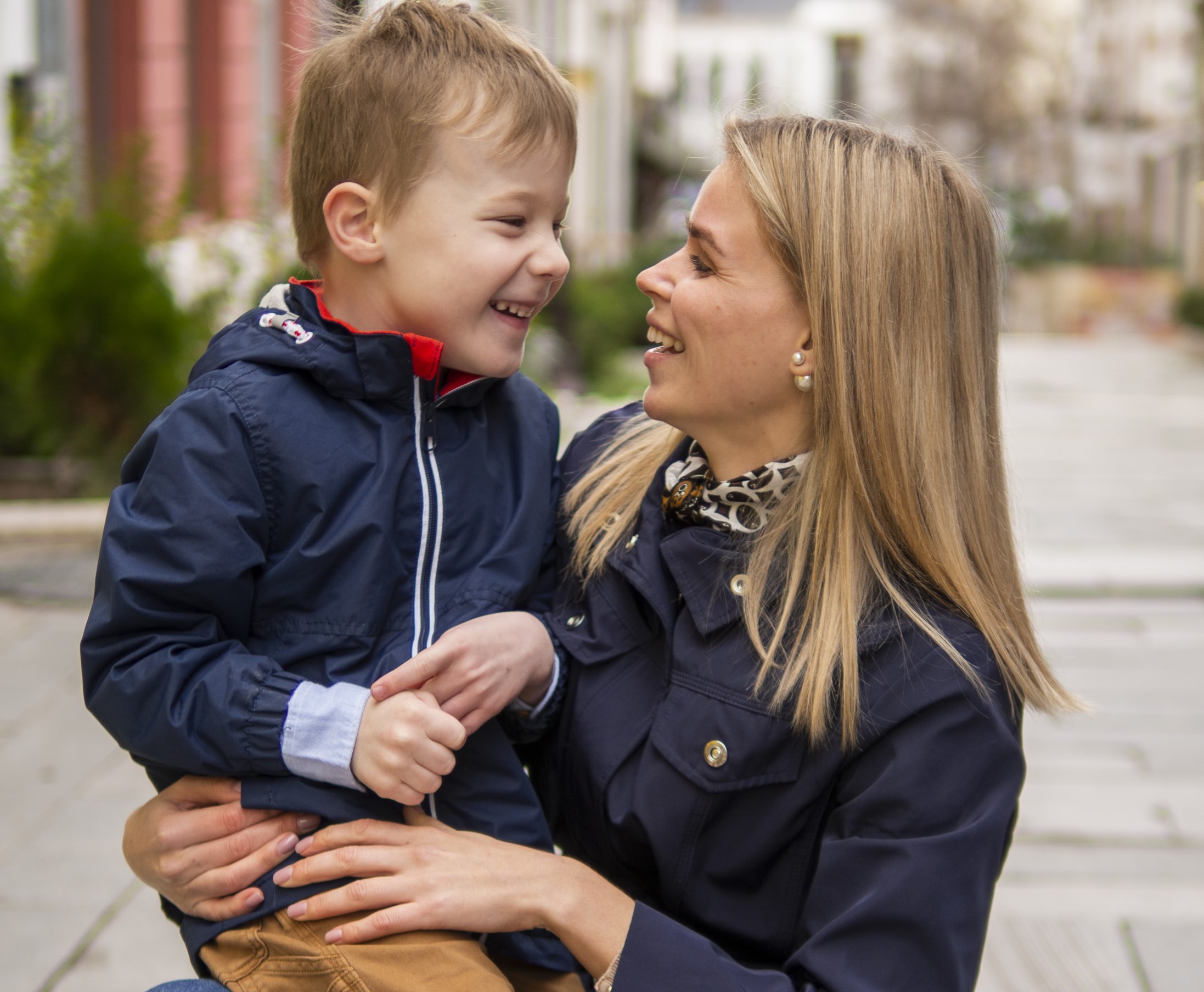
Every morning in White Plains followed the same exact ritual, a carefully choreographed performance played out on the suburban stage where we lived our supposedly perfect lives. My five-year-old son, Caleb, and I would walk hand-in-hand with my husband, Marcus, to the Metro-North station, a journey of precisely twelve minutes that had become so routine I could have navigated it blindfolded. The familiarity should have been comforting, but lately it had begun to feel more like a prison sentence—one I served willingly, cheerfully even, because that’s what good wives did.
Marcus was always immaculate in his tailored gray suits, the fabric so precisely fitted it seemed molded to his body rather than merely worn. The scent of starched cotton and expensive leather clung to him like a carefully constructed identity, each element chosen to project success and stability. His leather briefcase—genuine Italian leather, he’d made a point of telling me when he bought it—was held with a grip that suggested the weight of immense responsibility, though I’d long ago stopped asking what exactly filled it. To the outside world, to our neighbors and the other commuters we passed each morning, he was the perfect husband, the responsible father that any woman would dream of having by her side.
He would greet the neighbors with a smile that I’d come to recognize as calculated—a brief, bright flash of teeth that never quite reached his eyes, never softened the hard line of his jaw or warmed the cold assessment in his gaze. Mrs. Henderson next door would wave from her garden, and Marcus would call out a hearty “Beautiful morning!” Mr. Cho from the corner house would nod as he retrieved his newspaper, and Marcus would compliment his new car or comment on the weather with the easy charm of a man who understood the social contract of suburban life perfectly.
He constantly checked his gold watch—a Rolex his father had given him, a family heirloom that represented lineage and legitimacy—in a nervous tic that projected the air of a man who didn’t have a single minute to lose, whose time was valuable, whose presence in our lives was a gift we should be grateful for. I walked beside him, my hand resting lightly in the crook of his arm when he remembered to offer it, trying not to dwell on the crushing monotony of this routine, a ritual that had become so ingrained it felt like part of my own skin, like something I’d been born doing rather than something I’d chosen.
Caleb, his small superhero backpack dangling precariously from shoulders still baby-round despite his protests that he was a “big boy now,” would skip along the sidewalk, his little legs working double-time to keep pace with his father’s long, purposeful stride. Sometimes Marcus would slow down for him, reach down to ruffle his hair with an affection that looked genuine to anyone watching. Sometimes he wouldn’t, and Caleb would have to nearly run to keep up, his breath coming in small pants that he tried to hide because he wanted so badly to be strong like Daddy.
Before descending to the platform, Marcus would lean down with movements that had become as choreographed as a dance, precise and economical, wasting no excess motion. He would plant a quick, dry kiss on Caleb’s head—always the top of his head, never his cheek or forehead, as if even this small gesture of affection had to maintain a certain masculine distance. I would remain a few steps behind, a silent sentinel watching him disappear into the churning sea of commuters, the gray suits and black briefcases all blending together until I could no longer distinguish my husband from the dozens of other men making their way into the city.
We looked like a normal, almost exemplary family—a portrait of American stability that could have been pulled from a lifestyle magazine or a real estate advertisement. Young professional couple, beautiful child, thriving suburban existence. Yet deep inside, in a place I barely acknowledged even to myself, a cold, unsettling feeling had begun to fester. A subtle dissonance, like a note played slightly off-key in an otherwise perfect symphony, that told me something was profoundly wrong.
As Caleb and I made the familiar walk back through the quiet streets of our neighborhood—past the Henderson house with its perfectly maintained roses, past the Cho family’s impeccable lawn, past the new family on the corner whose names I still hadn’t learned despite them living there for six months—I found myself wondering if this was truly all that life consisted of. Accompanying the man who shared my bed to a train every morning without ever questioning what he did once it pulled away from the station. Where he went. Who he saw. What version of himself he became once he shed the costume of devoted husband and father.
People told me I was lucky. My mother, my sister, the other wives at Caleb’s preschool—they all said the same thing with varying degrees of envy tinting their voices. “Marcus is such a good provider.” “You’re so fortunate to have found a man who takes his responsibilities seriously.” “In this economy, having a husband with a stable job is everything.” And it was true, objectively, factually true. Marcus was a serious, hardworking man who provided for his family with an almost aggressive competence. The bills were always paid on time, often early. The fridge was never empty. Our life was a fortress of financial security, our savings account growing steadily, our future apparently assured.
But there was a coldness in our home that no one else saw, an uncomfortable, echoing silence in the evenings that I couldn’t explain and had stopped trying to understand. The house was always clean, meals were always prepared, schedules were always maintained, but there was an absence of something essential—warmth, perhaps, or genuine connection, or the easy intimacy that I’d imagined marriage would bring.
I would smile for my son, prepare his breakfast with the careful attention I’d once reserved for more creative pursuits, and play the part of the contented wife with an expertise born of years of practice. But deep down, a strange premonition lingered, growing stronger with each passing week—as if the perfect stability we projected to the world was just a fragile facade, a house of cards built on a foundation of sand, about to crack and crumble under the weight of truths I didn’t yet know but somehow sensed were there, waiting.
That particular morning started like any other. The alarm at 6:15 AM. The choreographed dance of showering, dressing, preparing breakfast while Marcus read the news on his tablet and Caleb watched his morning cartoons at a carefully regulated volume. Coffee made exactly how Marcus liked it—strong, black, in the blue mug his mother had given him. Toast with butter for Caleb, cut into triangles because he insisted they tasted better that way. The mundane rituals that comprised the scaffolding of our daily existence.
But as Marcus walked a few steps ahead of us on our way to the station, his stride confident and purposeful as always, his attention on his phone as he scrolled through what I assumed were work emails, Caleb squeezed my hand with a sudden, desperate tightness that made me stumble slightly on the sidewalk.
He tugged, his small hand surprisingly strong, forcing me to stop walking, forcing me to bend down to his level. His face, when I looked at it, was pale beneath his summer tan, his brown eyes wide with something that looked like terror. With a voice barely audible over the ambient sounds of the suburban morning—birds chirping, a distant lawn mower, cars passing on their way to wherever cars go—his trembling lips uttered the words that would shatter the illusion of safety I’d been clinging to.
“Mom,” he whispered, his eyes fixed on the cracked pavement beneath his sneakers, unable or unwilling to meet my gaze, “I don’t want to go home.”
I froze, every muscle in my body going rigid with shock. The sounds of the city—suddenly deafeningly loud—faded into a dull roar in my ears. My first instinct was to dismiss it as a childish whim, the kind of random fear that children sometimes experience. Perhaps he was tired from staying up too late watching his tablet. Perhaps he was anxious about something at preschool. Perhaps this was about the monster he’d mentioned living in his closet last week, the one I’d helped him “defeat” with a flashlight and a brave song.
But when he finally lifted his gaze to mine, his expression was far too serious, far too heavy for a five-year-old. There was something in his eyes that children shouldn’t have—a knowledge, a burden, a weight that made him look older than his years. He looked down again almost immediately, as if making eye contact was physically painful, as if he had just committed an act of treason by speaking these words aloud, as if keeping his silence was a physical pain he could no longer bear.
In his innocence, he seemed burdened by a secret far too immense for his small shoulders to carry. His whole body was tense, coiled like a spring, and I could see his bottom lip trembling with the effort of not crying.
The crowd of morning commuters flowed around us like a river around stones—businessmen with their briefcases, women in professional attire hurrying to catch trains, teenagers with their backpacks headed to the high school. They were all oblivious to the confession that was tearing my world in two, to the moment of fracture happening right there on the sidewalk while they worried about being late to meetings or whether they’d remembered to pack their lunch.
I stroked his hair with a hand that I was surprised to find steady, trying to transmit a sense of security that I no longer felt, even as a rising tide of anxiety flooded my own chest, making it hard to breathe, hard to think, hard to maintain the performance of calm normalcy.
“Why do you say that, honey?” I asked, pitching my voice into that particular register of tender concern that mothers learn, the one that’s meant to make children feel safe enough to tell the truth. “Did something happen? Did you have a bad dream?”
He looked away, his gaze sliding to the side as he bit his bottom lip—a habit he’d had since he was a toddler, one that appeared whenever he was deeply distressed or struggling with something he didn’t have words for. His small hands were clenched into fists at his sides, his knuckles white with tension.
It was then, after a long moment of agonizing silence during which I became acutely aware of my own heartbeat pounding in my ears, that he added in a voice even lower than before, a ghost of a sound that I had to lean in to hear: “Last night… I heard Dad talking about us.”
My heart didn’t just leap—it felt as if it had been seized by an icy hand and squeezed until I couldn’t breathe. Everything around me seemed to recede, to become distant and unimportant. A dark shadow had suddenly fallen across our ordinary life, transforming the familiar morning routine into something sinister, something dangerous.
I knew with a mother’s instinct—sharp and undeniable—that I couldn’t show panic. Not here, not now, not with Marcus still within sight, close enough to turn around and see us, close enough to notice if something seemed wrong. If he suspected that I was beginning to discover whatever truth lay hidden beneath our perfect suburban surface, I didn’t know what he might do. The thought sent a chill down my spine that had nothing to do with the morning air.
I knelt in front of my son right there on the bustling sidewalk, my knees against the rough concrete, uncaring of the stares we might be drawing from passersby. I held his small shoulders, my hands surprisingly steady despite the terror coursing through my veins, and looked directly into his eyes with an intensity that made him flinch slightly.
“What did you hear, Caleb?” I asked, keeping my voice low and controlled, though every fiber of my being was screaming with panic. “What exactly did you hear him say? It’s very important that you tell me, sweetheart. I promise you won’t be in trouble.”
His eyes—wide and brown like my own, fringed with the long lashes he’d inherited from my side of the family—filled with tears that he was fighting desperately to hold back. He was trying so hard to be brave, to be strong like the superheroes on his backpack, but he was only five years old and the burden he was carrying was crushing him.
In a shaky, broken whisper that I felt more than heard, he confessed: “Dad said he doesn’t want us at home anymore… and he has a plan. With you.”
Those words echoed in my mind like thunder rolling across a clear sky, impossible and undeniable all at once. A plan. With you. I couldn’t process it, couldn’t make the words fit into any framework that made sense. How could a child invent something so specific, so sinister? What if he had misunderstood a phone call, a conversation about work or finances or vacation plans? I tried desperately to convince myself it was a mistake, a terrible misinterpretation filtered through a five-year-old’s limited understanding of adult conversation.
But the raw, unshakeable certainty in his tone, the fear in his eyes, the way his whole body was trembling—these things disarmed me completely. Children don’t fake this kind of terror. They don’t manufacture this level of specific detail. And Caleb had never been a dramatic child, had never been prone to exaggeration or attention-seeking behavior. If anything, he was too quiet, too eager to please, too willing to fade into the background to avoid causing trouble.
The roar of a train pulling into the station jolted me from my paralysis. The sound was thunderous, mechanical, a reminder that time was still moving forward even though my world had just stopped spinning. I pulled my son into a fierce hug, burying my face in his hair, inhaling his familiar scent of sunshine and baby shampoo and the faint smell of the cinnamon toast he’d had for breakfast. I needed to ground myself in something real, something innocent, something that reminded me why I had to be strong.
As Marcus turned at the turnstiles to wave goodbye—his usual, practiced smile in place, the smile of a man whose morning had gone exactly according to plan—I felt the ground beneath my feet begin to crumble. The figure of my husband, so normal, so routine, so familiar after ten years of marriage, had suddenly morphed into a disturbing enigma, a stranger wearing Marcus’s face.
What did that plan mean? Why would he speak about us as if we were obstacles to be removed, problems to be solved, inconveniences to be eliminated? My head spun with a vortex of questions, each one more terrifying than the last. Was I in danger? Was Caleb? Had I been living with a man capable of… of what, exactly? What was he planning?
But I had to hide it all. Every ounce of fear, every spike of panic, every tremor of terror—I had to bury it deep and present a calm, placid surface. I clenched my teeth hard enough that my jaw ached, stayed silent when I wanted to scream, and forced a pleasant, normal expression onto my face as I lifted my hand to wave back at him. A perfect mirror of every other morning. A flawless performance of the devoted wife seeing her husband off to work.
My heart hammered violently against my ribs, so hard I was certain anyone standing near me would hear it, but I held my composure with an iron will I didn’t know I possessed. Instinct—primal, maternal, survival instinct—told me that a single misstep, one extra gesture of distress, one facial expression that didn’t match the script of our daily routine, could ignite his suspicion. And if he became suspicious, if he realized that Caleb had told me, if he knew that I was beginning to see him clearly…
I couldn’t let that happen. Not until I understood what we were dealing with. Not until I had a plan of my own.
As Marcus ascended the stairs to the platform, briefcase in hand, phone already at his ear as he placed what was probably his first business call of the day, I no longer saw the same man I’d married. His silhouette seemed transformed, the outline of a stranger capable of concealing unfathomable darkness. Every gesture I’d once found familiar now seemed sinister. The way he’d kissed Caleb’s head this morning—had that been affection or a goodbye? The way he’d smiled at me over breakfast—had that been love or calculation?
How long had I been living with a man I didn’t really know at all?
On the walk back home, still clutching Caleb’s hand so tightly I was probably hurting him but unable to loosen my grip, I tried to soothe us both with words I didn’t believe. “Daddy loves you very much, sweetie,” I heard myself say, my voice sounding hollow and distant, like it was coming from someone else’s throat. “I’m sure you misunderstood what you heard. Sometimes grown-ups talk about things in ways that sound strange to kids, but it doesn’t mean what you think it means.”
The lies tasted bitter on my tongue. I was trying to convince him, but really I was trying to convince myself, to cling to the comfortable fiction that everything was fine, that our life was still normal, that the man sleeping beside me each night wasn’t planning something terrible.
Caleb looked up at me, his expression solemn and far too knowing, and didn’t answer. In that heavy silence, I understood with a clarity that made my stomach turn that he didn’t believe me. He knew I was lying. He knew his father was dangerous. And somehow, at only five years old, he had the wisdom to recognize when adults were protecting themselves with denial.
A shiver traced its way down my spine like cold fingers walking along each vertebra. If Marcus had really said those words, if Caleb had truly heard what he claimed to have heard, then we were living under the same roof with someone who was no longer family, but a threat. A predator. A man capable of planning harm against his own wife and child.
From that instant, walking through streets that suddenly seemed less safe, less familiar, I knew I had to be vigilant. I had to feign tranquility while simultaneously starting to look for answers, to search for proof, to understand the nature and extent of the danger we were in. I couldn’t go to the police with the word of a five-year-old who had overheard part of a conversation. I couldn’t run to my family without concrete evidence because Marcus would simply deny everything, would paint me as paranoid or unstable, would find a way to maintain control.
I needed to know exactly what I was dealing with before I could act.
Instead of going straight home to the apartment where Marcus might have cameras or recording devices or ways of monitoring what I did when he wasn’t there, I took a detour. I told Caleb I wanted to buy him a juice box at the corner store, that maybe we could sit in the park for a little while and enjoy the morning. In reality, I needed time to organize my thoughts, to let the shock subside into something manageable, something I could think through rather than just feel in waves of panic that threatened to overwhelm me.
His revelation could not be ignored, could not be rationalized away or dismissed as childish imagination. A primal, maternal instinct—the same instinct that had woken me a hundred times in the night when Caleb was an infant, that had known something was wrong before conscious thought could catch up—screamed at me to pay attention to every detail, every nuance, from this moment forward.
Caleb’s small hand was sweaty in mine, his palm damp with the perspiration of fear. His anxious gaze darted around the park where we sat on a bench, watching other children play on the swings and slides, their mothers chatting peacefully nearby, all of them living in a world where husbands didn’t have sinister plans, where morning routines were comforting rather than performances, where the word “home” still meant “safe.”
I tried to smile at him, to project reassurance and strength, but my chest felt heavy, as if I were carrying an invisible weight that was slowly crushing me. As we sat there, the juice box forgotten and warm in his lap, I replayed his phrase over and over in my head like a recording stuck on repeat. Dad has a plan with you. The words became a terrifying mantra, a rhythm that matched my heartbeat, a truth I couldn’t escape.
Finally, I bought the promised juice, hugged him tight enough that he squeaked in protest, and we continued our walk back to the apartment with a feigned calm that felt like wearing a lead cloak. I had to maintain normalcy. I couldn’t let Marcus discover my distress, couldn’t give him any reason to suspect that I was beginning to see through whatever facade he’d constructed. If he was truly plotting something—and oh God, what could he be plotting?—showing fear might precipitate it, might force his hand before I was ready to protect myself and my son.
That afternoon, I decided with the clarity of absolute determination, I would begin to observe him through new eyes. Not as my husband, not as Caleb’s father, not as the man I’d once loved, but as a dangerous stranger who had infiltrated my life. I would watch, wait, and gather evidence.
Because whatever Marcus was planning, I was going to stop it. Even if it meant destroying everything I’d built, everything I’d believed in, everything I’d thought my life was.
When we finally reached our apartment building, my legs heavy with dread, the first thing that caught my eye made my blood run cold. There, on our front door, gleaming dully in the hallway light, was a new auxiliary deadbolt. A heavy, metallic circle of brass that I didn’t recognize, hadn’t authorized, hadn’t even known was being installed.
It looked freshly installed, the wood around it still showing the pale scars of new drilling. Marcus hadn’t mentioned any renovations. Hadn’t said anything about break-ins in the building or the neighborhood. Hadn’t given me any reason at all to believe we needed additional security measures.
A chill ran through my body as I stared at that lock, understanding viscerally that this was wrong, that this was part of whatever he was planning. That lock represented something—an invisible border, a line of control, a way of separating him from us or keeping us contained. Caleb stared at it too, his small face etched with confusion that was rapidly morphing into fear as he looked between the strange new lock and my face, trying to read my reaction, trying to understand what this meant.
“Why is there a new lock, Mommy?” he asked quietly.
“I don’t know, baby,” I said, my voice sounding strange and tight. “Daddy must have… must have wanted to make sure we’re extra safe.”
But even as I said the words, I didn’t believe them. This wasn’t about keeping us safe. This was about something else entirely. Control. Containment. Making sure that when the time came, when whatever plan he had was ready to be executed, we couldn’t escape.
We went inside, and everything appeared normal on the surface. The living room was tidy, exactly as I’d left it that morning. The table was set with two place settings for lunch—I always set it ahead of time, a small organizational habit that Marcus claimed to appreciate. The ambient noise of the television filled the space, a cooking show I’d left on for background noise. But that lock weighed on my mind like a silent, screaming warning that I couldn’t ignore.
What, or who, did he want to protect the house from? Or—and this thought made my stomach turn—was he trying to protect himself? From me? From questions? From discovery? Was this lock meant to keep people out, or to keep us in?
For the first time since we’d moved into this apartment three years ago, I realized my home—the place that should have been my sanctuary, my safe haven, the walls within which I was supposed to feel protected and loved—might have become a trap. A cage disguised as a comfortable middle-class existence.
And I was living in it with the man who held the keys.

Adrian Hawthorne is a celebrated author and dedicated archivist who finds inspiration in the hidden stories of the past. Educated at Oxford, he now works at the National Archives, where preserving history fuels his evocative writing. Balancing archival precision with creative storytelling, Adrian founded the Hawthorne Institute of Literary Arts to mentor emerging writers and honor the timeless art of narrative.