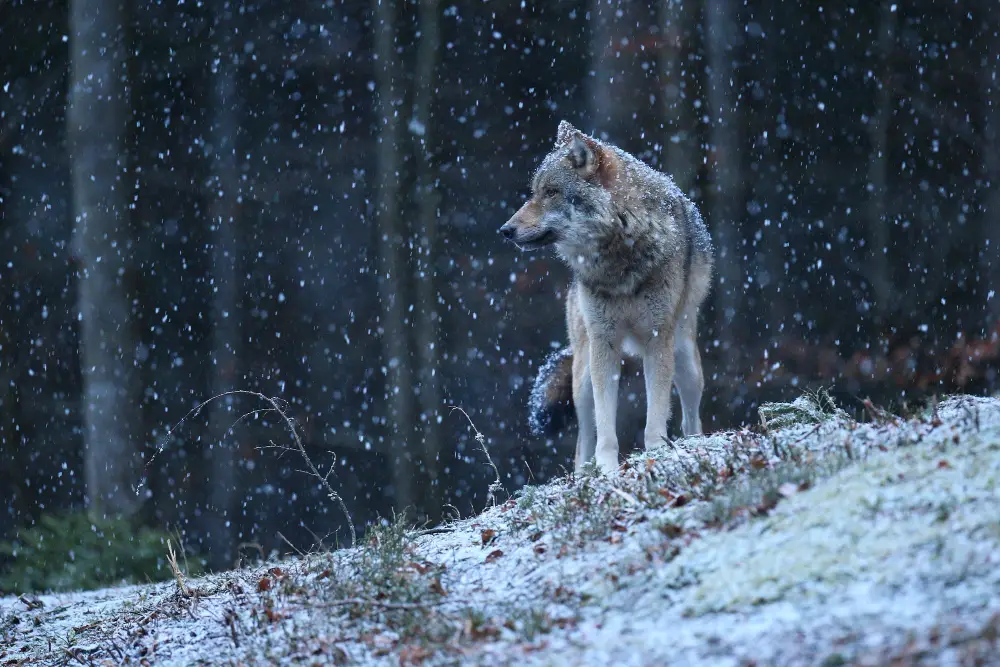
I stood at the window for a long time. I thought about the door, which was solid old wood with a heavy iron latch but with gaps in the frame that let in cold in the winter. I thought about the stove and the warmth in the room behind me. I thought about the wolves’ fur, rimed with ice, and the temperature outside, which had dropped far below freezing.
I thought about my mother, who had kept the forest-side curtains drawn, and what she might have done in this situation.
I thought she probably would not have opened the door.
The rational part of my mind went through the catalogue of reasons why opening the door was inadvisable. Wolves were wild animals. Wild animals that came close to human habitation were usually dangerous in one of several ways — sick, injured, cornered. There was no guarantee that exhaustion made them less dangerous. There was no guarantee that their stillness was anything other than a different kind of threat.
But I had been watching them for twenty minutes now, and something in their behavior did not fit any of the categories I knew. They had not tested the door. They had not circled the house. They had not displayed any territorial behavior or aggression. They simply stood there in the pause of the storm, leaning against each other slightly, looking at the light.
I went to the stove and stood there for another minute. The storm resumed outside, the wind returning with its load of noise and cold. I thought: if it were a person, exhausted, in a storm this severe, standing at a door, I would open the door.
I could not entirely account for why that thought was decisive. But it was.
I went to the door. I lifted the latch and opened it and stepped back.
The cold came in first, a wall of it, carrying the smell of snow and pine and something wild underneath, like copper or deep earth. Then the first wolf crossed the threshold.
It moved slowly, head low, body careful. Not the caution of a predator approaching prey but the caution of an animal moving through unfamiliar space, attentive, precise, measuring each step. It entered and stopped just inside the door and stood there, scenting the air.
The second followed, then the third. The fourth paused at the threshold longer than the others, nose working, head turning to look back at the darkness outside, as if checking something. Then it came in too.
I had moved to stand beside the table, putting it between myself and the door. An instinct rather than a plan. I kept my breathing even and my movements still.
They spread through the room with a quiet deliberateness that surprised me. They did not knock over furniture or lunge at the table. They moved the way water moves through a new space, finding the contours of it, filling in around the fixed objects. The first one went to the stove and stood near it, steam beginning to rise from its frost-covered fur. The second moved to the window and lay down beneath it. The third circled the room slowly — corners, the edge of the rug, the doorway to the hall — then lay down near the stove. The fourth one was different. It moved with more purpose than the others, nose to the floor, following a line I could not see. It went into the hallway and came back. Went to the corner of the room where the floorboards met the wall. Sniffed along the length of the baseboard. Went into the hallway again.
Then it lay down too, near the entrance, and was still.
I stayed where I was beside the table for a long time. The storm continued outside. The wolves lay in their places around the room like dogs that had always been there, their breathing slow and audible in the quiet between gusts of wind. The one near the stove had its eyes half closed. The one by the window watched me steadily for a while, then let its head drop onto its paws.
I became aware, standing there, of how strange the ordinary objects of the room looked with this new presence inside it — the kettle on the stove, the folded blanket on the arm of the chair, the row of my mother’s old jars on the shelf, all of it suddenly belonging to a different kind of room than it had belonged to an hour earlier. I thought about calling someone, and understood immediately that there was no one to call who would reach me before morning, and that even if there had been, I would not have known how to explain what was happening in a way that would not sound like the beginning of a breakdown.
After perhaps an hour, I moved carefully to my chair by the stove and sat down.
I did not sleep. Or I did not intend to sleep. But at some point in the early morning hours, with the fire burning low and the storm moving away to the south, I closed my eyes and did not open them again until dawn.
I woke to silence.
Not the ordinary silence of early morning, which has texture — birds beginning, the first sounds of the village waking, the small movements of a house adjusting to the rising temperature. This was a complete silence, sealed, as if the world outside the windows had been replaced with something else overnight.
The wolves were gone.
The door was closed. The room was empty except for the traces of their presence: the melted frost that had dried on the floorboards, the compressed shapes in the rug where two of them had slept, the faint wild smell that lingered in the air. If I had not known they had been there, I might have convinced myself I had dreamed it.
I stood in the middle of the room and turned slowly, taking inventory.
Then I saw the hallway.
The floorboards had been torn apart. Three planks broken clean through, the wood pale and splintered at the fractures. The earth beneath them was dug up, not randomly but in a concentrated area, as if something specific had been located and excavated. The fourth wolf, the one that had kept moving and sniffing while the others settled, it had done this work. During those hours when I had heard quiet scratching and told myself it was simply an animal uncomfortable in an unfamiliar space.

Lila Hart is a dedicated Digital Archivist and Research Specialist with a keen eye for preserving and curating meaningful content. At TheArchivists, she specializes in organizing and managing digital archives, ensuring that valuable stories and historical moments are accessible for generations to come.
Lila earned her degree in History and Archival Studies from the University of Edinburgh, where she cultivated her passion for documenting the past and preserving cultural heritage. Her expertise lies in combining traditional archival techniques with modern digital tools, allowing her to create comprehensive and engaging collections that resonate with audiences worldwide.
At TheArchivists, Lila is known for her meticulous attention to detail and her ability to uncover hidden gems within extensive archives. Her work is praised for its depth, authenticity, and contribution to the preservation of knowledge in the digital age.
Driven by a commitment to preserving stories that matter, Lila is passionate about exploring the intersection of history and technology. Her goal is to ensure that every piece of content she handles reflects the richness of human experiences and remains a source of inspiration for years to come.
This is a great story. Enjoyed it very much. Thank you for creating it. Look forward to more.
Great story! Well done.