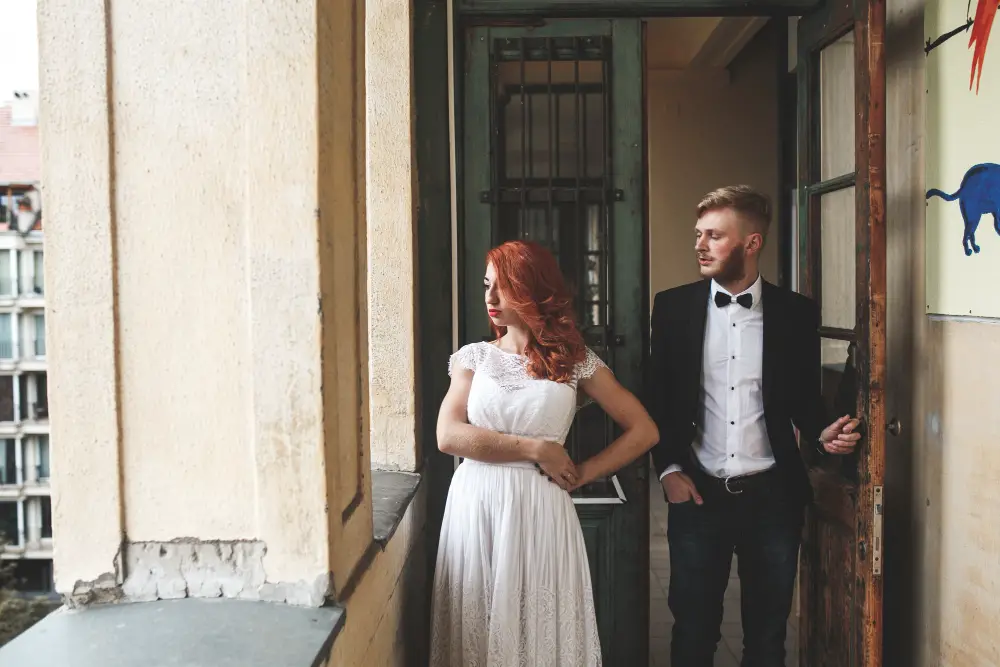
The Invoice
The staff member at the door smiled the way people do when they have been told to be polite about something ugly. He looked at his clipboard, then back at me, then at his clipboard again, as though my name might appear between one glance and the next.
“I’m sorry, ma’am. Your name isn’t on the list.”
Behind him, through the open French doors, two hundred white chairs faced an altar covered in hydrangeas. Blue-violet ones, the kind that only grow right in coastal Georgia if you plant them in acidic soil and tend them like they matter. I knew this because my sister Whitney had texted me about those hydrangeas eleven times in March. She had not texted me about the guest list.
I was standing there holding a garment bag. Inside it was a backup bustle pin, a spool of ivory thread, and a miniature sewing kit I had packed at five that morning in case the train snagged on a chair leg or the zipper caught on the beading near the hip, which it would, because I had warned Whitney about that seam three times. She’d said, “It’ll be fine, Tess. Stop worrying.” So I had driven forty minutes to stop worrying in person.
I watched his pen hover over the R section of the list. My name should have been right there, between Robinson and Sawyer. But there was a line drawn through that space. Not a gap. A line. Someone had crossed me off deliberately, neatly, like a correction.
My ribs did something strange. They tightened, then went still, like a breath that forgot to release. Through the open doors I could see the first rows filling up, the Hargroves on the left, our side on the right, Aunt Patty adjusting her hat, Cousin Devon on his phone. And somewhere inside, past the foyer and the string quartet warming up, my sister was standing in front of a full-length mirror wearing the dress I had spent ninety-two days making by hand.
Ninety-two days. Three months of fourteen-hour shifts in a studio that smells like sizing solution and cold coffee. Three months of hand-beading a bodice at two in the morning because the light is different at two in the morning and you catch mistakes you would miss at noon. Three months of cutting French lace so fine it dissolved if you breathed on it wrong. I once sneezed during a fitting and lost an entire panel. The dress was worth eighteen thousand dollars. Whitney had told the Hargroves it cost forty, from a designer named Elise Laurent who did not exist, at a studio on Spring Street in SoHo that was also a fiction.
I learned this from the family group chat three months earlier, when Whitney posted a screenshot of the receipt. I had stood in my studio holding my phone and read it twice. Elise Laurent Studio, the header said. Amount: $40,000. Diane, my mother, had replied with three heart emojis and the words worth every penny.
I was still holding that fact somewhere in the back of my chest when I turned from the door and found my mother already there, six feet away in a seafoam suit with pearl buttons, standing beside a column like she had been waiting. Not surprised. Not embarrassed. She was holding a ceremony program, the kind with a ribbon tied through the fold, and she looked at me the way you look at a stain on a tablecloth. Something you would rather not deal with in front of company.
“We discussed this, Tessa,” she said.
“You sent a text at eleven at night saying the venue was at capacity.”
“And it is.”
“There are forty empty chairs. I counted from the parking lot.”
She exhaled through her nose. That exhale was a Diane Ror specialty. It meant you had embarrassed her by being correct.
“We can’t let a poor designer shame the family.”
She did not whisper it. She did not even try to keep her voice down. The staff member with the clipboard suddenly found his shoes very interesting.
I looked at the ribbon on the program in her hands. Blush pink. Whitney had wanted blush pink everything. I had dyed that ribbon myself, at midnight, in my kitchen sink, matching it to the sash on the dress. My name was not on the program credits.
Something behind my sternum went flat. Not broken. I want to be precise about that. Flat, like a note that stops resonating. Like the air had been let out of something I had been inflating for twenty-nine years.
I looked past her through the doors. The dress moved. Whitney was spinning for someone, a camera flash going off, and the skirt caught the light and threw it back in that way silk charmeuse does when the bias cut is right. Mine was right. I had recut it twice to be sure.
I held the garment bag a little tighter. The emergency kit inside it was for her. I had driven forty minutes to protect a dress worn by a woman who had told her in-laws it was made by someone who did not exist.
So I smiled.
“Enjoy your day.”
I turned around, walked back to my car, and put the garment bag on the passenger seat like it was a person. I sat there for a moment with both hands on the wheel, engine off, listening to the parking lot sounds. Hargrove sedans, rental SUVs, a catering van from a company Whitney had also underpaid, though that was a different story.
It took my mother six words to reach inside me and take something out. The strange part was how clean it felt. Like a seam pulled free.
I drove the forty minutes back to Savannah with both windows down because the air conditioning in my Civic had died in July and I had been too busy sewing a wedding dress to fix it. The October humidity hung on my forearms like damp cotton. Spanish moss blurred past on both sides of the highway, and somewhere around mile marker fourteen, the garment bag shifted on the passenger seat and the zipper jingled, and the sound was so small and so stupid that my throat closed.
I did not cry. I want that on the record. I pressed my tongue to the roof of my mouth, a trick I learned at fifteen, the Thanksgiving that Diane told the table Whitney had gotten into Florida State and that I was still figuring things out, which was her way of saying I had chosen a sewing scholarship over a real degree. I held it there until the feeling flattened into something I could drive with.
The smell of the garment bag was what nearly undid me. Cedar and lavender from the drawer sachets I used to store muslin. Whitney used to steal those sachets for her school locker because she said they smelled expensive. She was fourteen, I was ten, and I had made them from fabric scraps and dried flowers from the backyard. When Diane found out, she said, “Let your sister have them. You can always make more.”
I could always make more. That was the whole arrangement, when I looked at it plainly. Whitney needed a Halloween costume, so Tessa made one. Whitney tore her homecoming dress, so Tessa fixed it. Whitney wanted custom tote bags for her sorority rush, so Tessa made twelve, one for each pledge sister, and Whitney never mentioned who made them.
Diane had a phrase for the whole system. She used it the way other mothers say I love you, casually, without checking whether it landed.
“Whitney is the face. You’re the hands.”
Like I was a body part someone had misplaced at a family reunion. Like Whitney was the store window and I was the back room where things got assembled. The metaphor worked for Diane because it meant she never had to credit me and never had to explain Whitney. It was efficient. I’ll give her that.
I had graduated from SCAD with a BFA in fibers and a concentration in textile construction. I paid for it myself, through scholarships, work-study, and a weekend job hemming curtains for a retirement home in Thunderbolt. Diane did not attend the graduation. She sent a card that said “Proud of you!” with an exclamation point that somehow felt sarcastic. Whitney sent a text: Congrats. Can you make me a dress for my anniversary dinner btw. No question mark. Not a question.
The studio came later. A twelve-by-fourteen room above Lorraine Mabry’s fabric shop on Broughton Street. Lorraine was sixty-seven and had been selling fabric in Savannah since before I was born. She gave me the space at reduced rent because she said I reminded her of herself at twenty-three: stubborn, talented, and catastrophically bad at charging people.
It was Lorraine who taught me about the signature. One afternoon she brought up a bolt of ivory charmeuse and laid it on my cutting table like it was a patient. She watched me run my hand across it, then said, “Every bridal designer worth a damn leaves a mark. Inside the corset, along the boning channel. Thread color that matches the lining, so nobody sees it unless they are looking. The ones who don’t sign their work get forgotten. The ones who do, the dress remembers, even if the bride doesn’t.”
I started signing my pieces after that. A tiny monogram in silver thread, T.R., tucked inside the corset along the left boning channel. No one had ever found one. No one had ever looked.
Three months before the wedding, Whitney had called. Not FaceTime, not a text. An actual phone call, which meant she wanted something that required vocal manipulation.
“Drew proposed,” she said, like it was a weather report. “And I need a dress.”
Whitney had met Drew Hargrove at a charity gala in Beaufort. The Hargroves owned a midsize logistics company, the kind of family that wintered in Sea Island and used summer as a verb. Whitney had been working as a marketing coordinator. Fine work, steady pay, nothing that would impress people who summer anywhere. But Drew loved her, or loved the version of her that showed up at galas.
The dress was supposed to be simple. It became, as custom dresses always do, everything. French Alençon lace bodice, hand-beaded with seed pearls. Silk charmeuse skirt cut on the bias so it would pour instead of hang. A cathedral train that needed its own zip code. The real price was eighteen thousand four hundred dollars. Whitney’s price was zero, because Diane said this is what family does, Tessa, and I said yes because the dress was my last try.
I did not say that out loud. But I said it to myself in the mirror above my cutting table at one in the morning, pinning lace to the bodice form with hands that shook a little, not from exhaustion but from something closer to prayer. If I made this dress beautiful enough, if the lace fell right and the beading caught the light and Whitney looked the way she was supposed to look, maybe Diane would see it. Not the dress. Me. Maybe she would look at the dress and, for once, trace the line backward from the beauty to the hands.
She didn’t. What she did was help Whitney lie.
I finished the dress on a Tuesday at two in the morning. I held it up under the fluorescent light of my studio and it was the most beautiful thing I had ever made for the most ungrateful people I had ever known.
The studio was dark when I got back from the wedding parking lot. I turned on the light and it buzzed and stammered, the way it had been doing for two weeks. I kept forgetting to replace it. The way you keep forgetting things that only matter to you.
The mannequin stood bare in the corner where the dress used to hang. Headless, armless, the color of old cream. I had bought it secondhand from a bridal shop that went under during COVID, and its left shoulder sat slightly higher than the right, which meant everything I draped on it pulled a quarter inch to the east. I had adjusted for that tilt so many times I sometimes adjusted for it in dresses on different mannequins. Habit is a strange kind of loyalty.
I sat at the cutting table and opened my phone. The group chat had twenty-three new messages, photos mostly. Whitney in front of the altar, Whitney and Drew, Whitney and Diane cheek to cheek holding champagne. The dress moved through every photo like a living thing. The train fanned across stone tile, the bodice caught afternoon light through stained glass, the skirt swayed with a weight that only real charmeuse has. No one in the chat mentioned the designer. No one mentioned me. There were forty-seven emoji reactions and not one had my name next to it. I had been erased so completely it looked effortless.
I set the phone face down and pressed my palm flat against the bolt of ivory charmeuse Lorraine had left for me that week. The fabric was cool and impossibly smooth. I held my hand there and the coolness traveled up through my wrist and into the part of my chest that had gone flat in the parking lot, and for a moment the two temperatures matched, and that was almost worse than crying.
A knock at the studio door. I hadn’t locked it, which was either careless or hopeful.
Lorraine came in carrying two cups of coffee. She set one in front of me without asking. She looked at the bare mannequin, then at me.
“So,” she said. “They wore it.”
“They wore it. And they told the man at the door I wasn’t good enough to watch.”
She sat down across from me and looked at me over the rims of her glasses, the look she reserved for bad hemlines and worse decisions.
“When are you going to send the invoice?” she said.
“It was free, Lorraine. Family rate.”
“Nothing is free, baby. You just haven’t counted the cost yet.”
She looked at the wall behind me where I had framed my business license next to a photo of my first commission. Below it, on a shelf, sat the stack of letterhead I had designed myself. Tessa Ror Atelier, clean serif type, a single needle trailing a curved thread. Five hundred sheets printed two years ago. Maybe thirty used, all for strangers, never for family.
“You know what the difference is between a seamstress and a designer?” she said.
I waited.
“A seamstress takes orders. A designer names her price.”
She finished her coffee, stood up, and left. The door clicked behind her. I pulled the letterhead toward me and looked at my own name for a long time.
I did not send the invoice that night. First I needed to do the actual math, not the emotional kind I had been running for twenty-nine years where the answer was always the same: deficit. I mean the dollars and hours, the labor and materials, the number I would quote a stranger who walked through the door.
Consultation fees, materials itemized to the last pearl, labor at ninety-two days and an average of nine hours per day at my standard rate for custom bridal work. What I would charge any stranger who walked through the door.
Grand total: $18,400.
I stared at the number. It looked enormous and completely fair at the same time. Like seeing your own reflection after a long absence and thinking, oh. That is what I look like.
I opened my invoicing software and started typing. Tessa Ror Atelier. Logo, single needle, curved thread. Addressed to Whitney Ror Hargrove. Itemized: consultation, materials, labor. Total due: $18,400. Payment terms: Net 30.
I CC’d Diane. Not because she owed the money, but because she owed the acknowledgment. She had orchestrated the free labor. She had stood at the door and smiled. She should see what free looks like when it comes with a number attached.
Lorraine stopped by around four the next afternoon. She stood behind me and looked at the laptop screen. She put her hand on my shoulder and squeezed once.
“Now you’re a designer,” she said.
I hit send at 9:47 on a Monday morning. By 9:52, my phone was ringing.
Diane Ror does not yell. I want to clarify that because people assume that a certain kind of mother is a screamer, that there is a volume to the damage, something you can point to. Diane does not yell. She modulates. She lowers her voice to a register that makes you lean in, and once you are leaning in, you have already conceded something.
“What do you think you’re doing?” she said. Not a question. A deposition.
“Billing for services rendered,” I said. I was standing at my cutting table with the phone on speaker, both hands pressed flat on the surface. I had learned a long time ago that if my hands were occupied, my voice stayed steady. Empty hands made me vulnerable.
“You made a dress for your sister’s wedding.”
“A gift that cost me ninety-two days and eighteen thousand dollars in labor and materials.”
“And your sister gave you the honor of dressing her on the most important day of her life.”
“She gave me the honor from a building I wasn’t allowed to enter.”
She exhaled. The exhale. Then: “If you don’t withdraw this invoice, you are no longer part of this family.”
I looked at the mannequin in the corner, bare and tilted slightly to the left the way it always tilted.
“I wasn’t on the guest list,” I said. “I think you already made that decision.”
She hung up without saying goodbye. Diane Ror does not say goodbye. She simply removes herself from the conversation the way she removed my name from the seating chart, cleanly, without ceremony, as though the space had always been empty.
Whitney called twenty minutes later, crying the way some people play piano. Technically proficient, emotionally precise, each note calibrated to produce a specific response in the listener. She’d had twenty-nine years of practice.
“I can’t believe you’d do this to me. On my honeymoon.”
“I sent an invoice, Whitney. I didn’t set anything on fire.”
“If Drew sees this and starts asking questions about the dress, he’ll ask about Elise Laurent.”
“There is no Elise Laurent. You made her up. You took forty thousand dollars from the Hargroves for a dress that cost them nothing because you told me it was free. Where did the money go?”
“That’s between me and my husband.”
“It’s between you and the truth. And right now your truth has an itemized invoice attached to it.”
She hung up.
Diane called again at 7:14 in the evening. She was crying now. Diane Ror cries even less than she yells, so when the tears come out they are meant to end wars. She said she had sacrificed, she had given us everything, she was the one who had told Whitney to ask me for the dress in the first place.
“You told her to ask because you knew I’d do it for free.”
“Because that’s what family does, Tessa.”
“Family also invites each other to weddings. There’s a fake receipt in the group chat, Mom. You replied with three hearts and worth every penny. You knew.”
The crying stopped like a faucet turned off. In the dry silence that followed I heard something I had never heard before in thirty years of Diane Ror phone calls. Nothing. Not a strategy, not a redirect. Just the sound of a woman who had run out of scripts.
Four seconds. Then: “If you pursue this, I will make sure everyone knows what kind of daughter you are.”
She hung up.
The text came at 10:30 that night from Megan, a girl I had gone to high school with who still followed everyone’s mother on social media because she treated it like a spectator sport. She attached a screenshot. Diane’s Facebook post. Public.
It was three paragraphs long, written in that particular style of Southern mother grief that reads like a church bulletin authored by a martyr. It said, with a heavy heart, that Whitney’s sister Tessa had decided to send an invoice for a dress she had volunteered to make as a gift, and was now demanding eighteen thousand dollars from a newlywed couple on their honeymoon. Twenty-four likes. Eighty-nine comments. So sad when jealousy tears families apart. Some people can’t stand to see their siblings happy. Praying for Whitney and Drew.
I sat in the studio long after that. The fluorescent finally gave up and went dark and I didn’t replace it. I sat in the glow of my phone screen reading comments from people who did not know me, who had never seen the inside of my studio or the thread count on that lace, and I thought maybe she wins. Maybe the story is already written and I am just the footnote, the jealous hands, the ungrateful body part.
Lorraine found me like that the next morning. She replaced the fluorescent tube and when the new one hummed to life and the room turned white again, she looked at my face and then at my phone, still open to the post. She read every comment. Then she set the phone down face-first on the cutting table.
“People will believe whatever story gets told first,” she said. “But the truth doesn’t need to be first. It just needs to be louder.”
She tapped the edge of my laptop. “An invoice with your name, your logo, and your work itemized line by line? That’s pretty loud, baby.”
I looked at the mannequin. Bare, headless, tilted slightly to the left, the way it always tilted, the way I always adjusted for. And I thought about the signature, silver thread T.R. inside the corset along the left boning channel, pressed against my sister’s ribs for her entire wedding day.
The dress knew who made it, even if nobody else did.
The voicemails started on Tuesday. Diane left fourteen in one hour. I played them back later from the studio floor and it was like listening to a woman auditioning for five different roles in the same play. Tears, then legal threats, then bargaining, then threats again. Voicemail fourteen was just a long exhale and a click.
Then my phone rang with a number I did not recognize. A 912 area code. Savannah, but not a contact I had saved.
“Miss Ror?” A woman’s voice. Clear, unhurried, the kind of voice that had never needed to raise itself because it had always been listened to. “My name is Ruth Hargrove. I believe you made my daughter-in-law’s wedding dress.”
My hand tightened around the phone. Not from fear. Something closer to the feeling you get when a teacher calls your name and you do not know if you are in trouble or about to be praised.
“I did,” I said.
“Funny. Because the receipt my family paid for says a woman named Elise Laurent made it out of a studio in SoHo. And Elise Laurent doesn’t seem to exist, Miss Ror.”
A pause. Not an empty one. A loaded one, the kind that has already drawn its conclusions and is simply waiting for you to catch up.
“No,” I said. “She doesn’t.”
“I thought not. My son mentioned at brunch last weekend that you had sent Whitney an invoice. Whitney told him it was a misunderstanding between sisters. Drew believed her, because Drew believes most things Whitney says, which is a separate conversation I intend to have with him in due time.”
Ruth Hargrove, I would later learn, had been the chief financial officer of her husband’s logistics company for twenty-two years before retiring. She did not use words like misunderstanding without auditing them first.
“So I did what I do when a number doesn’t add up,” she continued. “I looked at the dress. I had it brought to my house under the pretense of photographing the details for a family album. Whitney was delighted. She loves being photographed.” A trace of dryness there. Just a trace. “I took the dress to my tailor, a woman I have used for thirty years, and asked her to examine the construction. And she found something interesting.”
I closed my eyes.
“Inside the corset, along the left boning channel, a monogram in silver thread. T.R.”
“My tailor said it is a designer’s signature. A mark of authorship. She said only a trained couturier would know to place it there.” A pause. “She also said whoever made that dress was extremely talented. She used the word extraordinary. And Patricia does not use that word for anything, including her grandchildren.”
I opened my eyes. The room felt different. The way a room feels when someone opens a window you did not know was there.
“I searched your name,” Ruth said. “Tessa Ror Atelier. You have a website. Your portfolio is not modest. You have been featured in Savannah Magazine. You won an emerging designer award from the Bridal Association of the Southeast two years ago. You are not a poor designer, Miss Ror. You are an excellent one.”
I could not speak for a moment. Not only because I was emotional, but because no one in my family had ever said the word excellent in the same sentence as my name. Diane had said talented once at a Thanksgiving, and it had sounded like a diagnosis.
“Mrs. Hargrove—”
“Ruth.”
“Ruth. I didn’t send the invoice to cause problems. I sent it because my sister wore a dress I made for free while she told your family it cost forty thousand dollars from a designer who doesn’t exist. And my mother stood at the door of the wedding and told a man with a clipboard that I wasn’t good enough to come inside.”
A silence. Not the cold kind, not the Whitney silence or the Diane silence. A listening silence. The silence of a person taking inventory.
“I paid forty thousand dollars,” Ruth said slowly, “for a dress made by a woman my daughter-in-law uninvited from the wedding. And the woman who made it is charging eighteen. That means my family has been defrauded of forty thousand dollars by the bride.” She said it without heat. That was the most devastating part. The absence of drama. She had arithmetic where other people have outrage.
“How much is the dress actually worth?” she asked.
“Eighteen thousand four hundred. That is the fair market price for ninety-two days of custom work.”
“Then that is what I will pay you directly. The forty thousand is between my son and his wife, but the woman who made the dress should be paid by the people who wore it.”
“Thank you,” I said. It came out smaller than I expected.
“Don’t thank me,” Ruth said. “Thank your own hands. They’re the only honest ones in this entire arrangement.”
After we hung up, I sat in the studio and the silence was different. Not the fluorescent silence of loneliness. Not the phone-screen silence of being the villain. The silence after a storm breaks and you realize the roof held.
Drew called Whitney from the beach in Antigua that same evening. I was not on the call. Whitney told me later, in one of the many calls I eventually stopped answering, that he came back from a walk and asked her quietly, with the voice of a man holding something fragile, “Who is Elise Laurent?” She cried. She said it was complicated, that her sister was jealous, that the invoice was revenge. Drew listened. Then he said, “My mother found the designer’s signature inside the corset. The dress was made by your sister. The receipt was fake. Where is the forty thousand, Whitney?”
She did not have an answer that did not involve the truth. And the truth was a forty-thousand-dollar hole in the foundation of a marriage that was six days old.
Diane tried to intervene. She called Ruth Hargrove directly, mother to mother, she said, to clear the air. Ruth listened for approximately ninety seconds, then said, “Mrs. Ror, a misunderstanding is forgetting a name on a guest list. This is fraud.” And hung up.
Whitney called that evening. Not the honeymoon Whitney, not the crying Whitney. A different one. Quieter. The voice under all the other voices, the one that exists when there is no script and the performance has ended and you are just a person sitting in the wreckage of something you built out of lies because you did not think the truth was enough.
“Tess.”
Outside the studio window, Broughton Street was doing its evening thing. Couples walking toward restaurants, a busker with a banjo on the corner, the smell of fried shrimp from the place two doors down. The world continuing.
“I didn’t plan it,” she said. “The forty thousand. It wasn’t calculated from the start. It started small. Drew’s mom asked where I was getting the dress and I panicked. I didn’t want to say my sister was making it in a studio above a fabric shop. I wanted them to think I belonged in their world. So I made up a name, and then they offered to pay, and the number kept getting bigger, and I just let it happen.”
“You fabricated a receipt, Whitney. You created a fake designer with a fake address. That isn’t letting something happen. That’s building something.”
“I know.”
Her voice cracked. Not the practiced crack. A real one. The sound of dry wood splitting.
“I just wanted one perfect day. I wanted them to think I was someone.”
And there it was. The thing under the thing.
Whitney Ror Hargrove, the face, the one who danced in the center of the room, had looked at the Hargroves’ world and felt exactly what I had felt looking at ours. Not enough. She had stood in front of a mirror in a forty-thousand-dollar fiction and thought, if the dress is expensive enough, maybe I’ll finally belong.
She was wrong. But I understood the math. I had been running a version of it myself, not with money but with labor. We were both wrong. The difference was that I had paid in time, and she had paid in someone else’s money.
“You could have just told them the truth,” I said. “That your sister made it. That would have been enough.”
A pause. Then, very quietly: “It wouldn’t have been enough for Mom.”
I closed my eyes. Because she was right. Diane had built us both, Whitney into a face that needed to perform and me into hands that needed to produce. We were both her architecture. We just lived on different floors.
But understanding is not the same as forgiving. Understanding is an intellectual exercise. Forgiveness is a door, and I was not ready to open it. Maybe someday, but because I had decided to, not because she had asked.
“I’m not withdrawing the invoice,” I said.
“I know.”
“And I’m not going to pretend Elise Laurent is real.”
“I know.”
“But I’m not trying to destroy your marriage. I’m trying to get paid for my work. Those are different things.”
She was quiet for a while. The banjo outside had switched to something slow and minor key.
“The dress really was beautiful, Tess,” she said.
“I know,” I said. “I made it.”
We hung up. I don’t know if it was a goodbye or a pause. But it was the first honest conversation we had shared since I was ten years old, sitting behind a curtain sewing sachets for a sister who never asked where they came from.
The money arrived the next morning. A wire transfer. $18,400.00 from Ruth Hargrove, with a memo line that read: Invoice #027, Tessa Ror Atelier, custom bridal gown. Below it, a separate email from Ruth: For the most beautiful dress at the wedding, made by the only honest person in the room who wasn’t even allowed in.
I sat in my studio and stared at the number on the screen.
It was the first time someone had paid me what my work was worth. Not a family rate. Not a favor wrapped in guilt and called love. A price. My price.
I looked at the wall where I had pinned a scrap of muslin in Lorraine’s handwriting, months earlier. A seamstress takes orders. A designer names her price.
I finally understood what she meant. It was never about the money. It was about the naming. Standing in front of your own work and saying, this is what it costs. Not because you are greedy. Because you are real. Because your hands made something, and your hands have a name, and the name has a number, and the number is not zero.
Diane’s Facebook post stayed up for eleven days before she deleted it. By then, someone in the comments had replied with a link to my website. My portfolio. The Savannah Magazine feature. The bridal award. The comment said, Wait, so the daughter you called a poor designer made the dress and won awards for her work? It had two hundred and thirty-seven likes. Diane’s original post had two hundred and fourteen. The math was not in her favor.
She called me once more after that. I let it go to voicemail. She said she thought we should talk. She did not say she was sorry. She did not say she was wrong. I did not call her back. Not because I was punishing her. Because I had nothing left to say that an invoice hadn’t already said better.
Ruth Hargrove, true to her word, gave my name to six women in her circle. Mothers of brides, grandmothers of debutantes, one woman who wanted a custom christening gown. She didn’t do it as charity. She did it as recommendation. The first call came on a Wednesday, a woman named Caroline from Hilton Head whose daughter was getting married the following spring.
“Mrs. Hargrove gave me your name,” Caroline said. “She told me you made the most extraordinary dress she had ever seen.”
“I did,” I said.
I was standing at my cutting table, one hand resting on the bolt of charmeuse Lorraine had left for me. Cool under my palm. Steady.
“What’s your rate?”
I smiled. Not the smile from the parking lot, the one I had used to keep from breaking in front of a man with a clipboard. This one came from somewhere lower, somewhere warmer, the place where work and worth meet and finally agree on a number.
“Let me send you my pricing sheet,” I said.
After I hung up, I stood in the studio for a minute. The fluorescent hummed, the new one Lorraine had installed, steady and white. The mannequin stood in the corner, still bare, still tilted slightly to the left. On the hook by the door, where I had hung it the night I drove back from the wedding, was the garment bag. I walked over and unzipped it and took out the small pair of scissors I had packed at five in the morning for a woman who considered my presence the emergency.
I carried them to the cutting table. Smoothed the ivory charmeuse flat. Lorraine had left a note tucked under the bolt, written on a receipt in her terrible handwriting.
For your next client. Not your next apology.
I placed the scissors on the fabric, aligned the grain, and made the first cut.
The charmeuse fell open the way it always does when the bias is right. Like a breath let out slowly. Like a door someone finally decided to open from the inside.
Outside, Broughton Street went on with its evening. The banjo player, the smell of shrimp, the particular gold of October light through old glass. Ordinary things, continuing without drama, which is exactly how the best days actually feel when you are in them.
My hands were steady. The fabric was cool. The scissors were German steel, sharp enough to cut charmeuse without dragging.
I cut along the bias the way I always do, slow and sure, letting the blade follow the grain instead of fighting it.

Sophia Rivers is an experienced News Content Editor with a sharp eye for detail and a passion for delivering accurate and engaging news stories. At TheArchivists, she specializes in curating, editing, and presenting news content that informs and resonates with a global audience.
Sophia holds a degree in Journalism from the University of Toronto, where she developed her skills in news reporting, media ethics, and digital journalism. Her expertise lies in identifying key stories, crafting compelling narratives, and ensuring journalistic integrity in every piece she edits.
Known for her precision and dedication to the truth, Sophia thrives in the fast-paced world of news editing. At TheArchivists, she focuses on producing high-quality news content that keeps readers informed while maintaining a balanced and insightful perspective.
With a commitment to delivering impactful journalism, Sophia is passionate about bringing clarity to complex issues and amplifying voices that matter. Her work reflects her belief in the power of news to shape conversations and inspire change.