Last week the school called me in for a meeting.
Grace sat beside me with her hands clenched in her lap and her eyes fixed on the floor. She had been crying recently, the kind that leaves your face looking wrong for hours afterward, blotchy and swollen around the eyes, and she kept her chin down the entire walk from the parking lot to the vice principal’s office like she was bracing herself for whatever came next.
I had gotten the call at work. Detention. Disruption of class. Please come in at your earliest convenience, which in school language means now. I had driven the twelve minutes without the radio on, running through every possible version of what my fourteen-year-old could have done.
None of the versions I imagined were what actually happened.
The teacher sat across from us with a carefully neutral expression, the kind teachers learn to maintain when they know a situation reflects badly on the school but they still have to be the one explaining it. The vice principal sat beside her with a folder on the desk in front of him, unopened.
I said, “What exactly happened?”
The teacher sighed. “Another student made an insensitive comment during a discussion, and Grace reacted by shouting and knocking over her chair. It disrupted the entire class.”
The vice principal cleared his throat. “The other student is being disciplined separately. Grace has received detention for the disruption.”
I looked at my daughter. Her jaw was tight. She still hadn’t looked up.
“Tell me what was said,” I said to her directly.
She swallowed hard. Her hands pressed flat against her thighs. “She said maybe Dad just didn’t want to come back.”
No one in that room argued with what Grace said. Nobody clarified, nobody jumped in to correct the wording or soften it. The silence that followed her sentence told me everything I needed to know about whether it was accurate.
For a moment nobody moved.
Then I said, “And she laughed?”
Grace nodded.
I looked at the adults across the table. Both of them. Slowly. “So my daughter sat in your classroom and listened to another student mock her dead father, and your best answer is detention.”
The vice principal said, “We are handling both students.”
Grace muttered, “Not the same way.”
No one corrected her on that either.
I thanked them for their time, stood up, and walked my daughter out of that building. Neither of us spoke until we were in the car. Grace put her seatbelt on and looked straight through the windshield and I sat there with my hands on the steering wheel not starting the car for a full minute.
“You want to tell me the whole version?” I asked.
And she did. The class had been doing a discussion unit, something about current events and civic responsibility, and someone had brought up military families, and then somehow the conversation had slid sideways and this girl, a classmate Grace had known since middle school, had said it loud enough for the whole room to hear. Maybe he just didn’t want to come home. And then she laughed. And the two people sitting next to her laughed a little too.
Grace had knocked her chair back so hard it hit the desk behind her.
I started the car.
That night I found her sitting on her bedroom floor in her father’s old Marine Corps sweatshirt, the one that had been too big for her for years and still was, the sleeves coming down past her knuckles. She was holding his dog tags in her right hand, turning them over and over the way she did sometimes when she was working through something she couldn’t say yet.
When she looked up at me, her face crumpled in the way it does when she has been holding herself together for a long time and finally stops trying.
“I’m sorry I got in trouble,” she whispered. “I just couldn’t let her say that about him.”
I sat down on the floor beside her, my back against her bed.
“You do not have to apologize for loving your dad.”
She was quiet for a moment. “I lost it completely.”
“Yeah,” I said. “You did.”
She looked down at the dog tags. “What if I embarrassed him? What if he would have wanted me to just let it go and not make a scene?”
I let out this half-laugh that caught in my throat because it hurt too much not to. “Grace, your father once received a formal written reprimand for arguing with a superior officer because he thought the man was condescending to one of the younger Marines in his unit. He stood in an actual hallway at an actual Marine Corps base and told a man who outranked him that his tone was disrespectful and he needed to adjust it. Embarrassing authority figures was not something your father spent a lot of energy avoiding.”
That got the smallest smile out of her. Just a flicker, but real.
She turned the dog tags over in her palm one more time and then closed her hand around them.
“I keep thinking about what she said,” Grace told me. “Like she said it to be funny. Like his whole life was just a punchline.”
I put my arm around her and she leaned into me and we sat like that on her bedroom floor for a long time without saying much else.
The next morning at 8:17 my phone buzzed on the nightstand.
Mom are you awake
I wrote back, Yes. What happened?
Then she called. Her voice was shaking in a way that made my stomach drop before she had finished her first sentence.
“Mom. You need to come to school. Right now.”
I was already sitting up. “What is wrong? Are you hurt?”
A pause. Behind her I could hear what sounded like a large crowd, low and murmuring, the kind of noise a full auditorium makes when everyone is trying to be quiet and failing.
Then she said, “Four Marines just walked into the auditorium.”
Every muscle in my body locked. “What do you mean Marines. Is something wrong. Grace, what is happening.”
She let out a stunned breathless sound. “No. No, Mom, not like that. They brought a flag and everyone had to stand and the principal said they were already planning to contact us sometime this week and then someone from school called them and told them what happened yesterday.”
I was out of bed with my shoes in my hand. “I’m coming. Tell me everything in the car.”
She lowered her voice like she was somewhere she didn’t want to be overheard. “One of them said he served with Dad.”
The drive felt like it lasted forty-five minutes. It was twelve.
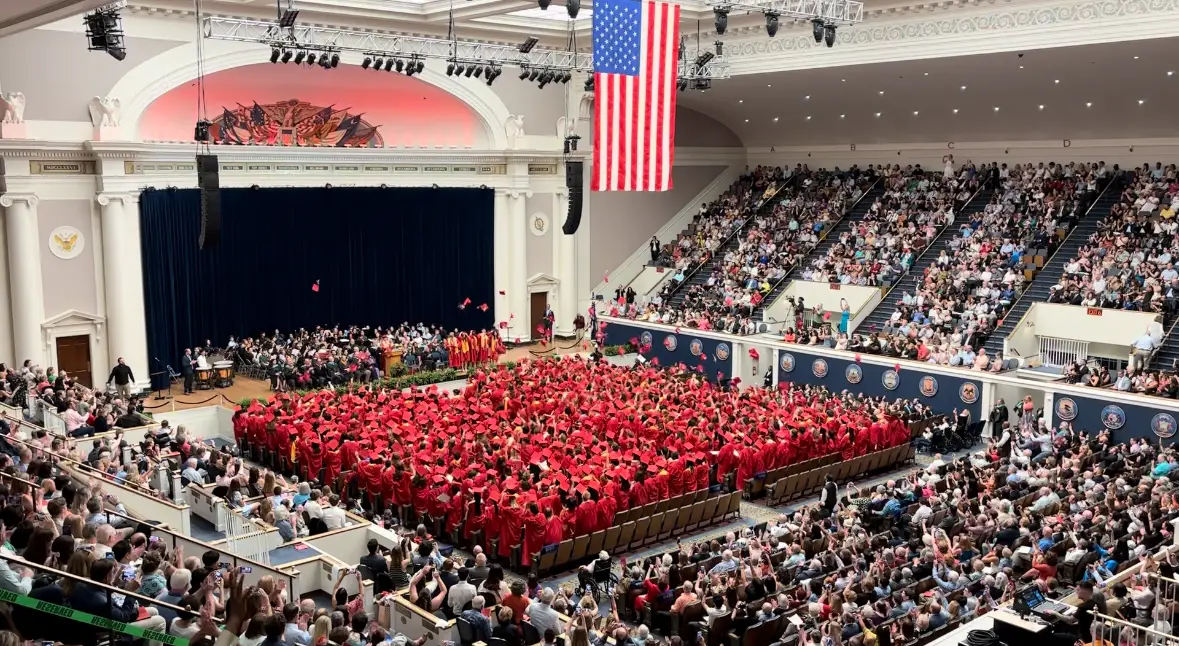
By the time I got there and parked at a crooked angle that I didn’t bother correcting, the whole auditorium was full. I could see it through the long windows that ran along the side of the building as I walked toward the entrance. Every seat filled. Teachers standing along the walls. The kind of attendance you only get when something has pulled an entire building into the same room at the same time.
A banner for the school’s upcoming service recognition week still hung over the stage from the week before, and I realized that must be part of why the principal had been able to pull this together so quickly. There was already infrastructure in place for exactly this kind of moment.
Grace was in the front row.
On the stage stood the principal and four Marines in dress blues, standing with the particular stillness that isn’t rigidity but presence, the kind that fills the room differently than civilian posture does.
The principal saw me come in near the back and gave me a look across the heads of four hundred students. It was a complicated look. It said she understood what had happened the day before and she understood why I was angry and she was trying to do something about both of those things at once.
Then she stepped to the microphone.
“Yesterday one of our students was hurt in a way that should never have happened inside these walls,” she said. “The comment that was made was cruel. It was wrong. And the response from this school was incomplete.” She paused. “This morning we have the opportunity to correct part of that failure, and to honor a service member whose family should have received formal recognition years ago.”
One of the Marines stepped forward.
He was older than the others, silver at his temples, carrying himself with the kind of quiet authority that comes from years of being the steadiest person in difficult rooms. He looked at Grace before he looked at anyone else in the auditorium.
“Your father was Staff Sergeant Daniel,” he said. “I served with him overseas. He was one of the best men I have known.”
Grace pressed both hands over her mouth.
The Marine opened a velvet box.
Inside was a Bronze Star medal.
A low murmur moved through the auditorium, the sound of four hundred people understanding simultaneously that they were inside a moment that mattered.
A second Marine stepped forward, carrying a folded flag with the careful precision of someone who has practiced the motion enough times that it has become sacred. He said, “This commendation was approved and processed years ago but was never formally presented due to an administrative error during a post-operation file review. The error has been identified and I was assigned to correct it. When we learned about what had occurred at this school yesterday, we requested permission to complete the presentation here, in front of Staff Sergeant Daniel’s daughter and her school community.”
That sentence landed differently than anything else that had been said. This hadn’t appeared from nowhere. It had existed for years, waiting to reach us, and something about that made it heavier and more real than if it had simply arrived on its own.
Captain Ruiz, the man who had spoken first, glanced toward where I was standing near the back wall and said, “This is a ceremonial replacement display flag. Your family should have received a proper presentation flag at the time of formal notification of loss. That failure has also been noted and is being addressed.”
I reached out and put my hand flat against the wall beside me.
Ruiz looked back at Grace.
“Your husband was brave,” he said to her directly, though I knew he was also saying it to me, and to the room. “But brave is too small a word on its own. He was steady. He was the person other people looked for when things got bad because he made things feel manageable when they shouldn’t have been. He laughed when days were hard and he made other people laugh too. He wrote home every chance he had. He was proud to be a Marine and he was proud to be a father and he talked about his daughter more than he probably realized he did.”
Grace broke then.
Not loudly. Not dramatically. Just quietly and completely, tears coming down her face that she couldn’t have stopped if she tried, her shoulders moving with it.
Ruiz stepped down from the stage, walked to where she was sitting in the front row, and knelt down in front of her so that she didn’t have to look up at him.
He said, quietly enough that I could only partially hear it from the back of the room, “He talked about you all the time. Every version of a good future he described had you in it. He would be so proud of you. He is so proud of you.”
Grace’s hand reached out and took his arm and she just held on.
The auditorium was completely silent for a long moment, the kind of silence that four hundred people create together without being asked to.
Then the principal stepped back to the microphone and said, “There is one more thing that needs to happen this morning. A student asked if she could address Grace directly. We believe that request should be honored.”
From somewhere in the middle section, a girl stood up and moved into the aisle.
Her face was the color of someone who had not slept and had been crying. Her hands were visibly shaking at her sides. She walked to the front of the auditorium and stopped a few feet from where Grace was sitting and she didn’t look anywhere except at Grace.
She said, “What I said yesterday was cruel. I said it without thinking about what it meant and without thinking about you and I have been sick about it since the moment it came out of my mouth. It wasn’t funny. It was wrong. I am sorry, Grace. I am genuinely sorry.”
It was quiet in the room.
Grace looked at her for a long moment. Long enough that a few people shifted uncomfortably. Long enough that it was clear Grace was deciding something, not just reacting.
Then she nodded once.
It wasn’t forgiveness exactly, not yet, but it was acknowledgment. It was Grace being more generous than she had to be.
When the assembly ended, Grace came up the aisle toward me and when she reached me she pressed her face into my shoulder and I wrapped both arms around her and held on as hard as I could.
After a moment she said, her voice muffled against me, “They remembered him, Mom.”
I pressed my lips to the top of her head. “No, baby. They never forgot.”
That should have been the end of it.
It wasn’t.
That night the medal sat on our kitchen table beside the folded flag. Grace kept walking past it throughout the evening, each time slowing to look at it, to touch the edge of the box, like she needed to keep confirming it was real and still there. I made dinner and she set the table around it without moving it and we ate with it sitting between us like a third person joining us for the meal.
Then she stopped in the middle of clearing plates and said, “Mom.”
“Yeah.”
“If the commendation was approved years ago, why didn’t we ever get it?”
I gave her the simple answer first. “Paperwork. Administrative delays. These things apparently fall through the cracks sometimes.”
She nodded slowly, but I could see she wasn’t fully satisfied with that. Grace has always had her father’s instinct for knowing when a story was incomplete.
And if I was honest with myself, so did I.
There had always been something slightly off about the records and the official communications that came after Daniel died. I had noticed it at the time but I had been in the early months of grief, alone with a young child, trying to survive the days. I had not had the bandwidth to pull on threads. I had filed the feeling away somewhere and tried to move forward.
The next afternoon, Captain Ruiz called.
“I hope I’m not intruding,” he said. “There are some next-of-kin documents tied to the reopened commendation review that I think should be delivered in person rather than mailed. Would it be all right if I came by?”
An hour later he was sitting at my kitchen table with a sealed envelope in front of him.
Grace had come home from school by then and she lingered in the doorway to the kitchen until Ruiz turned and looked at her directly and said, “You can stay. This concerns your father and you have every right to be here.”
She pulled out the chair across from me and sat down.
Inside the envelope were releasable records. Citations. Witness statements from two members of Daniel’s unit. And one handwritten letter that Daniel had mailed to his unit chaplain during a particularly difficult stretch toward the end of his deployment, which had been retained in his file and had recently been cleared for return to family.
I set the letter aside to read privately later.
Ruiz kept his voice even and careful.
“The medal delay was genuine and administrative,” he said. “That is a real thing that happened and it should have been caught sooner and it wasn’t and I am sorry for that. But the process of reopening the commendation file in order to correct that also reopened certain questions about the broader operation.”
I looked at him across the table. “What kind of questions?”
He met my eyes. “Questions that your family should have been made aware of when they originally arose. Questions that were not included in the official notifications your family received.”
I reached for the mission statements in the documents he had brought.
By the third page I understood why he had not wanted to send them through the mail.
The mission during which Daniel was killed had been flagged before it went forward. There had been documented concerns from intelligence analysts about the accuracy and currency of the information being used to plan it. There had been concerns from at least two officers on the ground about the timing. Daniel was not the only one who had raised questions. His concerns were noted in the record.
He went anyway because that was what he did. Because his unit was going and he was not the kind of man who let other people carry what he could carry himself.
Then everything went wrong. The intelligence was bad. The situation deteriorated fast. Daniel got people out. He went back. He covered them. He died doing it.
For years I had been carrying grief. The ordinary devastating grief of losing the person who was supposed to be beside me for the rest of my life, the grief of watching my daughter grow up without her father, the grief that has no clean edges and no particular end.
Now something else moved in beside the grief. Not replacing it. Taking up its own space.
Grace had been listening without speaking. She said quietly, “Did they lie about Dad?”
I looked at her. “Not about him. What they said about him was true.”
“Then about what?”
Ruiz answered. “About how complete the story they told was.”
Grace looked slightly sick. “So he died because someone above him made a bad call and then they told us a story that left that part out.”
Ruiz was silent long enough that the silence itself became the answer.
I spent the next few months asking questions.
Not days. Months. It took that long because the answers came in fragments and some of them were redacted and some offices responded once and then went quiet and some of what I needed I had to piece together from the overlapping corners of documents that didn’t quite line up with each other. Ruiz helped me where he was able to within the constraints of still being in uniform, which meant he helped more than he probably should have and less than I needed, but I was grateful for every bit of it.
What I eventually assembled was not a complete picture. I am not sure a complete picture exists anywhere in a form I will ever access. But what I had was enough to understand the shape of what had happened. Daniel had raised concerns and been overruled. The men who overruled him had written a version of events afterward that honored the sacrifice without examining the decision that had made the sacrifice necessary.
Later that spring, during the school’s annual service recognition event, the principal asked if I wanted to say a few words.
I almost said no.
I had prepared remarks that were safe and brief and appropriate for a school auditorium. I had them folded in my jacket pocket. I had planned to say something measured about gratitude and service and being thankful for the school’s efforts to honor military families.
Then I walked to the front of the room and I saw Grace sitting in the front row with her father’s dog tags under her blouse, the chain just barely visible at her collarbone, and I took the folded paper out of my pocket and put it down on the podium without opening it.
I stepped to the microphone and I said, “My husband was a hero. I am not using that word as ceremony. I mean it as a plain factual statement about the kind of man he was and the choices he made. I am grateful that the people in this room are finally saying that out loud in front of my daughter, because she needed to hear it from more voices than just mine.”
I paused.
“But I have learned something in the months since Captain Ruiz brought us Daniel’s file. Heroism and institutional failure can exist in the same story. They are not opposites. They are not mutually exclusive. The people on the ground can do everything right and still be failed by the decisions made by the people above them. Both of those things can be true about the same event.”
The room was completely still.
“For years my family was given a version of my husband’s death that was accurate but incomplete. The honor was real. The sacrifice was real. The courage was real. But the decisions that put him in that position, and the questions that were raised before that mission went forward, and the concerns that were noted and set aside, that part of the story was left out. He deserves the full truth. So do the families of every person we ask to put on a uniform and go somewhere dangerous on behalf of the rest of us. Honoring the fallen does not mean sanding the story down until it is easier for institutions to manage. Respect is not the same thing as simplification.”
My voice shook. I didn’t try to stop it.
“He was brave. He was funny. He burned pancakes and tried again. He sang off-key in the car and didn’t care who heard. He loved his daughter more than he knew how to say and he said it anyway, constantly, in every letter home. If we are going to remember him, then we remember all of him. Not just the parts that don’t implicate anyone.”
When I stepped back from the microphone there was a moment of absolute silence.
Then Ruiz stood up from his chair and came to attention and saluted.
Another Marine in the back of the room did the same.
Then a veteran in civilian clothes near the bleachers rose to his feet.
After that, a local reporter called. Then a journalist from a larger paper. Then two other families from Daniel’s unit contacted me, families I had not previously known, who said they had been carrying similar questions for similar years and had not known how to start asking them out loud.
The school quietly removed Grace’s detention from her record. By that point it mattered considerably less than I had expected it to.
What mattered was what happened at home.
Grace started asking different questions. Not how he died. Not the tactical details or the administrative failures or the sequence of events on that particular day. Different questions entirely.
How he laughed. What he ordered at restaurants and whether he always ordered the same thing. Whether he was a fast driver or a slow one. What music he listened to when nobody was telling him what to play. Whether he was ever frightened and what he did when he was.
I told her everything I could remember.
That he burned the same pancake recipe every Saturday morning for six years and kept a running tally of the ones that came out right versus the ones that had to be quietly disposed of and considered the bad ones character-building. That he sang loud and off-key and treated it as a personal victory that he had never once been asked to stop. That he cried the first morning we brought Grace home from the hospital and spent the next two days insisting firmly to anyone who asked that he had not cried, while visibly emotional about it. That he got written reprimands for arguing with people who outranked him when he thought they were wrong about something that mattered, and he accepted the reprimands without apology because he thought the argument had been worth having.
That the last letter he sent before the mission described a night where a younger Marine in his unit had been homesick and Daniel had sat up with him for two hours talking about nothing in particular until the kid could sleep.
That he was exactly the father Grace needed and she would keep finding that out in new ways for the rest of her life.
One night Grace took the medal out of its box and pinned it carefully on the wall beside an old photograph of Daniel holding her as a toddler. She stood in front of it for a long time.
Then she said, “I think I know him better now than I did before all of this started.”
I stood beside her and looked at the man I loved, frozen young in a photograph, our daughter in his arms, both of them looking at the camera with the same expression, bright and a little startled, like they had just discovered something wonderful.
“So do I,” I said.
That is where we are now.
Not fixed. Not clean. Not at the end of anything, because grief and love and the pursuit of a truth that keeps having more layers to it do not end tidily on a particular date.
But clearer. And less alone in it.
My daughter is not carrying her father’s memory by herself anymore. She knows who he was, the real full version, the one with the pancakes and the off-key singing and the formal reprimands and the two hours he gave to a homesick kid because it was the right thing to do. She knows the kind of man who looked at a situation that was being mishandled and said so, even when it cost him, because he thought the people depending on him deserved better than silence.
She got that from him.
She showed it in a classroom when she knocked over her chair rather than sit quietly while someone turned her father into a punchline, and she was right to do it even when it cost her detention, even when it embarrassed her, even when she worried afterward that she had let him down.
She had not let him down.
She had been exactly like him.
And no matter how many years it took, and no matter what had to be fought for and pieced together and said out loud in a school auditorium with a shaking voice, he was finally honored in front of the person who needed it most.

Specialty: Legal & Financial Drama
Michael Carter covers stories where money, power, and personal history collide. His writing often explores courtroom battles, business conflicts, and the subtle strategies people use when pushed into a corner. He focuses on grounded, realistic storytelling with attention to detail and believable motivations.