I had been waiting for this trip for nearly a year.
My parents lived far enough away that visits required planning, saving, and the kind of coordination that always seemed to get pushed to next month and then the month after that, until suddenly eleven months had passed and I was buying a ticket with the slightly guilty urgency of someone who has let too much time go. The flight was just under five hours. I had a window seat, a neck pillow I had finally remembered to pack, and no particular ambitions for the journey except to close my eyes somewhere over the middle of the country and wake up closer to home.
I had barely settled in when I noticed the smell.
At first I dismissed it. Airplane cabins carry all kinds of ambient odors, the recycled air, the galley heating something, the general compressed humanity of a hundred people in a sealed tube. I adjusted in my seat and looked out the window at the tarmac and told myself it would pass.
It did not pass. It got worse.
I looked down.
There was a foot on my armrest. Bare, unwashed, positioned with the casual confidence of someone who had decided the armrest was simply an extension of their personal space. The smell was coming directly from it, strong enough that I found myself breathing through my mouth without having made a conscious decision to do so.
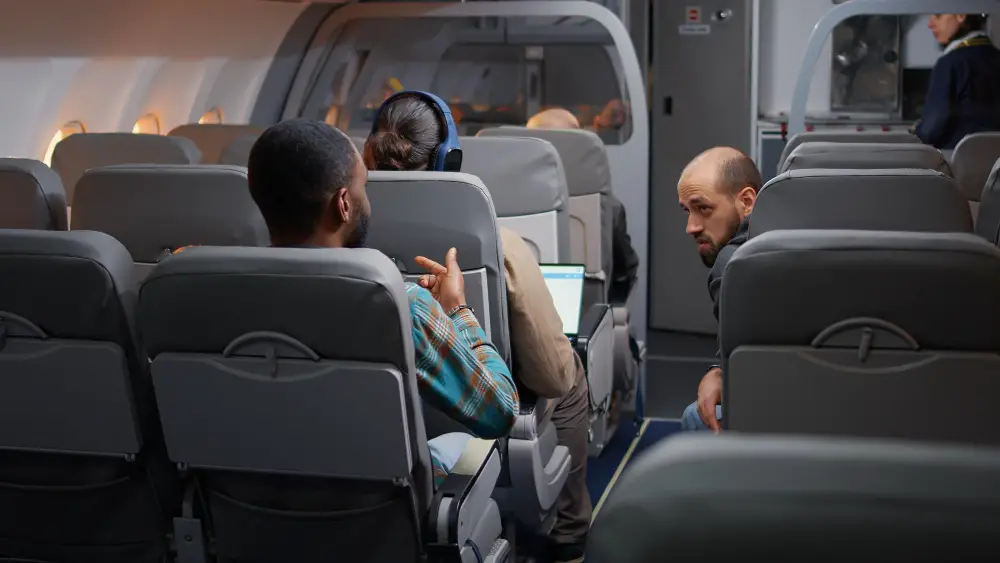
I turned around. The young man in the seat behind me was sprawled with his eyes half-closed, headphones on, radiating the particular ease of someone who has never once considered that his comfort might be creating a problem for anyone else. He looked to be in his mid-twenties. He looked completely at home.
Around us, a few passengers had already begun to notice. I saw a woman two rows up wrinkle her nose. The man across the aisle from me glanced down at the foot, then up at me, with an expression of sympathetic recognition.
I kept my voice level. “Excuse me. Could you please remove your foot?”
He pulled one side of the headphones away from his ear and looked at me with the delayed attention of someone who has been interrupted during something they consider more important.
“No,” he said. “It’s comfortable.”
I tried again. “That’s my armrest.”
He shrugged with the economy of someone who has considered the situation and found it beneath further engagement. “Then move somewhere else. I’m not moving.”
Something tightened in my chest. I reached over and gently pushed his foot off the armrest. He put it back within seconds, watching me while he did it, the faint suggestion of a smirk on his face. A game, apparently.
The smell had reached the point where the passengers nearest to us were no longer being discreet about their discomfort. I heard murmuring. I saw people shifting in their seats.
“Your foot smells,” I said, more directly now. “It’s bothering the people around you. Please remove it.”
He looked at me with the slow blink of someone who has decided that annoyance is a performance they don’t need to watch. “Close your nose,” he said. “And your mouth.”
I turned back to face forward. The cabin felt smaller than it had a moment ago, the way enclosed spaces do when something unpleasant has been established and everyone is waiting to see what happens next.
I thought for a moment. Then I pressed the call button.
The flight attendant arrived, professional and unhurried, and I asked if I could have a cup of hot tea. She said of course and came back a few minutes later with a small cup. I thanked her and held it in my lap and took a couple of sips and said nothing more.
I waited a few minutes. The foot was still there.
Then I shifted in my seat and let my hand tip slightly, and the remaining tea went over the armrest.
The effect was immediate. The young man yanked his foot back and came nearly upright in his seat, the headphones flying off, a shout tearing out of him that turned heads three rows in every direction.
“What are you doing?”
The flight attendant was back within moments. I looked at her calmly and apologized for the spill. I said it had been an accident. I also mentioned, in the same even tone, that the gentleman behind me had had his bare foot on my armrest for the last twenty minutes despite being asked several times to remove it, and that the smell had been bothering the passengers around us.
I did not have to say much else. The passengers around us said the rest.
The woman who had been wrinkling her nose confirmed that the smell had been genuinely unpleasant. The man across the aisle said the young man had been acting as though the rules applied to everyone except him since before takeoff. Someone else added something I did not fully hear, but the tone was not charitable.
The flight attendant’s expression did not change much, but it did change. She looked at the young man with the particular focused attention of someone who has decided that a situation requires clarity rather than warmth. She explained to him, quietly and without room for misinterpretation, that the behavior he had been displaying was in violation of the airline’s passenger conduct policy. She told him that continued disruption gave the captain grounds for action, and that action could include involving law enforcement at the destination airport.
He did not respond. He sat back in his seat and looked at his hands.
A few rows up, someone laughed under their breath. Then someone else. It was not the loud, gleeful laughter of a crowd that has been entertained, more the quiet, released laughter of people who have been holding their irritation for twenty minutes and have just been given permission to let it go. Several people were looking at him now, not with cruelty, just with the open, uncomplicated gaze of people who no longer feel the need to look away.
He kept his feet to himself for the rest of the flight. He put his headphones back on and stared at his screen and did not look at me again.
I leaned back in my seat. The smell was fading. Out the window, the cloud cover had broken and there was flat farmland below, the particular patchwork geometry of the Midwest from altitude, gold and brown and the occasional silver thread of a river.
I closed my eyes.
The flight attendant passed by a few minutes later and caught my eye as she went, a brief, neutral look that contained a great deal. I nodded. She moved on.
I slept for two hours, which was more than I had expected, and woke up with the descent already beginning and the familiar anticipation building of seeing people I had been missing without fully letting myself acknowledge how much. The cabin was quiet. The young man behind me had not moved.
There are people on this earth who interpret courtesy as weakness, who hear please and understand it as something they can ignore without consequence. They are not always young and not always men and they do not always announce themselves as clearly as this one did, but they exist, and you will eventually find yourself sitting in front of one.
The correct response to that situation is not to absorb it indefinitely in the name of keeping the peace. Keeping the peace, when one person is the only one making any effort toward it, is not peace at all. It is just a different arrangement of the same problem. Sometimes the most useful thing you can do is create a small, undeniable consequence and let it do its work.
I am not recommending hot tea specifically. I am recommending the general principle.
We landed twenty minutes early. I was through the terminal and in the arrivals hall before I had fully registered that the flight was over, and then I saw my parents through the glass doors, my mother already waving before she could have been certain it was me, my father a step behind her with his coat still half on.
I walked through the doors. My mother hugged me first, holding on in that particular way of someone who has been counting the months. My father put his arm around my shoulders and said something low and warm that I have already half forgotten and that does not matter because what I remember is how it felt.
Behind me, the terminal went on doing what terminals do. Somewhere in the parking structure, presumably, a young man with clean-smelling feet was locating his ride and going wherever he was going.
I did not think about him again for quite some time.

Laura Bennett writes about complicated family dynamics, difficult conversations, and the quiet moments that change everything. Her stories focus on real-life tensions — inheritance disputes, strained marriages, loyalty tests — and the strength people find when they finally speak up. She believes the smallest decisions often carry the biggest consequences.