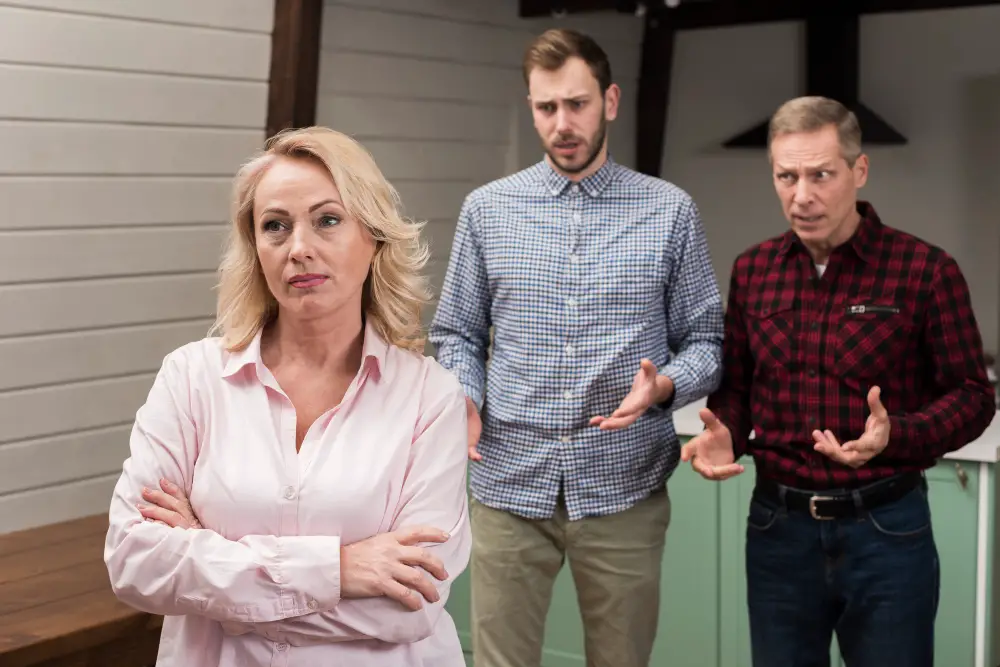
That morning, my husband slammed the bedroom door so hard the wedding photo above the dresser shook against the wall.
I had been awake for less than a minute. The pale winter light was just beginning to press through the blinds, that cold flat light that makes everything look provisional and unfinished, and I was still in the slow drift between sleep and consciousness when the sound split the morning open and Graham was standing at the foot of the bed with his jaw already set and his eyes carrying the specific anger of a man who has been working himself up for hours.
He ripped the blanket off me.
“Get up. You think you can disrespect my mother and still sleep in?”
I sat up, pulling myself together. The argument from the night before came back in full immediately, the way bad things do, without the mercy of gradual recall. We had gone around the same number for over an hour. Eight thousand dollars. Each time I said no, he reframed the request, changed the language, tried a different angle. A loan, not a gift. Temporary. She had nowhere else to turn. I was being rigid. I was making him choose.
I had refused to choose for him. That was apparently the same thing as choosing wrong.
“I’m not giving your mother any more money,” I said. My voice was still rough with sleep. “I told you that last night. Nothing has changed.”
He let out a short, bitter laugh. “Unbelievable. She needed help from family.”
“She needed eight thousand dollars.”
“That’s what helping looks like sometimes.”
“She asked me because she knows you don’t have it.”
The room went a degree colder. His jaw tightened, the specific tension of a man absorbing a true thing he has no way to argue with.
I had watched this dynamic for six years. Graham’s mother, Lorraine, had a gift for transforming her own financial instability into other people’s emergencies. A broken furnace became a crisis requiring immediate resolution because the winter was particularly brutal this year and she simply could not manage. Car repairs could not wait because without a car she could not get to work and without work she could not begin to address any of the other things. Credit card debt that had been accumulating for years arrived with sudden urgency, as if the debt had just discovered its own existence and could not be reasoned with. The framing was always the same: family helps family. This is what we do for each other. Of course it will be paid back, that goes without saying, but right now the important thing is the need.
What never arrived in the framing was accountability for how the need had been created. The question of how the furnace had been allowed to reach a state of crisis without any preparation, how the car had gotten to the point where it needed a repair this large, how the credit card debt had grown to this number, these were questions that sat unasked in the room, politely overlooked by everyone in the way you overlook something that everyone can see but no one wants to be the person to name.
I had agreed to help twice.
The first time, Graham promised it would come back within the month, and his certainty was so complete that I believed him. The money did not come back. When I mentioned it six weeks later, the story had changed in small but significant ways. The amount he remembered was different from the amount I had given. The timeline had always been longer than a month, he was certain of that, I must have misunderstood. Lorraine was working through some things and it wasn’t a good time to push. Graham looked at me with the mild confusion of someone who genuinely could not reconcile my account with his own, and I sat with the uncomfortable possibility that one of us was wrong about what had been said, and then I let it go because letting it go was easier than the alternative.
The second time, Lorraine came to our kitchen on a Tuesday afternoon and sat at the table and cried. She called me the daughter she never had. She held my hand and told me she did not know what she would do without me in her life, that I had brought something into their family that had been missing, that she thanked God for me regularly. I wrote the check while she was still sitting there because I did not want her to have to ask twice.
That money also did not come back. This time there was no conversation about it at all, no revised timeline, no explanation. It simply passed out of existence in the accounting of our relationship, like a line item that had been quietly deleted and that I was expected, through my ongoing participation in Sunday dinners and holiday gatherings, to confirm I had not noticed.
Both times, I was expected to absorb the loss gracefully and continue as before. To smile at Sunday dinners and act as though nothing had happened, as though the pattern did not exist, as though each incident were genuinely isolated and unprecedented rather than the latest entry in a record I had been keeping in the back of my mind for years. As though the daughter she never had were a status that required ongoing maintenance in the form of money and silence and the steady performance of not keeping track.
Not this time.
“She’s coming at noon,” Graham said. “You’re going to set the table and apologize.”
I looked at him. “For what?”
“For the way you spoke to her last night. For making her feel like a criminal.”
“I told her I wouldn’t give her money. That’s not the same thing.”
“In my family it is.”
I threw the sheet aside and stood up. “If she doesn’t want to be treated like someone who takes things that aren’t hers, she should stop taking things that aren’t hers.”
Something shifted in his expression. He stepped closer, close enough that I could smell the stale coffee and last night’s whiskey that clung to him, and there was something in his posture that I had not seen before, or had been refusing to recognize.
“You don’t talk about my family like that,” he said. “Not in my house.”
“It’s our house,” I said. “I pay half the mortgage.”
That was when he shoved me.
Not hard enough to knock me down. Hard enough that the dresser caught the backs of my legs and I grabbed the edge of it to keep my balance. Hard enough that the room went completely still and we both stood there in the sudden silence of something that could not be taken back.
There was no apology in his eyes. What I saw instead was calculation. He was already sorting through the available responses, deciding which one would be most useful. He straightened his shirt, a small gesture that seemed to be directed at himself, as if composure could retroactively undo what his hands had done.
“At noon,” he said quietly, “you’ll fix this.”
Then he walked out and closed the door behind him.
I stood with one hand on the dresser, breathing carefully. The wedding photo had settled back against the wall. The pale winter light was the same as it had been a minute ago. Everything in the room looked identical to how it had looked before Graham came in.
Nothing was.
I had a thought, in those first minutes of standing there, that was very simple and very clear. It was not an angry thought, not a wounded one. It was more like the thought you have when you finally look directly at something you have been seeing peripherally for a long time and recognize it for what it is. The thought was: this is not the first time he has chosen her over me, and it will not be the last, and I cannot keep absorbing the cost of that choice.
I picked up my phone. I sat down on the edge of the bed. I opened my contacts and found the number I had saved three weeks earlier after a conversation I had told no one about.
Diane Mercer had been recommended to me by a colleague whose own separation I had watched from a distance, someone whose composure during a difficult year had seemed to me like evidence that the right support made the impossible manageable. I had called Diane on a Thursday evening in November, sitting in my car in the hospital parking lot so that Graham would not hear, and I had told her the situation in the flat, precise way I described clinical cases, laying out the facts without the feeling. She had listened without interrupting. She had asked several questions, all of them practical. At the end of the call she had said, you have more options than you think, and I had driven home in the dark with that sentence, turning it over, deciding what to do with it.
I had not decided immediately. I had spent three more weeks watching and thinking and keeping my records current, waiting to be certain. This morning, I was certain.
I also called Nathan. And then I called Officer Ortiz’s direct line, which I had obtained through a contact at work, and I explained what had happened that morning in the bedroom in brief, factual terms, and she asked if I was safe and I said yes, and she asked if I wanted someone present at noon and I said yes, and she said she would be there.
By 11:40 the dining room was set exactly the way Graham would have wanted it. I had put out the good dishes and set the table carefully and made the coffee he liked. I wanted nothing in the room to suggest that I had arranged anything. I wanted everything to look like compliance right up until it didn’t.
At noon sharp, the doorbell rang.
I raised my voice deliberately. “Come in.”
Lorraine entered first, perfectly dressed, carrying herself with the bearing of someone arriving to be honored rather than to share a meal. Behind her came Paige, Graham’s younger sister, holding a bakery box and already wearing the expression of someone who suspects the afternoon will not go the way she was told. Graham followed last, unhurried, still operating under the assumption that he had set the terms of this gathering and that I was executing them.
Then Lorraine stopped walking.
Two people were already seated at the table.
My brother Nathan sat with his hands folded, calm in the way he was always calm, the way of someone who has been told what to expect and arrived prepared. Beside him sat Diane Mercer, a family attorney I had quietly consulted three weeks earlier after a conversation that had clarified several things about my options and my rights. And near the window, in a position that was not accidental, stood Officer Lena Ortiz in uniform.
Graham went pale.
The confidence drained out of his posture so completely and so quickly that I could see the moment he understood he had walked into something he had not prepared for.
“What is this?” Lorraine demanded.
“Lunch,” I said. “You said noon mattered.”
Graham turned to me. His voice had dropped to something controlled. “What did you do?”
“I invited people who care about facts.”
Officer Ortiz stepped forward slightly, not aggressively, just enough to be present in a way that registered.
“She called the police?” Lorraine said, her voice climbing.
“I called,” I said, “because your son put his hands on me this morning.”
The room went silent in the particular way rooms go silent when something has been said that cannot be unsaid, when the air itself seems to hold still to accommodate the weight of it.
Paige looked at her brother. “You did what?”
“It was nothing,” Graham said quickly. “She’s exaggerating.”
“Be careful with that word,” Officer Ortiz said. Her voice was even, almost neutral. “It often becomes relevant later.”
I looked at Graham, not with anger, not with the shaking voice I had half expected from myself. I had been preparing for this moment for weeks and I had discovered, in the preparation, that clarity produces a kind of stillness that has nothing to do with not caring. “I’m not here to ruin you,” I said. “I’m here because I am done pretending.”
Lorraine had recovered enough to attempt control. She shifted her weight, lifted her chin, made the small adjustments of a woman who has talked her way out of difficult rooms before. “This is ridiculous. Families have arguments. She’s being dramatic and she knows it.”
Diane spoke from her seat, calmly, in the measured tone of someone who chooses each word with the awareness that it may eventually matter somewhere official. “I’m here regarding a pattern of financial coercion and the terms of a potential separation.”
Lorraine turned the word over as if she had misheard it. “Separation.”
“Yes,” I said. “Because being physically pushed over money is not something I’m prepared to accept. Not once. Not as an isolated incident. Not wrapped in an apology I’ve already heard twice.”
I had prepared folders. I set one in front of each person at the table. Bank transfer records. The two previous loans with their promised timelines and their actual outcomes. Text messages in which the repayment terms were discussed and then revised and then simply never mentioned again. A clear, documented sequence laid out chronologically.
Graham stared at the folder in front of him. “You kept records.”
“Yes.”
“For how long?”
“Long enough.”
He looked up at me with something I could not quite read. Not guilt, not exactly. Something more like the expression of a man who has spent years operating under the assumption that a situation has no memory, and has just discovered it does.
“Because I got tired of being rewritten,” I said. “Every time I tried to talk about what had happened, the version changed. The amount was different. The terms were different. My tone was the problem, not the pattern. I got tired of arguing against a story that kept revising itself, so I started keeping the original.”
Lorraine looked at the documents in front of her for a moment and then looked away, the practiced gesture of someone declining to be accountable for information they have been given.
Then she made her final mistake.
“If you had been a better wife,” she said, her voice precise and cold, “my son wouldn’t be under so much pressure.”
The room stayed very still.
I had been waiting for this. Not consciously, not with eagerness, but in the way you wait for the thing you already know is coming, the thing that has been approaching for years wearing different faces. I had been letting her have that sentence for six years, absorbing it in its various forms, making room for it because confronting it directly had always seemed like more disruption than I could manage.
“I was waiting for you to say that out loud,” I said.
Paige set the bakery box down on the table. She looked at her mother with an expression I had never seen on her face before, something past discomfort, something that looked like recognition. “Mom. What is wrong with you?”
Lorraine lifted her chin. “I won’t be judged in a house where there’s no loyalty.”
“Loyalty,” I said. “You’ve used that word with me before. You used it when you asked me for money the first time. You used it when you called me the daughter you never had in my kitchen and I wrote you a check because I believed you meant it. I have been loyal to this family in the most concrete way available to me, which is money, and time, and silence about things I should have said out loud a long time ago. What you mean when you say loyalty is compliance. Those aren’t the same thing.”
Graham tried to reassemble authority from the wreckage of the last ten minutes. “Can we stop this. Can we just stop performing for these people and have a conversation like adults.”
Diane looked at him without animosity. “The documentation isn’t a performance. It’s a record. It existed before today and it will exist after today regardless of what happens in this room.”
Graham looked at me. The calculation was still happening behind his eyes, but the options had narrowed considerably. “You planned all of this.”
“Yes.”
“Because she asked for help.”
“Because you shoved me against a dresser this morning,” I said. “And because that was not the beginning of something. It was the end of a long middle. You have spent six years choosing her demands over my boundaries. You made me the person responsible for managing her expectations and absorbing her resentment when I declined. And this morning, when I declined again, you chose her in the most physical way you have ever chosen her. That is what this is about. Not the money. Not the argument. The choice.”
He did not say anything.
“You’re leaving for a week,” I said. “If you don’t, I’ll file for a protective order today.”
“You can’t put your husband out of his own home,” Lorraine said, and her voice had finally lost the certainty it had carried through the entire conversation. It sounded like what it was: a woman saying the last thing she had left.
“She can,” Diane said. “And the process is straightforward.”
Graham looked at the table. He looked at the folder. He looked at me one more time with the expression of a man searching for the version of events where he wins, or at least where he does not lose this badly, and not finding it.
“I’ll get some things,” he said.
Within twenty minutes he had packed a bag and gone. Lorraine left without speaking to me again, which was the most honest communication we had ever had. Paige lingered in the entryway and stood there for a moment not quite looking at me, and then she looked at me and said, “I’m sorry. I’ve watched her do this to people my whole life and I never said anything. I’m sorry.”
I told her it was not her fault. I meant it.
Then the house was quiet in a way it had not been in years. Not the quietness that comes when an argument has finally exhausted itself and everyone has retreated. A different kind. The quietness of a room that has been cleared of something heavy, where the air is simply air again, where you can stand still without bracing.
I sat down at the dining room table with Nathan and Diane and Officer Ortiz, and we talked through the next steps practically, the way you talk through next steps when the emotional part has already happened and what remains is the operational. Diane walked me through the protective order process. Officer Ortiz told me what her report would include. Nathan made coffee and listened and said almost nothing, because he understood that what I needed from him right now was presence rather than commentary.
After they left, I sat in the quiet house by myself for a while. I did not call anyone. I did not go through my phone. I just sat in the dining room with the winter light coming through the south-facing window and let the afternoon exist around me. It was the first time in a long time that silence had felt like rest rather than like waiting for something to go wrong.
The divorce took eight months. There were apologies during that time, some of them sounding genuinely felt, and there were attempts to revisit the situation from different angles, to find the framing in which what had happened was primarily a misunderstanding or a moment of exceptional pressure rather than a pattern with a documented history. Graham went through several versions of the story before he settled on one he could live with, and I understood that need even if I could not help him meet it. He was a person who had never been required to hold two truths at once: that he loved me and that he had also hurt me, that he was not a monster and that he had also done monstrous things. People who have never been asked to manage that kind of complexity often find it unbearable when it arrives.
I did not hate him. I want to be precise about that. What I felt was something quieter and more durable than hate, something closer to the clarity that comes when a long confusion finally resolves. I had spent six years in a marriage where the terms kept shifting underfoot, where the story of what was happening and what I could reasonably ask for kept being revised in ways that made me doubt my own accounting. That was over. The record was clear. Whatever Graham needed to believe about himself was his to manage.
But clarity, once it arrives, does not require your continued maintenance of it. It simply exists, and you carry it with you, and it shapes the decisions you make going forward in ways that feel less like strategy and more like consequence.
A year later, I hosted lunch in that same dining room.
There were no documents on the table. No attorney in a chair by the window. No folder prepared for each place setting. Just people I had chosen deliberately and carefully, people whose presence in my home felt like what a home was supposed to feel like rather than what I had been making do with.
I had repainted the dining room in November, the same shade I had always liked but had kept suggesting we change because Lorraine had once said the color made the room look cold. I had refinished the hardwood floors in the hallway over a long weekend in January with a friend from work who knew what she was doing and brought the right equipment and good music and did not ask me to explain anything I wasn’t ready to explain. I had rearranged the furniture in the living room so that the afternoon light landed differently, and I had noticed, in that first week after the change, that I was sitting in the living room in the evenings for the first time in years. The room had always felt like it was arranged for visiting rather than for living, and now it felt like mine.
The good dishes were out again. The light came in from the south-facing window and fell across the table in the long, generous way it does in January when the sun is low and has to work for everything it reaches. I had made the kind of lunch that takes most of a morning, the kind that fills the house with smell before anyone arrives.
At noon, the doorbell rang.
I smiled and raised my voice. “Come in.”
The door opened. The afternoon light came in with it, and with it came the people I had invited, and the sound of them, and the warmth of a house that was being used exactly as it was supposed to be used.
That hour, that table, that house: mine. Not only in the legal sense, not simply in the sense of names on a mortgage and keys on a hook, but in the way that matters more and takes longer to arrive. The sense that you are standing in a place that belongs to you because you decided it would and you defended that decision when it required defending, quietly and without apology, until the people who wanted to take it from you ran out of leverage.
That is the only kind of ownership that holds.

Laura Bennett writes about complicated family dynamics, difficult conversations, and the quiet moments that change everything. Her stories focus on real-life tensions — inheritance disputes, strained marriages, loyalty tests — and the strength people find when they finally speak up. She believes the smallest decisions often carry the biggest consequences.