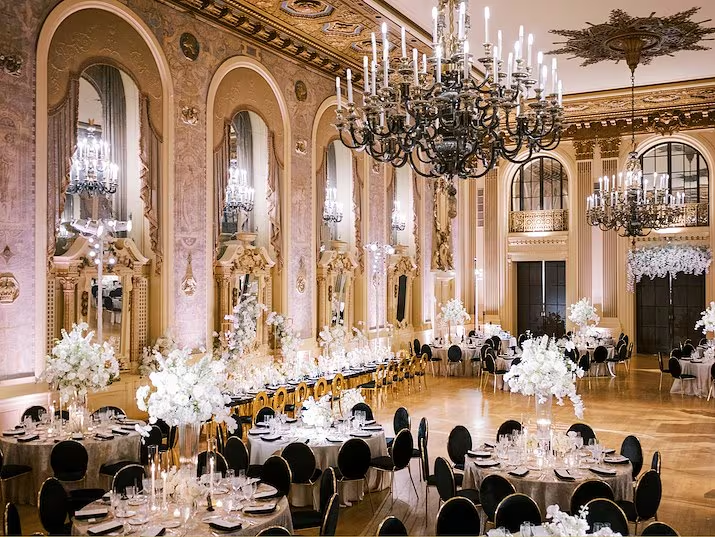
The table went quiet in the way tables do when someone says something that cannot be unsaid.
My aunt Vivien set down her champagne glass, looked at me, and spoke five words that split my life in half.
“You know your mom hid that letter, right?”
Nobody moved. Not Ryan. Not Luke. Not my grandmother Evelyn, who had stopped breathing somewhere in the middle of the sentence. Not the guests at the next table who had gone still without quite understanding why.
I turned slowly toward my mother.
She didn’t flinch. She didn’t look away. She reached up, adjusted her pearls, and smiled at me with the particular calm of someone who has had fourteen years to prepare for this moment.
“You wouldn’t have lasted a semester,” she said.
My name is Gloria Dean. I’m thirty-two years old. Three weeks ago, at my sister’s wedding, I found out that my mother had thrown away my Columbia University acceptance letter when I was eighteen years old. And then I reached into my purse and showed her what I had been carrying for six months.
But I’ll get to that part.
First, let me take you back to 2012.
Senior year at Brookdale High, a school small enough that your GPA was everybody’s business. Mine was 3.9. I worked Friday and Saturday nights at Marino’s Pizza for six dollars an hour plus tips and saved every cent because I knew no one else was saving anything for me.
My mother, Elaine Dean, had a system.
There was my younger sister Chloe, fourteen at the time. And then there was me.
Chloe got violin lessons. Chloe got a private SAT tutor. Chloe got a college counselor who came to our house with color-coded binders and charged two hundred dollars an hour. I got a stack of community college brochures left on my bed one afternoon. No explanation. No conversation.
My mother had a phrase for the difference between us. She said it at family dinners, at church, even at the grocery store, delivered in the same neutral tone someone uses to describe the weather.
“Chloe has potential. Gloria has stability.”
Stability. Like I was a piece of furniture.
I didn’t argue. I didn’t fight. I just applied to Columbia behind her back.
I wrote my essay at the public library after my shifts ended. I paid the application fee with tip money — sixty-three dollars in crumpled bills stuffed into an envelope. I didn’t tell my mother because I already knew what she would say. She had said it a hundred times in a hundred small ways. So I addressed the application myself, sealed the envelope, and dropped it into a mailbox miles from our house where she couldn’t intercept it.
By April, every day after school, I checked the mailbox before stepping inside.
Our mailbox sat at the end of the driveway, dented and faded, the red flag hanging crooked. My mother got home from her job at the district office around 3:15. My bus dropped me off at 3:40.
Twenty-five minutes.
That was all the head start she needed.
I didn’t know that back then.
One evening I sat at the kitchen table, hands wrapped around a glass of water I hadn’t touched, and asked her directly, “Did anything come from Columbia?”
She barely glanced up from the grocery ad in front of her.
“Nothing came. I’m sorry, honey. Maybe it’s for the best.”
I nodded like I understood. I went upstairs, closed my door, and cried into my pillow so quietly no one would hear. She never came to check on me.
The next morning, there was a stack of freshly printed community college brochures on the kitchen counter beside my cereal bowl. Ridge County Community College. East Valley Technical Institute. Bright covers. Smiling students. Tuition costs circled in red ink.
She had printed them the night before while I was upstairs crying.
She had already decided my future.
I enrolled that August.
I told myself it was temporary. I told myself I would transfer. I told myself it was just a detour. And for a while I kept telling myself that, until the voice got quieter, until one day it stopped.
I was eighteen. My mother told me I wasn’t enough, and I believed her.
The next fourteen years I wouldn’t call failure. I’d call it a slow climb up a staircase someone had already told you led nowhere. Two years at Ridge County. Then North Penn State Harrisburg. A degree in project management and thirty-eight thousand dollars in student loans.
I got a job as an administrative assistant at a midsize construction company answering phones and filing permits. Then I started reading blueprints because nobody told me I couldn’t.
By twenty-six I was a project coordinator. By twenty-nine, a project manager. By thirty-one, a senior project manager overseeing residential builds worth three to four million dollars each.
I bought a small house fifteen minutes from where I grew up. I paid my own mortgage. I mowed my own lawn.
And every time I hit a milestone, every raise, every promotion, every completed project, my mother found a way to shift the spotlight.
“That’s nice, Gloria. Chloe just got promoted at Sterling and Hayes. Isn’t that amazing?”
Not loud. Not cruel. Precise. Like a scoreboard I hadn’t agreed to play on, and on that scoreboard Chloe was always winning because the rules kept changing.
I never blamed Chloe. She was my little sister. She worked hard in her own way. What I resented was myself. For not being enough. For not getting into Columbia. For being exactly what my mother said I was.
The kind of girl who stays local.
That belief sat in my chest like a weight I carried everywhere for fourteen years.
Then, six months before the wedding, something shifted.
I was sitting in my car in a convenience store parking lot during lunch, eating a sandwich and scrolling my phone, when I saw a headline that stopped me mid-bite.
Columbia University School of General Studies: The Ivy League path for non-traditional students.
I read it once, then again, then a third time more slowly.
This wasn’t a certificate. Not a short course. A real Columbia degree. A full undergraduate program designed for people who didn’t take the traditional path. People who went to community college. People who started late. People who had lived a little before coming back.
People like me.
I sat there for forty-five minutes. My lunch break was thirty. I didn’t care.
That night I started the application at two in the morning at my kitchen table, the glow of my laptop cutting through the dark. I didn’t outline anything. I didn’t plan. I just wrote the truth.
I’m thirty-two. I work in construction management. I never stopped wanting this.
Two weeks before the wedding, the letter arrived.
A thick envelope with the blue crest of Columbia University stamped in the corner.
I opened it in my car. Same parking lot. Different season.
I read the first line and started crying so hard I couldn’t see the second.
I folded the letter, slid it into my wallet, and carried it with me every day.
I planned to show Vivien at the wedding. She was the only person I trusted with something that fragile. I didn’t know yet that the letter in my wallet was about to collide with something buried for fourteen years.
Chloe called me in March. She was getting married. Ethan Cole. Good guy. Smiled a little too much, but he meant it. She asked me to be a bridesmaid.
“Not maid of honor?” I joked.
“Mom already kind of assigned herself that role,” she said.
Of course she did.
Two days later, my mother called. Not to congratulate me. To manage me.
“Gloria, this is Chloe’s day. Don’t make it about you.”
“I haven’t done anything, Mom.”
“I know how you can be.”
That phrase. The one she had been using since I was twelve. Any time I had an opinion. Any time I set a boundary. Any time I existed in a way she hadn’t approved.
She also informed me I’d be wearing sage green, not the dusty rose the other bridesmaids were wearing.
“It’s better for your complexion,” she said.
I hung up and sat in my kitchen thinking about every holiday, every birthday, every dinner where I showed up, smiled, and played my part. The reliable one. The stable one. The one who didn’t need anything because she had been taught not to ask.
I was thirty-two years old. I managed four-million-dollar construction projects. I coordinated teams of thirty people. And somehow my mother still treated me like a girl who needed to be told what color to wear.
The rehearsal dinner the night before the wedding was held at a country club. Soft lighting, pale tablecloths, candles that smelled like vanilla.
My mother stood to give a toast. She held her champagne glass like it was authority.
For nine minutes — I timed it on my phone under the table — she spoke about Chloe. Chloe’s childhood. Chloe’s first recital. Chloe’s acceptance to Westbrook. Chloe’s kindness. Chloe’s future.
She did not say my name.
Not once.
Not in nine full minutes.
I sat four feet from her in the sage green dress she had chosen, and I did not exist.
After the toast, I felt a hand squeeze mine under the table. Vivien. Her grip was too tight. Her eyes were red.
“I’m sorry,” she whispered.
“Sorry for what?”
She opened her mouth, then closed it. Reached for her glass.
“Your mother is not who you think she is,” she said quietly. “And neither are you.”
“Tell me what, Vivien?”
“Tomorrow,” she said. “I promise.”
She walked away, her heels echoing down the hallway until she disappeared. I sat there a long time after she was gone. Something was coming. The way you feel a storm before it breaks, when the air shifts first.
The morning of the wedding, the bridal suite smelled like hairspray and gardenias. Chloe sat in front of a vanity mirror looking beautiful in a way that makes your chest tighten for a second.
“Zip me up,” she said.
I stepped behind her and pulled the zipper up slowly.
Then the door opened. My mother walked in holding an actual clipboard.
“Flowers need to be moved six inches to the left. Row three needs rearranging.” Then her eyes landed on me. “And Gloria, stand in the back for photos. Chloe is the bride.”
“I’m five-six,” I said. “She’s five-four. That’s not a problem.”
“Smile less during the ceremony,” my mother added, already turning away. “You’re pulling focus.”
Smile less. At my sister’s wedding, I was being told to dim myself so no one would accidentally notice me.
The makeup artist caught my eye in the mirror. We didn’t say anything. We didn’t need to.
Chloe squeezed my hand. “You look beautiful,” she whispered.
“Thanks, Chloe,” I said. And I meant it.
The reception speeches started at seven-thirty. Ethan’s best man told a messy, funny story about burnt pasta. Everyone laughed.
Then my mother stood up.
She had changed into a cream jacket with pearls resting at her throat. She took the microphone like she had been waiting for it all day.
For six minutes, she spoke about sacrifice. The divorce, the late nights, the lessons and competitions, the applications she reviewed. Every story was about Chloe. Every single one.
“Some children are born to shine,” she said near the end, her voice soft. “Others are born to watch.”
Then she sat down.
I walked out through a side door into the October air and pressed my hands against the brick wall behind the building, breathing in slow uneven breaths.
Others are born to watch.
Into a microphone. In front of a hundred people. At her other daughter’s wedding.
I wanted to leave. I wanted to get in my car and never sit at that table again. But I thought about how the story would go. My mother at brunch the next morning, shaking her head gently. Gloria left early. She’s always been jealous of Chloe. You know how she can be.
If I left, she would win. She would rewrite the entire night before I even reached the highway.
And then I thought about Chloe. My sister, not my mother’s favorite, not the golden child, just the girl who used to knock on my door at midnight and whisper “Do you think anyone will ever like me back?” She didn’t do this. She didn’t deserve her wedding turning into the night her sister disappeared.
So I went back inside.
Aunt Vivien grabbed my hand the moment I sat down. Her grip was tight.
“I can’t keep this anymore,” she said.
“Keep what?”
She looked at my mother, who was smiling while someone complimented her speech. Then she looked back at me.
And she said it.
“You know your mom hid that letter, right?”
The table stopped.
“We all knew.”
I couldn’t move.
“What letter?”
“Your Columbia letter. Gloria, you were accepted. She took it out of the mailbox and threw it away.”
Not the polite kind of silence.
The kind that presses on your chest. The kind where you can hear ice shifting in a glass.
I turned slowly to my mother.
“Is that true?”
She picked up her wine glass, took a slow sip, set it down carefully. Then she adjusted her pearls, glanced at Vivien, and said, “Oh, Vivien. You’ve always been dramatic.”
My grandmother’s hand moved to her chest. Ryan’s mouth fell open.
“Elaine,” Vivien said, her voice rising. “Tell her the truth.”
My mother turned her eyes back to me. Calm. Steady. The same expression she had worn fourteen years ago when she told me nothing had come in the mail.
“It was a long time ago. Let it go.”
“I didn’t let it go,” I said. “Did you throw away my acceptance letter from Columbia University?”
I needed every person at that table to hear the question.
They did.
My mother looked at me the way she always had — measuring, calculating, deciding how much truth she would allow into the room.
Then she smiled.
“You wouldn’t have lasted a semester.”
Not a denial. A justification.
My grandmother inhaled sharply. Vivien closed her eyes.
The room shifted around us. Conversations slowed. The music felt suddenly out of place.
Something inside me cracked open.
For fourteen years, I had believed I wasn’t good enough. And in one moment, that belief collapsed. Not into anger. Not yet. What I felt was clarity. Because she had just confirmed the truth I had been running from since I was eighteen.
I was good enough.
Columbia had said yes.
The universe hadn’t rejected me.
She had.
I reached down slowly and unzipped my purse. My fingers found the envelope immediately. Soft edges. Familiar weight. The blue crest I had traced again and again over six months.
I pulled it out.
Her smile disappeared.
I placed the envelope on the table between us. Official paper. Official seal.
“I applied to Columbia’s School of General Studies six months ago,” I said. “I did it myself. My own essay. My own money.”
I unfolded the letter and laid it flat.
“And I got in.”
The table stopped breathing.
My grandmother’s hand rose to her mouth. Vivien was crying silently now — not from champagne, but from something older. Ryan leaned forward to read the letter. Luke, who had been glued to his phone all night, set it face-down on the table.
My mother stared at the paper.
The smile was gone entirely. Not slowly. All at once, like a light switched off behind her eyes. I watched her gaze move from the crest to the text to my name. I watched her understand the one thing she had tried to prevent for fourteen years.
“You took my first chance, Mom,” I said quietly. “I applied because I wanted it, not because of you.”
She said nothing.
“You told me I wouldn’t last a semester.”
I lifted the letter just enough for her to see it clearly.
“Columbia disagrees.”
Someone at the next table covered their mouth.
My mother straightened her posture, smoothing her jacket like she was resetting herself.
“You’re ruining your sister’s wedding,” she said, voice controlled but sharp.
“No,” I said. “You did that.”
“This is private family business,” she said, glancing around.
“No it isn’t,” Vivien said, her voice firm now. “You made it public when you stood at that microphone and erased her. She earned this. She earned it then and she earned it now. You took it from her. Own that.”
My mother opened her mouth. Nothing came out.
“She earned it,” Vivien said again.
Chloe appeared beside the table, still in her wedding dress, the train gathered in one hand, her veil pushed back. Someone had told her. Ethan stood just behind her, hand at his tie, caught between stepping in and staying out.
“Is this true?” she asked. Her voice was tight. “Mom, did you throw away her letter?”
“Sweetheart. Not now.”
Chloe pulled away from her reaching hand.
“Did you?”
My mother said, “I did what was best for this family.”
Chloe looked at me. “You got into Columbia when you were eighteen?”
I nodded.
“She told me you never applied,” Chloe said, her voice breaking. “She said you didn’t want college. That you were happy staying here.”
I let the silence sit for a moment.
“I wasn’t happy,” I said. “I just didn’t know there was another option.”
Chloe covered her mouth. Her shoulders shook.
“I didn’t know, Gloria. I swear I didn’t know.”
I stood and pulled her into a hug.
“I know,” I whispered. “I know.”
Over her shoulder Ethan met my eyes and gave a small nod.
Chloe pulled back, wiped her cheeks, and looked at our mother.
“What else did you lie about?”
My mother stood and picked up her cream clutch like she was stepping out of a meeting.
“I’m leaving,” she said. “You’ve all made your choice.”
The same move she had always made. Absence as punishment. Turning her own exit into everyone else’s failure.
“Sit down, Elaine.”
My grandmother’s voice cut through the room.
Evelyn, eighty-two years old, small and gentle her entire life. Not now.
“Sit down and listen to your daughter.”
My mother froze.
Then she sat.
I didn’t raise my voice. I didn’t list everything she had done. I didn’t need to.
“I’m not asking for an apology,” I said.
She looked at me.
“I just need you to understand something.” I folded the letter and slid it back into my wallet. “You didn’t stop me, Mom.”
I let the next words land.
“You delayed me. Fourteen years, and I’m still going.”
My grandmother reached across the table and covered my hand with hers.
“Good girl,” she said softly.
I turned to Chloe. “This is your day. I love you. I’ll stay for your first dance.”
She nodded and squeezed my hand the way she used to when she was little.
“Okay,” she whispered.
I looked at my mother one last time.
“I’m not punishing you,” I said. “I’m protecting myself.”
She didn’t respond.
I sat back down. Vivien poured me a glass of champagne. We clinked glasses quietly. No words needed.
The music shifted. A slow song began.
Chloe and Ethan stepped onto the dance floor, and the song was “At Last” — she had loved it since she was sixteen. I could still picture her in her room singing into a hairbrush, laughing at herself between verses. Now she moved slowly under the string lights, her head resting on Ethan’s shoulder.
I stood at the edge of the dance floor and watched.
Vivien came to stand beside me. She smelled like champagne and something lighter.
Relief.
“I should have told you years ago,” she said.
“You told me tonight. That’s what matters.”
She was quiet for a moment, watching Chloe. Then she said something that shifted everything one more time.
“Your mother applied to Columbia too. Right after high school.” She kept her eyes on the dance floor. “She didn’t get in. I found her rejection letter once, years ago. She burned it.”
I stood very still.
“She never told you?” Vivien said. “She never told anyone.”
I looked across the room at my mother, sitting alone at the table now, staring at the centerpiece.
For the first time, I didn’t see only control.
I saw something broken. Something that had never healed. Something she had decided to pass on rather than sit with.
It didn’t excuse any of it.
But it explained some things.
I stepped onto the edge of the dance floor and hugged Chloe when the music slowed. She held on longer than usual.
“This is your day,” I said. “I love you.”
“Don’t you dare apologize,” she said immediately. She pulled back and looked at me differently. Not with admiration.
With recognition.
“You got in twice,” she said.
I smiled. “I did.”
“Then go.” She adjusted my collar, her hands gentle, familiar. “Go be everything you were meant to be. And call me when you get there.”
I grabbed my coat, my purse, my keys, and walked out through the lobby, past the guest book and the framed photos, out into the October night.
The cold air hit my face and I breathed it in until it hurt.
In my car, I pulled out the letter one more time. The overhead light turned the blue crest silver. I read it slowly, not like the first time in that parking lot when I thought it might not be real.
This time I read it like it belonged to me.
Because it did.
The fallout in the days that followed didn’t arrive with drama. It spread quietly, the way truth does once it stops being contained.
My mother called me eleven times in three days. I didn’t answer once.
Her voicemails told the whole story.
Monday: Call me. We need to talk like adults.
Tuesday: You’re being childish, Gloria.
Wednesday morning: Fine. I’ll tell everyone you made this up.
Wednesday afternoon, after my grandmother had already called every branch of the family: silence.
She stopped. For the first time, she had no version of the story that worked.
She was quietly removed from planning the family Christmas gathering, something she had controlled for decades. No discussion. No vote. A new group chat appeared. Her name wasn’t in it.
When she found out, she called my grandmother.
“You lied to your daughter for fourteen years,” Evelyn told her. “You can sit this one out.”
She wasn’t cut off. She wasn’t disowned. She was moved from the center to the edge.
The same place she had kept me my whole life.
Chloe called five days after the wedding.
“I keep replaying everything,” she said. “All the comparisons. All the times she put us side by side and I just accepted it.”
“You were fourteen,” I said.
“I’m twenty-eight now,” she replied. “I should have asked.”
We talked for two hours, longer than we ever had. No filters. No version approved by our mother. She told me things I didn’t know — that my mother had told her I never applied to any universities. That she said I chose a simple life. That every time Chloe succeeded, it was used as proof that she was better, not just different.
“I thought I was her daughter,” Chloe said quietly. “But I was her trophy.”
“You’re still her daughter,” I said. “Just not the only one.”
“I love you, Glow,” she said before we hung up.
“I love you too.”
And for the first time in years, it felt simple.
August came.
Morningside Heights.
I stood outside the gates of Columbia University with a lanyard around my neck and orientation papers in my bag. A boy nearby was video-calling his parents, showing them the campus. His mother was crying.
I put my phone away.
The General Studies orientation was separate. Thirty-two people in a room. Thirty-two different paths. A veteran. A single mother. A former chef. A woman my age who decided one morning she wanted something different.
For the first time in a long time, I didn’t feel behind.
I felt right.
The adviser stood at the front and said something I hadn’t known I was waiting to hear.
“You belong here. That’s why we admitted you.”
Seven words.
Fourteen years late.
Exactly on time.
I thought about the kitchen table in 2012. The brochures with the circled tuition costs. The silence. The version of me my mother had built and I had agreed to inhabit.
I took a picture outside. Blue sky. Stone buildings. The same crest I had carried in my wallet, now carved above me. I sent it to Chloe. To Vivien.
Not to my mother.
At the end of the semester I checked my grades at eleven at night, sitting at the same kitchen table where I had once filled out community college forms.
GPA: 3.7.
Dean’s List.
She said I wouldn’t last a semester.
I read it three times. Then I closed my laptop and sat in the quiet.
Chloe replied to my message almost instantly — I’M SO PROUD OF YOU, all caps, too many exclamation points, emojis I didn’t fully understand but felt anyway.
Vivien sent flowers. The card read: Fourteen years late. Right on time.
My mother didn’t call. Didn’t text. Didn’t send anything. I had told her I would reach out when I was ready. She didn’t cross that line. Whether that was respect or pride, with her they had always looked the same.
I wasn’t ready.
But for the first time, I knew I was exactly where I was supposed to be.
I’m currently in my second semester at Columbia’s School of General Studies. I still work part-time as a project manager. Turns out managing construction deadlines prepares you well for managing deadlines in school. My adviser says I’m on track to graduate in two and a half years. I’m thinking about adding a minor in urban studies because somewhere along the way I fell in love with understanding how cities work.
Chloe and I have dinner once a month. Sometimes in the city, sometimes she drives up and we find a small place on Broadway and sit for hours. She talks about Ethan, their apartment renovations, the dog they adopted — a scruffy little thing named Biscuit who refuses to listen to anyone.
Our relationship is different now. Better. Honest. No comparisons. No scoreboard.
Vivien has been sober since the wedding. She says something shifted that night, like finally telling the truth made it impossible to hide from herself anymore. Every Monday she sends me a message: Go get it this week. I reply with a thumbs-up and a coffee emoji. It’s our routine.
My mother hasn’t apologized. She may never. I’ve made peace with that. Or I’m learning to. Because the truth is, my worth was never hers to decide.
It never was.
Some days that feels like freedom. Some days it feels like loss. Most days it feels like both — standing between two versions of myself, the one I used to be and the one I’m becoming, choosing every day to keep moving forward.
I’m not telling you this so you feel sorry for me. I had a home. Food on the table. A sister who loved me, even if neither of us understood the truth until now.
My life wasn’t tragic.
It was redirected.
But I’m telling you this because some people carry the same kind of lie for years. Maybe someone told you that you weren’t smart enough. That you weren’t capable. That your dreams were too big. Maybe it came from a parent, a teacher, a partner, someone you trusted. Someone who decided your limits for you.
And maybe you’ve been living under those limits ever since.
They were wrong.
You don’t need them to admit it. You don’t need an apology. You don’t need them to look at your life and say they were wrong before you can move.
You just need to stop believing them.
I didn’t go to Columbia to prove my mother wrong.
I went because I deserved to be there.
The girl who filled out that application after long shifts, saving sixty-three dollars in crumpled bills, mailing her dream to a mailbox miles away where no one could intercept it — she deserved it.
The woman who built a career on her own without anyone telling her she was enough — she deserved it too.
Whatever your version of this is, go.
It’s not too late.
It was never too late.
The only person who gets to decide how far you go is you.

Specialty: Emotional Turning Points
Rachel Monroe writes character-driven stories about betrayal, second chances, and unexpected resilience. Her work highlights the emotional side of family conflict — the silences, the misunderstandings, and the moments when someone quietly decides they’ve had enough.