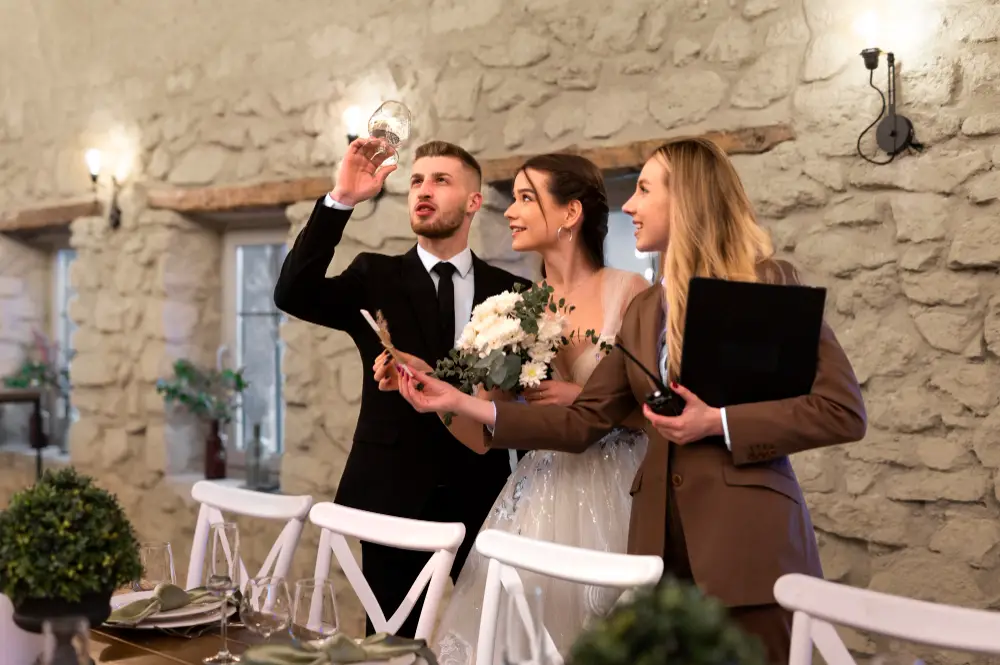
I was fastening my grandmother’s earrings when Natalie burst through the door.
She did not knock. That alone told me something. Natalie had been my cousin and closest friend for thirty years and she had always knocked, even in the middle of emergencies, even when she was afraid, because she believed in small courtesies the way other people believe in anchors. The fact that she came through the door without pausing, without the half-second of consideration she always gave, told me before she spoke a word that whatever had happened was bad enough to dissolve her ordinary habits.
Her face had gone a color I could not quite name. Not pale in the ordinary sense. Closer to gray, the specific gray of someone who has absorbed information and is still sorting out what it means.
“Sophie,” she said. “You need to come with me right now.”
I did not ask her what was wrong. Something in the way she said it made questions feel inadequate, like trying to stop a flood with a question. I gathered the front of my dress in both hands and followed her out of the bridal suite and down the narrow service corridor that ran behind the main hall. The estate was the kind of place built for occasions like this one, climbing roses on stone archways, warm string lights in the trees, a string trio rehearsing somewhere in the distance, and the sound of early guests beginning to arrive in the courtyard. I had loved all of it that morning. Standing in the bridal suite with my grandmother’s earrings and the dress I had chosen for reasons that had nothing to do with what anyone else thought of it, I had felt, for the first time in months of planning, genuinely ready for the day.
The farther we walked down the service corridor, the colder I felt. There was no particular reason for it. The temperature had not changed. Something else had.
When we stepped into the ballroom, three waiters were adjusting place cards at the head table. They moved with the careful, slightly guilty economy of people who know they are in the middle of something they did not cause and cannot fix and would prefer not to be present for. I thought at first it was an ordinary last-minute change, the kind that surfaces at every wedding, a guest who needed to be near the aisle, a family configuration that had shifted since the original seating chart. Weddings breed small logistical chaos. I was prepared for that.
Then I looked at the names on the cards.
To the right of Ethan’s seat: his parents, Mr. and Mrs. Calloway. Then his sister and her husband, two of his uncles, three cousins. Nine seats. Nine perfect place settings with the good china and the full complement of cutlery and the polished glasses that caught the light in the way expensive glassware does, making everything look both deliberate and effortless.
I looked for my parents’ names.
They were not at the head table.
Natalie touched my arm and pointed toward the side wall. Set against a pillar, angled in a way that put them facing sideways to the front of the room rather than toward it, were two folding chairs. No linens. No centerpiece. No printed name card, nothing to indicate that anyone had given the placement any thought beyond its function as a place to put people the room had not quite accounted for. They looked like the chairs venues set out along walls when an event runs over capacity. They looked like an afterthought.
I stood there for a moment understanding what I was looking at before I could bring myself to say it.
“What is this?” I asked.
The event coordinator, a composed professional woman who had managed forty weddings I knew of and had never in our planning sessions shown anything but graceful competence, swallowed so visibly I saw her throat move. “Mrs. Calloway called this morning,” she said. “She requested the change. She said it was a family decision. She said it had the groom’s approval.”
I heard the last sentence twice somehow. First as information. Then as something else.
“She said Ethan approved it.”
“That is what she told us.”
I turned toward the entrance at precisely the moment Patricia Calloway came through it. She wore a dark green dress cut to flatter someone who knew exactly what flattery was worth, diamonds at her throat, and the expression she always wore in public, a smile calibrated just short of warmth, elegant enough to read as grace if you did not look closely, sharp enough to communicate something else if you did. Her gaze swept the room with the ease of a woman who always expected it to be arranged to her satisfaction, and when it passed over the two folding chairs against the pillar, it lingered for less than a second before returning to me.
“Please don’t be dramatic, Sophie,” she said. “Your parents can sit there perfectly fine. It’s not as if they’re accustomed to events like this.”
The room contracted.
I had absorbed a great many things from Patricia Calloway over the two years of my engagement. The absorption had been gradual, incremental, the way erosion works, each incident small enough to dismiss on its own, the pattern only visible when you stepped back far enough to see the whole landscape.
I had absorbed her opinion of my dress, which she described to Ethan as too simple for a Calloway wedding, though I had chosen lace that deliberately echoed my grandmother’s veil and I knew exactly what that choice meant and why I had made it. I had absorbed her opinion of the reception menu, particularly the chicken mole recipe my grandmother had passed to my mother and my mother had taught me over many Sundays, which Patricia described at a planning dinner as too humble for guests of this caliber, the word humble deployed with the specific contempt of someone who understands that humble is not a neutral description. I had absorbed her suggestions about the guest list, several entries on my side she recommended I consider removing because they would not, in her estimation, add meaningfully to the event. I had absorbed the comments about my neighborhood, my education, the careers of my parents, all delivered with the particular technique of someone who knows how to wound without leaving marks, how to be insulting in a way that can be reframed as concern or honesty or simply candor if challenged.
And every time, Ethan had found me afterward with some version of the same request. She means well. She just speaks directly. She’ll come around once she sees you’re serious. Can we not ruin the evening over this. I need you to be patient.
I had been patient. I had found the part of myself that could go quiet and I had sent it forward to manage the room while the rest of me stood behind it and kept score.
But she said the word pathetic. She let her eyes go to the folding chairs and then to the doorway, where my father had just appeared in the suit he had been paying off in monthly installments since November, shoulders squared, doing the thing he had been doing my entire life, which was refusing to look undone in circumstances that could not be controlled. Beside him, my mother adjusted the strap of her purse and kept her face composed with the careful, heartrending dignity of a woman who has decided that her daughter’s day will not be diminished by anything she herself does.
She was trying to protect me from the humiliation of watching her be humiliated.
Something went very quiet in me.
I asked where Ethan was. No one seemed to know. Someone said he had stepped outside to take a call.
That detail arranged itself with everything else.
If Ethan had approved this change, and if he had stepped away, then he had either arranged to be absent when I discovered it or had simply not considered that I would discover it before the ceremony, that we would take our vows and sit at that table and my parents would be visible from the main floor as the people who had been parked against the wall, and I would be expected to carry that quietly because what alternative would there be at that point, we would be married and the reception would be underway and making anything of it would mean making a scene.
That was the architecture of it. The whole thing assumed I would accept what I was given once the moment to refuse had passed.
I was standing next to the microphone stand near the lectern where the welcome speeches would be made. Natalie caught my wrist once as I moved toward it, a light, questioning grip, but by the time I registered her hand I was already there. I lifted the microphone and turned toward the room, where guests were beginning to drift in from the courtyard, and I said, clearly and without raising my voice, “Before this wedding begins, there is something everyone here deserves to hear.”
The trio stopped playing. A waiter froze with a tray of champagne still elevated. The conversations stalled and then went silent in a wave that moved from the front of the room to the back, the way silence moves when people sense instinctively that something is about to break open.
“I want to start with an apology,” I said. “To my parents, who have just been humiliated on their daughter’s wedding day.”
My mother lifted one hand slightly from her side, a small, almost invisible movement that meant please stop. My father did not move at all. His expression was so controlled that looking at it hurt in a way that Patricia’s cruelty had not.
I told the room what I had just been told. That the head table had been altered that morning without my knowledge. That nine seats had been reserved for Ethan’s family. That my parents had been placed against a side wall with two folding chairs and no linen and no explanation. That when I asked why, I was told the groom had given his approval.
At that moment, Ethan came in through the side door from the parking lot with his tie slightly loosened and his phone still in one hand. He stopped when he heard his name and took in the room and then took in me standing at the microphone, and even from across the ballroom I watched the color leave his face in a way I had never seen before.
“Sophie.” He was already walking toward me, his voice doing the thing it did when he was trying to sound patient. “Put that down.”
I did not turn toward him right away. “And when I asked for an explanation,” I said into the microphone, “the mother of the groom looked at my parents and said, quote, they look pathetic trying to fit in here.”
No one moved.
Patricia stepped forward, her voice controlled but brittle at the edges. “That is not what I said.”
“You said it in front of witnesses.”
Ethan reached me then. He lowered his voice the way men do when they want to appear reasonable for a room they believe they can still redirect. “You’re making a scene.”
I looked at him fully. Long enough for the whole room to feel the weight of it. “The scene was already made,” I said. “I’m refusing to stand in it quietly.”
“We can handle this privately.”
“Privately,” I said, “is where your mother says whatever she wants and I’m expected to recover gracefully before the next time.”
Someone near the back said his name in a tone I had never heard directed at him. Guests who had been standing in the doorway moved fully into the room now, unable to stay peripheral.
“One question,” I said. “Did you know they changed the seating?”
It was the simplest question I had ever asked him. The answer required no preparation, no context, no careful phrasing. Yes, and I should have told you. No, and I’m appalled. Either answer would have taken five words and would have told me something I could work with.
He looked at me for two seconds. Then one. Then his eyes moved to his mother.
He said nothing.
I stood with the microphone in my hand and felt something come clear in me that had been obscured for two years. Not anger. Clarity. I could see the whole structure of it suddenly, not just this moment but every moment that had assembled itself into this one. Every time I had been asked to be patient while Patricia said something corrosive. Every time Ethan had smiled thinly and asked me not to ruin the evening. Every time I had adjusted and accommodated and found the part of myself that could go quiet, while she was never once asked for basic decency in return. He had always requested my maturity. He had never once requested her respect.
“I understand,” I said into the microphone. And for the first time that day, I entirely meant it.
I did not stop there. I had not intended to go further, but once I understood that silence would simply hand them the story, I kept going. I told the room about the dress, and the menu, and the guest list, and the many private moments over two years in which Patricia had found ways to remind me that I needed to know my place if I wanted to belong in her family. I told them calmly, without theater, the way you state things you have finally decided deserve to be stated.
As I spoke I watched Ethan. That was where the real information was. Patricia was understandable, in her way. The world makes Patricias regularly and they are never difficult to recognize once you have learned the shape of them. But Ethan had watched it happen and made silence into something he called love. He had asked me, in a hundred different softened tones, to absorb what could not be changed, to be mature about what could not be acknowledged, to keep the peace in a household where only I was ever asked to maintain it.
“The wedding is canceled,” I said.
There was no theatrical collapse. The aftermath was human and untidy. A glass broke somewhere. A flower girl began to cry because the adults had taken on frightening expressions. Guests rose and turned and conferred in low voices. The coordinator sat down on the edge of a chair as if her legs had reconsidered their purpose.
Ethan found me later in a side hallway near the garden doors. The noise from the ballroom had settled into something more ordinary, the sounds of a room of people deciding to make the best of a situation, which is a thing people are remarkably good at when given half a reason. My aunt Veronica was in there. My father had found his way to a seat among people who were glad to have him. Whatever remained of the occasion was being salvaged by people more gracious than the situation deserved.
Ethan came to the hallway in his wedding suit with his face carrying everything the afternoon had cost him and he knelt in front of me. I will say this: it was not a performance. It had the specific, unpolished quality of someone doing a thing because they have run out of better ideas rather than because they have rehearsed it. Whatever he felt in that moment was real, even if it had arrived too late to matter.
“Sophie. Look at me.” His voice had lost the control it was always managed with. “We can fix this. We’ll move the chairs, put your parents at the front, make whatever apology you want from whoever you want. We can still do this today. The ceremony can still happen.”
I looked at him kneeling in the hallway in his good suit and I felt something that was not quite pity and not quite the absence of it. Something more like the sadness of understanding clearly, for the first time, the shape of a thing you have been living inside.
“I don’t want chairs moved,” I said. “I want a life where no one needs to be reminded that my parents deserve a seat at the table. Not today. Not as a correction. Not because I made a scene and it became unavoidable. I want it to be true without my having to perform a scene to make it happen.”
“My mother made a mistake.”
“Your mother did exactly what she has always done,” I said. “The difference is that today you cannot tell me you didn’t see it.”
He looked up at me. Desperate and angry and, somewhere beneath both, something that might have been recognition of the kind that comes too late. “If you walk away now, there is no coming back from this.”
There it was. The sentence women are trained to be afraid of, the one that positions leaving as the catastrophe rather than the years that made leaving the only honest option. As if the loss of this particular future were the worst possible outcome, worse than a life spent absorbing contempt and calling the swallowing of it grace.
I thought about all the things I had let pass in the name of not ruining the evening. The aggregate weight of them, laid end to end, the years they added up to.
Then I thought about my father in his installment-plan suit with his shoulders squared and his face refusing to come undone.
“That,” I said, “is exactly what I’m counting on.”
I slipped the ring off my finger. I held it in my palm for one moment, not for drama, just because the moment existed and I was in it and I wanted to be present for it. Then I placed it in his hand.
He looked down at it the way people look at things they cannot make mean what they need them to mean. I did not wait for him to look up.
I walked back into the ballroom. My aunt Veronica had the microphone and was raising a glass and saying something fierce and warm that made half the room laugh with the released tension of people who have been holding their breath. The workers served the meal. Most of the guests stayed. The flowers were used. The string trio played through dinner. My parents sat at the head table, my mother still composed but no longer trying so hard to be, my father with the particular ease of a man who has been given back something that was taken from him without ceremony, and who does not require a ceremony to receive it.
It was not the wedding I had planned. But it was truer than what I had planned, in the specific way that things become truer when the pretense has been removed.
Later that evening, my father found me near the garden doors where the tent light was softening into the dark. He put his arm around my shoulders and said nothing for a moment, the way he did when he was finding the right words for something that mattered. Then he said he had never been more proud of me. Not for the drama or the microphone or the public nature of any of it. For the thing underneath all of it, the decision that had been building quietly for two years and had finally said what it needed to say.
I leaned against him in my wedding dress and let the weight of the day settle around me. It was the truest moment of the whole occasion.
The months that followed were not triumphant, but they were clean. There is a meaningful difference. Clean does not mean painless. It means honest, and honest is the ground on which everything else eventually has to stand.
There were hard mornings. There were conversations I had not anticipated having, with mutual friends who were not sure how to calibrate their loyalties, with relatives on both sides who wanted to understand and relatives on both sides who wanted to minimize. There were people who described the whole thing as a tragedy of miscommunication, as though Patricia’s contempt and Ethan’s silence were merely stylistic differences that a bit more goodwill might have bridged. I let them have that framing. I did not need everyone to see it clearly. I needed only to see it clearly myself.
I went back to school for the certification I had been deferring because Ethan said I already worked enough. I took trips I had been postponing. I had long dinners with friends I had let fade because there had always been another Calloway obligation requiring my presentable best, another event where I had to be polished enough to withstand whatever the evening brought. I went to therapy and said difficult things out loud and let myself grieve not only the man I had almost married but the version of me who had been quietly shrinking herself to fit a space that was designed to make her feel fortunate for being permitted inside it.
There was grief in it. Real grief. Not just for the wedding or the relationship but for the years I had spent adjusting myself rather than asking whether the situation deserved adjustment. For the patience I had extended without limit while none was ever asked of Patricia. For the careful, invisible work of being loved in a way that required so much management.
But underneath the grief was something that held. Something that did not waver even on the hardest mornings. The knowledge that I had not been complicit. That when the moment arrived where complicity was the only alternative to truth, I had chosen truth. Not gracefully, not quietly, not in the way women are usually praised for their choices. Loudly, in public, with a microphone, in front of a room full of people including Ethan’s relatives and my own and the event coordinator who was now probably the most interesting person at every wedding industry dinner she would ever attend.
My father stopped apologizing when my name came up in conversation. My mother, slowly and with the particular grace of someone who has been waiting a long time for permission, stopped trying to disappear.
A year later, someone asked over coffee whether I regretted canceling my wedding in front of everyone.
I did not have to think about it. The question arrived and the answer was already there, settled, the way answers are when they have had long enough to stop being questions.
“No,” I said. “I would have regretted marrying him.”
That was the complete truth. Not a version of it managed for social comfort. The whole thing.
Because what happened that day was not a ruined wedding. A wedding is not ruined by unused flowers or confused guests or a coordinator who has to rebook her afternoon. A wedding is ruined when the woman at the center of it is asked to accept her own diminishment as the price of being loved.
I was not willing to pay that price.
What I remember now is not the string lights or the roses on the archways or the dress I had chosen for my grandmother’s sake. I remember the microphone in my hand. I remember my own voice choosing me in public, out loud, in a room full of people who needed to hear it and one person who needed to say it.
And I remember understanding, in that moment of saying it, that sometimes the most loving thing you can do for yourself is refuse to celebrate the life that would have broken you. That the refusal, done clearly and without apology, is not an act of destruction. It is the first honest act of a life that intends, going forward, to be honest.
I intend to be honest going forward.
That was the only vow I kept that day. It turned out to be the only one that needed keeping.

Laura Bennett writes about complicated family dynamics, difficult conversations, and the quiet moments that change everything. Her stories focus on real-life tensions — inheritance disputes, strained marriages, loyalty tests — and the strength people find when they finally speak up. She believes the smallest decisions often carry the biggest consequences.