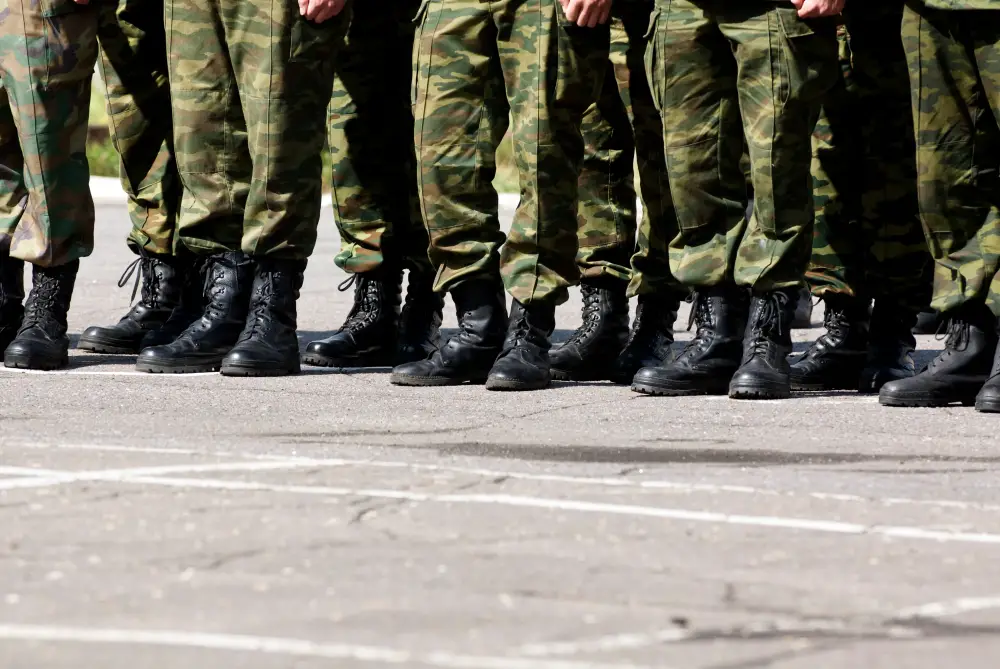
The locker room was already loud when she walked in.
That particular kind of loud that belongs to groups of men in confined spaces before a hard training session: lockers slamming, someone’s laugh carrying above the rest, a conversation about nothing in particular that was really about establishing presence. The sound of people who are comfortable and know it.
She appeared in the doorway and the room did not go quiet. It continued for a few seconds with no change, and then a kind of awareness spread through it, not silence but a subtle shift in frequency, the way a room changes when it registers something new.
She walked in without hurrying. Her uniform was standard issue, nothing that marked her out in any formal way, hair pulled back tight, posture straight without being rigid. She did not scan the room the way new people usually scanned rooms, that quick inventory of the space and its occupants, the instinctive social accounting. She moved directly to the nearest bench, set her bag down, and began to change with the economy of someone who had done this many times in many places and had no energy to spare for anything that was not the task at hand.
The first sound was a single low laugh from somewhere to the left.
Then another, from a different direction.
Within a minute, several of them were watching openly, the kind of watching that is itself a statement, that is designed to be noticed. Someone near the lockers said something to the man beside him and they both looked at her and one of them smirked.
A soldier named Petrov took it further. He was the kind of man who needed an audience and had learned over the years that locker rooms provided one reliably. He stepped forward with the particular looseness of someone who is performing confidence rather than possessing it.
“Did you take a wrong turn somewhere?” he said. The tone was friendly in the way that things are friendly when they mean something else. “This isn’t where they keep the administrative offices.”
A few people laughed.
Another soldier, Marchetti, moved to flank her from the other side. “You sure you’re in the right building?”
A third came closer than he should have. He was looking at her hair with the specific interest of a man who has decided that examining another person’s body is an acceptable thing to do when that person cannot stop you.
“Haven’t had a woman in this unit for a while,” he said. “We’ve missed the variety.”
She did not look up. She was tying her bootlaces with the focused attention of someone who considers the task important enough to do correctly. Her hands moved steadily. Her jaw did not tighten. No visible breath held, no visible moment of gathering herself. She simply continued with what she was doing as if the words were in a language she had not chosen to learn.
This had the effect such stillness always has on people who are accustomed to getting reactions. It made them louder.
The jokes became less clever and more crude. Petrov, emboldened by the laughter, leaned in and reached toward her hair with one hand, the gesture of someone who wants to demonstrate that he can.
She stood up before he made contact.
She stood with the smooth efficiency of someone rising from a starting block, and when she was upright she was looking straight ahead, which happened to be approximately at Petrov’s chin, and she reached past him for her jacket and put it on without acknowledging his existence.
When she moved toward the door, three of them stepped into the space in front of her. Not violently. The choreography of men who want to see what happens when they use their bodies as a collective obstruction.
Petrov was still smiling. “Somewhere you need to be?”
She looked at him.
Not up at him, not with the adjustment of someone calculating the size difference. Directly at him, the way you look at something you have already decided is not a threat.
“Move,” she said. One word, flat and quiet, carrying the specific authority of someone who is not making a request. “Or you’ll regret it.”
They looked at each other and laughed, the three of them, the laughter of people who have concluded that calm in a woman means harmlessness.
“What exactly are you going to do?” Petrov said.
She tilted her head slightly, and something moved in her expression that was not quite amusement.
“You’ll find out,” she said. “Shortly.”
They moved, eventually. Not out of concern. Out of the lazy curiosity of people who want to see what happens next and understand, on some level, that blocking a doorway has limits. They shuffled aside and she walked through and they watched her go and went back to their conversation.
Nobody thought much about it after that.
They were still in the middle of their easy locker-room certainty when the training hall assembled.
The hall was exactly what it always was: a large cold-lit space with rubber flooring and the smell of exertion baked into the walls over years, the kind of room that did not make concessions to comfort because comfort was not what happened here. They stood in formation and the usual sounds of a unit assembling faded and the commander came in and stood in front of them and looked at the formation with the expression he always wore, which was the expression of a man who has seen enough to be done with being surprised by anything.
“Attention,” he said. “You have a new officer taking over your training rotation.”
A murmur moved through the formation. The men to either side of Petrov exchanged a glance. Petrov himself was already beginning to formulate something he planned to say quietly to Marchetti.
The commander stepped to the side.
She came forward.
The murmur stopped. Not immediately, but in stages, as people registered what they were seeing, ran through the available interpretations, and found only one that fit. The woman from the locker room. Standard uniform. Hair pulled back. The same face, the same expression, except that now she was standing at the front of the room in the position that the front of a training hall is designed to communicate unambiguously.
Petrov’s mouth closed.
She did not appear to be in any hurry. She looked across the formation with the thoroughness of someone reading a document, taking in each face in turn, spending a fraction of a second on each one. She had a very good memory for faces, developed over years in situations where remembering who was in front of you could matter significantly.
When she had finished the survey, a faint expression crossed her face. Not a smile exactly. Something more controlled. The expression of someone setting a timer.
“Good morning,” she said. Her voice in the hall was different from her voice in the locker room, not louder but fuller, carrying to the back without effort in the way that comes from years of being heard in large spaces under difficult conditions. “I’m Captain Voss. I’ll be running your training for the next sixteen weeks.”
Nobody said anything.
She walked along the front of the formation. She did not rush this. She stopped briefly at several positions, spending a moment with each face, establishing that she had looked at it and would remember it.
She stopped in front of Petrov. She held his gaze for four seconds, which is longer than it sounds when you are the person being looked at by a commanding officer who has something to remember you for.
“I expect a great deal from this unit,” she said, continuing her walk. “What I experienced this morning tells me we have significant room for improvement.”
Petrov stared straight ahead. Beside him, Marchetti appeared to have become very interested in a spot on the opposite wall.
“We begin in five minutes,” Captain Voss said. “I would use that time to prepare yourselves. Not because the work we’re starting today will be difficult.” She turned at the far end of the formation and looked back at all of them. “But because the work we’re starting today will be difficult, and I don’t want any of you telling me later that you didn’t know.”
The unit stood in formation and said nothing.
She walked to the equipment rack, picked up a clipboard, and began reviewing the session plan with the same complete attention she had given to her bootlaces an hour earlier.
The five minutes passed.
What followed was two and a half hours that dismantled several assumptions the men of the unit had been carrying about their own fitness, their tolerance for sustained discomfort, and the relationship between someone’s physical size and their capacity to make your life genuinely difficult. Captain Voss did not raise her voice during any of it. She did not need to. She had the kind of authority that functions best at a normal register, that gains nothing from volume because it is not trying to intimidate anyone. It is simply telling you what is going to happen and then making it happen.
Petrov, in the final thirty minutes of the session, was on his hands and knees on the rubber floor with his arms beginning to fail him, doing what Captain Voss had described as corrective assessment and what Petrov was experiencing as the most thorough physical reckoning of his adult life. She stood beside him and looked down at him with the same expression she had used in the locker room doorway.
“You said,” he managed, between efforts, “you would stop. If we asked.”
“I said,” she replied, “that you would ask me to stop. I didn’t say I would.”
She waited for his next repetition.
“But I will,” she added, “when you’ve earned it.”
She walked to the next station.
Marchetti was doing better than Petrov, which was not the same as doing well. The third soldier, the one who had been interested in her hair, had completed his assessment twelve minutes earlier and was sitting against the wall with a water bottle held in both hands and the particular expression of someone updating their understanding of the world.
By the time the session ended, the training hall was silent with a different quality than the silence of the locker room. That silence had been the silence of people deciding not to say something. This was the silence of people who had run out of things they wanted to say.
Captain Voss stood at the front of the hall and looked at what remained of the formation.
“Same time tomorrow,” she said. “Drink water tonight. Sleep if you can.”
She picked up the clipboard, tucked it under her arm, and walked out.
In the locker room, afterward, the metal lockers were quieter than usual. Someone sat on a bench with his head down. Someone else moved slowly toward the showers with the gait of a man who was reassessing his understanding of most things.
Petrov sat on the same bench she had changed at that morning. His hands were flat on his knees. He stared at the middle distance.
Marchetti came and sat beside him and said nothing for a while.
“She told us,” Petrov said eventually.
Marchetti nodded.
“In the doorway,” Petrov said. “She told us exactly what was going to happen.”
He had the look of a man who had been handed back a very clear statement he had made and asked to consider it again in light of everything that had subsequently occurred.
Marchetti was quiet for another moment.
“Same time tomorrow,” he said.
Petrov did not respond. He reached for his bag and pulled it toward him and began, slowly and without his usual noise, to gather his things.

Specialty: Legal & Financial Drama
Michael Carter covers stories where money, power, and personal history collide. His writing often explores courtroom battles, business conflicts, and the subtle strategies people use when pushed into a corner. He focuses on grounded, realistic storytelling with attention to detail and believable motivations.