I came home from my husband’s funeral in a black dress that still held the warmth of the afternoon and the faint, sickly sweetness of lilies.
I had been bracing myself for the silence. That particular silence grief produces when there is finally nowhere else to be, when the receiving line has ended and the casseroles have been accepted and the last car has pulled out of the cemetery. The hollow, airless stillness of a home that has become one person smaller. I had been steeling myself for it the entire drive back, pressing my heels together on the floor of the car and telling myself to breathe.
I pushed open the front door.
I stepped into my own living room and stood there for a moment, genuinely uncertain whether I had the right apartment.
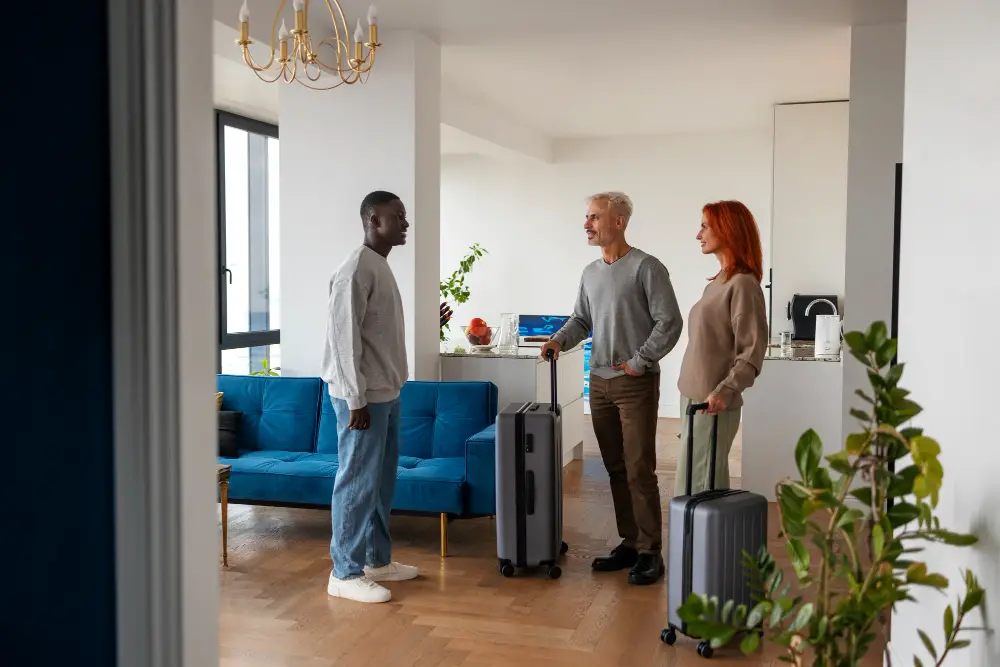
My mother-in-law, Marjorie Hale, stood in the center of the room directing traffic. Eight people moved around her with the focused efficiency of a team that had already been at work for some time. Closet doors hung open. Hangers scraped against wood with a sound that grated through my chest. Bradley’s things were being folded, stacked, zipped into suitcases with the brisk impersonal energy of people who had somewhere to be.
A carry-on sat on the couch where Bradley used to fall asleep reading.
Two of his cousins worked in the hallway, building a tower of boxes.
On the dining table, beside the bowl where we kept our keys, sat a handwritten list in Marjorie’s sharp, slanted hand. Clothes. Electronics. Documents.
And right there in the entryway, untouched and utterly disregarded, sat Bradley’s temporary urn beside the flowers that had come with it from the funeral home. They had already begun to droop slightly at the edges.
Something moved through me then that was not quite grief and not quite rage. It was a specific kind of recognition — the terrible clarity of watching people reveal exactly who they are at the precise moment when there is no longer any reason to perform otherwise.
Marjorie turned at the sound of the door.
She didn’t startle. She didn’t look embarrassed. She simply raised her chin the way she always did when she had already decided the outcome of a situation.
“You’re back,” she said.
I stood in the doorway in my bare feet, my heels dangling from one hand. I had not eaten since the morning. My body felt distant from me, as though I were watching it from somewhere slightly above and behind. I looked at the room. At Fiona rifling through drawers. At Declan zipping up one of Bradley’s travel bags with the focused satisfaction of a man completing a task. At a younger cousin carrying framed photographs like excess décor being cleared after a party.
No one looked at me directly. No one paused. It was as though I had been buried alongside him and was simply a ghost in the room now, something to step around.
“What are you doing in my home?” I asked.
Marjorie didn’t answer the question. She tapped the dining table twice with two fingers and said, very clearly, “This house is ours now. Everything of Bradley’s too. You need to leave.”
I looked at the open closets. At the suitcases. At the list on the table. Then I looked back at her. “Who let you in?”
She reached into her handbag and produced a brass key. Held it up with the casual authority of someone displaying a credential. “I’m his mother,” she said. “I’ve always had one.”
That key hit harder than anything else she could have said.
Bradley had asked for it back months earlier. He had mentioned, quietly and without drama, that he suspected she still had a copy. He hadn’t pushed the issue because that was who he was — a man who chose peace over confrontation whenever the cost of confrontation was mostly his own energy. He had trusted that it wouldn’t matter. Or perhaps he had simply been too tired to keep fighting on every front.
Now she was holding it like a deed.
Fiona yanked open the drawer of Bradley’s desk. Papers shifted. Something inside me tightened all at once.
“Don’t touch that,” I said.
Fiona turned toward me with the unhurried expression of someone who has already dismissed you. “And who are you now?” she asked. A small pause for timing. “A widow. That’s all.”
There are words that wound because they are cruel. And there are words that wound because they are clarifying. That one clarified everything.
I laughed.
It came out before I could stop it or shape it into something more appropriate for the occasion. It wasn’t soft. It wasn’t embarrassed. It was the laugh of a woman who has just understood that the people in front of her have walked straight into a trap built by the one man they had underestimated for thirty-eight years.
Every head in the room turned.
Marjorie’s expression hardened into something between offense and suspicion. “Have you lost your mind?”
I brushed beneath one eye and finally looked at her properly. “No,” I said. “You’ve all just made the same mistake with Bradley that you’ve been making his entire life. You assumed that because he was quiet, he was weak. Because he was private, he had nothing. Because he didn’t perform his life for your approval, he must not have built one.”
Declan straightened up from the suitcase. He was Bradley’s cousin on his father’s side, a man who had spent his adult life arriving at the edges of other people’s stability and helping himself. “There’s no will,” he said, with the confidence of someone who had already looked. “We checked.”
“Of course you did,” I replied. “And of course you didn’t find one.”
What none of them knew was that six days earlier, in a hospital room lit by the pale sterile glow of monitors, Bradley had predicted this conversation almost word for word.
He had been lying against the raised back of the hospital bed, pale in the way that frightened me because it wasn’t the ordinary pale of illness but something thinner, more final, as though his skin had begun to let light through. The monitors beeped their steady, metronomic indifference. Rain moved down the window in thin silver threads. He had been clear-headed right until near the end, and that particular evening he was more precise than he had been in days.
He squeezed my hand. His grip was lighter than I was used to.
If they come before the flowers die, he said, laugh first. Elena will handle the rest.
I had thought the morphine was making him dramatic. Bradley was not a dramatic man. That was one of the things I had loved about him from the beginning — the way he moved through the world without needing it to acknowledge him. But he held my eyes in a way that wasn’t dramatic at all, and he said more quietly, They won’t come as family, Avery. They’ll come as collectors.
He made me repeat his instructions back to him. Call Elena. Don’t argue. Don’t let them take anything. And laugh first.
He was right. To understand just how right, you have to understand who Bradley Hale actually was.
To his family, he was the difficult one. The son who kept to himself, moved away, returned messages late when he returned them at all, skipped the manufactured family emergencies and the reunions that were less about affection than accounting. He was the one who had stopped being useful in the way Marjorie defined useful, which was to say he had stopped being available.
To strangers, he seemed unremarkable in the most trustworthy possible way. Mid-thirties. Thoughtful eyes. A calm voice that didn’t compete for space. He rotated between the same two watches and preferred linen shirts, secondhand books, and restaurants where the acoustics allowed actual conversation. He could disappear into a crowd without effort or apparent regret.
Marjorie had spent his entire childhood confusing that quality with insignificance.
Her world operated on hierarchy and performance and what she called family obligation, which in practice meant a rotating system of debts and rescues in which some people were always giving and others were always receiving, and the identity of each was fixed from birth. There was always a cousin who needed rescuing, an aunt who needed covering, some story that required someone else to fund its ending. Bradley had been useful for years because he was capable — he paid things on time, he read the fine print, he cleaned up problems without theatrics. Then he met me, and something in him stopped volunteering.
We had met in Valencia, years before St. Augustine, when I was working on translation for an archive project and he was consulting on historical asset recovery cases for a law firm. That was how he described it at first. Consulting. A neat, forgettable word.
Only later did I understand what the work actually was.
Bradley had a gift for tracing paper trails. Not the kind of brilliance people make speeches about, but something more practically dangerous — the ability to look at a stack of dry corporate filings and hear the outline of a theft inside them. He could track shell companies and buried trusts and staged transfers and hidden ownership structures. He could identify beneficiary changes that had been engineered rather than chosen, and forged estate documents that had passed through several sets of hands without anyone raising a question. He had built that skill the slow way, first assisting attorneys, then banks, then private clients whose estates had been quietly stripped by greedy relatives and opportunistic partners who had understood that the law moves deliberately and family members rarely want to prosecute each other.
Over time he took equity in recovery cases instead of fees. Then a quiet stake in a recovery firm. Then another in a title analytics company that specialized in exactly the kind of documentation problems his clients kept bringing him. He used his middle name, Rowan, in most of those ventures — partly for privacy, partly because he had learned early what his family did when they sensed money nearby.
By the time I married him, Bradley had built something his relatives would never have believed because believing it would have required them to have respected him, and they had made different decisions about that long ago. He had built real wealth. Not loud wealth. Not the kind that announces itself through visible consumption. The kind held in trusts and carefully structured LLCs and accounts that do not need to be admired to function. The kind that comes from patience and from understanding, better than almost anyone, how other people hide things.
We lived comfortably. We traveled when we wanted to, ate where we pleased, collected books instead of status symbols. He paid debts early and donated quietly to preservation projects and scholarships for students in archival research. He never once told his mother a number. That last part enraged her more than anything else.
Once, walking along St. George Street in the early evening, when the heat was finally breaking and the old balconies threw long shadows across the stone, he said to me: When you spend enough years tracing greed, you either become greedy or you become private. He had chosen private. I had understood that before he explained it, which I think was part of why he trusted me.
We bought the condo in St. Augustine through a holding company that later became part of a trust structure I barely thought about, because I trusted him and because he had never been the kind of person who used money to fill a room. The arrangement was elegant in the way his best work always was. Invisible until needed.
Marjorie hated mysteries she couldn’t control. At dinners, she asked whether Bradley was still doing that small consulting job. She reminded him that family should know these things in case something happened. She laughed too loudly and said she hoped he wasn’t trusting me with all the passwords, because women could be unpredictable where money was involved. Bradley let those remarks settle without responding to them, which enraged her further.
One night after she left our apartment, he stood with his forehead against the closed door for a moment before turning around, and he said very quietly, My family does not love information. They love access.
That was the night he told me the rest of it.
Years earlier, after his father passed, Bradley had discovered that Marjorie and Declan had been using estate documents to obtain short-term financing — adjusted signatures, temporary substitutions, family borrowing against the dead on the assumption that the living would continue absorbing it. He had cleaned it up quietly to protect his father’s name. He covered some of it himself. He blocked the rest through legal channels that left no trace of his involvement. And they had mistaken that restraint for weakness, or for love, when in fact it was grief — the grief of a son who still believed, for a while longer, that the people who raised him were capable of something better.
When he stopped saving them, they called him cold. Changed. Marjorie told people I had turned him against his own blood. The truth was simpler and harsher: once he had experienced a life without the constant friction of being used, he no longer volunteered for it.
Then came the hospital.
His collapse happened quickly. Chest pain that was supposed to mean nothing became an intensive care admission that meant everything. The diagnosis arrived with the bluntness that serious diagnoses always carry, and suddenly every hour had a different quality to it than it had before.
He stayed clear-headed long enough to do what men like Bradley do when they understand that disorder is coming.
He prepared.
Elena Cruz arrived at the hospital the next morning with a leather portfolio and a notary from her office. I still remember the sound of the pen clicking and the blue seal being pressed into place, and Bradley’s hand trembling once before steadying. He signed documents I couldn’t fully absorb at the time because I was using all my available attention to hold myself together. He transferred final ownership of the condo and every related holding into the St. Augustine Harbor Trust, with me named as sole trustee and beneficiary. He updated every investment account. He revoked every family access authorization that lingered in older records. He finalized a letter of instruction to Elena outlining exactly what she should do and when.
And then he created what he called a contingency file.
“If they behave like human beings,” he said, “it won’t matter.”
I asked what the file contained. He looked at me with that tired, slightly crooked smile — the one that surfaced whenever he caught himself being more sentimental than he usually allowed. “Enough,” he said.
He died two days later.
Now I stood in our condo with his family stepping over his funeral flowers, and I finally understood what enough meant.
My phone buzzed. Elena: We’re downstairs.
I looked at Marjorie. At Declan. At Fiona still hovering over Bradley’s desk as though something valuable might be hiding beneath the paper clips if she only looked long enough.
“You should probably put those suitcases down,” I said.
Marjorie let out a sharp, impatient sound that was almost a laugh. “Or what?”
There was a knock at the door.
I walked through the entryway, past the urn, and opened it.
Elena Cruz stood in the hallway in a navy suit with rain still drying on her shoulders. Beside her was Luis Ortega, the building manager, clipboard in hand. And beside him stood Deputy Collins from St. Johns County — broad-shouldered, unhurried, wearing the expression that experienced law enforcement develops when someone else’s audacity has made the outcome entirely obvious before anyone has said a word.
Elena held a black folder under one arm.
Marjorie appeared in the hallway behind me. “Who is this?”
Elena glanced past my shoulder, taking in the suitcases, the open closets, the people, the list lying on the dining table. When her eyes came back to Marjorie, they held nothing at all.
“Elena Cruz,” she said. “Counsel for the late Bradley Hale and for the St. Augustine Harbor Trust. I’m here because this residence is under active legal protection and the trustee has reported unauthorized entry and attempted removal of property.”
The air in the apartment changed with that sentence. Not dramatically. Just with the quiet finality of something that has been set in motion and cannot now be reversed.
Declan stepped back slightly. Marjorie’s chin went higher.
“This is family property,” she said.
Luis opened his clipboard. “No, ma’am. This unit is owned by Harbor Residential Holdings, retitled six days ago into the St. Augustine Harbor Trust. Occupancy rights belong solely to Mrs. Avery Hale. We also have written revocation of all prior access permissions on file.”
“That’s impossible,” Marjorie said.
Elena slid the first document from the folder and held it up just enough to be seen. “It is recorded,” she said. “Not impossible.”
Fiona made a recovery attempt. “There’s no will. We checked.”
“Exactly,” Elena replied. “There is very little left to probate. That was intentional.”
The silence that followed had a specific texture. Because in one sentence, Bradley had beaten them using the one tool they had never thought to understand: structure. They had come looking for a will and found nothing. They had not thought to ask what happens when everything has already been transferred before there is a death to contest.
Marjorie looked at me then. For the first time since I had opened the front door, she was not performing certainty. Something moved behind her eyes that I had not seen from her before.
“What did he tell you?” she asked.
“Enough,” I said.
Deputy Collins stepped forward precisely as far as necessary. “I’m going to need personal belongings identified and this property cleared. Any ownership disputes are handled through the appropriate channels, not by removing items from a residence you do not control.”
Declan made one last effort. He pointed at the desk and said something about a business arrangement, money Bradley had owed him, a verbal agreement made years back. Fiona muttered that Marjorie had every right as his mother to secure family documents. A younger cousin began quietly unzipping the suitcase he had packed, as though invisibility might return and protect him if he acted small enough.
Elena opened the black folder and produced a second tab.
“Before anyone says something that worsens their position,” she said, “you should understand that Bradley anticipated a challenge. He left signed copies of prior demand letters regarding unauthorized use of his name. He left documentation of attempted access to his accounts. And he left surveillance images from an earlier, unauthorized visit to this property during the week of his hospitalization.”
Declan went still.
That was when I understood the full shape of it. Bradley hadn’t simply expected them to come. He had anticipated exactly who would move toward which drawer.
Elena placed three photographs on the dining table. In the first, Declan stood in Bradley’s study with his hand inside a drawer, taken during the week Bradley had been in intensive care. In the second, Fiona stood at the desk with a folder open under the lamp. In the third, Marjorie let herself in through the front door and glanced over her shoulder before stepping inside.
No one in the room made a sound.
Deputy Collins looked at the photographs and then looked at nothing in particular.
“He installed interior cameras after a prior incident,” Elena said. “The files are backed up offsite.”
Marjorie’s mouth opened. Closed. When she finally spoke, she said the only thing people say when certainty has fully abandoned them. “He wouldn’t do this to family.”
Elena spoke before I could. “He did exactly this to family,” she said. “Because of what family repeatedly did to him.”
From the folder she withdrew a sealed envelope. My name was written on the front in Bradley’s handwriting — that neat, deliberate script I had seen on birthday cards and grocery lists and the margins of books he was reading.
Elena held it out to me. “He asked that this be opened only if they came into the condo after his death,” she said.
My hands were unsteady as I opened it.
Inside was a single sheet of paper.
Avery,
If you are reading this with my mother in the room, then I was right, and she arrived before the flowers faded.
Laugh first.
I did. More quietly this time, but enough. Enough that he would have recognized it.
The rest of the letter was brief. He apologized for leaving me to handle this particular ugliness while I was already grieving. He told me he loved me. He told me not to negotiate with people who treated loss as an opportunity. He said the documents Elena carried were more than sufficient to remove them, and that if his family chose humiliation over grace, he had left them precisely what they had earned in a separate probate provision.
Marjorie caught that last part. “What does that mean?”
Elena answered without inflection. “It means Bradley did make one probate provision. Each named relative receives one dollar and a no-contest clause. Any continued interference triggers the release of supporting records to appropriate civil and criminal counsel regarding prior fraudulent activity involving estate instruments and unauthorized credit use.”
Fiona sat down heavily in one of my dining chairs. Declan said something under his breath that was not quite audible.
Marjorie stared at Elena. “He left me one dollar?”
“Yes.”
“His mother?”
“His decision.”
Marjorie turned to me. And what I saw in her face in that moment was not grief. It was exposure. The specific, unguarded expression of someone who has spent years being certain that the quiet one wasn’t watching, and has just discovered they were wrong.
She had spent his entire life treating him as someone who existed to absorb the consequences of her appetites, to clean up the messes, to fund the stories, to remain available and forgiving and finally grateful for the opportunity. His last act was refusal. A quiet, airtight, meticulously documented refusal.
Deputy Collins cleared the room.
Luis supervised as every bag was unzipped and every item was returned to where it had come from. Shirts back into closets. Cables back into drawers. Two watches back onto the valet tray on the bedroom dresser — the same two watches Bradley had rotated through for years, the ones he wore regardless of what was happening because he had never been interested in performing success.
It took nearly an hour. No one looked at the urn.
Before she left, Marjorie paused in the doorway and turned back toward me. There was something in her eyes that might have been a final attempt at leverage, or might have just been the residue of a life spent believing she could still win any room she walked into.
“You think this makes you safe?” she asked.
I stood near the entry table, one hand beside Bradley’s flowers. “No,” I said. “Bradley made me safe. This only makes you visible.”
She left without another word. The door closed.
The apartment went quiet.
Not peaceful. Not yet. But honest in a way it had not been since I walked back in.
Elena sat down with me at the dining table after Luis and the deputy had gone. She slid a small flash drive from the folder. “He recorded a message the morning after he signed everything,” she said. “For you. And one portion for the record in case the family contested the trust.”
I plugged it into Bradley’s laptop with hands that still didn’t entirely feel like mine.
His face appeared on the screen. Hospital light. Pale. Eyes tired but unmistakably, specifically his — that same precise focus I had known from the beginning, unchanged by everything.
He smiled at the camera. That crooked, slightly self-conscious smile he only produced when he caught himself being more sentimental than he thought he should be.
“Avery,” he said. “If you’re seeing this, then first, I’m sorry. Second, if my family is in the condo while you watch it, I hope you laughed.”
I laughed. And the sound broke something open in my chest that had been held too tightly since the hospital, and then for a while I sat with my hand over my mouth and let that happen.
He continued. He said he had spent too many years confusing loyalty with surrender. He said loving me had taught him that peace required real boundaries rather than endless patience. He said he had arranged everything the way he did because he wanted the one person who had never reached for his wallet before reaching for his hand to be protected first.
Then his expression shifted into something quieter and more deliberate. “For the record,” he said, and his voice lost its softness entirely: “My mother, Fiona Hale, and Declan Hale have no authority over any property, account, or file associated with me, Rowan Ledger Recovery, Harbor Residential Holdings, or the St. Augustine Harbor Trust. Any claim otherwise is false. Any use of old keys, old papers, or old family stories should be treated as what it is: trespass dressed as grief.”
The screen went dark.
I sat there for a long time with tears on my face, one hand still hovering near my mouth. Not from surprise. Because even in death, in a hospital room with monitors ticking beside him and rain on the glass, he had sounded exactly like himself. Precise. Careful. Quietly devastating.
The formal challenges never came.
Perhaps Marjorie understood that what Bradley had constructed was not the kind of case you contest unless you are prepared to lose publicly and in detail. Perhaps Declan remembered standing in that study with his hand in a drawer while a camera recorded the timestamp. Perhaps Fiona simply didn’t have the appetite for what probate court would expose. Whatever the reason, the contest Elena had anticipated never materialized.
Within three weeks, the trust transfers were complete. The condo remained mine. The investment accounts settled cleanly outside probate. Bradley’s private donations — to preservation projects, to scholarships, to causes he had never felt the need to tell anyone about — continued exactly as he had instructed.
In those weeks I learned more about what Bradley had built than I had in ten years of living beside him. Not because he had hidden himself from me. He hadn’t. But because I had never measured him by what he controlled, and he had known that, and I think it was one of the reasons he trusted me with all of it.
That was the particular irony that stayed with me. The people who had come to collect his estate had never been curious enough about Bradley himself to understand what they were walking into. They had wanted what he had accumulated without any interest in how he had become the person who accumulated it. They had reduced him to a resource and then been genuinely shocked to discover he had been paying attention the whole time.
A month later I walked alone through the historic district at dusk, when the tourists thin out and the old city settles back into something closer to itself. St. George Street in that particular light — the late sun turning the old stone amber, the ferns draping down from the balconies above. I stopped in front of the café where Bradley and I had once spent two hours debating whether private people are born or made.
He had said made. Usually by surviving the wrong kind of attention.
He had been right about that too.
When I came home, the condo was quiet. Mine in a way it hadn’t fully been while I was still adjusting to what had happened in it, still reordering the furniture of my understanding. I set fresh flowers beside his urn. I opened the windows and let the warm, damp Florida air move through the rooms. Everything was where I had left it. Nothing had been taken.
Nothing had been lost except the illusion that shared blood guarantees decency.
I stood in the doorway for a while before turning on the lights. Then I laughed once more, softly, mostly to myself.
“They never knew who you really were,” I said into the quiet apartment. “But I did.”
Outside, the evening settled over St. Augustine the way evenings do there — slowly, warmly, with a kind of patience that suggests the city has seen enough to know that most things pass and a few things last.
Bradley had been one of the things that last.
Not his money. Not his structures. Not the clean legal architecture of trusts and revocations and contingency files. Those were the instruments. What lasted was the understanding he had arrived at somewhere between Valencia and here, somewhere between being endlessly useful to people who saw him as a resource and becoming a man who understood that love is specific and loyalty has limits and the most important things in a life are not the ones that can be seized after you are gone.
He had protected what mattered. And then he had let everything else be exactly what it was.
I turned on the lights and went inside.

Laura Bennett writes about complicated family dynamics, difficult conversations, and the quiet moments that change everything. Her stories focus on real-life tensions — inheritance disputes, strained marriages, loyalty tests — and the strength people find when they finally speak up. She believes the smallest decisions often carry the biggest consequences.