What the Rain Sounds Like
Lightning cracked across the sky hard enough to turn the hospital windows into mirrors.
In that white-blue flash, I saw my father at the far end of the corridor, soaked through, gripping his phone like it was the only thing keeping him upright. A police officer stood beside him, speaking in a low, careful voice. I heard every word anyway.
“Sir, I really think you need to see this for yourself. She’s awake. There’s someone with her.”
My father didn’t answer. He stared through the gap in the curtain around my bed with a look I had never seen on him before. Not anger. Not the worn resignation he wore at home like a second coat. Something older than those things. Fear that looked buried and recently unearthed.
His face had gone gray. Then, with the stiffness of a man walking toward something he dug himself, he pushed open the door.
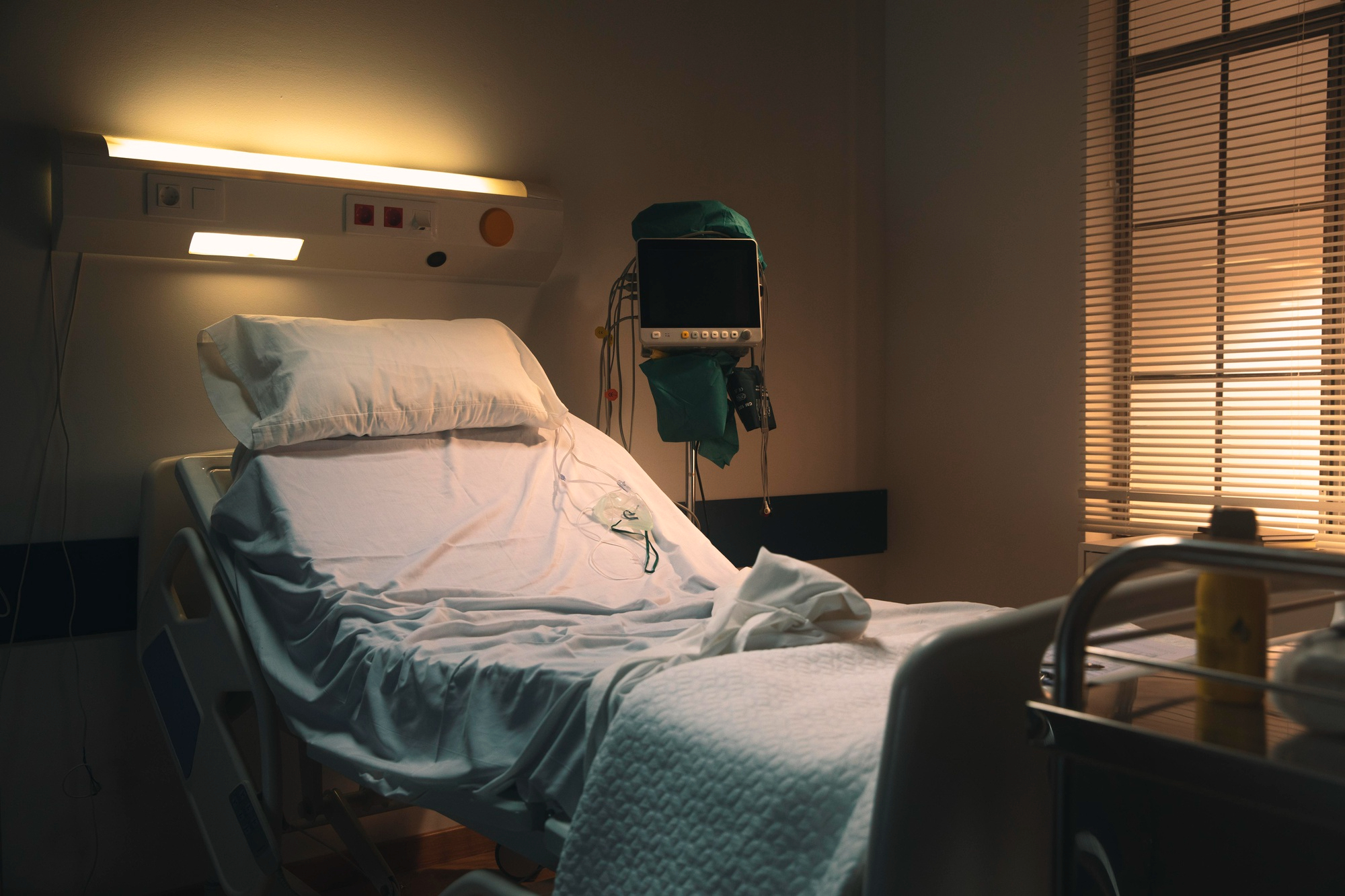
I was lying propped up in the hospital bed, an IV in my arm, a dull ache spreading through my ribs with every breath. My hair was still damp from the rain. The room smelled of antiseptic and wet asphalt and the soap a nurse had used to wipe blood from my temple.
I was not alone.
The man seated beside me looked up as my father entered. He had one hand wrapped loosely around mine, as though he had been afraid to let go in case I disappeared. His face was unfamiliar and not unfamiliar at the same time, one of those impossible faces that seems to exist at the edge of a memory you cannot quite locate. He was somewhere in his early fifties, with rain-dark hair threaded through with silver and tired eyes that seemed gentler than any eyes had a right to be after a night like this. There was something grounded about him, something steady, as if the storm had spent itself against him and failed.
When his gaze met my father’s, the whole room changed.
My father stopped in the doorway. For a second, nobody moved. The storm rattled the window. The heart monitor beside my bed kept its patient, indifferent rhythm.
Then my father made a sound that was not quite language. More like breath catching on broken glass.
“You,” he said. “You can’t be here.”
The man beside me did not flinch. He only tightened his fingers gently around my hand, as if reminding me I was not alone, even though I had no idea who he was.
By the time the officer had stepped in with his notebook, by the time I had told him what I could remember, the image was already assembling itself in fragments the way traumatic things do: the rain starting before sunset, the windows rattling, my mother’s voice calling from upstairs. Emily in the hallway with her arms crossed and that brittle little smile she wore when she already knew how a scene would end.
My mother’s sapphire ring had gone missing from her dresser, along with an envelope of cash. She had called us all upstairs. Emily had arrived first. I had arrived second, still holding the dish towel. My father came last, wearing the expression he always wore when he wanted a problem solved with as little personal discomfort as possible.
“The ring is gone,” my mother said. Her hands shook but her voice was cold. “And the cash.”
I had looked from face to face, waiting for someone to say the obvious. That it might have been misplaced. That we should look before accusing anyone.
Instead Emily said, “Nora was up here earlier.”
And just like that, the room tilted.
I had been upstairs. I’d gone for a sweater from the laundry basket outside the linen closet because the house was freezing and my mother kept the heat at sixty-eight regardless. But Emily only had to open the door. She never had to push anyone through it. That was her gift.
They searched my bag. Nothing. Then Emily said to check my coat, and my mother crossed the hall and thrust her hand into the pocket and pulled out a pawn slip. White paper, folded twice. In neat black letters, the description of a sapphire ring.
I said it was not mine. I said I had never seen it before.
My father closed his eyes for one second, the way he always did before choosing the path of least resistance.
“If you took it because you’re in some kind of trouble,” he said, “say that. Lying only makes it worse.”
That was the oldest trick in our house. Give me a crime I did not commit and then offer mercy if I confessed to it. That was how the family stayed peaceful. How Emily stayed blameless. How my father stayed comfortable in his silence.
I said I would not confess to something I had not done. My mother said I could leave until I was ready to be honest. I turned to my father and waited for him to stop it, waited for him to say this had gone far enough. It was not the first time I had waited for him to do something like that.
He held the front door open.
That was who he had always been. A man who let terrible things happen politely. Who decided that keeping the peace was the same thing as keeping the family together, not understanding until too late that some families are held together only by the weight pressing down on the person everyone has decided can hold the most.
I stepped out into the rain. No one followed.
Now, in the hospital, I kept my eyes on the officer while I told him all of this and felt the man beside my bed listening without interrupting, his face unreadable except for a pulse ticking in his jaw.
Eventually I looked at him again.
“You know me,” I said.
“Yes.”
“From where?”
Something passed through his face. Regret, maybe, or a grief that had been in him so long it had learned to move quietly.
“That’s a longer answer than you need right now.”
“I nearly died,” I said.
The words came out flat. Just true. That seemed to hit him harder than I expected.
Before I could push further, my father stepped back into the room. He had gone home to change but looked no more rested. His eyes were red-rimmed. He closed the door with the care of a man who believed the slightest sudden movement might shatter something already past repairing.
When he saw me awake he said my name for the first time that night. Then his gaze shifted to the man in the chair and the softness in his face vanished.
“I told you to stay away.”
The man stood. He wasn’t much taller than my father but the room seemed to rearrange itself around him.
“That promise ended,” he said evenly, “the second you let her walk out into that storm.”
“You don’t know what happened.”
“I know enough.”
My father dragged a hand over his mouth. “She doesn’t know anything.”
“Exactly.”
The word landed between them like a dropped stone.
Pain pulsed through my side with every breath, but curiosity had become stronger than pain.
“What don’t I know?” I asked.
Neither answered. The tension thickened. Finally my father looked at me and then away again.
“If she finds out who you are,” he said hoarsely, “everything falls apart.”
The man turned to me. For the first time since I had woken up, he looked afraid. Not of my father. Of what telling me might do.
He exhaled slowly.
“I’m not a stranger,” he said. “I’m your father’s brother. The one they told you was dead.”
I spent the rest of that night trying to fit those words into the shape of my life and realizing with a hollow clarity that they would not fit. Which meant my life had not been the shape I thought it was.
I had spent twenty-three years believing my father’s brother had died young. That was the story. My mother said it was before your time whenever I asked, in the tone that warned me not to ask again. My father went quiet in the particular way of someone managing something rather than feeling it. There had never been photographs in the house, never a name spoken without something immediately closing around it. But I had noticed the outlines anyway. My grandmother once started to say I laughed exactly like someone before my mother cut her off so sharply the whole room froze. A box in the attic marked G. Hale disappeared the day after I found it. A Christmas photograph with its corner torn away so precisely that it was obvious a person had been removed rather than a moment lost to age and light.
I had not been imagining any of it.
My uncle, whose name was Gabriel, stayed in the chair beside my bed through the rest of the night and into the morning, slipping into shallow stillness the way people do when they know better than to trust a night but cannot help needing rest. When I found him watching me in the thin early light, I asked if he had ever planned to tell me.
He said yes. When he could do it without making my life harder.
I almost laughed at that, though it came out closer to a grimace. He said he knew it had been a strange strategy for the timing. The pain flashed across his face when he said it, real and briefly unguarded, and I understood he had been replaying this night in his mind since before I even woke up.
I studied him in the pale morning. He had the kind of face that life marks honestly, not handsome in a preserved sense but real. Lines at the corners of his eyes. A small scar near his chin. Calloused hands built for work rather than performance. He did not look like someone dangerous. He looked like someone who had been standing outside other people’s lives for too long.
Over the following days, in the spaces between nurse visits and formal statements and the careful, devastating appearances of my family, he told me the rest.
His father, my grandfather Arthur, had been mean in all the ways that don’t leave easy evidence. The night Lily died, she was seven years old and afraid because Arthur had been drinking and throwing things. Richard, my father, had just gotten his license. He said he would take her for ice cream until things calmed down. Gabriel went with them.
He was driving too fast. They hit standing water on a curve. The car spun. Gabriel remembered the sound of it more than anything. Metal and glass and Lily screaming once and then not again.
Arthur arrived before the police did. Richard was bleeding but conscious. Gabriel was half out of the windshield. Arthur looked at both his sons and made a choice. He told the police Gabriel had been driving.
Because Richard had scholarships and teachers who believed in him and a talent for seeming responsible. Because Gabriel was already the difficult one, the one who fought back and skipped school and did not perform the version of himself that anyone preferred. It was an easy story to tell.
Gabriel spent time in juvenile detention and then on probation, and when he turned eighteen he left the town entirely. My grandmother wrote to him. She could not stop writing about Lily, about Richard, about her own failure to interrupt things when she might have. Somewhere along the way, dead became easier than disgraced for everyone who remained. Easier than explaining his absence in photographs. Easier than letting the lie find its edges.
When I was born, Richard had tracked Gabriel down at a construction site two towns over and begged him not to come near his family. Gabriel agreed, on one condition: that Richard would never become their father. That he would never ask his daughters to carry his fear.
He had done it anyway.
Officer Ramirez came back the morning after my mother’s visit, in which she had used the word misunderstood to describe being thrown out into a storm after a false accusation, and in which Gabriel had said quietly that she had always had a talent for calling cruelty something more polite. Ramirez closed the door behind him and said he had found the pawn shop listed on the slip.
The ring had been pawned the previous afternoon.
Not by me.
By Emily Hale. Her ID. The video matched. Her signature.
I let out one broken laugh that turned into tears, not because I was surprised but because I had been right and still felt no victory in it. Only the exhausting relief of a person who has been told they were crazy for years and has just been handed proof they were not.
When my family came that afternoon, all three of them, Emily looked furious rather than guilty. That was the first thing that struck me. She always recovered fastest, always reached indignation before shame the way some people reach for a coat before they have even acknowledged the cold. She stopped when she saw Gabriel seated beside my bed and rolled her eyes in a way that was meant to dismiss the entire room.
Ramirez had positioned himself by the door. When Emily’s eyes found him, he told her he was there because the ring had been pawned under her name.
The color left her face so fast it was almost shocking.
She recovered. She said she had been planning to get it back. She said I was supposed to have admitted it and handed everything over before things went this far. She actually said that. The room she had built the lie inside of was still the room she expected to inhabit, still the room where her logic held.
I said very quietly that she had wanted me to confess to her theft.
She finally looked at me then, really looked at me, and what I saw in her face was not one thing but several things at war: panic and resentment and embarrassment and beneath all of it the childish fury of someone whose script had gone wrong.
She said I always acted so innocent. She said she was sick of everything being about my feelings, my boundaries, my ideas about fairness.
I said she had stolen from my mother, framed me, and watched my father throw me out into a storm.
She said she hadn’t made me leave.
I said she hadn’t needed to. She had known they would choose her.
That landed the way true things land when everyone in the room knows them and no one has been willing to say them aloud. My father sank into the chair by the window.
He looked at me, and for the first time in my life there was no refuge left in his expression. No polite neutrality. No hiding.
“I should have stopped it years ago,” he said. “I should have stopped all of it.”
When they were gone, I told Gabriel to tell me about Lily. He told me about the plays she wrote on notebook paper and cast with trees because she said trees had the best emotional range. He told me about the summer at the lake in the photograph, about our grandmother dropping a pie face-first in the dirt and laughing until she cried. He told me about a little girl who made life better and who died in a car he was riding in while the brother who was actually driving stayed silent and spent the next twenty years mistaking survival for innocence.
My father came alone one evening and sat in the chair Gabriel had occupied for days and said the thing plainly.
I was driving.
He said it without softening it, which was more than I had expected from him. He told me how Arthur had made the calculation in front of both his sons. He told me he had been telling himself he would fix it later for so long that later became a life.
I told him he had loved me in a way that still let me stand alone in the rain.
He covered his face with one hand.
I had never seen my father cry. He wept without sound and I did not comfort him, and that was new. Not cruel. Just honest. The old reflex to soothe, to make things easier, to smooth over whatever sharp thing had surfaced so everyone could go back to being comfortable, that reflex had something broken in it now, and I was not sure I wanted it repaired.
I went home with Gabriel.
He lived forty minutes outside the city in a small house with a deep porch and peeling green shutters at the edge of a town where everyone seemed to know what day the trash went out without needing to ask. There was a workshop in the back, wind chimes on the side porch, and a vegetable garden going soft at the edges of autumn. On the drive out, clouds threatened rain that never fell, and I watched the landscape change from city to suburb to something quieter, and felt something in me shifting along with it, some long-held tightness beginning to release its grip.
Inside the house smelled of cedar and coffee and something recently simmered with garlic. The furniture did not match. The floors creaked. There were books on windowsills, a half-finished crossword on the kitchen table, photographs on the mantel arranged by nothing in particular except what Gabriel had wanted to look at.
One was my grandmother in a sunhat, laughing.
One was Lily, unmistakable now that I knew her face.
One was Gabriel standing with a woman I did not know, both of them covered in paint, grinning at something outside the frame.
You had a life, I said, and immediately felt foolish. Of course he had. But part of me was still adjusting to the idea that he had continued existing in full color while my family insisted he had vanished into black and white.
He heard what I meant. Yes, he said softly. I did.
On the dresser in the guest room was a glass of water and a note in careful block letters: If you need anything in the night, knock loudly. My hearing is worse than my pride.
I laughed despite myself. Gabriel leaned against the doorframe and looked relieved.
That first week I slept more than I had in months. Recovery does strange things to time. Hours blur but small moments become enormous. The first shower you can take without dizziness. The terror of stepping outside when the sky darkens, because some part of your body still thinks storm means exile.
Gabriel never pushed conversation but was always present when I needed it. He made soup that lasted three days. He knew how much honey I liked in tea after watching once. He had the rare gift of knowing when to sit in silence without making the silence a test.
On the third night, thunder rolled far off beyond the hills and my hands started shaking around my mug before I was fully aware of why. He looked up from the stove, turned the burner down, came around the island slowly enough not to startle me, and asked if I wanted to go sit on the porch and listen until the rain sounded like weather again.
The kindness of that. Not denying the fear. Not dismissing it. Just making room for it until it changed shape.
We sat wrapped in old blankets with our tea going cold and listened to the rain on the roof and the railings and the dark soil of the garden.
After a long while I said I used to think surviving meant getting good at pretending things did not hurt.
Gabriel looked out into the dark. That is one way to stay alive, he said. It is not the same as living.
A wooden box had come with me from my grandmother. Gabriel had kept it for her, as she had asked before she died, and inside were letters and photographs and one envelope addressed in her handwriting. For Nora. When I finally opened it she told me what I had needed to hear from someone who loved me without condition: I was not difficult. I was not dramatic. I was not wrong to notice what others pretended not to see. She said that families create roles when they are afraid of the truth, that one child becomes the golden one and one becomes the one expected to carry everyone else’s discomfort, and that this is an old pattern and a cruel one, and she should have interrupted it more forcefully than she did. She told me Gabriel was alive and that he had loved me from the day I was born, though from too far away. She said that peace built on my silence was not the same thing as love. She said: when the truth finally arrives, you will know how to bear it.
The hurt of reading it was real. So was the strange fierce comfort woven through it. She had seen me. Even when she failed me, she had seen me. After a lifetime of being told I was too much or too sensitive or too easily wounded, there was something almost holy in that simple fact.
In one of the photographs, a much younger Gabriel sat on a park bench holding a bundled baby. My grandmother’s hand reached toward the blanket from the edge of the frame. On the back, in her handwriting: Gabriel with Nora, May.
You held me, I told him.
He smiled. Once that I can prove. Maybe twice.
But I don’t remember.
No, he said. You were a baby.
It should have made the loss smaller. It only made it feel larger. Somewhere out there had been a version of my life where my uncle existed, where my grandmother had photographed us together, and then a door had closed and a lie had been built over the opening.
The weeks that followed were what recovery actually looks like: less a transformation and more an untangling. Emily returned the money. The ring was recovered. My mother declined to press charges, which surprised no one. My father began therapy. My mother did not. Emily moved out. I went back to the bookstore after three weeks, slower than before but steadier.
My father sent holiday cards with small, pressure-free updates. He had sold Arthur’s watch. He had visited Lily’s grave with Gabriel for the first time in twenty-seven years.
When I asked Gabriel how that had gone, he said: wet, cold, honest.
Did you forgive him, I asked.
Gabriel gave me a look over the rim of his mug. Forgiveness is not a switch, Nora. It is more like weather. Changes when it is ready.
The spring came late and wet. On the first warm day, Gabriel and I planted tomatoes from seedlings my grandmother would have called too leggy and worth saving anyway. While my hands were in the soil, my phone buzzed. My father had sent a photograph: three headstones under new grass, Lily Hale’s name carved between the others, a small bunch of yellow daisies on the ground in front.
I stood looking at it for a long time. Then I sent back four words. Thank you for telling me.
A minute later: I should have sooner.
I put the phone in my pocket and went back to the dirt.
Gabriel looked over from where he was working.
Everything okay, he asked.
I pressed a seedling into place and covered its roots carefully.
Not okay, I said. But maybe more true.
He smiled the way my grandmother used to when she thought I had figured something out worth keeping. That is usually where better starts, he said.
A year after the storm, we drove to the lake in the old photograph. It looked smaller than I expected and somehow exactly the same. Summer light lay across the water in long white ribbons. Children shouted from the public dock.
Gabriel had the photograph in his wallet now, tucked behind his license until the edges softened. We stood roughly where it had been taken and he pointed out where the old bait shop used to be, where Lily had declared swans were probably just overgrown ducks with better publicists, where my grandmother had dropped a pie face-first in the dirt and laughed until she cried.
I listened and built them in my mind: the family we might have been if truth had come earlier, if fear had not been mistaken for duty, if love had learned how to be brave. Then I let that imagined family go. Because grieving what never existed is still grief, but it cannot be home.
On the drive back, clouds gathered low and gray.
Rain, Gabriel said, looking at the windshield.
A year ago that observation would have tightened every muscle in my body. Some part of me still braced, reflexive and fast.
Then the first drops struck the glass. Gentle. Even.
Not a threat. Just weather.
I rested my head against the seat and listened to it.
For most of my life, I said after a while, I thought the worst thing that could happen was everything falling apart.
Gabriel kept his eyes on the road. And now?
I watched the rain bead and run down the glass.
Now I think the worst thing is living inside a lie so long you start calling the cracks home.
He was quiet for a moment. Then he nodded once.
Your grandmother would have liked that, he said.
I know.
The rain thickened then steadied, drumming softly overhead as the miles went past. I was not the girl standing on the porch with a bag in her hand and disbelief lodged like ice in her throat. I was still carrying what had happened. Some hurts do not vanish. They become part of your structure, and if you are lucky, part of your wisdom.
But I was no longer carrying it alone.
When we reached the house the garden was drinking in the storm, leaves shining dark green against the gray sky. Gabriel pulled into the drive and killed the engine and for a moment neither of us moved.
The rain drummed on the roof.
Home, I thought.
Not the word I had grown up with. The real one. The one built slowly after truth arrived. The one that did not require me to disappear so that someone else could stay comfortable. The one where the dead were named, the living were seen, and the rain was allowed to be only rain.
Gabriel looked at me.
You coming?
I smiled, reached for the door, and stepped out into the weather without fear.

Specialty: Emotional Turning Points
Rachel Monroe writes character-driven stories about betrayal, second chances, and unexpected resilience. Her work highlights the emotional side of family conflict — the silences, the misunderstandings, and the moments when someone quietly decides they’ve had enough.