The Brass Handle
My father was standing frozen in the doorway of the oceanfront cottage I had purchased for my parents’ fortieth wedding anniversary, one hand still wrapped around the brass door handle, the other clutching a small grocery bag. Behind him, gray waves rolled against the rocky Monterey shoreline. It should have been a quiet Tuesday morning. Instead, my mother was crying so hard she could barely stand upright, and a man who had married into our family four years earlier was telling my father he had no right to enter his own home.
“This isn’t your house,” Daniel Mercer said again, louder this time, as though my father were hard of hearing rather than stunned into silence. My mother Linda was standing on the porch in her slippers and cardigan, mascara running in dark lines down her cheeks, and when she called me her voice was shaking in the specific way it shook when she was trying not to fall apart entirely. “Ethan, you need to come right now. He changed the locks.”
I was at my office desk in San Jose. I was in my car within four minutes. The drive to Cypress Point takes forty five minutes under normal conditions. I pushed it to thirty eight. When I pulled into the driveway, gravel crunching under my tires, the first thing I saw was my parents’ suitcases sitting on the porch like luggage at a hotel checkout. The second thing I saw was my brother in law standing with his arms folded and a set of keys dangling from his fingers. My sister Claire stood behind him, pale and stiff shouldered, looking at a point somewhere past my left ear.
Eight months before that Tuesday, I had driven my parents to a small dinner to celebrate their anniversary. I had reserved the back room of their favorite restaurant in Pacific Grove, the one with the low lighting and the crab bisque my mother had been ordering since I was twelve years old. Over dessert, I slid a navy envelope across the table.
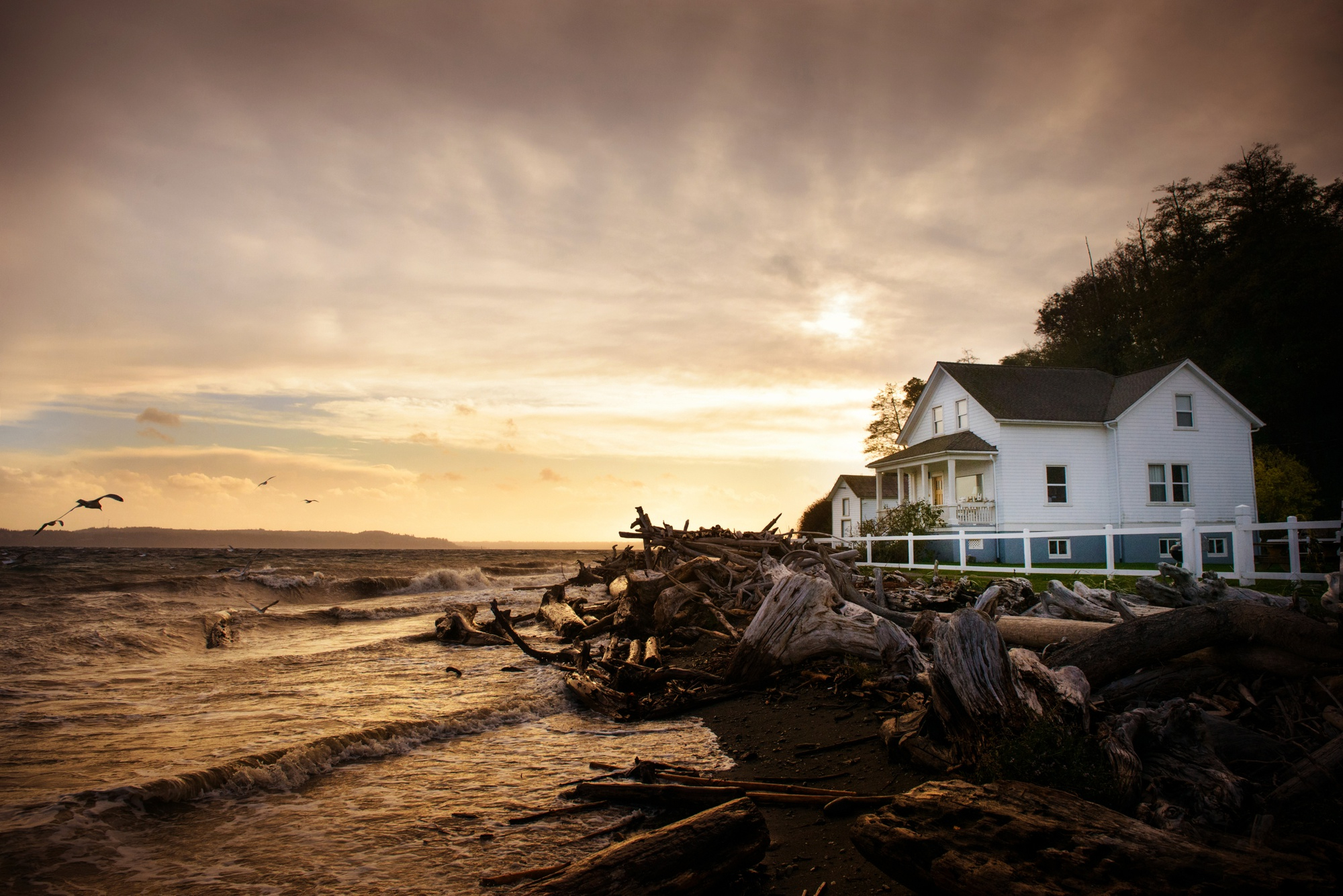
Inside were the documents for the cottage on Cypress Point. Oceanfront. Three bedrooms. A wraparound porch with an unobstructed view of the Pacific. My father read the first page twice before he looked up. My mother covered her mouth with both hands. It was not temporary. It was not shared. It was theirs.
Both of my parents had worked in ways that the word work does not quite capture. My father spent thirty five years in construction management, the kind of career that takes a physical toll so gradual you do not notice it until you look at photographs from a decade ago and see a man whose back was straighter and whose hands were steadier and whose mornings did not begin with the particular caution of someone cataloguing which joints had decided to cooperate that day. He built things for other people. Commercial buildings, residential developments, municipal projects. He built them well and he was proud of the work and he came home every evening to a house that was never as fine as the ones he had spent the day constructing, and he never complained about the disparity because complaining was not something my father did. He endured. He adjusted. He went back to work.
My mother stretched a household budget with a precision that amounted to its own kind of labor, the invisible kind that never appears on a resume and never generates a pension but that holds a family’s daily life together with the same structural integrity that my father’s work gave to buildings. She knew the price of milk at three different grocery stores. She knew which bills could be paid on the fifteenth and which had to be paid on the first. She kept a notebook, and the notebook was her instrument, and the instrument was never acknowledged by anyone except me, because I had found it once as a teenager and had understood, with a clarity that rearranged something inside me permanently, that my mother was performing daily calculations of survival that she never discussed and never wanted discussed.
They had never owned something just for themselves. They had never had a place that was purely about rest and the ocean and the particular peace that comes when you stop performing for the world and simply exist. I wanted to give them that. The house was deeded into a trust I had set up specifically for their protection. The taxes were covered. The maintenance was handled through a local property management company. The only thing they needed to do was live there. That had been the plan.
Standing in the driveway eight months later, watching Daniel jingle those keys with the casual confidence of a man who believes he has covered his angles, I understood that someone had a different plan.
“What’s going on?” I asked.
Daniel produced a folder. The folder was his tell. He had brought paperwork, which meant he had been planning this long enough to generate paperwork, which meant this was not a spontaneous misunderstanding. This was something that had been discussed, strategized, and executed while my parents were, as far as they knew, simply living in their home.
“Claire and I have been looking at the management situation,” he said. “Your parents are getting older. The upkeep, the taxes, liability exposure, it’s a significant burden. We’ve decided the most practical solution is to list it for short term rental. Good revenue, professional management, it solves the financial problem.”
“You decided,” I said. Flatly. Not as a question.
“Someone had to be responsible.”
Claire spoke from behind him. “Ethan, you need to calm down. You’re making this into something it isn’t.”
I looked at my sister. She had been my closest friend for the first twenty years of our lives. We had grown up in the same house, shared the same dinners, been shaped by the same parents and the same particular brand of love that came from people who worked hard and expected little and gave what they had without keeping a ledger. The woman standing behind her husband on my parents’ porch, refusing to meet my eyes, was someone I recognized in structure but not in content. She had the same face. She did not have the same priorities.
“Mom is in tears on her own porch,” I said. “Dad was just locked out of his own house. And you think this is nothing?”
Daniel jingled the keys again. A small gesture. Casual. The kind of small gesture that reveals everything about how a person sees the situation, because a man who understood what he had done would not be jingling the keys. He would be holding them very still.
“I’m protecting the asset,” he said.
That word. Not home. Not gift. Not sanctuary. Asset. Everything in me went cold and clear simultaneously, the way a room goes cold and clear when someone says the thing they have been thinking all along and the air itself rearranges around the honesty of it.
My mother told me he had threatened to call the police if they tried to go inside. My father, the man who had spent thirty five years building things for other people, had been standing on the porch of his own retirement holding a grocery bag while a man half his age told him the locks had been changed and there was nothing he could do about it. That was when I stopped treating this as a family disagreement.
“Give me the keys,” I said.
Daniel laughed. It was a short laugh. Dismissive. The laugh of a man who has made a calculation about power dynamics and believes the calculation is correct. “No. And I’d remind you that Claire is your sister. We’re family here.”
I watched my father flinch at that. My mother looked at Claire with an expression I had never seen on her face before, not anger exactly, not hurt exactly, but the specific grief of a parent who sees her child clearly for the first time and does not like what the clarity reveals. It was the look of a woman who had spent decades believing something about her daughter and who was now watching that belief be contradicted by evidence standing on her front porch in pressed khakis with a set of stolen keys.
Claire said Daniel was just trying to be responsible. She said I had dropped a massive financial responsibility on our parents without thinking it through. I had, in fact, thought it through at considerable length. I had covered the property taxes through the trust. I had arranged for maintenance. I had structured the ownership specifically to prevent exactly what was currently happening. But Claire did not know about the trust yet, because I had not needed to tell her. I had anticipated that I might someday need to. That day had arrived.
Daniel waved his folder. “We have paperwork.”
I held out my hand. He hesitated and then gave it to me, which suggested he either had not read it carefully or believed I had not read enough contracts to know what I was looking at. Inside: a draft rental listing agreement, a proposed lease template, and a document Daniel had apparently drafted himself titled Authorized Property Representative, with a signature block that he had signed. Himself. Authorizing himself.
“This is worthless,” I said.
“It establishes our role in managing the property.”
“It’s a document you made. It has no legal standing.”
I turned to Claire. “Did you approve this? Specifically the part where you changed the locks on Mom and Dad’s home?”
She hesitated. Her mouth opened slightly and then closed. That hesitation was its own answer. It was the hesitation of a person who has been carried along by someone else’s momentum and who has just realized, standing on the porch in front of her parents and her brother, that the momentum has delivered her somewhere she cannot easily defend.
“We were trying to help,” she said.
“By putting their suitcases on the porch.”
“It was temporary. Just while the first renters were scheduled to arrive.”
“There are no renters,” I said. “There will be no renters. Because this house is not yours to rent.”
Daniel raised his voice. “Do you have any idea what this property could generate per month on the short term market?”
My mother made a sound. Not words. Just a sound. The sound of a woman who has just fully understood that her son in law was treating her home as a revenue stream and that her daughter had stood by and let it happen. My father turned away from both of them and looked at the ocean. I have never forgotten that. The way he turned from his own family and looked at the water instead, because the water had never tried to take anything from him.
I took out my phone and called Sarah, my attorney, who had been waiting since I called her from the car. I put her on speaker. “Sarah, one question. Who owns the property at Cypress Point?”
Her voice came through clearly enough for everyone on that porch to hear. “The property is held in the Hayes Family Residential Trust. You are the grantor. Your parents, Robert and Linda Hayes, are the designated lifetime occupants. No other party has any legal authority over the property, its access, its management, or its use.”
Daniel’s folder dropped slightly. Claire said the word trust as though she had never heard it before.
Sarah continued without prompting. “I should also note that the act of changing locks on legally designated occupants, thereby preventing their access to their legal residence, potentially constitutes unlawful lockout. Depending on the circumstances, that can carry civil liability and in some cases criminal exposure.”
“We’re family,” Daniel said. To Sarah. To the phone in my hand. As though the word family were a legal instrument that overrode property law.
“Family relationships don’t override property law,” Sarah replied, with the particular gift she had for saying difficult things in a completely neutral tone, which made them land harder than they would have coming from someone who sounded angry.
Silence settled over the porch. Then the photographer arrived. She came up the driveway with a camera bag and a pleasant professional expression, looking at her phone and then at the house and then at the small crowd of us on the porch with the expression of someone who has walked into something she was not briefed on. She was there for the interior listing shoot. For the short term rental. Daniel had scheduled a photographer. He had moved past the planning stage and into the execution stage before anyone in my family knew what was happening, which told me that this was not a test or a negotiation. It was an attempted takeover that had been interrupted at the last possible moment.
I sent the photographer away with my apologies and her card. The police arrived seven minutes later, called by a neighbor who had seen the commotion. Two officers came up the driveway and took a reading of the scene: my parents standing on the porch of their home with luggage beside them, Daniel with keys in his hand, Claire with her arms folded.
Daniel started talking immediately, the way people talk when they believe that volume and confidence can substitute for facts. He talked about property management and financial responsibility and family oversight and his role as an authorized representative. The officer waited until he was done, looked at the folder for approximately fifteen seconds, and said, “This document isn’t legally valid.”
My father, who had been quiet through most of this, who had spent the morning being humiliated in front of his own house by a man who had been in the family for four years and who had never once built anything with his hands or stretched a dollar or done any of the work that had earned the right to stand on that porch, straightened slightly. “My son bought it for us,” he said. “It’s our home. He’s been trying to rent it out without our permission.”
Nobody argued with that.
The officer turned to Daniel. “You need to return those keys immediately. You’re not to interfere with these residents’ access to the property. Further interference could result in legal action.” Daniel handed over the keys. He did it in the particular way of someone who is furious but has run out of leverage, which is one of the more satisfying things I have ever witnessed, though satisfaction is not quite the right word for what I felt. What I felt was closer to relief, the deep structural relief of watching something that was in danger of breaking hold its shape.
Within twenty four hours, Sarah had sent a formal cease and desist to Daniel and Claire’s address. Within forty eight, the rental listing that Daniel had already posted to two platforms was removed by the platforms themselves after Sarah’s notifications. Within a week, I had strengthened the trust documentation with additional protections, updated the access controls, installed a security system, and documented every element of what had happened. My mother hated all of it. Not the outcome. The process. She hated that it had required lawyers and police and legal filings. She had raised both of her children and she did not like the version of the world in which those children required legal management to coexist.
“I just want the family to be okay,” she told me the first evening after everything settled. We were sitting on the wraparound porch, the ocean doing its thing through the dusk, and her voice was tired in a way that had nothing to do with physical exhaustion. It was the tiredness of a woman who had spent her life holding a family together and who was now confronting the possibility that the family contained forces she could not hold.
“I know,” I said. “But the line got crossed.”
“I know it did.” She paused. The ocean filled the pause with the sound it makes at dusk, which is different from the sound it makes in the morning, slower, more deliberate, as though the water itself is winding down. “I keep thinking about what I did wrong. Whether I raised her to think this was acceptable. Whether there was something I should have caught earlier.”
“You didn’t do anything wrong.”
She shook her head. “Parents always think that. And they’re almost never right.”
I did not argue with her about that, because she had earned the right to process this in her own way, even if her way involved shouldering responsibility that did not belong to her. That was how my mother had always operated. She found the nearest burden and picked it up, and the picking up was so habitual that she often did not notice she was carrying things other people had dropped.
“I just wish it hadn’t happened,” she said.
Claire called repeatedly in the first two weeks. The calls moved through a recognizable sequence. Angry first, then defensive, then emotional, then something that sounded like it might be moving toward honest. I let most of them go to voicemail. The ones I answered, I kept short. In the last conversation we had before the calls stopped, I told her what I had been carrying since the morning on the porch.
“It wasn’t just Daniel. You were standing behind him. You had the same information he did. You made a choice.”
“I know,” she said.
“This wasn’t a mistake or a misunderstanding. It was a plan. You planned it.”
She did not argue. The calls stopped after that. Weeks passed. Then two months. Then three.
Then one afternoon in October, a car pulled into my parents’ driveway. I was there for dinner, the kind of regular visit that had started naturally in the months after everything settled, quiet evenings with the ocean audible through the windows and my father in his favorite chair and my mother cooking something she actually enjoyed rather than something she had to stretch. The car was Claire’s. She was alone.
She sat on the porch steps for a few minutes. I watched from the window. My mother went out first, because of course she did. That was who my mother was. A woman whose love was not conditional on receiving the kind of treatment she deserved, which was both the most admirable and the most painful thing about her, because it meant she would always be the first person to extend a hand to someone who had hurt her, and it meant the people who hurt her would always know that the hand would be extended, which is a kind of knowledge that can be used for good or for exploitation depending entirely on the character of the person holding it.
Claire came inside. She sat at the kitchen table. She looked like someone who had been through something that had rearranged her in the process, not broken exactly but reshaped, the way wood warps when it has been exposed to conditions it was not built for. Her hair was different. Her hands moved differently, less certain, slower, as though she had lost the habit of occupying space with the automatic confidence that comes from being half of a partnership that generates its own momentum.
She said she was sorry. Not the performing kind of sorry, not the kind that comes with explanations and context and the implicit request that you validate the reasonableness of the behavior being apologized for. Just sorry. Plain. Imperfect. The kind that costs something to say because it does not ask for anything in return. She said she had known it was wrong while it was happening. She said she had told herself the things people tell themselves when they are following someone else’s plan and want to believe the plan is reasonable: that it was practical, that it was for the family’s benefit, that the discomfort she felt was just resistance to change rather than the moral alarm it actually was. She said she had stood on the porch that morning and watched our mother cry and had felt something inside her fracture, and that the fracture had been spreading ever since, slowly, the way cracks spread in a foundation when the weight above is distributed unevenly.
My father nodded once and said her name in the quiet way he said things when they were important. My mother held her hand. I stayed at my end of the table and let it happen. I did not need to forgive her in that moment. I needed to watch my parents receive what they needed, which was their daughter back, even if the daughter who came back was a different and in some ways chastened version of the one who had left. Chastened. Clarified. A person who had seen what she was willing to do when someone else’s confidence carried her far enough, and who had not liked what she saw.
Daniel never came back. The details of what happened between him and Claire were not mine to know or distribute, and I learned only the broad shape of it over the following year. A separation. A process. The dissolution of something that had revealed, in the end, what it was made of. I will say this about Daniel: he saw a house on the Monterey coast and he saw revenue, and he was not wrong that the house could generate revenue, and he was not wrong that short term rentals on the Central Coast are lucrative, and he was correct about every number he had calculated. He was wrong about what the house was for. He was wrong about who it belonged to. And he was wrong about me, which was the mistake that cost him the most, because he had assumed that a son who gave his parents a house out of love would not also have the foresight to protect that house with the law, and the assumption was based on the belief that sentiment and strategy are opposites. They are not. They are the same thing, applied at different altitudes.
Claire came for Thanksgiving. She sat in her old chair at the table in the cottage, the one by the window where the light came in best in the evening, and she ate the food my mother made and watched the ocean and did not say much. That was all right. You do not need to say much when you are where you are supposed to be.
My father and I walked down to the water after dinner. The light was going, the horizon that particular combination of orange and grey that the Central Coast does better than anywhere else, a color that does not have a name but that makes you feel, briefly, as though the world has been organized for your benefit and will remain that way for exactly as long as the light lasts. My father walked slowly. His knees were worse that year. His hands were stiff in the cold. But he walked to the water because the water was his, in the way that things are yours not because a document says so but because you have earned the right to stand near them and feel at peace.
He put his hand on my shoulder.
“I thought we lost this place that morning,” he said.
“I know.”
“I was standing there and I thought, this is how it ends. Some fight over money, and we lose the house, and the family falls apart.”
“But that’s not what happened,” I said.
He was quiet for a moment. The ocean moved in and out on the rocks below us with the patience of something that has been doing the same thing for longer than any family dispute has ever lasted.
“Because you made sure of it,” he said finally. “You thought ahead. You protected it before it needed protecting.”
I had thought ahead because I knew what I was building. I had known that a house is not just a physical structure. It is a statement about what you value and what you intend to protect. And I had known, with the clear eyed realism of someone who had watched how things go in families when money and property enter the picture, that the statement needed to be made in legal language as well as personal feeling. A trust. A document. A structure that said: this is for them. Not for anyone else. Not for profit. Not for management. For them. Not an asset. A home.
When I bought that house, I had been thinking about my father’s hands. About the decades of work those hands had done, the buildings they had helped raise, the tools they had held, the weight they had carried. I had been thinking about my mother’s notebook, the one I found as a teenager, the columns of figures and the careful handwriting and the particular dignity of a woman who managed scarcity without complaint and who deserved, after all of it, a porch where the only number that mattered was the number of hours of sunlight left in the day.
They deserved peace. They deserved the ocean. They deserved a place where nobody would ask them to justify their presence or calculate their value or move aside for someone else’s profit margin.
The last time I visited before the end of that year, I arrived to find my mother on the wraparound porch with a cup of coffee and a book she had been meaning to read for three years. My father was in the workshop he had set up in the back room, making something with his hands the way he had always liked to, the sound of a saw moving through wood carrying faintly through the house like evidence that the world still made sense. The ocean was doing what oceans do. The house was quiet in the good way, the way houses are quiet when the people inside them are not performing or worrying or bracing for the next demand but simply occupying the life they built.
I stood in the driveway for a moment before I went inside. The brass door handle caught the light. The porch was empty of suitcases. The locks had been changed back months ago, and the keys were where they belonged, in a small bowl on the console table in the front hall, available to the people who lived there and to no one else.
This was what I had bought. Not square footage. Not ocean frontage. Not a listing on a rental platform. A life my parents had earned, protected by a structure they would never have thought to build for themselves, held in place by the particular combination of love and legal foresight that families require when the world discovers that something they have is worth taking.
My mother looked up from her book when I came through the door. “You’re early,” she said, and smiled, and the smile was the kind that comes from a person who is not worried about anything at all, and I stood there for a second longer than I needed to, in the doorway of a house that was warm and paid for and safe, and I let the feeling settle, because some things you build are worth standing still long enough to notice.

Adrian Hawthorne is a celebrated author and dedicated archivist who finds inspiration in the hidden stories of the past. Educated at Oxford, he now works at the National Archives, where preserving history fuels his evocative writing. Balancing archival precision with creative storytelling, Adrian founded the Hawthorne Institute of Literary Arts to mentor emerging writers and honor the timeless art of narrative.