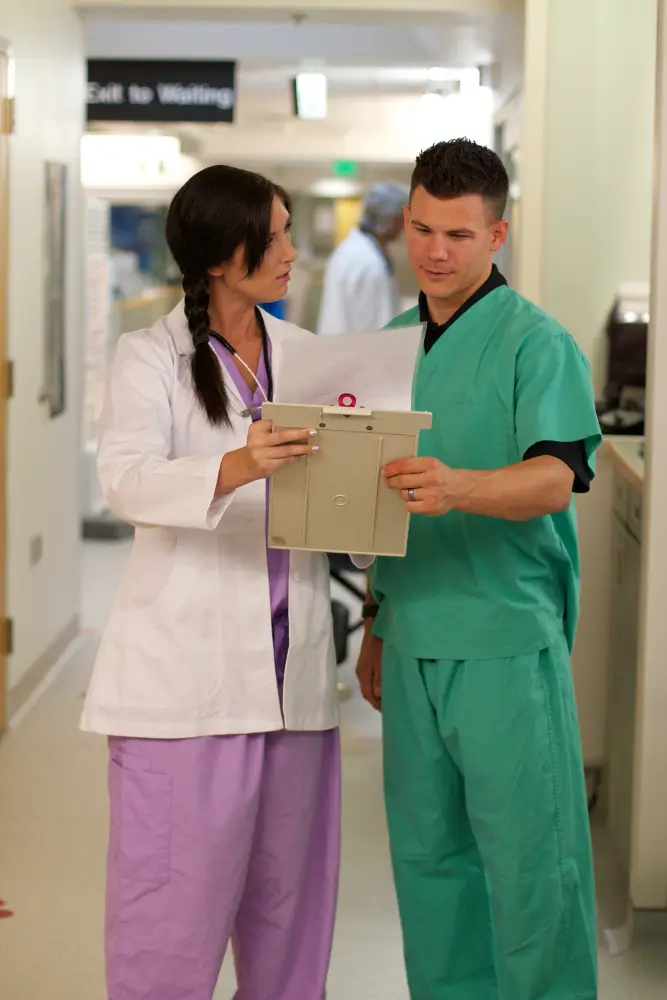
The doctor did not look like a man delivering good news.
He stepped out of the delivery room, caught my arm before I could push past him, and guided me several feet down the hall, away from the nurses and the family waiting area. Rainwater still clung to the hem of my pants from the dash in from the parking lot. Somewhere behind the swinging doors, a baby was crying.
“Mr. Ortega,” he said, lowering his voice, “I need you to stay calm.”
I almost laughed. Calm. I had spent months acting like a king preparing for his heir, and now this man had his hand locked around my forearm like I might bolt.
“Is Renata okay? Is the baby okay?”
He released my arm but did not soften. “The baby is stable. The mother is stable. That is not the issue.” He glanced once toward the delivery room, then back at me. “This child is not yours.”
For a second I genuinely thought I had misheard him. I stared at him, waiting for the correction, the explanation, the sentence that would tell me he meant something else. A paperwork issue. A lab mix-up. A misunderstanding involving insurance forms.
“What the hell are you talking about?” I said.
He inhaled slowly, as if he had already rehearsed this conversation and hated every version of it. “On admission, we reviewed transferred prenatal records from Renata’s previous provider. Her estimated due date does not match the timeline she gave this clinic. Based on those records, and on the condition of the baby at birth, conception happened well before the date you listed as the beginning of your relationship.”
Heat climbed into my face. “No. That’s impossible.”
“I’m afraid it isn’t.” He kept his tone professional, but there was something hard in his eyes now. “There are enough inconsistencies here that I felt obligated to speak to you privately before you signed the birth paperwork.”
I shook my head. “You can be wrong about dates.”
“Not by that much.” He handed me a copy of the intake summary. Weeks. Dates. Prior scans. Weight. Notes from a physician in San Antonio. And then, near the emergency contact section on the original file, another name.
Mauricio Vela.
My mouth went dry.
“Who is that?” I asked, though the sound that came out barely qualified as a voice.
The doctor folded his hands. “That is a question for Renata.”
Behind him, through a narrow glass panel in the door, I caught a glimpse of a nurse wheeling a bassinet past. The baby inside had a thick head of dark hair visible beneath the hospital cap. The nurse moved too quickly for me to see more, but I did not need to. Something deep and primitive had already started caving in.
I walked straight into Renata’s recovery room.
She was pale, sweaty, and half propped against pillows, her hair clinging to her forehead in damp strands. For one split second she smiled when she saw me, and I saw the future I had paid for flicker in her face like a light about to burn out.
“Is he beautiful?” she whispered.
I held up the paperwork. “Who is Mauricio Vela?”
The smile disappeared. For a beat she said nothing, and in that silence every lie we had ever built together stood up and introduced itself. She looked away first.
“Julian, not now,” she murmured.
“Not now?” I stepped closer. “The doctor just told me this baby isn’t mine. Tell me he’s wrong.”
She swallowed hard. “It’s complicated.”
That was the moment I knew. Not because she confessed. Not because the doctor had records. Not even because another man’s name sat on a form where mine should have been. I knew because guilty people do something honest people never do when truth arrives: they start negotiating with reality instead of denying it.
“How long?” I asked.
She closed her eyes. “I was going to tell you.”
“When? After I signed my name? After I brought him home? After I put him in the nursery I paid for?”
Tears slipped from the corners of her eyes. A nurse appeared in the doorway and told me I needed to lower my voice or leave the room. I wanted to keep shouting. Instead I backed away, numb with a humiliation I had not yet understood was not entirely Renata’s doing.
My phone was vibrating in my pocket. I ignored it once, then again. On the third call I pulled it out and saw seven missed calls from Elena, Camila’s older sister. My stomach tightened for a different reason. There was a voicemail. I stepped back into the hallway and hit play.
“Julian, answer your phone. Camila’s at Memorial Women’s. She went into labor early and there were complications. She didn’t want me to call you, but they needed information and I am not letting your pride make this harder than it already is.”
The message ended with a sound that chilled me more than the doctor’s whisper had. Elena was crying.
For a moment the hallway tipped sideways.
On one side was the private clinic I had chosen to celebrate the future I thought I deserved. On the other side, suddenly and brutally real, was the woman who had stood beside me when I had nothing, laboring without me because I had thrown her out like a problem I no longer wanted to manage.
I called Elena back. She answered on the first ring.
“How bad is it?”
“You don’t get to sound concerned now.” Her voice was hard and precise.
“Elena.”
“Her blood pressure spiked. They rushed her in. She’s been asking us not to tell you, and after what you did, I almost listened.” Her voice broke. “If anything happens to her.”
She did not finish. She did not need to.
I left the clinic without another word to Renata. Rain hammered the windshield so hard on the drive across Houston that the road looked underwater. Every red light felt personal. Every memory arrived with the same cruel timing.
Camila asleep at the kitchen table after a night shift with invoices spread around her, her head resting on her forearm, still in her work clothes, having stayed up to keep the accounts straight on a business that was more my ego than my plan. Camila handing me grocery money from tips she had hidden away in an envelope under the kitchen shelf, the winter my revenue dropped and I could not bring myself to admit it to her because I was too proud to let her see me struggling. She had given me the money without making me ask, which was worse than if she had made me ask, because it meant she had already been watching and worrying and preparing without saying a word that might humiliate me.
Camila laughing in our first apartment, the one with water damage on the ceiling and a neighbor upstairs who appeared to be training for the Olympics in what sounded like wooden clogs. The ceiling leaked every time it rained and we had no bucket large enough and she had laughed at the absurdity of it until I laughed too, and somehow the laughter made the apartment feel like ours in a way that a nice place never would have. She had always been able to do that, find the version of a hard thing that was survivable.
Camila holding the ultrasound photo with both hands like it was something holy, her face so open and unguarded in that moment that it had startled me, because she did not often let me see that version of her, the version that hoped without reservation.
And me. Me choosing a woman in a red dress over all of it because I liked the version of myself reflected in her eyes. Because Renata had looked at me like I was still becoming, and Camila had known me when I had nothing to become, and I had confused memory with diminishment.
Memorial Women’s was nothing like the private clinic. The floors were older, the lighting harsher, the waiting area crowded with tired people and vending machine coffee. Elena was near the maternity desk with her arms crossed so tightly across her chest I thought she might crack a rib. When she saw me, her face went white with rage.
“You actually came,” she said.
I deserved worse than the disgust in her voice. “Where is she?”
Elena stepped forward until only inches separated us. “Do not walk in there acting like a husband. You stopped being that the night you made her carry her own bags out the front door.”
I looked past her toward the secured maternity wing. “Please.”
Her expression shifted, just slightly, from fury to exhaustion. “The baby is here,” she said. “A girl. She’s in observation for breathing support, but the doctors think she’ll be okay.”
My knees nearly gave out. “A girl?”
Elena’s eyes filled, though she refused to let the tears fall in front of me. “Camila lost a lot of blood. They got her stabilized. She just came out of surgery.”
Surgery. I leaned a hand against the wall because I no longer trusted my legs.
All at once I could see the entire shape of what I had done. While I was buying imported cribs and gold bracelets for a fantasy, my wife had been carrying our child through swollen ankles, sleepless nights, and fear. While I was pacing outside another woman’s delivery room, Camila had been fighting to bring my daughter into the world with her sister beside her instead of me.
Elena noticed something crack in my face. “What happened?” she asked.
I laughed once, and it came out broken. “The baby at the clinic isn’t mine.”
For the first time since I arrived, Elena looked stunned. Then she gave a small, bitter shake of her head. “So that’s what it took.”
There was no defense for that. None.
A pediatric nurse led me to the nursery window. My daughter was in a small heated bassinet with a tiny tube under her nose and one fist curled against her cheek. She was impossibly small and impossibly real. Her skin was pink. Her hair was dark like Camila’s. One of her socks had slipped half off, and some animal part of me wanted to reach through the glass and fix it.
“Her name is Lucia,” Elena said quietly.
Camila had chosen a name without me. The fact that it hurt was proof of how selfish I still was. I had forfeited that right. Even so, standing there looking at my daughter, I understood with humiliating clarity that I had almost traded the only real thing in my life for a lie wrapped in perfume.
I sat outside Camila’s room for two hours before the nurse allowed me in.
She looked smaller than I had ever seen her. The hospital gown swallowed her frame. Her lips were dry. Her hair was braided loosely over one shoulder, and there was a waxy exhaustion to her skin that terrified me, not because she looked fragile but because I had done this. Not the labor, not the complications, those had their own causes. But she was here without me, had been here through all of it without me, and I had made that choice by a series of smaller choices over months that I had told myself were just about me and Renata, as if a marriage could be partitioned that cleanly, as if what I was doing to myself in private was somehow not also what I was doing to her.
When she opened her eyes and saw me standing there, no fear crossed her face. Only recognition. Then distance.
“Elena called you,” she said. It was not a question.
I moved closer to the bed and realized every apology I had rehearsed on the drive over now sounded filthy. “Camila, I’m sorry” was not enough for betrayal. It was not enough for abandonment. It was not enough for laboring alone. So I told the truth instead.
“I was at the clinic with Renata,” I said. “The doctor told me the baby isn’t mine.”
She blinked once. That was all. She was too tired even for shock.
“I didn’t come here because of that,” I added quickly, hearing how weak it sounded even as I said it. “I mean, I came as soon as I found out about you. But I’m not here because she lied. I’m here because I should never have left you alone in the first place.”
Camila looked at the ceiling for several seconds before answering. “Do you know what the worst part was?”
I could not speak.
“It wasn’t finding the messages,” she said. “It wasn’t even hearing you tell me to leave. It was realizing that while I was still loving you, you had already turned me into a burden in your mind.” Her eyes shifted back to mine. “I could survive your cheating. What broke me was seeing how little mercy you had left for me.”
I felt every word exactly where it was aimed. Not at my pride. At whatever was underneath my pride that I had spent years burying under accomplishment.
I moved to the side of her bed but did not touch her. I had lost the right to reach for comfort from the person I had destroyed.
“Tell me what to do,” I said.
Her laugh was soft and devastated. “That is still such a Julian question. You think there’s a task for this. A contract. A fix. A sequence of steps that gets you back to where you want to be.” She swallowed painfully. “There isn’t.”
Tears burned my eyes for the first time that day. “I know I don’t deserve another chance.”
“No,” she said. “You don’t.”
The bluntness of it did not feel cruel. It felt clean.
She turned her face toward the window. “But Lucia deserves a father who learns how to show up. So if you’re finally done performing for yourself, show up for her. Not for me.”
Those last three words cut deeper than if she had screamed.
The consequences spread out in two directions over the following weeks.
On one side there was Renata. The DNA test confirmed what the doctor already knew. The baby belonged to Mauricio Vela, a man she had dated before me and kept chasing after he left. She admitted, in a voice stripped of glamour, that she had transferred clinics because the original due date would have exposed everything sooner. She said she had not planned it exactly, that she had only panicked, that she thought I was rich enough and vain enough to accept the timing if I wanted the fantasy badly enough.
She was right about one thing.
“You were already leaving your wife,” she said during our last conversation. “Don’t act like I invented the man you became.”
I stood in her apartment surrounded by expensive furniture I had paid for and realized I hated her less than I hated the accuracy of that sentence. She had lied. She had used me. But she had found the door open. I instructed my lawyer to remove my name from everything related to the child. I took back no gifts. I made no threats. I simply ended it. Mauricio eventually resurfaced when the paternity results became official, and that mess became theirs to live with.
On the other side there was Camila and Lucia, and that was where the real debt began.
I moved out of the house because it had never been mine alone, regardless of whose name sat on more of the paperwork. I transferred the property to Camila as part of the divorce settlement. I gave her the company shares she had informally helped protect in the early years, the ones any honest court would have counted anyway if she had wanted to fight. She did not ask for war. She asked for peace.
I started therapy. My mother had taken one look at me in the hospital hallway and said, “Whatever is broken in you did not start with that other woman, and if you don’t dig it out, you’ll poison your daughter too.” So I dug.
The digging was not dramatic. No single session where everything cracked open and reformed. Just the slow, uncomfortable work of sitting across from another person week after week and being asked to explain myself honestly, which is harder than it sounds when you have spent years arranging your explanations for maximum favorable impression. My therapist had a way of waiting through my polished versions of events until I got bored of performing them and said something true by accident. Then she would lean forward slightly and ask me to stay with that.
I learned unpleasant things about myself. How quickly I equated admiration with worth. How success had made me cruel because I had always secretly feared being ordinary again, and rather than sit with that fear, I had simply surrounded myself with people and things that reflected a version of myself I could respect, and when the people who had known me before began to feel like evidence of who I used to be, I had started treating them as something to move past. How I treated the people who loved me as witnesses to my lowest years, and once I grew ashamed of those years, I started resenting the witnesses. Camila had witnessed the worst of me and loved me anyway. I had repaid that by deciding her loyalty was proof she was beneath me.
None of those insights won Camila back. They were not supposed to. What they did was teach me how to be present without demanding that my presence be celebrated.
I sat in the NICU with Lucia after work on the days they allowed it. I learned how to hold the bottle at the right angle, which took longer than it should have because I kept tilting it wrong and she would suck in air and fuss. I changed diapers badly at first, then less badly, then eventually with the competence of someone who has simply done the thing enough times that the incompetence fades. I took a parenting class on Tuesdays evenings in a church basement with fathers who did not know or care that I had once considered myself important. I showed up to pediatric appointments and learned which vaccines caused which reactions and what temperature warranted urgent care versus monitoring. I answered calls from Elena on the first ring even when I suspected the call was going to be painful, which it usually was. I stopped treating money and regret as interchangeable, as if signing large checks could balance a moral account that was denominated in something else entirely.
Camila watched all of it with the caution of someone approaching a dog that had bitten her once already. When Lucia came home from the hospital, I did not move back in. I brought groceries to the porch, assembled a crib in the nursery Camila chose, then left when Elena gave me the look that meant my time was up. Little by little, Camila allowed longer visits. Then shared feedings. Then afternoons at the park. Never romance. Never softness mistaken for invitation.
Six months later, our divorce became final. The judge asked if the settlement was voluntary. I said yes. Camila said yes. Our lawyers signed. The stamp came down, and a marriage that had survived poverty, long hours, and years of uncertainty ended not with drama but with paperwork and a silence so complete it felt sacred.
Outside the courthouse, I told Camila I was sorry one last time. She adjusted Lucia on her hip and studied me with an expression I could not quite name. It was not forgiveness. It was not hatred either. Maybe it was the colder, harder thing that sometimes arrives after both.
“I believe you’re trying now,” she said.
I waited.
“But trying after the damage is not the same as not doing it.”
Then she walked to her car.
That should have been the end of us, and in the way that mattered most, it was.
A year later I was still in Lucia’s life. I had a smaller apartment, fewer illusions, and a calendar organized around custody schedules, school forms, and pediatric checkups. The kind of calendar that belongs to an adult who shows up without expecting applause for it.
There was a period, in the early months, when I had still been performing my own redemption, arriving with the right expression and the careful evidence of a changed man, and Elena had seen through it and told me without softness that presence was not a gift when the person receiving it could see you counting it as credit. That had been useful information. I stopped thinking about what Camila owed me for my improvement. She owed me nothing. What I had was the obligation to show up regardless of whether the terms felt generous to me, and to do so without making her feel that my showing up was a transaction she should feel grateful for.
Camila had found her footing again. Some of the softness returned to her face, but it was no longer for me. It belonged to Lucia, to herself, to the life she had rebuilt without waiting for me to become worthy of it. She had gone back to work at a firm that valued her. She had started running in the mornings. She had repainted the living room a color I would not have chosen, and it was better than anything I would have chosen.
On Lucia’s second birthday, Camila let me stay through cake and presents instead of asking me to leave right after. It was a small family gathering, and the fact that I was permitted to remain for all of it rather than the designated hour felt significant in the specific way that small permissions feel significant when the larger ones are gone. Lucia got frosting on my shirt and laughed so hard she hiccupped. Camila laughed too, involuntarily, her hand coming up to cover her mouth the way it used to when something caught her off guard, and for one dangerous second the room looked like the life I had thrown away.
Then the second passed, and it was just a birthday party, and I was just the father of the birthday girl, which was the only thing I had earned the right to be.
When I was leaving, I stood at the doorway that used to be mine and turned back. Camila was wiping Lucia’s hands with a damp cloth, focused and gentle, entirely absorbed in her daughter. She looked up at me with the expression of someone who has made peace with an outcome they did not choose.
“Goodnight, Julian,” she said.
Not “I love you.” Not “stay.” Not even “thank you.” Just my name, spoken without bitterness, as if she had finally placed me in the correct category of her life.
I drove home knowing the answer had already arrived. I had not been restored. I had been allowed to become useful, which was smaller than what I had hoped for and larger than what I deserved.
People who hear this story often focus on Renata’s lie, as if that was the tragedy. It was not. Her deception was only the mirror that forced me to see my own. The real ruin happened much earlier, the night I watched my pregnant wife walk out of our house with two suitcases and called it freedom.
I still show up for Lucia. I always will. Camila and I co-parent carefully and respectfully now, with boundaries built from pain and maintained by discipline. She never came back to me, and I eventually understood that this was not punishment. It was the natural consequence of a woman deciding that her life was worth more than waiting for a man to become what he should have been.
Maybe that is what divides people when they hear what happened. Some say a man who changes should be forgiven. Others say some betrayals do not earn restoration, only responsibility. After everything I did, I no longer know which answer is kinder. I only know that becoming a better father did not make me a better husband in time, and the woman I destroyed had every right to heal somewhere my remorse could not reach her.

Ethan Blake is a skilled Creative Content Specialist with a talent for crafting engaging and thought-provoking narratives. With a strong background in storytelling and digital content creation, Ethan brings a unique perspective to his role at TheArchivists, where he curates and produces captivating content for a global audience.
Ethan holds a degree in Communications from Zurich University, where he developed his expertise in storytelling, media strategy, and audience engagement. Known for his ability to blend creativity with analytical precision, he excels at creating content that not only entertains but also connects deeply with readers.
At TheArchivists, Ethan specializes in uncovering compelling stories that reflect a wide range of human experiences. His work is celebrated for its authenticity, creativity, and ability to spark meaningful conversations, earning him recognition among peers and readers alike.
Passionate about the art of storytelling, Ethan enjoys exploring themes of culture, history, and personal growth, aiming to inspire and inform with every piece he creates. Dedicated to making a lasting impact, Ethan continues to push boundaries in the ever-evolving world of digital content.