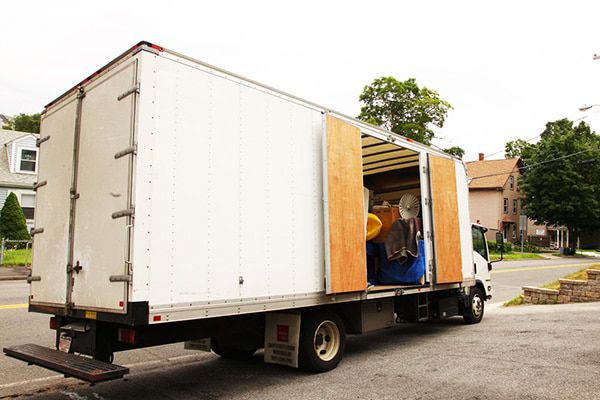
The moving truck was parked half on my driveway and half on the grass I paid a landscaping crew to keep in the particular condition that makes a house look like it belongs to someone who has never had to wonder about money. It was early October outside Chicago, the kind of evening where the air carries the smell of wet leaves and something burning pleasantly somewhere down the street, the last warmth of the year gathering itself before it gives up entirely. Inside the house, expensive candles were already arranged for a weekend that was supposed to be the beginning of something. My wedding dress hung upstairs in the spare closet, still in its garment bag, still waiting. The seating chart was on the kitchen island next to a glass I’d left there that morning, half-full of coffee I’d forgotten to finish. The rehearsal dinner was less than twenty-four hours away.
And my fiancé was on the truck ramp, carrying one of his mother’s cardboard boxes into my house.
Not our house. Mine.
My name is Allison, and I want to be precise about something before anything else: I am not a person who makes mistakes about what she owns. By thirty-three I had built a life that most people only glimpsed from the outside, after it had been polished into something that looked like luck. Five bedrooms on a quiet street lined with maples that go gold in October and look like something from a painting. A firm with my name on the door. A calendar that runs fourteen months in advance and contains, at any given time, more court hearings and corporate audits and confidential client meetings than most people navigate in a decade. I run a financial forensics firm. My job, distilled to its cleanest form, is finding the numbers people bury. I have put together cases that unraveled schemes hidden behind three layers of shell companies and seven years of falsified filings. I have sat across from men in very expensive suits and watched them understand, in real time, that the thing they believed was invisible had been visible all along.
Somehow, I had missed the numbers living under my own roof.
Brandon saw me before I reached the porch. Something moved across his face fast enough that someone less trained at reading faces might have missed it, not fear exactly, more the specific expression of a man who has been caught repositioning a piece on a board he believed only he could see. Then he smiled, and the smile was warm, and practiced, and landed the way his smiles always did, comfortably, as if warmth were the most natural thing in the world.
“Allison, babe,” he said, shifting the box higher against his chest. “You’re home early.”
Behind him, the truck held what appeared to be an entire household. Boxes labeled in thick black marker: Brenda, summer wardrobe. Brenda, kitchen things. Brenda, bedroom. That last one I read twice.
I looked at the truck. I looked at the house. I looked at the man I was supposed to marry in two days.
“What is this?” I asked.
He sighed in the particular way that frames the other person’s entirely reasonable question as an overreaction before they have finished asking it.
“Mom’s landlord pulled something awful. She had to be out today. I couldn’t just leave her with nowhere to go.”
I knew Brenda Marsh the way you know a weather system that has been hovering at the edge of your life for two years, close enough to affect the atmosphere, never quite making landfall until suddenly it does. She had spent those two years telling anyone who would listen that she maintained a downtown condominium, a healthy retirement account, and what she called standards, by which she meant a specific set of preferences regarding thread count, restaurant reservations, and the social weight of other people’s professions. She wore pearls to casual lunches and corrected the pronunciation of menu items at places that served ten-dollar sandwiches. She once stood in my kitchen and looked around with an expression of measured sympathy and said, “Well, at least Brandon will bring some warmth into this place,” a sentence I had placed in a mental file and never discarded.
Now her boxes were on my lawn, and her son was carrying them across my threshold with the body language of someone doing something entirely reasonable.
I walked inside.
The first-floor guest suite was empty. The second guest room, the one with the queen bed and the window that looks over the backyard where the roses I planted three years ago still come back every spring, was also empty. The sound was coming from upstairs.
From my bedroom.
I walked up and stood in the doorway and took in what was in front of me with the careful, deliberate attention I use in depositions, when I need to see everything before I decide what to say about any of it.
Brenda was standing inside my walk-in closet. She was removing my leather work bags from the shelves and placing them in the hallway with the brisk efficiency of someone sorting items at a donation center, things of no particular significance belonging to no one in particular. She was dressed in a cream-colored blouse and looked entirely untroubled. The bags she was handling were not untroubling to me. They were the ones I bought after my first seven-figure case, when I understood for the first time that the work was real and lasting and mine. The briefcase in the pile was the one I carried into federal court on the day a boardroom full of executives learned that their CFO had been routing company money through a series of trusts connected to his brother-in-law’s landscaping company. I had bought that briefcase specifically for the occasion because I believed, and still believe, that the way you carry yourself into a room matters.
Brenda did not look guilty because it had not occurred to her to be.
“Oh good,” she said, without turning around. “You’re home.”
She held up one polished finger in the direction of the closet.
“You have far more space in here than one person needs. I’ll need this whole section for my seasonal things. We can figure out a system.”
I stood still and listened to the soft thud of another bag landing on the hardwood floor.
“You’re moving into my bedroom,” I said.
It was not a question. I was stating what I was looking at.
Brenda smiled in the patient way of someone explaining something obvious to someone who is being unnecessarily slow about understanding it.
“Brandon lives here,” she said. “You’re getting married on Sunday. Family shares these things. It’s not complicated, Allison.”
Brandon appeared behind me in the doorway, rubbing the back of his neck with the particular gesture he used when he wanted to signal that he was uncomfortable without actually doing anything about the source of the discomfort.
“Mom’s had a really terrible day,” he said quietly. “Can we not add to it?”
I looked at him and waited.
I was not waiting for a monologue. I was not waiting for grand declarations or elaborate performances of loyalty. I was waiting for one sentence, the most basic and obvious sentence available to a person in his position. Something as simple as: Mom, this is Allison’s room. Or: Mom, we need to talk before we move anything. Or, at bare minimum: Mom, let’s put her things back on the shelves.
Instead he looked at the floor and then back at me with the careful expression of a man who has already decided which side of this he is on and is hoping I will make his position easier to maintain.
“The guest bed is hard on her back,” he said. “I just thought, maybe for tonight, you could take the sectional downstairs. It’s really comfortable. You’ve said so yourself.”
The silence that followed was not empty. It had a specific texture and weight to it.
Brenda watched me from inside my closet with an attention that was not unkind exactly but was evaluating, the way a card player watches another player who has just been dealt a hand they need to assess. Brandon watched me with nervous hopefulness, the expression of a man counting on the fact that the calendar said Sunday and hoping that was enough leverage.
They both understood what they were doing. They were counting on the wedding date. They were counting on the idea that I had too much invested in the weekend ahead to be willing to make it complicated, that I would absorb the immediate indignity to preserve the larger plan, that I would do what I had been doing for two years, which was make room and call it love.
Two years.
I had made room for Brandon in my schedule, reorganizing client calls and court prep around his preferences without being asked to explain why I was doing it. I had made room for him in a house I had bought, furnished, and maintained entirely on my own, where he paid eight hundred dollars a month toward utilities and called this contributing while I paid the mortgage that did not exist because I had bought the house with cash, and paid the property taxes and the insurance and the repairs and the groceries and the lawn service and the security system and the Italian marble countertops he leaned against while explaining to dinner guests what he meant by building something together.
I had let him say our place at client dinners. I had let Brenda call my firm your little accounting thing in front of my colleagues at a birthday party and smiled and said nothing. I had let both of them mistake the patience I extended as a choice for a kind of permission, as if silence were a signature on a document I hadn’t read.
Now I was standing in the doorway of my own bedroom watching his mother remove my things from my shelves while he suggested I sleep on the sectional, two days before our wedding, and the word he used, the specific word he chose, was heart.
“Come on, Allison.” His voice dropped into the register he used when he wanted to make my limits sound like personality flaws. “Have a little heart. It’s one night.”
Brenda turned from the closet and added, with the serene confidence of someone who has never lost an argument she cared about, “You sit at a desk all day, darling. One night on a sofa won’t damage anything.”
I looked at my bags on the floor. I looked at the woman in my closet. I looked at the man in my doorway.
“Okay,” I said.
Brandon blinked.
“What?”
“Okay,” I repeated. Same tone. Same volume. Just the word.
His shoulders dropped with a relief so immediate and complete that it was almost anatomical, a physical unburdening, and he exhaled and said, “Thank you, babe. I knew you’d understand. I knew it.”
Brenda gave a small satisfied nod and turned back to my shelves.
I bent down and picked up two of my bags from the hallway floor. The first one held my laptop. The second held my work phone, a portable scanner, and a collection of access credentials and encrypted tools that most people only encounter when they are already in serious trouble or being investigated for it.
“I’ll just grab what I need,” I said pleasantly. “I have some work to finish.”
Brandon leaned toward me to press a kiss to my forehead, the gesture of a man who has just managed a situation successfully. I had already moved toward the stairs before he got there. He pretended not to notice. I let him pretend.
Downstairs, the house was quiet in the way it gets late on autumn evenings, the particular silence of a house in which a great deal has been planned and arranged and is waiting for something to begin. The caterer’s confirmation was on the kitchen island beside a sample menu card with gold-foil lettering and a small sprig of dried lavender someone had attached with a ribbon. The florist had delivered white roses that morning and they were arranged in a tall glass vase near the window. A bottle of wine stood by the sink, still sealed, chosen weeks ago for the night before the rehearsal dinner.
I walked past all of it and went into my office.
That room was the one space in the house Brandon had never entered without asking first, not because he respected it in any principled way but because he didn’t understand it, and things he didn’t understand made him vaguely uneasy in a way he preferred not to examine. Three monitors. A lockable filing cabinet in gun-metal grey. Soundproof panels installed when I started taking on cases that required absolute discretion. Client records secured behind the kind of encryption that appears in legal proceedings as evidence of professionalism rather than secrecy.
I closed the door. I turned the lock. I set my bags on the desk and stood there for a full minute without turning on a single screen.
I let myself feel the floor under my heels, which I hadn’t taken off. I let myself feel the particular exhaustion of a person who has been managing someone else’s comfort for so long that she has forgotten to notice how much it costs. I felt the specific humiliation of being moved out of my own bedroom like an inconvenient piece of furniture that didn’t fit the new arrangement, and I let myself feel it completely rather than packaging it into something more manageable.
Then I sat down and opened my laptop.
The previous spring, Brandon had asked me to file his taxes. He called it couple stuff, which was how he categorized any task he found tedious and wanted done. He had given me login credentials for his computer, his bank accounts, his investment statements. He had done this casually, without apparent awareness of what he was handing to a woman who spent her professional life following financial trails through documents most people believed were private. I had filed his taxes, found three deductions his previous accountant had missed, and said nothing about the access I now had or the other things I had incidentally seen.
I had not looked further at the time because I had chosen not to. That choice now felt like a different person made it.
I started with Brenda’s story.
There was no landlord crisis.
Public records do not know how to be discreet. They simply exist, indexed and retrievable, and if you know how to ask for them, they answer. I found the filings in under twelve minutes. There was no sudden tragedy, no unscrupulous landlord pulling the rug without warning. There were court documents. There were scheduled notices. There was a timeline that anyone reading it carefully would understand had been predictable for the better part of six months.
Brenda had not lost a rental apartment.
She had lost a condominium she owned to a foreclosure proceeding that had been moving through the relevant channels since spring.
The lockout had not happened that day out of nowhere. It had been coming for long enough that there had been time to plan around it, time to make arrangements, time to tell someone who was about to marry into the situation before she was two days out from the ceremony and standing in her own hallway watching her things get stacked on the floor.
I sat back in my chair and looked at the ceiling.
Then I kept going.
The next record I found detailed a series of cash advances across three different accounts, taken over a period of about eight months, some of them against Brenda’s condo equity before the foreclosure was finalized. The amounts were not small.
The record after that was more interesting.
Casino markers. Not the kind that suggest occasional recreation. The kind that suggest a long and expensive relationship with a specific category of bad decision.
I followed the trail with the steady, focused attention I bring to every case, the part of me that does not editorialize or react while it is still gathering, that simply moves from document to document and lets the shape of the thing emerge. It is not a comfortable skill to have turned on your own life. But it is accurate.
The account linked to Brandon’s personal email contained statements I hadn’t seen before because they were for accounts I hadn’t known existed. Opened eleven months ago. A line of credit against a financial product he had described to me, in general terms I’d accepted as vague but unremarkable, as “just some investment stuff I’m sorting out.”
Not investment stuff.
Debt. Concealed, accumulated, and serviced in ways that had required more active management than any innocent financial embarrassment would typically demand.
And then I found the credit cards.
Two of them. Platinum accounts, the kind with significant limits and the kind of fees attached to them that only make sense if you intend to carry large balances for extended periods. Both opened approximately six weeks earlier.
Both in my name.
Not Brandon’s name with my name added as a secondary holder. My name, primary, sole. My Social Security number. My credit history, which was the only thing in this picture that was genuinely excellent, being used as the foundation for someone else’s financial architecture.
The billing address was not my house. It was a private mailbox at a mail service location on the other side of the city, the kind of address people use when they need a legitimate-looking destination for things they don’t want arriving at their actual residence.
I looked at the balances.
Both maxed.
I put my hands flat on the desk and looked at the numbers on the screen and understood, with the clinical precision of a person who has sat across from a great many people who had done something like this and tried to hide it, exactly what I was looking at.
This was not a man who had been embarrassed and careless and hoped it would work itself out. This was a man who had made decisions. Deliberate, sequential decisions that required knowing things about me, accessing things that were mine, and constructing a structure designed to route consequences in my direction while he stayed adjacent to the wreckage and retained deniability.
The last soft thing I had been holding onto quietly, the part of me that had continued to arrange explanations and make allowances and tell myself that love involved a certain amount of willful blindness, went cold in a way that felt almost physical.
At seventeen minutes past two in the morning, my private phone rang.
I have two phones. My business line is known to clients, attorneys, and professional contacts. My private line is known to a much shorter list of people, selected for reasons of trust I had earned through actual evidence rather than assumption. When that phone rings after midnight, I answer it.
The name on the screen was Terrence.
Brandon’s brother-in-law. Married to his older sister, a quiet marriage that had always seemed to function as a kind of separate peace from the rest of the family dynamics. Terrence was a CPA with a specialty in estate planning, the kind of man who listened more than he spoke at family gatherings and who had a way of looking at things that reminded me, not always comfortably, of looking in a mirror. We had spoken professionally once, briefly, about an unrelated matter. He had my private number because I had given it to him after that conversation with the instinct, unexamined at the time, that it might matter someday.
“Allison.” His voice was low and careful. “Are you somewhere private?”
I looked at the locked door.
“Yes.”
“Good.” A brief pause. “Open your secure email. Right now.”
The file appeared in my encrypted portal less than forty seconds later. Terrence said nothing while I opened it, and I appreciated that about him. He let the document speak first.
The first page looked like wedding paperwork. Not in an alarming way, in the way of something that had been designed to look routine, to look like the kind of administrative formality that accumulates around a wedding, the kind of thing someone might set in front of an exhausted person at the end of a long emotional day and indicate with a pen and a reassuring smile was just standard, just a formality, just something the venue or the attorney or whoever needed for the records.
I read the clauses.
I read them the way I read every document that matters, slowly, starting from the definitions section, moving through each numbered provision without skipping anything because I have learned too many times that the thing that matters most is always in the part that reads most boringly.
My company. My intellectual property and client contracts and the professional reputation I had spent eleven years building case by case in rooms full of people who had initially not expected to take me seriously.
My house. The one I bought with cash when I was twenty-nine, the one with the maples and the roses and the office with the soundproof walls, the one where my wedding dress was hanging upstairs in a garment bag next to a bedroom my fiancé had just given to his mother.
My investment accounts. My retained assets. The financial infrastructure of a life I had constructed without any of the people currently sleeping in it.
Brandon’s name appeared in the document where mine had been.
Terrence’s voice came back, quieter than before.
“They were going to put it in front of you tomorrow evening. After the rehearsal dinner, probably. When you’d be tired and happy and not reading carefully.”
I thought about the wine on the counter. The gold-lettered menu card. The white roses.
“How long have you known?” I asked.
“Long enough to decide I couldn’t not call.” He paused again. “I’m sorry, Allison. I want you to know I argued against it. For whatever that’s worth.”
“It’s worth something,” I said. And I meant it.
We spoke for another twenty minutes. He told me what he knew, which was enough, and I told him what I had found, which clarified the rest, and by the time we finished talking, the shape of the entire thing was visible to me from multiple angles. The casino debt. The credit cards. The planned foreclosure of Brenda’s condo and the arrangement, decided well in advance of tonight, that she would move into my house after the wedding because the document Terrence had sent me would, if signed, have made my house a marital asset over which Brandon would have had legal claim. The truck on my lawn was not a crisis response. It was advance preparation. Brenda had not come because she had nowhere else to go. She had come because the plan called for her to be there.
After I ended the call, I sat quietly for a few minutes.
Not from indecision. From the particular discipline of knowing that how you do something matters as much as what you do, and that the note I was about to write needed to be exactly right.
I opened a blank document and thought about what I wanted to say and what I did not, what needed to be explicit and what could simply be implied by the presence of certain attachments. I thought about the woman upstairs in my bed, who had looked at my briefcase like it was something without value. I thought about the man who had handed her my room and called my objection a deficiency of heart. I thought about the document on my screen with my name moved to the wrong side of every line.
I saved copies of everything to my encrypted server and to a separate external drive I locked in the cabinet beside my desk. I sent a compressed file of the most important documents to my personal attorney, who has handled my contracts and property matters for six years and who I knew would be awake early.
Then I wrote the note.
It was not long. Length was not what the situation required. What it required was clarity, the specific clarity of a person who has read the document, followed the money, traced the accounts, and arrived at a set of conclusions that are not speculative.
I told him what I had found. The credit cards opened in my name. The balances. The private mailbox. The financial records that told a different story than the one I’d been given about his mother’s situation. The document Terrence had sent, which I named specifically and attached a copy of so there would be no confusion about whether I had actually seen it or was guessing.
I told him the wedding was cancelled. Not postponed. Not in need of discussion. Cancelled.
I told him that my house was my house, a fact recorded in public property records under my name alone, paid for in full three years before he had a key to it, and that I would expect him and his mother and everything bearing the label Brenda to be gone before I finished the meetings I had scheduled for that morning.
I told him that I had already sent the relevant financial documents to my attorney and to the fraud division of the relevant state agency, and that if the credit accounts opened in my name were not closed and the balances disputed through the appropriate channels promptly, the process that would follow would be both formal and public.
The last line was the one I thought about longest.
I wrote it simply, without elaboration, because it didn’t need any: I hope the couch was comfortable.
I printed two copies, signed one, and walked into the kitchen at twenty-three minutes before five in the morning. The white roses were still in their vase. The candles were unlit. The caterer’s gold-lettered menu card was right where I’d left it.
I set the note on the kitchen island.
Then I made myself a cup of coffee, sat down at the table by the window, and watched the sky above the maples go from black to the specific dark blue that happens just before dawn decides to commit, and I felt, with a certainty that sat entirely differently from anything I’d felt in the two years prior, that the life I had built was still mine.
It had always been mine.
I had simply stopped behaving as though I knew that.
The calls I made between five and seven that morning were brief and professional. My attorney, who was indeed awake, read the documents I sent and called back within fifteen minutes with a measured but unambiguous assessment. The credit fraud reports were filed before seven thirty. The relevant legal notices were prepared and ready to be served by the time the maples outside my window were fully visible in the morning light.
The caterer was gracious when I called. The florist less so, but professionally. The venue had a cancellation policy I was entirely prepared to absorb, because money spent not making a catastrophic mistake is not lost money.
I called my best friend Rachel at seven fifteen and told her everything in roughly the order it had happened, and she listened without interrupting, which is one of the things I value most about her, and when I finished she said, “I will be there in forty-five minutes,” and she was.
Brandon came downstairs at nine, sleep-creased and wearing the kind of easy morning expression that belongs to a person who has not yet remembered what happened the night before or what might be waiting for them. He saw the note before he saw me. I was sitting at the kitchen table with my second cup of coffee, watching.
I watched him read it.
I watched the expression change.
I did not say anything, because the note said everything that needed saying and I had written it for exactly this reason.
He looked up at me when he finished, and the thing on his face was not guilt initially, it was calculation, the brief, visible assessment of a person trying to determine whether the situation is recoverable. I recognized it because I had seen it on other faces in other rooms, men who had been caught and were not yet sure how badly.
Then he looked at my expression, and whatever he saw there told him what he needed to know.
I picked up my coffee cup and said, “The door code will be changed at noon. I’d recommend using the time efficiently.”
Then I walked back into my office and closed the door.
Rachel arrived at nine forty. She brought pastries and the particular kind of steadiness that comes from a person who has known you long enough to skip the part where you have to explain how you feel and go straight to what needs doing. We sat in my office and went through the remaining documentation while upstairs, the sound of boxes being moved traveled through the ceiling in the same direction it had traveled the night before, only this time in reverse.
By eleven thirty, the house was quiet.
By noon, the code was changed.
By the following Tuesday, both fraudulent credit accounts had been flagged, disputed, and closed. My attorney sent the appropriate correspondence. The relevant financial complaint was formally filed and acknowledged.
The wedding invitations had gone to sixty-four people. I wrote sixty-four personal messages explaining that the wedding would not be taking place, none of which included details beyond what was necessary, and most of which received responses so warm and immediate that I had to set my phone down several times to collect myself.
The white roses stayed in the vase until they were gone. I had paid for them and they were beautiful and there was no reason to throw them out.
The dress I returned. The deposit I recovered. The seating chart I put through the shredder in my office on a Tuesday afternoon in October when the maples outside were at absolute peak color, gold and orange against a sky so blue it looked deliberate, and I stood at the window for a moment before I sat back down to work and thought that the house had never looked more like mine than it did right now, in this particular light, with no one else in it but me.
I had built it for exactly this. A life that holds when tested.
It held.

Lila Hart is a dedicated Digital Archivist and Research Specialist with a keen eye for preserving and curating meaningful content. At TheArchivists, she specializes in organizing and managing digital archives, ensuring that valuable stories and historical moments are accessible for generations to come.
Lila earned her degree in History and Archival Studies from the University of Edinburgh, where she cultivated her passion for documenting the past and preserving cultural heritage. Her expertise lies in combining traditional archival techniques with modern digital tools, allowing her to create comprehensive and engaging collections that resonate with audiences worldwide.
At TheArchivists, Lila is known for her meticulous attention to detail and her ability to uncover hidden gems within extensive archives. Her work is praised for its depth, authenticity, and contribution to the preservation of knowledge in the digital age.
Driven by a commitment to preserving stories that matter, Lila is passionate about exploring the intersection of history and technology. Her goal is to ensure that every piece of content she handles reflects the richness of human experiences and remains a source of inspiration for years to come.