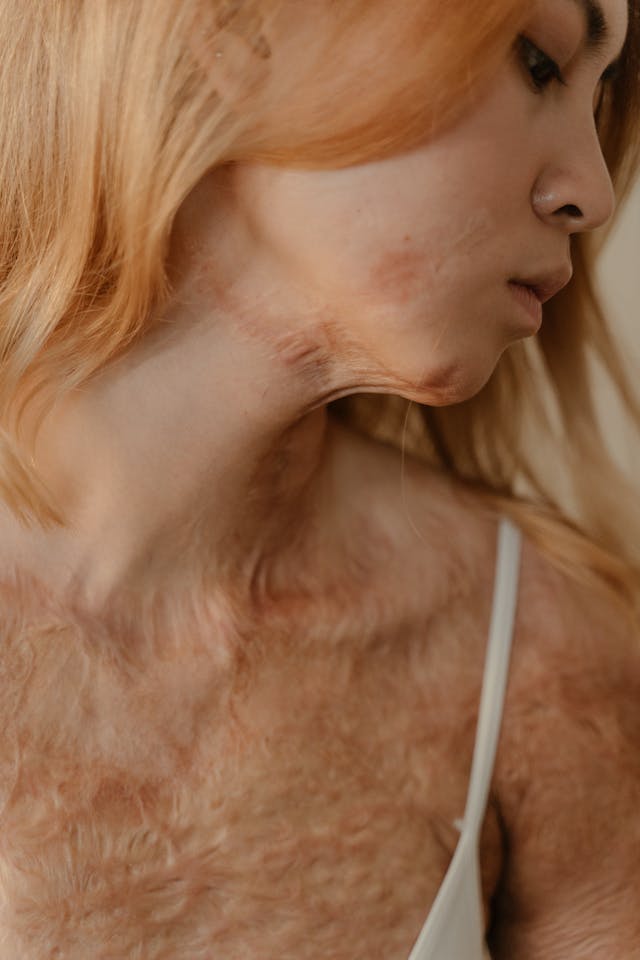
I was nine years old when the fire happened.
I woke up coughing, surrounded by smoke so thick I couldn’t see my bedroom door. Somewhere upstairs, my mom was screaming my name. By the time firefighters got us out, the kitchen had been destroyed, and parts of my face, neck, and arm were burned badly enough to leave scars that never fully faded.
Over the years, you get used to your reflection in the mirror. It takes longer than you think it will, and the process is not linear. There are mornings when you barely notice, and mornings when you stand at the sink for a full minute before you can make yourself move. You learn which angles of light are kinder. You learn what clothing covers what. You learn the particular calculation of how much makeup accomplishes what, and how much is simply too much effort for too little result.
What I never learned was how to stop noticing other people’s reactions.
The harder part of growing up was the looking. Nobody at school openly said cruel things, but I always noticed the looks, the whispers, the questions that kids asked with too much curiosity and not enough tact. It hurt in that low, persistent way that becomes background noise after a while. You stop expecting it to stop and start just managing it.
By my senior year, I had gotten good at acting as if it didn’t bother me.
I had a routine. Arrive early, leave by a side door when possible, sit at the back of the room where fewer people were looking. I had a small group of friends who had known me long enough that they had stopped seeing the scars the way strangers saw them. In most ways, my life was ordinary. I got decent grades. I liked writing and astronomy and making people laugh when I was comfortable enough to try. I just also happened to be the girl with the scars, and that fact shaped more of my decisions than I liked to admit.
So when prom came around, I told my mom I didn’t want to go.
“You can’t hide forever, Cindy,” she said. “One bad thing already changed your life once. Don’t let it keep deciding things for you. Prom happens once in a lifetime.”
She wore me down the way she always did, patient and sure of herself, and eventually I agreed. We bought a dress, curled my hair, and I spent an hour doing makeup that mostly covered the scars on my neck. Standing in front of the mirror before leaving, I thought I looked almost normal. Whatever that meant.
The second I walked into prom, I regretted coming.
The gym looked beautiful. Lights hung from the ceiling, and music blasted through the speakers. But all my classmates were taking photos, dancing, and laughing in their own closed circles, and I was standing alone near the drinks table pretending to text people who weren’t texting me.
After almost an hour, I was ready to leave.
Then Caleb walked over.
Everybody knew Caleb. He was in my class: popular, tall, handsome, and the football captain. The kind of person other people arranged their attention around. So it was strange when he stopped in front of me, looking not like the confident football captain but like someone trying to get something important right.
He held out his hand and asked, “Would you please dance with me?”
I thought he was joking. I actually looked around for a second to see if his friends were watching and laughing. They weren’t. Or at least, if they were, they weren’t what he was looking at.
He was looking at me.
So I took his hand.
The second he led me onto the dance floor, people stared. I caught girls whispering. A few guys looked completely shocked. Caleb ignored all of them, and after a while, I found I could too.
We danced for most of the night. Somewhere along the way, I stopped feeling invisible. He made me laugh. He talked to me like a person and not like someone to be careful around, which sounds like a low bar but felt enormous in that gym with everyone’s eyes on us. By the end of the night, I didn’t even want prom to end anymore.
Afterward, Caleb walked me home instead of leaving with his friends.
“You had fun tonight?” he asked.
“Yeah,” I admitted. “More than I expected.”
He smiled, but something about him seemed distracted, like there was something he wanted to say but couldn’t quite get out. We walked the last two blocks mostly in silence, and when we reached my house we stood awkwardly on the porch steps for a moment.
“Thanks for tonight,” I said.
Caleb shoved his hands into his pockets and nodded. He looked at me seriously and said, “I’ll see you,” and then he walked away.
I stood on the porch and watched him go, trying to figure out what had just happened and not quite managing it.
The following morning, loud banging shook the front door.
I came downstairs half asleep and immediately froze at the bottom of the stairs. My mom had answered, and I could see her talking to two police officers. Beside them on our porch stood a man and a woman I recognized after a moment as Caleb’s parents, both of them looking like they hadn’t slept.
Everyone turned toward me.
A knot formed in my stomach.
One of the officers stepped forward. “Cindy, when was the last time you saw Caleb?”
“Last night after prom. He walked me home.”
“Did he say where he was going afterward?”
“No. Why? Did something happen?”
The officers exchanged a look. Then one of them said something that made my stomach drop.
“Miss, do you really not know what Caleb has done?”
I stared at him. “What?”
The officer spoke carefully. He said that their department had recently reopened several old reports connected to incidents from years ago. During that process, Caleb had admitted he was near my house the night of the fire almost ten years ago.
For a second I couldn’t even process the words.
“What do you mean he was there?”
The officer took a breath. “Caleb witnessed something connected to your house fire when he was nine years old.”
“What kind of something?”
Before the officer could answer, Caleb’s father suddenly spoke. His voice was strained, almost desperate. “He never meant for any of this to happen.”
The officer explained that Caleb’s older brother, Mason, had a history of getting into trouble as a teenager. That night, Caleb secretly followed Mason on his bike and saw his brother exiting my house shortly before the fire started. Recently, Caleb finally told his parents part of what he had seen because Mason was about to be released after serving time for a different crime.
But that morning, Caleb’s parents realized he was gone. He wasn’t answering calls. His truck was missing. After hearing from another parent that Caleb had spent prom night with me, they thought maybe I knew where he was.
I told them I didn’t.
Technically, that was true.
But after they left, I couldn’t stop thinking about the one place Caleb and the football guys always used when they wanted privacy. The abandoned factory site near the edge of town. Before I had time to talk myself out of it, I told my mom I needed fresh air, grabbed my backpack, and headed for the bus stop.
For the first time since the accident, I felt like the truth about that fire was finally close. And I needed to hear it from Caleb himself.
The bus dropped me three blocks from the spot. The old factory had been shut down for years and was mostly broken windows, graffiti, and teenagers trying to avoid adults. I spotted a group of football players sitting near one of the buildings almost immediately.
The second they noticed me walking toward them, the conversations stopped. A couple of them exchanged looks. One guy laughed under his breath. I ignored it all and kept walking until I stopped in front of them.
“Has any of you seen Caleb?”
Nobody answered at first. Then one of the boys leaned back against the wall and smirked. “Why? Are you his girlfriend now?” A few of them laughed.
I should have turned around, but after everything I had heard that morning I wasn’t backing down. “I just need to talk to him.”
Most of them avoided eye contact after that. Finally, a player named Drew spoke up. “He might be at Taylor’s place.” The others looked at him. Drew shrugged. “What? We all know they’re secretly dating.”
That came as a surprise to me. I hadn’t known anything about Caleb and Taylor.
“Taylor with the piercings?” I asked.
Drew nodded. Her parents were out of town for the weekend.
I asked for the address, thanked him, and left before anyone said anything else.
Twenty minutes later, a taxi dropped me off outside a small blue house. I knocked. Taylor answered in an oversized sweatshirt and looked genuinely shocked to see me standing on her porch.
“Cindy?”
“I’m sorry for showing up like this, but the police and Caleb’s parents came to my house this morning looking for him.”
The second I said Caleb’s name, her expression changed. Then I heard footsteps behind her, and Caleb appeared looking exhausted, like he hadn’t slept at all.
The moment he saw me, his face went pale.
“Cindy.”
I folded my arms. “You were there the night of the fire?”
For a second, nobody spoke.
Then Caleb stepped outside. “Yeah,” he admitted.
Hearing him say it out loud made my stomach twist.
“What happened?”
Caleb looked down while he spoke.
“When I was nine, I saw Mason sneak out of our house late at night. He used to do stuff like that all the time back then, and I followed him on my bike because I thought it was some kind of fun game. I lost sight of him for a while, but eventually I spotted him climbing out of a window at your house. Then, a few minutes later, I noticed smoke coming from the kitchen.”
He swallowed hard.
“I got scared and rode home. The next morning, when everyone started talking about the fire and what happened to you, I kept thinking that if I told anyone, Mason’s life would be over. So I stayed quiet.”
“You were nine,” I said.
He looked at me. “I know. But that didn’t make it easier to live with.”
He told me that Mason kept getting into more trouble as he got older. Juvenile detention. Fights. Eventually, prison for something unrelated. But Caleb never stopped thinking about that night. Especially not after starting the same school as me years later.
“Initially, I tried avoiding you,” he admitted. “Every time I looked at you, I thought about the fire. But avoiding you became impossible. Classes, hallways, football games, group projects. You were always there. And after a while, guilt turned into something else.”
Taylor stood behind us in the doorway, quietly listening.
Then Caleb told me something I hadn’t expected.
Before prom, he had overheard some guys joking about how nobody would ask me to dance.
“I snapped at them. One of them almost punched me over it.”
He looked at me steadily. “I didn’t ask you to dance because I felt sorry for you. I did it because I was tired of pretending I didn’t care about you.”
I didn’t know what to say to that.
He explained that after walking me home, he had come to Taylor’s because he needed to talk to someone he trusted about finally telling me the truth. He had planned to come and find me today.
We stood there quietly for a moment. Then I asked the question that still bothered me most.
“Why would Mason do something like that in the first place?”
Caleb shook his head slowly. “I honestly don’t know.” He hesitated. “But maybe it’s time we asked him ourselves.”
An hour later, Caleb was driving us to the correctional facility two towns over. Taylor stayed in the car while Caleb and I went inside for the visitation.
The drive took about forty minutes on back roads through flat farmland. Neither of us said much. I watched the fields go by out the window and tried to think about what I was actually going to say, but my mind kept drifting. I had grown up with a story about my own life that had a gap in the middle, a blank space where the cause should have been. An accident. Bad luck. Wrong place, wrong time. I had accepted that story because there was no other one available.
Now I was driving toward a different one.
The lobby of the correctional facility smelled like industrial cleaning products and recycled air. A guard checked our IDs, explained the rules, and walked us through what felt like three sets of doors before we reached the visitation room. The room had tables bolted to the floor and chairs bolted to the tables. Fluorescent light without mercy.
The entire drive there, my stomach had been in knots. I had spent years imagining what Mason must be like, building him into something monstrous because it was easier than not understanding. When he walked in, he just looked tired and older than his age. He walked the way people walk when they have been carrying something heavy for a long time.
The second he saw me sitting beside Caleb, his face fell.
Nobody spoke at first. Then I leaned forward and asked the only thing I cared about.
“Why did you do it?”
Mason stared at the table for a long moment before answering.
“It wasn’t intentional. When I was fourteen, I used to sneak around neighborhoods at night doing stupid things. That night, I saw the garden gnome outside your house and walked over to look at it. Then I noticed the kitchen window was cracked open.”
Caleb went tense beside me.
Mason continued. “I climbed inside because I thought maybe I could take something small without anyone noticing. While I was in the kitchen, I lit a cigarette. After a few minutes, I left it on the counter while I went to look through the living room.”
I felt sick listening to him.
“Then I heard movement upstairs and panicked. I climbed back out the window and ran. I didn’t even realize there was a fire until the next morning.”
Caleb stared at him. “You never meant to start it?”
“I didn’t know,” Mason said. He seemed genuinely confused that Caleb had believed otherwise. “I thought I just broke in and left. I didn’t know about the fire until I heard people talking about it.”
You could see it all over Caleb’s face: nearly a decade of believing his brother had done something terrible on purpose, and now discovering the truth was stranger and sadder and more ordinary than the story he had been carrying.
Mason looked at me. The shame on his face was real and made him look younger than his years. “I’m sorry, Cindy. About everything.”
Silence filled the room.
Then he added quietly, “If you want to report it now, I understand.”
I looked at him for a long moment.
I had expected to feel anger sitting across from him. Rage, even. I had imagined this meeting in different forms over the years without knowing I was imagining it, and in every version I had been furious. But mostly I felt sad. Sad that one reckless decision from a fourteen-year-old had changed so many lives. Sad that Caleb had carried guilt for almost a decade over something he had barely understood as a small child. Sad that Mason had spent years in and out of trouble when maybe, if the truth had surfaced earlier, something might have been different.
I thought about what I actually wanted from this room, from this conversation, from all of it. Not justice exactly, though I understood why someone might call it that. Not punishment. Mostly I just wanted to stop not knowing. I wanted the gap in my story filled in so I could stop spending energy on the blank space.
That was what Mason had given me, sitting across a bolted table in a room with fluorescent lights.
The whole truth. Small and stupid and ordinary and devastating all at once.
When Caleb and I left the facility, neither of us spoke much during the drive back.
There is a particular quiet that comes after something you have been waiting to understand finally makes sense. It is not a comfortable silence exactly. It is more like the silence after a long rain, when everything is still and slightly rearranged.
Before heading home, we stopped at the police station.
I found the officers from that morning and told them everything Mason had admitted. When they asked whether I wanted to move forward with charges, I shook my head.
“No,” I said. “I don’t, and I’m sure my mother won’t either.”
One of the officers looked at me carefully. “You understand what that means?”
“Yes.”
I understood. It meant Mason would not face additional charges for what happened to my house and to me. It meant the official record would reflect a closed case with no prosecution. It meant that some people, if they heard about it, would think I had made the wrong choice.
But I had spent nine years living with the scars from that fire, and I knew something that was hard to explain: the scars were not the worst part. The worst part had been the way I let them close off my life, the decisions I made out of shame and anticipation of rejection, the prom I almost didn’t attend, the hand I almost didn’t take.
Nothing was going to erase what was written on my skin.
But for the first time in years, I also understood that it didn’t have to keep writing my future.
When Caleb drove me home that afternoon, we sat in the car outside my house for a few minutes without moving. The afternoon light was coming through the windshield at a low angle. Down the street, a sprinkler clicked through its rotation.
“Are you okay?” he asked.
“I don’t know yet,” I said honestly.
He nodded like that was the right answer.
“I should have told you sooner,” he said. “The truth, I mean. I kept telling myself there was a right time, a better way, but I think mostly I was just scared.”
“Of what?”
He looked at me. “That you’d hate me for waiting this long.”
I thought about that for a moment. About being nine in a smoke-filled room and not being able to find the door. About Caleb, also nine, watching something he didn’t understand from the street and riding home on his bike because he was frightened and didn’t know what to do. About how much of the harm in the world comes not from cruelty but from people being scared and young and not knowing what the right thing to do is in time to do it.
“I don’t hate you,” I said.
He exhaled slowly.
“I’m not saying it was nothing,” I added. “What you knew, how long it took. That’s not nothing.”
“No.”
“But I don’t hate you.”
We sat in silence for another moment.
“What happens now?” he asked.
I thought about my mom’s voice the night she talked me into coming to prom. One bad thing already changed your life once. Don’t let it keep deciding things for you.
“I don’t know exactly,” I said. “I think I figure that out one day at a time.”
I got out of the car. He waited until I reached the front door before pulling away, which I noticed and appreciated more than I said.
Inside, my mother was at the kitchen table with a cup of tea and the look of someone who had been waiting and trying not to show it. She had heard from the police, she said. She already knew the broad shape of what I had done and where I had been.
She listened while I told her the rest.
When I finished, she was quiet for a while, turning her tea cup in her hands.
“Are you glad you know?” she asked finally.
I thought about it honestly.
“Yes,” I said. “It’s not a better story. But it’s the true one. And I think I needed the true one more than I needed a better one.”
She put her hand over mine across the table.
That evening I stood in the bathroom and looked at myself in the mirror for a long time. The scars on my neck and face caught the bathroom light the way they always had, familiar and permanent. I had stood in front of this mirror hundreds of times and practiced not flinching, practiced looking at myself without the complicated mix of grief and defiance and acceptance that flared up unpredictably, even now.
But something was different tonight.
Not the scars. They were exactly what they had always been.
What was different was quieter and harder to name. Something had been set down. Something that had been following me through every hallway at school, every careful application of makeup, every careful smile, the particular weight of not knowing why, of carrying an injury without understanding its source.
Now I understood.
It didn’t fix anything.
But it changed the shape of what I was carrying, and that turned out to matter more than I expected.
My phone buzzed on the counter. A text from Caleb.
I’m glad you came to find me today.
I looked at it for a moment. Then I typed back.
Me too.
I set the phone down and looked at my reflection one more time.
The scars were still there.
But for the first time in years, they didn’t feel like the whole story.
They were just part of one.
And the rest of it was still being written.
There is something strange about having a question that has lived inside you for almost a decade finally answered. The answer itself was not what I had imagined, and the feeling was not what I had expected either. I had half-expected relief, and I got some of that. But mostly I got something more like stillness.
When Caleb dropped me home that afternoon, we sat in the car outside my house for a few minutes without moving. The afternoon light was coming through the windshield at a low angle. Down the street, a sprinkler clicked through its rotation.
“Are you okay?” he asked.
“I don’t know yet,” I said honestly.
He nodded like that was the right answer.
“I should have told you sooner,” he said. “The truth, I mean. I kept telling myself there was a right time, a better way, but I think mostly I was just scared.”
“Of what?”
He looked at me. “That you’d hate me for waiting this long.”
I thought about that for a moment. About being nine in a smoke-filled room and not being able to find the door. About Caleb, also nine, watching something he didn’t understand from the street and riding home on his bike because he was frightened and didn’t know what the right thing to do was. About how much of the harm in the world comes not from cruelty but from people being scared and young and not knowing what they’re supposed to do in time to do it.
“I don’t hate you,” I said.
He exhaled slowly.
“I’m not saying it was nothing,” I added. “What you knew, how long it took. That’s not nothing.”
“No.”
“But I don’t hate you.”
We sat in silence for another moment.
“What happens now?” he asked.
I thought about my mom’s voice the night she talked me into coming to prom. One bad thing already changed your life once. Don’t let it keep deciding things for you.
“I figure it out one day at a time,” I said.
I got out of the car. He waited until I reached the front door before pulling away, which I noticed and appreciated more than I said.
Inside, my mother was at the kitchen table with a cup of tea and the look of someone who had been waiting and trying not to show it. She had heard from the police. She already knew the broad shape of what I had done that day.
She listened while I told her the rest.
When I finished, she was quiet for a while, turning her tea cup in her hands.
“Are you glad you know?” she asked finally.
I thought about it honestly.
“Yes,” I said. “It’s not a better story. But it’s the true one. And I think I needed the true one more than I needed a better one.”
She put her hand over mine across the table.
That evening I stood in the bathroom and looked at myself in the mirror for a long time. The scars on my neck and face caught the light the way they always had, familiar and permanent. I had stood in front of this mirror hundreds of times and practiced not flinching.
But something was different tonight.
Not the scars. They were exactly what they had always been.
What was different was quieter and harder to name. Something had been set down. Something that had been following me through every hallway, every careful application of makeup, every careful smile. The particular weight of not knowing why. Of carrying an injury without understanding its source.
Now I understood.
It didn’t fix anything.
But it changed the shape of what I was carrying.
My phone buzzed on the counter. A text from Caleb.
I’m glad you came to find me today.
I looked at it for a moment. Then I typed back.
Me too.
I set the phone down and looked at my reflection one more time.
The scars were still there.
But for the first time in years, they didn’t feel like the whole story.
They were just part of one.
And the rest of it was still being written.

Ethan Blake is a skilled Creative Content Specialist with a talent for crafting engaging and thought-provoking narratives. With a strong background in storytelling and digital content creation, Ethan brings a unique perspective to his role at TheArchivists, where he curates and produces captivating content for a global audience.
Ethan holds a degree in Communications from Zurich University, where he developed his expertise in storytelling, media strategy, and audience engagement. Known for his ability to blend creativity with analytical precision, he excels at creating content that not only entertains but also connects deeply with readers.
At TheArchivists, Ethan specializes in uncovering compelling stories that reflect a wide range of human experiences. His work is celebrated for its authenticity, creativity, and ability to spark meaningful conversations, earning him recognition among peers and readers alike.
Passionate about the art of storytelling, Ethan enjoys exploring themes of culture, history, and personal growth, aiming to inspire and inform with every piece he creates. Dedicated to making a lasting impact, Ethan continues to push boundaries in the ever-evolving world of digital content.