When Henry Whitaker died, the whole town of Willow Creek, Missouri, came out to the funeral.
They filled the little white church on Route 9 until people spilled into the front yard beneath the old maple trees. Farmers came in polished boots. Mechanics came with grease still under their fingernails. Men who had once borrowed money from Henry and never been asked for interest stood quietly with their hats in their hands.
But Mason Whitaker sat alone in the second pew.
His older brother Clayton sat in the front row with his wife, dressed in a tailored black suit that looked more expensive than Mason’s pickup truck. His sister Brielle dabbed at her eyes with a lace handkerchief, careful not to smudge her makeup. His youngest brother Reed kept checking his phone under the hymnal. Their stepmother Evelyn wore black pearls and a widow’s veil, though she had not slept in the same room as Henry for the last eight years of his life.
Mason wore his father’s old brown jacket.
It still smelled faintly of pipe tobacco, motor oil, and cedar shavings.
Henry had spent his final months in a hospital bed in the downstairs parlor. Clayton visited twice. Brielle came once, complained about the smell of medicine, then left before supper. Reed showed up only when he needed Henry to sign papers for another loan.
Mason was there every day.
He changed the sheets. He cooked soup Henry barely touched. He slept on the couch so he could hear his father coughing in the night. Two nights before Henry died, the old man gripped Mason’s wrist with surprising strength.
“Don’t let them make you small,” Henry whispered.
Mason leaned close. “Who?”
Henry’s eyes flicked toward the hallway, where Evelyn had just passed.
“All of them,” he said.
Now Henry was in the ground, and the Whitaker family was gathering at the farmhouse for the reading of the will.
Clayton received the farmhouse and the surrounding eighty acres. Brielle received Henry’s savings account and three rental properties. Reed received the lake cabin, two vehicles, and the remaining shares in Whitaker Feed and Supply. Evelyn received lifetime use of the farmhouse, Henry’s pension, and a generous cash trust.
Attorney Hendricks cleared his throat and turned the final page.
“And to my son, Mason James Whitaker, I leave the old tool barn on the west ridge, along with the two acres directly surrounding it, in recognition of his practical nature and affection for simple things.”
Silence filled the room.
Then Reed laughed.
Brielle covered her mouth, pretending to cough. Clayton leaned back in his chair, smiling like a man who had just won an auction.
“The tool barn?” Reed said. “Dad left him that death trap?”
The old tool barn sat half a mile from the main house, up a gravel path nobody used anymore. Its roof sagged. One wall leaned outward. The windows were broken. It had not stored real tools in years, only rusted blades, mouse nests, and a workbench so warped it looked like it had melted.
Clayton walked over to Mason, loud enough for everyone to hear. “At least you got something that matches your ambition.”
Brielle sighed. “Daddy knew you liked fixing junk.”
Reed smirked. “Maybe he can live in it. Save money on rent.”
Mason slowly stood.
Attorney Hendricks finally looked at him. There was something in the old lawyer’s face Mason could not read. Shame, maybe. Or fear.
“Is that all?” Mason asked.
“Yes. That is the document submitted for probate.”
Submitted. The word stuck in Mason’s mind.
Clayton clapped him on the shoulder hard enough to make him step back. “You always said you didn’t care about money.”
“I don’t,” Mason said.
“Good. Then you won’t mind being poor.”
Mason looked around the dining room where he had eaten birthday cake as a boy, where Henry had taught him checkers during thunderstorms. No one in that room looked sorry for him. Not one.
So Mason walked out.
He did not slam the door. He did not shout. He crossed the porch, down the steps, past the family cars, and toward the west ridge. The sky was low and gray. A cold wind moved through the fields. Behind him, laughter rose from inside the house.
Mason kept walking.
The old tool barn came into view, hunched against the weather like a tired animal. Its red paint had faded to the color of dried blood. The big sliding door hung crooked, chained with a lock so rusty it looked ancient.
He pulled a pair of bolt cutters from his truck, snapped the chain, and pushed the door open.
Dust rolled out like breath from a tomb.
Inside, broken rakes hung from nails. Rusted saws leaned in a corner. The floor groaned beneath his boots. Mason turned to leave.
Then something caught his eye.
On the far wall, behind a pile of warped boards, someone had carved a small mark into the wood.
A circle. Inside it, three letters.
A.W.H.
Amos William Whitaker. Mason’s grandfather.
Below the carved initials, barely visible beneath dust, was a line scratched into the wood.
NOT FOR THE GREEDY. ONLY FOR THE ONE WHO STAYS.
Mason stared at it.
Then the wind pushed against the broken wall, and somewhere beneath his feet the floor answered with a hollow knock.
He stomped once. Solid. He moved three feet left and stomped again.
Hollow.
Mason knelt, brushing dust and straw aside. There, hidden beneath a loose plank, was an iron ring. He wrapped both hands around it and pulled. The plank lifted with a long, dry groan.
Beneath it was darkness.
And stairs.
Mason descended.
Cold air rose from below, carrying a smell unlike the barn above. Not rot. Not mildew. Cedar. Oil. Paper. Something preserved.
At the bottom, he found himself in a low underground room lined with stone walls, the ceiling reinforced with steel braces. It was not a cellar. It was a workshop.
A long wooden bench stretched along one wall. Above it hung tools wrapped in oiled cloth. Fine tools: planes, chisels, gauges, hand-forged clamps, instruments Mason did not recognize. Metal cabinets along another wall were each labeled in neat handwriting. PATENTS. SURVEYS. DEEDS. CORRESPONDENCE. PERSONAL.
In the center of the room sat a heavy steel safe.
On the workbench lay a letter sealed in a yellowed envelope with MASON written across the front.
He opened it with trembling hands.
Son,
If you found this, then they did exactly what I feared they would do.
I am sorry.
I wanted to tell you everything before I died, but Evelyn watched me too closely, and Clayton had people around me when I was at my weakest. I made mistakes in my life. But leaving you nothing was not one of them.
This barn belonged to your grandfather Amos. He built the room below it during the Depression, when banks failed and men lost farms overnight. He said the safest place for truth was under the feet of those too proud to look down.
Inside the safe is what you need. The combination is the day your mother brought you home.
Mason lowered the letter.
Caroline. Not Evelyn. His real mother, who had died when he was nine, leaving behind lavender soap, a garden full of marigolds, and a grief Henry never fully escaped.
April 17, 1998.
Mason had been born early, small enough to fit in Henry’s two hands. Caroline had brought him home wrapped in a blue blanket during a thunderstorm. Henry said the lightning stopped the moment she carried him through the door.
Mason turned to the safe.
04-17-98.
The final click sounded like a gunshot in the underground room.
Inside were trust papers, deeds, bank statements, a flash drive, a wooden box, a bundle of old photographs, and another envelope.
READ FIRST. TRUST OLIVIA CARTER.
Mason knew Olivia. Everybody in Willow Creek knew her. She had grown up on the neighboring farm, gone to law school in Columbia, then returned when her mother got sick. She worked part-time at the county courthouse helping people with land disputes and wills, and she was known for making grown men stammer when they lied.
He opened the envelope.
Son,
The will they read is not my true will.
Mason read the line again.
The true documents are here. They were signed, witnessed, recorded, and placed in trust with Judge Leland Carter before he passed. Olivia knows where the second set is. The farm, the business shares, and the mineral rights under the west ridge were placed in a family trust years ago. The trust names you as managing heir, not because you are my favorite, but because you are the only one who loved this land more than what could be taken from it.
The others received generous inheritances already. Clayton took money for his failed development deal. Brielle took money for her boutique. Reed took money for every emergency he created. Evelyn took more than all of them.
You stayed.
Now let the truth stand.
Your father, Henry
Mason sat down on the floor.
Managing heir. True will. False will.
He reached for the documents and began reading. There were deeds, trust papers, bank statements, copies of checks made out to Clayton, Brielle, Reed, and Evelyn over fifteen years.
Clayton had received $420,000. Brielle $210,000. Reed nearly $300,000. Evelyn $650,000 from an account labeled Amos Reserve.
Then he found the geological survey.
Estimated subsurface deposit: high-grade white clay and rare earth mineral traces along west ridge parcel.
The two acres around the barn were not worthless. They were valuable. Maybe very valuable.
He opened the wooden box.
Inside was a pocket watch, a gold wedding ring that had belonged to Caroline, and a folded note in his mother’s handwriting.
For Mason, when he is old enough to know that love is not always loud.
Above him, floorboards creaked.
Mason snapped off his flashlight.
Someone was in the barn.
Then Clayton’s voice called from above. “Mason? You in here?”
A second voice joined him. Evelyn.
“Clayton, I told you. He probably ran off to cry somewhere.”
Clayton’s footsteps moved overhead. “Look at this place. Can you believe Dad left him this?”
Evelyn’s voice became lower. “Make sure he signs the release anyway. Paul says we need all heirs to waive objection before the land sale.”
“What about the west ridge?”
“Nobody wants the barn parcel.”
Clayton chuckled. “Not yet.”
Mason’s grip tightened.
So they knew something.
“Clayton,” Evelyn said, “if your father hid anything, it would be here.”
A long silence. Then Clayton said, “We’ll bring a crew tomorrow.”
Their footsteps faded. The barn door scraped shut.
Mason climbed the stairs, replaced the plank, covered it with dust and straw, and drove straight to Olivia Carter’s office on Main Street.
She answered his knock in jeans and a gray sweater, holding a coffee mug.
“Mason Whitaker?”
“Sorry. I know it’s early.”
She studied his face, then opened the door wider. “Come in.”
He placed Henry’s letter on her desk. She read it without speaking, her expression moving from surprise to confirmation.
When she finished, she looked up. “I wondered when you’d come.”
“You knew?”
“Your father was scared. He placed documents with my dad years ago. After Dad passed, his files came to me.”
“They’re bringing a crew to the barn today.”
Olivia grabbed her coat. “Then we’re going together.”
They reached the west ridge just after seven. The farmhouse below was quiet, though Mason could see Clayton’s SUV in the driveway.
In the underground room, Olivia moved like a person entering a crime scene, photographing the safe, the cabinets, the documents, the hatch, the carved message.
When she examined the trust papers, her face went pale.
“Mason, this isn’t just a will dispute.” She turned a page. “This trust was executed properly. Your father transferred the farm, the business shares, and the west ridge rights into it. The document they read yesterday could not legally give those assets away because Henry no longer personally owned them.”
“So Clayton doesn’t own the farmhouse?”
“The trust does.”
“And me?”
She looked at him. “You are named successor trustee and primary beneficiary of operating assets. Your father left you control of nearly everything that matters.”
A truck engine sounded outside.
Clayton’s voice carried through the barn walls. “Careful with the front.”
Olivia shut the safe. They climbed the stairs. Clayton stood at the opening with two men in work jackets behind him. Evelyn waited near the barn door.
When she saw Mason, her mouth tightened.
Olivia stepped forward. “No one is entering, demolishing, removing, altering, or searching this structure.”
Clayton’s face reddened. “This is private family business.”
“I represent Mason Whitaker as of this morning.”
Clayton pointed at the open hatch. “That’s on my father’s land.”
“No. It appears to be on trust land. You may want to speak to counsel.”
Clayton moved toward Mason. “What did you find?”
Mason looked at his brother’s expensive boots standing in the dust of the barn he had mocked. “Something Dad wanted me to have.”
The tiny glance that passed between Clayton and Evelyn told Mason everything. They were afraid.
Olivia took out her phone. “I am calling Sheriff Danner. And then I am calling the probate court.”
Clayton laughed harshly. “You’re bluffing.”
“Mr. Whitaker, your father trusted my family with sealed legal documents. If you submitted a contradictory will while knowing a trust existed, you may have exposed yourself to civil liability. If you forged, concealed, or destroyed documents while Henry Whitaker was ill, you may have exposed yourself to criminal investigation.”
Clayton said nothing.
The fire started four nights later.
Mason woke in his truck to the smell of smoke. His phone rang. Olivia.
“The barn is on fire.”
By the time he reached the ridge, flames were licking up the west wall. Fire trucks blocked the road. Orange light flashed across the fields.
Olivia stood near her car, coughing, wrapped in a blanket, soot marking her face. She had arrived to check the seal, seen flames at the back, and called 911.
The barn did not burn completely. The old oak frame held longer than anyone expected. The stone room below survived. At dawn, the fire marshal found the gas can in the weeds behind the barn.
By noon, Reed had been found at a motel outside Springfield, drunk and carrying twelve thousand dollars in cash. He confessed before lunch. Clayton had told him to damage the barn, make it look unsafe, force a demolition order before the inventory could continue. Reed claimed he did not know the fire would spread so fast.
Clayton denied everything. Evelyn claimed shock. But Reed had text messages.
The court hearing took place on a rainy Tuesday in June.
Paul Hendricks admitted, through his attorney, that Evelyn had pressured him to simplify the estate and that Clayton had assured him the trust was outdated family nonsense. Reed’s confession, text messages, and financial records created a chain no amount of expensive lawyering could make disappear.
Judge Ellis ruled the trust valid. Mason Whitaker was confirmed as successor trustee. The false will was set aside.
When the ruling was read, Mason did not feel triumph. He felt tired.
Outside, in the rain, Clayton followed him down the courthouse steps. His suit darkened in the downpour. For the first time in Mason’s life, Clayton looked truly frightened. Not angry. Frightened.
Then, slowly, unbelievably, Clayton dropped to his knees on the wet courthouse sidewalk.
Evelyn stared down at him in horror.
Then she knelt too. Her knees hit the wet concrete, and her black skirt soaked instantly.
“Mason,” she whispered. “I am begging you.”
Clayton said, “I’m sorry, okay? I was wrong. I was angry. Dad never respected me the way he respected you.”
Mason pulled his arm free. “He gave you everything you asked for.”
Clayton’s face twisted. “No. He gave me money. He gave you trust.”
Mason looked at Evelyn. “Did you know the will was false?”
She closed her eyes. That was answer enough.
“Did you pressure Dad while he was sick?”
Her lips trembled. “I was afraid.”
“Of what?”
“Being left with nothing.”
Mason almost laughed. “You were never afraid of having nothing. You were afraid of someone else having enough.”
Clayton bowed his head.
Mason crouched so Clayton had to look at him. “I am not going to lie for you. I am not going to protect you from consequences you created. But I will tell the truth, all of it. If you cooperate, if you admit what you did, if you help recover what was taken, I won’t ask for cruelty. I won’t ask for maximum punishment just to satisfy my anger.”
Clayton whispered, “So you’ll forgive me?”
Mason stood. “No. Not today. Forgiveness is not a rope you throw to a drowning man so he can drag you under. Maybe one day. But not while you’re still asking for rescue instead of repentance.”
He turned to Evelyn. “You will leave the farmhouse by the date set by the court. You will return Caroline’s jewelry. Every piece.” He looked at Clayton. “And you will stop speaking for this family.”
He walked away.
Behind him, no one laughed.
One year later, the west ridge looked nothing like it had the day Mason first opened the broken barn.
The old frame rose straight and strong, reinforced with new beams cut from local oak. The faded red boards had been saved wherever possible, sanded, sealed, and fitted beside new lumber so the barn wore its history honestly. Above the door hung a hand-carved sign:
THE WHITAKER WORKSHOP Built from what remained.
Inside, the main floor held workbenches, tool walls, welding stations, and long tables where students learned to measure twice before cutting once. The underground room had been preserved behind glass in some areas and used in others, a living record of American handcraft and rural ingenuity.
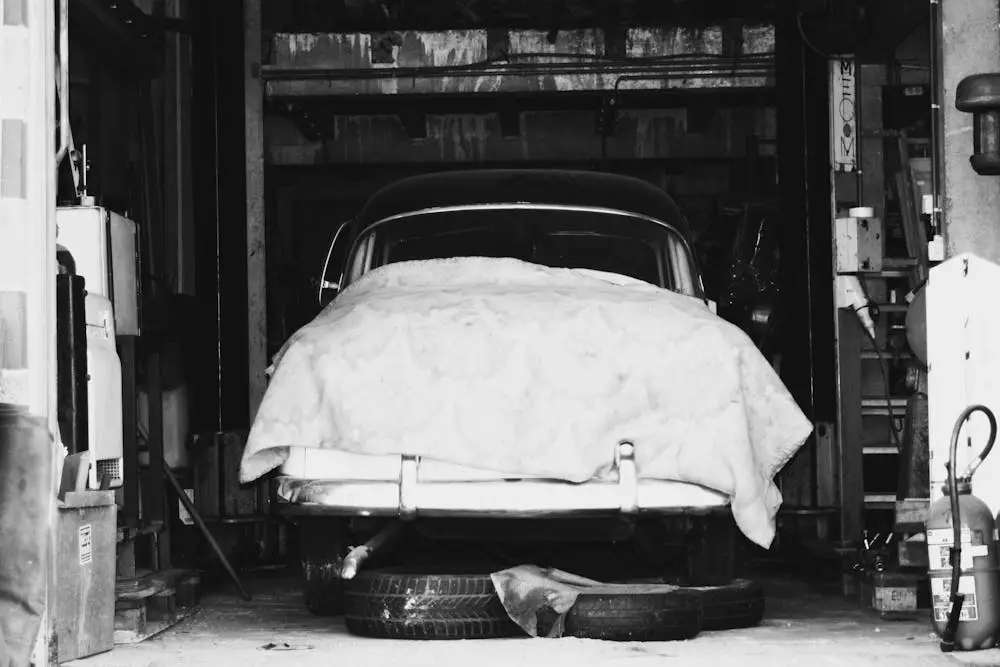
The Cord 812, the 1937 classic Mason had found under the canvas tarp, sat in the restoration bay, still not finished. Mason worked on it every Friday evening. Not because it needed to be done quickly. Because some beautiful secrets deserved patience.
The first class had twelve students. The second had thirty-four. By spring, the county school system partnered with the workshop for vocational credit. Veterans came for small-engine repair. Farmers came for equipment maintenance. Teenagers who had been told they were trouble learned to rebuild carburetors, frame walls, repair furniture, and sharpen blades.
One boy named Tyler, who barely spoke for the first month, built a cedar chest for his mother and cried when Mason told him the corners were clean.
Brielle proved useful, though Mason was careful not to say that too often. She organized open houses, donation drives, and a scholarship fund for students who could not pay. She still dressed better than everyone else, but she no longer looked like she was trying to prove something with every button and bracelet.
Reed entered recovery, served his time through probation and restitution, and came to the workshop six months after the fire with shaking hands. Mason gave him a broom. Reed took it. For three hours, he swept floors without speaking. The next week, he came back.
Clayton did not.
He pleaded guilty to lesser charges, lost his business, his house, and most of his friends. He moved into a small apartment and took work managing inventory for a construction supplier.
Until the anniversary of Henry’s death.
Mason arrived early and found Clayton standing outside the workshop, hands in his jacket pockets, staring at the sign. He looked thinner, older, his hair more gray.
“You rebuilt it,” Clayton said.
“Yes.”
“I thought you’d sell.”
“I know.”
Clayton nodded slowly. Then he took something from his pocket. A small envelope. “I found this in a storage unit. It was mixed with Evelyn’s things. She said she forgot about it, but I don’t believe her.”
Mason took it. His name was written on the front in Caroline’s handwriting.
Inside was a photograph. Caroline sat on the porch steps, holding baby Mason in her lap. Henry stood behind her, one hand on her shoulder, looking younger and happier than Mason could remember. On the back, Caroline had written:
Mason belongs to this land because he listens to it. Henry says that sounds silly. I say someday it will matter.
Mason stared at the photo until his eyes burned.
“I should have given it to you sooner,” Clayton said.
“Yes,” Mason said.
“I know.”
That was new. Clayton knowing without defending himself.
Mason placed the photo carefully in his jacket. “Thank you.”
Clayton looked at the workshop. “Do you need help with anything?”
Mason thought of Amos’s words carved into the wood below.
Build something.
“There’s a delivery of lumber coming at nine,” he said. “You can unload.”
Clayton looked surprised. “That’s it?”
“That’s it.”
Clayton removed his jacket, rolled up his sleeves, and waited by the gravel drive.
They worked for two hours. Clayton was soft-handed and out of shape. He dropped boards twice. He sweated through his shirt. He got a splinter and cursed like he had been shot.
Mason did not laugh.
But Reed did when he arrived, and Brielle laughed too, and even Clayton laughed eventually, grudging and embarrassed.
At noon, Olivia came with sandwiches. She and Mason had been together for four months by then, though half the town claimed they had known it would happen from the first courthouse filing. She kissed him on the cheek and handed him coffee. Clayton noticed but said nothing. That alone felt like progress.
After lunch, Mason unlocked the underground room for a group of new students. He told the story he now told every opening day.
“This barn was left to me when everyone thought it was worthless. I thought so too. But under the floor was a room built by my grandfather, protected by my father, and nearly destroyed by greed.” He walked to Amos’s tool wall. “These tools don’t matter because they’re old. They matter because they prove someone cared enough to make something that lasted. That’s what we do here. We make things that last. Tables. Engines. Houses. Skills. Trust. Sometimes even families, if the pieces aren’t too warped.”
He picked up one of Amos’s hand planes.
“When people call something broken, they usually mean they don’t have the patience to repair it. But broken is not the same as worthless.”
He looked around the room. At the students. At Olivia. At his siblings. At the burned beam preserved above the doorway as a reminder.
“And sometimes, the thing everybody leaves behind is the only thing worth keeping.”
That evening, Mason climbed the hill behind the barn.
From there he could see the whole spread: the farmhouse below, no longer ruled by Evelyn’s cold silence; the creek flashing silver in the sunset; the walnut trees moving in the wind; the workshop glowing warmly behind him.
He sat in the grass and took out the photograph Clayton had given him.
Mason belongs to this land because he listens to it.
He listened now.
The wind moved through the ridge. A hammer rang faintly from the barn below, where Reed had stayed late to fix a loose hinge. Brielle’s laughter drifted from the porch as she argued with Olivia about event banners. Clayton’s truck started, then stalled, then started again, because he still had not learned how to handle an old manual transmission.
Mason laughed softly.
He had been left with a broken tool barn.
But Henry had left him proof.
Amos had left him roots.
Caroline had left him love.
And the people who had once mocked him had ended up on their knees, not because Mason became cruel, but because truth finally stood taller than their lies.
Mason folded the photograph and placed it over his heart. Then he walked back down toward the workshop, where the lights were still on, the doors were open, and everything broken had a chance to become useful again.

Adrian Hawthorne is a celebrated author and dedicated archivist who finds inspiration in the hidden stories of the past. Educated at Oxford, he now works at the National Archives, where preserving history fuels his evocative writing. Balancing archival precision with creative storytelling, Adrian founded the Hawthorne Institute of Literary Arts to mentor emerging writers and honor the timeless art of narrative.