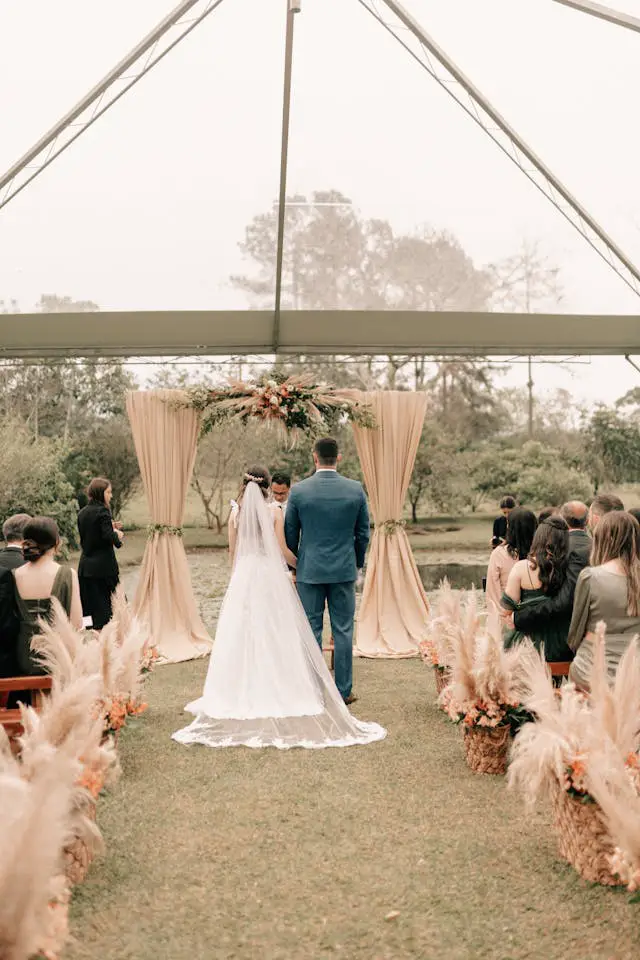
Finally Awake
Part One: The Aisle
I always believed my wedding day would end with happy tears.
Not the kind you blink back because you are overwhelmed by joy, though I had imagined those too, but the kind that arrive quietly and without warning when you realize that the life you have been building has finally, actually become real. I had been planning this day in some form or another since I was old enough to understand what a wedding was, and for most of those years the clearest image in my mind was not the dress or the flowers or the church. It was my father’s arm. The specific feeling of Daniel Hale’s arm beneath my hand as he walked me toward someone who loved me.
My father raised me alone from the time I was small. My mother left when I was young enough that her absence became simply the shape of things rather than a wound I could locate precisely, and my father filled the space she left with a totality that I understood, as an adult, must have cost him enormously. He braided my hair before school with the focused patience of a man who had taught himself to do it correctly because his daughter needed it done. He worked nights and was home in the mornings. He sat beside me when I was sick and drove me to the things that mattered and was present for the things that did not matter and never made me feel the difference between the two. He used to say, when I was small enough to believe parents said only things they meant completely: your life will be better than mine. I will do everything to make sure of it.
I believed him then. I still believed him the morning of my wedding, standing at the church doors in my dress with the smell of white roses coming through from the nave and the sound of the organ beginning somewhere inside.
Julian and I had been together for four years. We had spent three of them in Europe, living in a flat in Lisbon with a view of the river and the particular rhythm of a life built entirely by two people who had chosen each other freely and without interference. He was thoughtful and steady and funny in the precise way that made me feel understood rather than entertained, and when he asked me to marry him I said yes before he finished the question.
My father had met him only through video calls across a bad connection, which was one of the specific textures of our long-distance life, the freezing screen and the half-second delay and the slightly formal quality of a man doing his best to know someone through a small rectangle of light. They had spoken perhaps a dozen times. My father missed the rehearsal dinner with a fever and sent his apologies in the warm, self-deprecating tone he used when he felt guilty about something but did not want to make a fuss. He said on the phone that night: I will see him tomorrow, when I walk you to him.
He said it as though it were simple. The simplest thing in the world.
Part Two: The Doors
The organ played the processional and I felt my father’s arm tighten fractionally beneath my hand, the subtle adjustment of a man collecting himself, and I thought the tightening was emotion, the ordinary complicated feeling of a parent who has spent decades preparing their child for a life away from them and is now arriving at the moment when that life formally begins.
We walked through the doors and into the nave and the light changed the way it does inside old churches, filtered through colored glass, landing softly on the faces of the people who had traveled to be here. I saw Julian at the altar before anything else. He was smiling in the way he smiled when he was genuinely happy rather than performing it, the slightly asymmetric smile I had spent four years learning to read, the one that reached his eyes before it fully reached his mouth.
My father stopped walking.
It was not a stumble or a hesitation. It was a complete stop, as though something had simply switched off the mechanism that had been moving him forward. His grip on my arm became something different, no longer guidance but steadying, the grip of a man who needs something solid to hold onto.
“Dad?” I kept my voice low. The music was still playing. The guests had not yet understood that something was wrong. “What is it? What’s wrong?”
He was staring at Julian. His face had done something I had no reference point for, the blood leaving it in a way that was visible even in the colored light, color draining from a face until it is the particular gray of shock rather than of illness.
“No,” he whispered. The word was barely sound. “This can’t be.”
Julian’s smile had not yet changed. He had not seen my father’s face clearly enough at this distance, or he had seen it and had not yet allowed himself to register what he was seeing. He began walking toward us the way you walk toward something you want to move past quickly, with the brisk purpose of a man handling an unexpected situation.
My father lifted one hand. It was shaking.
“How can it be you?” he said, and his voice had a quality I had never heard in it before, the quality of a man who is confronting something he had believed was safely in the past. “I was certain you had disappeared thirty years ago.”
The music faltered. Or perhaps I simply stopped hearing it.
“You know each other?” I said. I looked at Julian and I looked at my father and I tried to find an explanation in either of their faces that would make this something manageable, something that had a simple resolution waiting a few minutes ahead.
My father said a name. Not Julian. Another name, a name I did not recognize, said in the tone of a man identifying something he cannot quite believe he is seeing.
Julian looked at me. His expression had changed entirely, the smile gone, something older and more complicated in its place.
“There is something your father never told you,” he said.
Part Three: The Office
Elise, my maid of honor, was the person who held the room together while I could not. She has that quality, a calm practical authority that emerges in crisis the way certain people’s best selves do, and she moved through the pews asking everyone to please stay seated, that we needed just a moment, that everything was fine. I heard her voice from somewhere behind me as I pulled my father into the small office off the vestibule that I had been shown during the venue tour months earlier, thinking at the time that it was a pleasant room and that I would probably never need to use it.
I closed the door. My dress filled most of the available space. My father sat in the chair near the desk and he looked, suddenly, very old.
“Tell me,” I said. “All of it.”
He told me. He told me in the careful, halting way of a person who has been storing something for a long time and is now releasing it in the wrong order, having to revise and restart, the story emerging not as a narrative but as a series of facts that gradually arranged themselves into a shape I could recognize.
Julian’s real name was Adrian. He had been using his middle name, Julian, for reasons that would become clear. My father had known his family. Before I was born, before my father had met my mother, he had been engaged to a woman named Claire. She was his first love, the serious kind, the kind that leaves a mark even after the relationship itself has ended. The engagement had not survived the interference of a man named Leonard, a wealthy property developer who moved through the world with the confidence of someone accustomed to acquiring what he wanted. Claire had chosen Leonard. My father had understood that choosing as a rejection of everything he was and everything he could offer, and he had carried that understanding for decades.
Claire and Leonard had a son. The son had a large red birthmark across his face, distinctive, the kind of physical marking that makes a face unmistakable once you know what you are looking at. My father had known this child. Had seen him, a small boy, before the years intervened and before the families separated completely. He had believed the boy gone from his life permanently.
The boy was standing at the altar of my wedding in a suit that fit him precisely, waiting for me.
My father’s company, the construction firm he had worked for in those years, had collapsed during a period when Leonard was involved in financial arrangements that were not entirely legitimate. The details were vague even as my father described them, the kind of vague that suggested he knew more than he was saying or that the knowing had become tangled with the not-knowing over decades of selective remembering. Leonard had helped cover certain things. My father had been adjacent to that covering, perhaps culpably, perhaps innocently, in the way that proximity to wrongdoing distributes itself across everyone nearby.
That was the history. Thirty years old, buried under an ordinary life, and now standing in a church vestibule with the organ silent on the other side of the wall.
“Why did he come back?” I asked. “If this is about the fraud, why come back now?”
My father looked toward the door for a long moment before answering.
“I don’t think it is about the fraud,” he said. “I think it is about Claire.”
Part Four: The Hallway
Elise opened the office door to tell me that Julian wanted to speak with me alone. My father was on his feet immediately, the protective reflex of a man who has been a parent so long the instinct is faster than thought.
I told him I was not a child.
He sat back down with the expression of someone who knows better than to argue but has not made peace with being overruled. I left him there and went into the hallway.
Julian was standing near the stained-glass windows, their light falling across him in blue and amber. He was nervous. I recognized the specific quality of his stillness when he was containing something, the controlled surface over whatever was happening underneath, and it struck me suddenly that I had seen this quality before without knowing what it was, that there had been moments in four years together when the controlled stillness had appeared and I had read it as thoughtfulness or introversion rather than as a man managing information he was not prepared to share.
“You lied to me,” I said.
“Not about loving you.”
I held that statement for a moment and found that I could not simply dismiss it, which was its own form of difficulty. He said it without the quality of someone deploying a line. He said it the way he said things he meant.
“Then why the name? Why hide who you were?”
“Because I knew this would happen. The moment your father heard my name, this.” He paused. “I did not want it to happen. I wanted time to find a way to tell you without the situation controlling how you heard it.”
He told me about his mother. Claire had died several years earlier, the kind of slow illness that gives a person time to revisit everything they have been carrying, to speak the things that had been stored through years of ordinary life. In those final months she had spoken of my father constantly. Not with tenderness, or not only with tenderness. With the retrospective grief of a woman who had spent decades blaming the wrong person for the shape her life had taken, and who was running out of time to determine whether the blame had been accurate.
She believed my father had abandoned her. That was the story she had lived inside. Leonard had offered her a version of events, early in their marriage, that placed my father as the one who had chosen to disappear rather than fight for her, and she had accepted that version and built her understanding of her own past around it. Whether Leonard had lied deliberately or whether the truth was more complicated was something Julian had spent years trying to determine and had not fully resolved.
“So you found me because of him,” I said. “Because of my father.”
He did not deny it. He said at first, yes, that had been the reason. He had wanted to understand what his mother could not understand before she died, wanted to find someone connected to the version of his father’s story that had never been told. He had found me through connections that were easier to trace in the age when everything is findable, and he had arranged to be in the same place. He had expected, he said, to ask a question or two and leave.
“And then?” I said.
“And then I met you,” he said. “And then nothing went the way I expected.”
I searched his face. He was not performing grief. The grief was present in the way real things are present, taking up space without announcing itself. I thought of four years. Four years of mornings and ordinary evenings and the way he made coffee and the way he argued about films and the way he had held me without speaking on the night my father called with a health scare that turned out to be minor but had not felt minor at two in the morning. I thought about what it meant that all of it had begun from a different place than I had believed.
“Did you ever intend to tell me?”
“Yes,” he said. “I kept waiting for the right moment.”
“We were five minutes from getting married.”
He had no answer for that. The absence of an answer was its own kind of answer.
He said one more thing before we went back to the office. He said my father was not innocent in what had happened to his mother. He said Claire had written to my father years after she married Leonard, during the unhappy years, and that the letter had not been answered.
He said: if you do not believe me, ask him.
Part Five: What My Father Said
We went back to the office together. My father was still in the chair, older-looking than he had seemed this morning, carrying something on his face that I had not seen before, the particular expression of a person who has been found out.
I asked him directly: had Claire written to him.
He said yes.
Something moved through me that I did not have an immediate name for, a compound of anger and grief and the particular disorientation of discovering that a person you have trusted absolutely contains rooms you were never shown.
He explained the way he always explained things he was ashamed of, carefully, with the precise qualifying language of a man who knows he cannot fully justify something and is trying at least to be comprehensible. By the time Claire’s letter arrived, he had met my mother. I was a baby. He had built, with enormous effort and from the rubble of what had happened in those earlier years, a life that felt stable and manageable and good. The letter had arrived and he had read it and had understood that answering it would require reopening everything, that the past he had managed to seal would crack open and flow into the present he was trying to protect.
He had told himself it was too late. He had told himself that nothing he could say would undo what had happened and that responding would only cause more damage all around. He had filed this reasoning somewhere he could access quickly whenever the thought of the unanswered letter surfaced, and he had kept filing it for thirty years, and I had never known it existed.
“You told me she chose that life,” I said. “Every time she came up, that was the story. She chose him. She moved on.”
“I believed that,” he said. “I needed to believe it.”
I backed away from him, not dramatically, just the small physical distance that arrives instinctively when your understanding of something shifts and you need space around you to absorb the shift. Both men were in that room with me, both of them shaped by a history that had been unfolding for thirty years before I existed, both of them carrying their portion of what had gone wrong, and I was standing at the center of it in a wedding dress, five minutes from a ceremony that had not happened.
Elise came to the door. The guests were asking questions. What did I want to do?
I looked at Julian. I looked at my father. I stood there and held both of their faces in my vision at the same time and I thought about love, which is not a simple thing even when it appears simple from the outside, and I thought about what I actually knew versus what I had believed I knew, and I thought about the four years that were both real and built upon a foundation whose actual shape I had never been permitted to see.
Part Six: The Ring
My hands were shaking when I took the ring off. Not from anger or grief specifically, though both were present. From the particular physical response of a body that is doing something irrevocable and knows it.
Julian watched me. He did not move toward me. He had the expression of a man who wants very badly to say something and has understood that this is not the moment, that the only thing he can give me right now is the space to make the decision I am making without interference.
“I cannot marry someone when I do not know who they are,” I said. I said it quietly, not for the room, not for my father, only for Julian, because it was the truest thing I could say about why I was doing what I was doing, and I wanted him to hear it stated clearly rather than implied by my actions.
He did not argue. He looked like someone absorbing a blow they had known was coming but had hoped might still miss them.
I turned to my father. He was still sitting. He looked like a man who has been carrying something for thirty years and has finally put it down and discovered that the putting down is not relief but its own form of weight.
“You buried yours until it exploded at my wedding,” I said.
He did not argue either. The not-arguing was the thing that told me he understood, that he was not going to reach for the justifications he had been using for decades to make the unanswered letter livable. He sat with it. He let me say it and he let it stand.
Elise and I walked back into the nave together.
The priest moved toward me with the expression of a man who has seen many things in the service of his profession and has learned not to project. He asked if I needed a few more minutes.
I looked at the flowers, which were white and perfect. I looked at the candles, which were still burning. I looked at the faces of the people who had flown from other countries and driven from other cities to be in this room today, people who had given days of their lives to witness something that was not going to happen.
“There will not be a ceremony today,” I said.
The words moved through the church in the particular silence that exists when a large group of people is receiving information at the same time. Not chaos, not noise, the specific quiet of simultaneous understanding.
Julian stood at the altar, pale. My father stood somewhere behind me, carrying guilt heavier than his age.
I took one long breath. I lifted the hem of my dress so I would not trip on it, a practical, ordinary gesture, the kind of gesture that exists outside of drama and ceremony and all the performances that surround the significant moments of a life. I walked toward the doors with Elise beside me, her hand briefly at my back, present without intruding.
Part Seven: Outside
The air outside the church was different. Cooler, or perhaps simply cleaner because I had not been breathing properly for the last forty minutes and now I was. The cars were still in the lot. Someone’s child was sitting on a low stone wall eating something from a paper bag, entirely unconcerned with what was happening inside.
Elise stood beside me without speaking. She has always known when speaking is the right thing and when it is not, and this was a time when it was not, when the most generous thing anyone could offer was simple physical presence without the pressure of a question attached to it.
I stood there and took stock of what I knew.
I knew that Julian had found me because of my father, that the beginning of us had been shaped by something outside of us. I knew that he had kept this from me across four years and had not found a right moment because there was no right moment, that the right moment had been years earlier and once it had passed every subsequent moment had the weight of all the previous ones pressing against it.
I knew that my father had received a letter from a woman in pain and had not answered it because answering it would have required him to open something he had closed, and that he had spent thirty years constructing a version of the past in which this made sense and in which he was not the person who had done it.
I knew that I had been loved by both of them, genuinely, in the specific and imperfect ways that people love when they are also trying to manage their own histories.
I knew that love being genuine did not make the omissions irrelevant.
I thought about Claire, who had died believing something about my father that might not have been entirely accurate, who had spent her life inside a story that had been partly assembled for her by a man with interests of his own, who had written one letter and received no response and had taken the silence as confirmation. I thought about what it meant to spend a life inside a story that is not quite right and to run out of time before you can revise it.
I did not feel abandoned. I did not feel broken in the specific way that people describe when the thing they have been building collapses. What I felt was something quieter and in its own way more serious than either of those, the feeling of a person who has just seen clearly for the first time in a long while and is taking in the actual landscape rather than the landscape they expected.
I did not know yet what I would do about Julian. Four years is not nothing, and love, even love built partially on foundations that were not disclosed, is not nothing either. What I knew was that I could not marry him today, that today was not a day for the permanence of a ceremony because too much had just been revealed and revelation requires its own time before commitment can mean what commitment is supposed to mean.
What I knew about my father was more complicated and would take longer to know fully. He was the man who had braided my hair and worked nights and sat beside me when I was sick. He was also the man who had received a letter from someone who was suffering and had decided it was too late to respond, and who had spent the following thirty years presenting me with a version of that choice that made it look like the only reasonable option. Both of these were true simultaneously, and I would need more time and more honest conversation than we had managed in an office off a vestibule to understand what they meant together.
Elise said, eventually, quietly: “Where do you want to go?”
I thought about it. The reception venue was still booked. The flowers were still fresh. Somewhere across the city, cars were waiting to carry people to a dinner that was no longer attached to anything.
“Somewhere quiet,” I said. “Somewhere with good coffee.”
She laughed, very softly, the laugh of someone who has been through enough with a person to find relief in the ordinary.
We walked to her car. The stone wall where the child had been sitting was empty now. The child had gone back inside, or gone home, or simply moved on in the uncomplicated way of small people who have not yet learned to stay in one place rehearsing what might have happened differently.
I sat in the passenger seat and looked at the church through the window as Elise started the car. Julian’s car was still in the lot. My father’s too.
I had walked into that building this morning as the woman I thought I was, the woman I had been assembling across thirty-one years, the daughter of Daniel Hale and the fiance of Julian, the person whose history was the history I had been told it was. I was leaving as someone in the process of revising all of that, which is not a comfortable thing to be but is, I was discovering, a necessary one.
My father had said: your life will be better than mine. I will do everything to make sure of it.
He had meant it. He had also, without knowing it, done things that made the better life harder to find, buried a history that found its way to the surface anyway on the day least suited to receiving it. This did not cancel the meaning of what he had meant. It complicated it.
Elise drove. The city moved past the windows. People were walking in the afternoon light, going about the ordinary business of a day that had not been their wedding day and had not become suddenly something else, and I watched them with the attention of someone who has just been reminded that most moments are not extraordinary, that the extraordinary ones arrive without warning and require the ordinary ones to absorb them.
I was not broken. I was awake.
The distinction mattered more than I would have been able to explain to anyone who had not spent forty minutes in a church vestibule discovering that two people they loved had been living, in parallel, inside versions of the past that neither had ever fully disclosed.
The coffee was going to be good.
I was going to need it.

Adrian Hawthorne is a celebrated author and dedicated archivist who finds inspiration in the hidden stories of the past. Educated at Oxford, he now works at the National Archives, where preserving history fuels his evocative writing. Balancing archival precision with creative storytelling, Adrian founded the Hawthorne Institute of Literary Arts to mentor emerging writers and honor the timeless art of narrative.