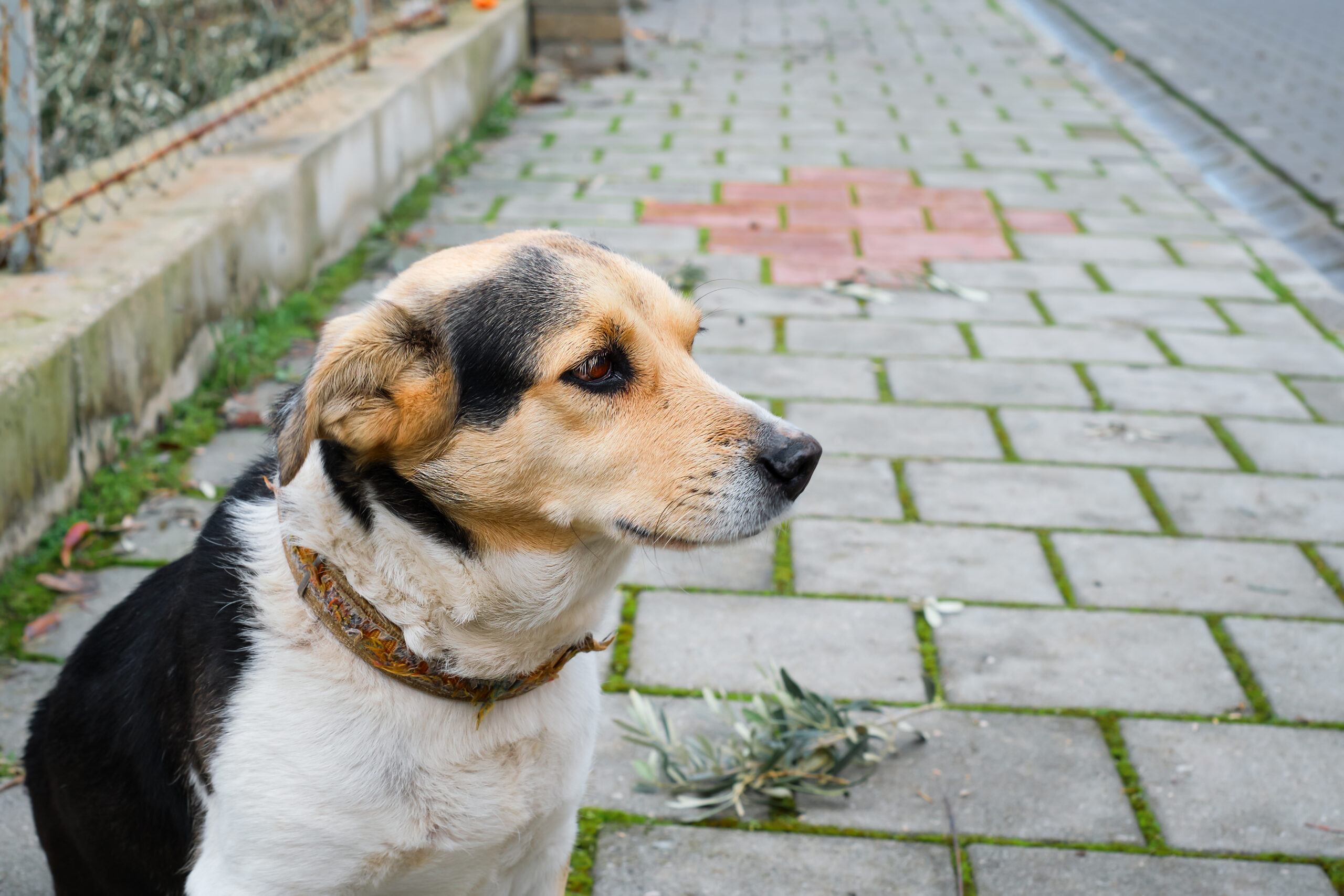
Canela watched every step he took.
Her eyes followed Miguel from the door to the kitchen and back again, measuring the distance between his boots and her puppies with the quiet calculation of an animal deciding whether humans could be trusted one more time.
When he returned from the bathroom with a folded towel, Lupita had already wrapped the pale puppy in the corner of her sweater. She was breathing on him softly, again and again, with the patience of someone who was afraid to move too fast and lose what little warmth she had found.
The other puppies made small sounds inside the box, their bodies pressed together like folded socks in the dirty rags Miguel had lined it with. Canela kept her muzzle low over them, but her eyes kept returning to the bracelet on the floor.
Miguel noticed that every time Lupita looked at the bracelet, the dog’s ears flattened against her head.
“It came from somewhere,” Miguel said. “Someone put it in that box, or someone lost it near her.”
“Or Canela took it,” Lupita said quietly.
Miguel stared at her.
“She dragged six newborn puppies across the highway,” Lupita continued. “Maybe she dragged that bracelet for a reason too.”
Outside, a neighbor’s television laughed through the wall, loud and ordinary, as if the world had not shifted inside apartment 3B.
Then came three hard knocks at the door.
Miguel and Lupita froze.
Canela stood so fast the box scraped the tile, and one puppy cried from the sudden movement.
“Miguel,” Lupita whispered.
The knocks came again, sharper.
“Open up,” Don Ernesto called. “I heard an animal.”
Miguel closed his eyes for one second and felt the cost arriving sooner than he expected. Their rent was late by nine days, and Don Ernesto had already reminded him twice about the no-pets rule.
Lupita gathered the puppies closer to the wall, but there was nowhere to hide a starving mother dog with rope burns on her paws. Canela’s rope dragged across the floor, leaving a thin reddish line from her injured feet.
Miguel looked at that line, then at Lupita, then at the door trembling under another knock.
He could lie. He could say the sound came from the street, apologize, keep his voice low, and protect their apartment for nine more days.
Or he could open the door and let whatever happened next walk in with Don Ernesto’s shoes.
Lupita did not tell him what to do.
That silence hurt more than anger would have.
Miguel opened the door halfway.
Don Ernesto stood there in his undershirt, one hand on his keys, his eyes already looking past Miguel’s shoulder.
“I knew it,” he said. “You brought a dog in here.”
“It’s temporary,” Miguel said. “She was on the highway. Her puppies are sick.”
“My building is not a shelter.”
“I know.”
“You know everything, Miguel, but you still do whatever brings trouble to my door.”
Behind him, Canela gave a low growl, and Don Ernesto’s expression hardened.
“Out,” he said. “Tonight.”
Lupita stood slowly, still holding the pale puppy against her chest.
“Don Ernesto, please,” she said. “Give us until morning. They won’t survive outside.”
“That is not my problem.”
The sentence landed without cruelty in the voice, which somehow made it worse.
Miguel kept his eyes on the landlord’s keys, turning over three choices that none of them felt clean. If he argued, they lost the apartment. If he obeyed, Canela and the puppies might not survive the night. If he called someone official, the bracelet might become something larger than all of them combined.
“Give me two hours,” Miguel said.
Don Ernesto laughed once, without humor.
“For what? To make another excuse?”
“To find somewhere safe,” Miguel said. “For the dog. For all of them.”
Don Ernesto looked at Lupita, at the puppy hidden in her sweater, and something tired moved across his face.
“Two hours,” he said. “Then I don’t hear barking, crying, or one more scratch on my floor.”
When the door closed, Miguel leaned his forehead against it and breathed like a man who had been running.
Lupita did not comfort him.
She went back to the bracelet.
“We have to call the hospital,” she said.
Miguel turned.
“And say what? That a dog dragged their bracelet down the highway with six puppies?”
“Yes.”
“They’ll think we’re crazy.”
“Maybe,” Lupita said. “But maybe someone is looking for Sofía Herrera.”
Canela growled again at the name, softer this time, as if it hurt instead of frightened her.
Miguel crouched near the dog, keeping his hands visible and low.
“Who was she to you, girl?” he asked.
Canela did not move.
But one of the puppies pushed blindly toward her belly, and she bent to clean him with desperate tenderness.
Lupita called the hospital with the bracelet number, her voice polite at first, then firmer when she had to repeat herself. Miguel could hear only fragments from where he sat.
Found bracelet. Federal Highway 45. Newborn puppies. Name Sofía Herrera. No, not a prank. No, we’re not asking for anything.
Then Lupita went silent.
Her face changed slowly, as if someone on the other end had opened a door she had not expected to find.
“When?” she asked.
Miguel stood.
Lupita listened, her eyes fixed on the tile.
“Thank you,” she said at last, but the words came out empty, like a courtesy paid from habit.
She ended the call and set the phone beside the bracelet.
“They said Sofía Herrera left the hospital yesterday morning,” Lupita said.
Miguel waited for the rest.
“With a newborn daughter.”
The room became smaller.
The puppies whimpered under Canela’s body, and the refrigerator clicked in the kitchen.
“What does that have to do with Canela?” Miguel asked, though the question already felt too simple.
Lupita shook her head. “They wouldn’t tell me more. But the nurse asked where exactly we found the bracelet.”
“And?”
“She asked if there was a dog with us.”
Miguel looked down at Canela.
The dog was staring at the door now. Not at Miguel. Not at Lupita. At the door, as if she had heard footsteps no one else could detect.
Lupita picked up her phone again, but her hand trembled before she could unlock it.
“We should call the police,” she said.
Miguel immediately thought of his truck. The unpaid fine. The expired inspection sticker he had promised to fix after the next delivery. The hours he would lose, the questions, the suspicion, the particular way people like him were rarely believed first.
Then he looked at Canela’s paws.
He hated himself for thinking about the truck.
“They may take the dog,” he said.
“They may help her.”
“They may take the puppies too.”
“They may find Sofía.”
“And if Sofía left that bracelet because she wanted no one to find her?”
Lupita looked at him then, hurt by the possibility and by the fact that he had said it out loud.
The pale puppy made a tiny sound, almost a complaint, and Lupita lowered her eyes again.
She knew, as Miguel knew, that people left things behind for many reasons. Some ran from danger. Some caused it. Some were simply too tired to keep carrying every piece of their own life.
Miguel sat on the floor, his back against the cabinet, and pressed both hands over his face.
His phone vibrated.
His dispatcher. He had missed the delivery window. There would be a penalty, possibly worse, because he had already received two warnings that month.
He let the call fade.
Lupita watched the screen go dark.
“That job pays our rent,” she said.
“I know.”
“I said bring them because I couldn’t bear it. But I didn’t say lose everything.”
“I know.”
“And now there is a hospital bracelet, and maybe a missing baby, and maybe nothing we can actually fix.”
Miguel looked at her.
The anniversary flowers he had not bought seemed suddenly small, but not unimportant. This was how he always fell short, not through any single betrayal, but through small absences that accumulated quietly until they added up to something she felt every day.
“I’m sorry,” he said.
Lupita’s eyes filled, but she did not let the tears fall.
“For tonight or for every night you thought apologizing later was the same as not failing in the first place?”
Miguel had no answer that would not sound poor.
Canela shifted, and the rope around her neck tightened against the cardboard.
Lupita noticed it first.
“Wait,” she said.
She moved closer slowly, with the scissors from the kitchen drawer in one hand, her other palm turned upward.
Canela growled, but she was too exhausted to rise.
“I’m not hurting you,” Lupita whispered. “I’m only taking this off.”
Miguel held his breath.
The scissors slid under the rope.
For one second, time stretched thin. The building noises faded. The puppy’s breathing, Lupita’s fingers, Canela’s fixed eyes, all of it seemed to hold in a single quiet place.
Then the rope snapped.
Canela flinched as if pain had answered before relief could arrive.
Something fell from inside the knot.
Not dirt. Not a thorn.
A small folded receipt, wrapped in clear tape to keep it dry.
Miguel picked it up with two fingers. The paper was greasy, creased, and stamped with the logo of a roadside motel twelve kilometers north.
On the back, someone had written two words in blue pen.
Room 6.
Lupita covered her mouth.
Canela lowered her head and touched the receipt with her nose. Then she looked at Miguel. Not begging forgiveness now. Asking him to understand.
Miguel felt the choice finally become clear, and somehow that made it heavier.
He could call the police, step back, and let strangers decide what Room 6 meant. Or he could drive there first, with two hours left before Don Ernesto returned, carrying a truth he did not yet know how to hold.
Lupita whispered, “Miguel, don’t go alone.”
He looked at the puppies, at Canela’s shaking body, at the bracelet with Sofía’s name printed in hospital ink.
Then he thought of every missed call, every late apology, every time he had chosen the easier silence over the harder presence.
“I won’t go alone,” he said.
He picked up the bracelet and the receipt. He reached for his keys with a hand that no longer trembled.
Canela stood despite her pain. When Miguel opened the apartment door, she stepped forward before anyone could stop her.
And for the first time that night, neither of them tried.
Miguel carried the box while Lupita held the pale puppy against her chest, wrapped inside her sweater. Canela walked beside them, limping badly, but every time Miguel slowed down, she looked back with quiet insistence.
The hallway smelled of fried onions and floor cleaner, painfully normal for a night that no longer felt ordinary. Behind one door, someone laughed at something on television, and Lupita pressed the puppy closer without saying anything.
Don Ernesto opened his door before they reached the stairs. His face was already set hard with suspicion and impatience. Miguel expected anger, another warning, maybe the final words that would end their time in this building.
But Don Ernesto looked at Canela’s bleeding paws, then at the box, and his mouth tightened in a different way.
“Two hours,” he said quietly. “Don’t make me regret giving you that much.”
Miguel nodded, unable to tell whether what he felt was gratitude or shame.
In the truck, Lupita sat with the puppies on her lap, her knees keeping the cardboard steady. Canela climbed in slowly, then placed her muzzle against the receipt in Miguel’s hand before lying down.
The motel appeared after fifteen minutes, half hidden behind a gas station and a row of tired mesquite trees. Its sign flickered between two letters. The parking lot held only three cars under weak yellow lights. Room 6 had a blue door with chipped paint and a plastic chair tipped sideways near the window.
Miguel turned off the engine. For a moment nobody moved.
Lupita looked at him, and he saw fear there, but underneath it something he had not seen in her eyes for months. Not forgiveness. Something more fragile than that, and more honest. A trust that was still deciding whether he deserved it.
“I’ll knock,” Miguel said.
“And I’ll call emergency services now,” Lupita answered, already holding her phone.
Miguel did not argue, and that small surrender seemed to steady both of them at once.
Canela forced herself down from the truck before he could stop her, limping directly toward Room 6. At the door she whined once, low and broken, then scratched weakly with one injured paw.
Miguel knocked.
No answer.
He knocked again, louder, hearing every second stretch around the sound of Lupita speaking quietly into her phone behind him.
Then a voice came from inside, so faint he almost mistook it for air moving under the door.
“Canela?”
The name changed everything.
Lupita covered her mouth. Miguel’s hand fell from the doorframe.
“It’s Miguel,” he called gently. “We found your dog. We found the puppies. Are you Sofía?”
For several seconds there was only breathing from the other side.
Then the lock clicked.
The door opened the width of a hand, and a young woman looked out with a face emptied by exhaustion. She was not dramatic, not wild, not like someone in a story hiding from a terrible scene. She looked like a person who had run out of strength while still trying to stay polite.
Canela pushed forward with a soft sound that seemed older than pain. Sofía slid down against the wall, and the dog pressed her head into Sofía’s lap, and Sofía began crying without making any sound.
Lupita stepped closer, holding the pale puppy.
“Sofía,” she said carefully. “We called for help. They’re coming.”
Sofía looked terrified at those words. Her fingers tightened in Canela’s fur.
“No,” she whispered. “Please. They’ll take her.”
“They’ll take who?” Miguel asked.
Sofía looked toward the back of the room.
On the bed, wrapped in a white towel, was a newborn baby girl sleeping in shallow little breaths.
Lupita moved before Miguel could speak, not rushing, but with the instinctive care of someone approaching fragile glass. The baby was warm, but the room was not. Empty water bottles near the bed. A hospital bag. Receipts scattered beside a nearly dead phone.
Sofía’s wrist was bare where her bracelet had been, and Miguel understood where the one in his pocket belonged.
“I left because they said my baby wasn’t safe with me,” Sofía whispered, watching Lupita touch the baby’s blanket.
“Who said that?” Miguel asked.
Sofía stared at the floor.
“My mother. The doctor. The social worker. Maybe all of them were right.”
Lupita turned sharply, but she did not interrupt.
Sofía rubbed Canela’s ear with trembling fingers, the same motion repeated as if it were the only thing keeping her from coming apart entirely.
“I panicked,” she said. “I thought if I left, I could prove I could take care of her.”
Miguel looked at the newborn, the tired mother, the dog who had dragged her own puppies across a highway toward the first person willing to stop.
The truth was not one clean villain. It was a chain of fear and pride and poverty and one bad choice after another, each one made by someone who believed they had no better option.
Sofía looked at Canela and swallowed hard.
“She followed me from home,” she said. “She had her puppies in the alley behind the motel.”
Lupita’s eyes filled.
“You left them there?”
“I couldn’t carry everyone,” Sofía whispered. “I thought I could come back after the baby stopped crying.”
The sentence broke inside the room, not because it was monstrous, but because it was almost understandable, and that was the hardest part.
Miguel wanted the truth to be simpler. He wanted someone to blame completely so he could feel clean about his own choices.
Sofía pressed both hands over her face.
“When I went back, Canela was gone. The box was gone. I thought I had lost them all.”
Canela licked her wrist, and Sofía bent over her the way a child asks forgiveness from something that cannot judge, only love.
Sirens approached in the distance, not screaming, just growing closer through the thin motel walls.
Sofía looked up, panic returning to her face.
Miguel crouched in front of her.
“You don’t have to run again,” he said.
“You don’t know that.”
“No,” he admitted. “I don’t. But I know running made everything smaller until even breathing became impossible.”
Lupita looked at him when he said that, and he knew she heard more than he had intended.
Emergency workers arrived with calm voices and warm blankets, filling the small room with careful questions. Sofía answered in fragments at first, then in longer sentences, while Canela stayed pressed against her leg and would not be moved.
The baby was carried out for examination, and Sofía followed, but she stopped when they reached the parking lot.
“They’ll separate us,” she said.
The paramedic did not promise what he could not control.
“We need to make sure your daughter is safe,” he answered. “And you too.”
That honesty hurt, but it also gave the night something solid to stand on.
Sofía nodded once, as if signing away the lie that love alone was enough to make everything safe.
The puppies were taken in a second warm box, a rescue worker moving them carefully one by one while Canela watched with her whole body tense. When she saw them being wrapped in clean cloth, something in her seemed to exhale. She did not follow them when they were carried to a separate vehicle. She stayed beside Sofía, limping in circles around her feet until a gentle pair of hands lifted her and wrapped her in a blanket too.
Miguel stood in the parking lot with his hands in his pockets, watching the organized movement of people trained to arrive after things had already broken.
Lupita came to stand beside him.
For a moment, neither of them spoke.
“The bracelet,” she said finally.
Miguel reached into his pocket and handed it to one of the paramedics, explaining where they had found it, how Canela had been dragging it on the highway with the puppies. The paramedic wrote something down and thanked him in the way of a person who had learned not to be surprised by what people carried and what they left behind.
A social worker came to speak with Miguel and Lupita. She was young, with tired eyes and the kind of careful voice that had learned not to promise things. She asked how they had found the dog, where the box had been, what condition the puppies were in when they arrived at the apartment.
Miguel answered everything honestly, including the part about Don Ernesto’s two-hour deadline, which made her write something else down.
“The mother and baby will be assessed,” the woman said. “There’s a process. It won’t be fast and it won’t be simple, but there’s a process.”
“What happens to Sofía?” Lupita asked.
“That depends on a lot of things. But she came back. She didn’t run again.” The social worker glanced toward the ambulance where Sofía sat with a blanket around her shoulders. “That matters more than people think.”
The mesquite trees along the edge of the parking lot moved in a small wind. Somewhere behind the motel, the highway hummed with trucks moving through the night, carrying weight in both directions.
Lupita took Miguel’s arm. Not a romantic gesture. The gesture of someone who has decided to keep standing beside a person after understanding them more clearly.
“The puppies,” she said. “What happens to them?”
The social worker gave her a number for the rescue center where they were being taken. She said they were young enough that they would need round-the-clock care for several weeks, and that people who found animals in distress were sometimes allowed to follow up.
Lupita saved the number in her phone.
They drove back in near silence. The truck smelled of dog and cardboard and the particular quiet of people who have said most of what needed saying for one night.
When they reached the building, Don Ernesto was still awake. His light was on under the door.
Miguel knocked.
Don Ernesto opened it, looked at the empty arms, the empty box, the absence of dog, and said nothing for a moment.
“There was a woman,” Miguel said. “And a baby. We found them.”
Don Ernesto studied his face, then looked at Lupita.
“The fine you owe me,” he said at last, “can wait until Friday.”
He closed the door without waiting for thanks.
Inside the apartment, the tile still bore the thin reddish line from Canela’s paws. Lupita found it when she went to wash her hands, and she stood looking at it for a long time before she got the mop.
Miguel sat at the kitchen table with the receipt from the rope, the two words in blue pen, and let himself feel the fullness of what the night had been.
His phone had seven missed calls. His dispatcher. One penalty notice already sent to email. A message from his brother asking whether he was coming to lunch on Sunday.
He set the phone face down and looked at the wall.
Lupita came and sat across from him. She set two cups of tea on the table between them, not touching his hand, just placing the cup in his reach.
“I know we lost the delivery,” he said.
“I know too.”
“I’ll call in the morning. Explain.”
“They may not care why.”
“No,” he said. “They may not.”
Lupita wrapped both hands around her cup.
“But we didn’t leave them on the road,” she said.
That sentence was not forgiveness for every late apology and missed moment. Miguel understood that. It was something smaller and more specific. A record of one night when the harder choice had been the one they made.
He nodded.
They drank their tea.
Three weeks later, Lupita went to the rescue center on a Tuesday morning while Miguel worked a short route. The pale puppy had been named by the workers there, a small brown name for a small surviving thing. He was the weakest of the six and also the last to let anyone touch him without trembling.
When Lupita held out her hand, he sniffed it for a long time.
Then he walked onto her palm with the careful steps of someone deciding to trust again.
She called Miguel from the parking lot, and she was laughing in the way he had not heard since before things between them had become mostly obligation and apology.
He pulled to the side of the road to listen.
Two months after the night at the motel, Sofía Herrera appeared in a local newspaper, not as a subject of a crisis story but in a photograph: a young woman sitting in a community room with a baby on her knee and a look on her face that was not yet peace, but was clearly working toward it. A caption mentioned a family reunification program and a support network for new mothers in difficult circumstances.
Miguel tore it out and left it on the table without comment.
Lupita read it that evening and set it beside the photo they kept on the refrigerator door.
In the photo, a dog stands at the edge of a highway with rope burns on her paws, a cardboard box behind her, and her head turned toward a truck that has just stopped.
She is not begging.
She is waiting to see what kind of people are inside.

Specialty: Quiet Comebacks & Personal Justice
David Reynolds focuses on stories where underestimated individuals regain control of their lives. His writing centers on measured decisions rather than dramatic outbursts — emphasizing preparation, patience, and the long game. His characters don’t shout; they act.