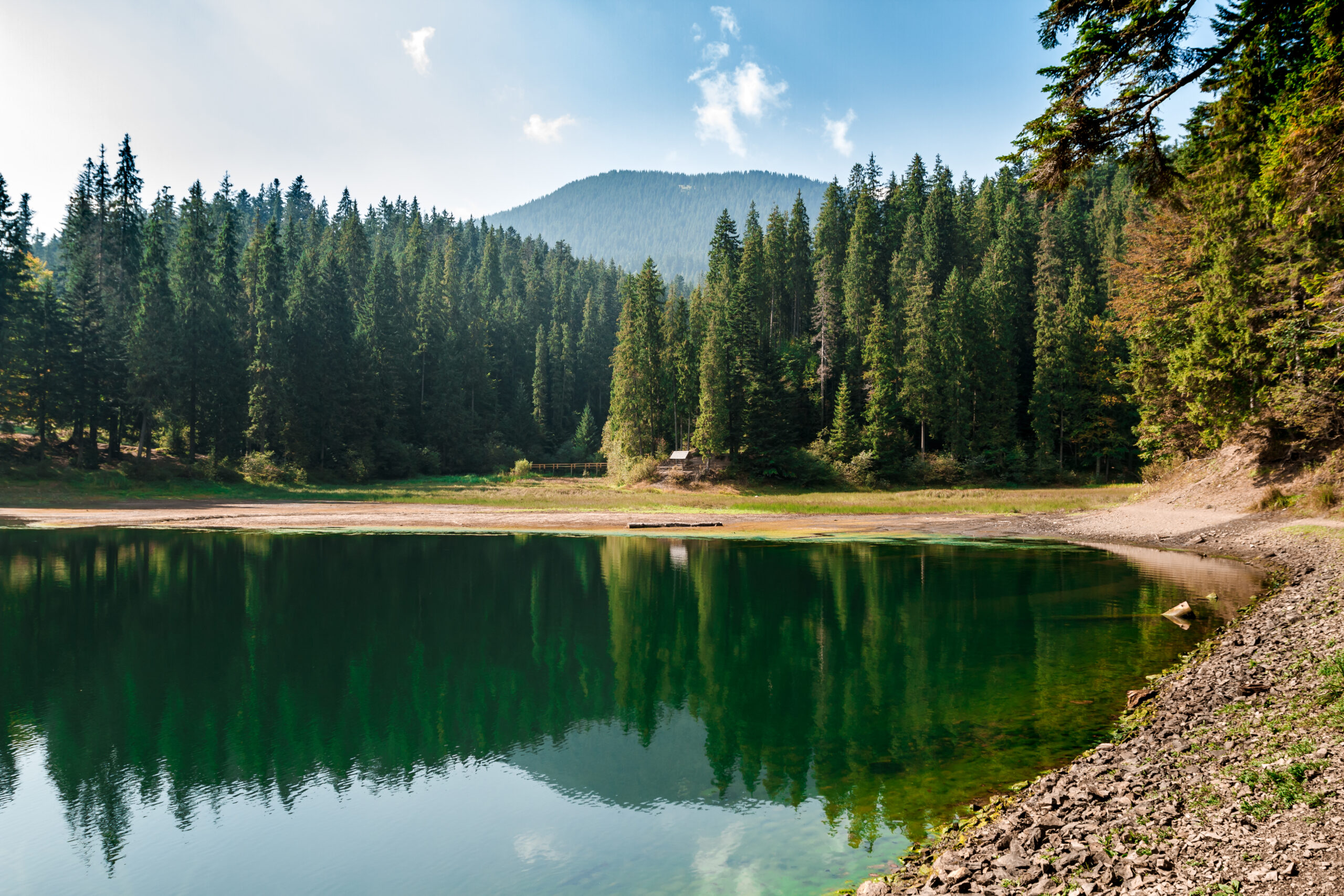
The first time the HOA president called the sheriff on me for swimming in my own lake, I was floating on my back at sunset, listening to loons, trying to remember how to breathe without my wife.
The water was cool and spring-fed, the same water my grandfather had swum in before he built the cabin in 1952. Above me the sky over the North Carolina pines had gone orange and lavender. Crickets were just starting up in the grass. It should have been the most peaceful moment of my week.
Then I heard sirens.
I swam to the dock, climbed the ladder, and stood there dripping while Deputy Martinez stepped out of his cruiser wearing the expression of a man who already knows he is part of something ridiculous. Behind him, at my property line, Karen Whitmore stood with her arms crossed and a smile that looked painted on.
“Mr. Henderson,” Martinez said, doing his best not to sigh, “I’m sorry, but I have to issue a citation per an HOA complaint.”
He handed me a paper. One thousand dollars. Unauthorized recreational water usage in a restricted zone.
I looked at it. Then at him. Then at Karen.
“Ma’am,” I said loudly enough for her to hear, “this is my lake. I built that dock with my own hands before you’d ever heard of North Carolina.”
Karen lifted her chin. “The community has standards,” she said. “Your behavior affects neighboring properties.”
That was the moment I understood she was not going to stop with one citation. She wanted control, total and permanent. And she had made one significant miscalculation.
Before I became the grieving widower in the cabin by the lake, I spent twenty years as municipal finance director for Milbrook County. I had watched small officials hide power inside vague ordinances, smiling corruption, and enforcement language that no one bothered to read carefully. I knew how paper trails worked. I knew what happened when people in minor positions of authority started believing no one would ever push back.
I also knew exactly how to dismantle those systems without ever raising my voice.
My name is Garrett Henderson. Three years earlier I had buried my wife Sarah after twenty-two years of marriage and a brutal fight with cancer. Losing her felt like someone had reached into my chest and removed the part of me that understood tomorrow. Everything in the city held her memory like a mirror. The grocery store where she talked me into flowers. The red light where she sang badly to old pop songs. The hospital parking garage. The coffee shop near my office. Grief made ordinary geography unbearable.
So I retired early, left Milbrook County, and drove south to the four-acre property my grandfather had left me, set in the pines outside a small North Carolina town with a spring-fed lake that had been in our family for decades. Pop had built the cabin after Korea, and the land had saved his sanity once. I was hoping it could do the same for mine.
For a while, it worked.
I drank coffee from Sarah’s chipped blue mug on the dock every morning and watched mist rise off the water. Rainbow trout broke the surface at dawn. Loons called across the lake. Wind moved through the pines with a sound like distant rain. The silence felt like medicine. No budget hearings. No contractors lying about invoices. No commissioners pretending not to understand their own votes. Just water and trees and enough quiet to hear myself think again.
Then a developer bought the old logging road north of my fence.
Bulldozers arrived. Survey stakes. Chainsaws. Century-old oaks came down. The mornings started smelling like diesel exhaust and cut lumber instead of pine and wet earth. Two years later, forty-seven oversized houses were crammed onto land that had never been designed to hold them. The subdivision was called Lakeside Luxury Estates, which would have been funny if it weren’t so arrogant. They had no lake. They had windows facing mine.
Karen Whitmore arrived from California in a white BMW with personalized plates and enough self-importance to fill a courthouse. Within six months she had maneuvered herself into HOA president. At first she treated me like a curiosity, clicking down my gravel driveway in heels with store-bought cookies, making comments about my rustic charm, suggesting she could help me modernize the cabin, hinting at something she called integrated shoreline planning. Then she offered to buy my land at well below market value.
I said no.
The smile changed after that.
The first complaint she filed was about my dock. County code enforcement came out, reviewed my 2008 permits, and left embarrassed. Her next complaint claimed my stocked trout were contaminating the watershed. The environmental inspector laughed so hard he had to take off his glasses. “This lake is cleaner than most municipal supplies,” he told me. Karen smiled tightly and said she was only concerned for the community.
Then she found the ordinance.
In the 1920s, the county had passed a forgotten rule requiring recreational permits for certain water activities near clustered residential development. It had sat dormant for decades because no sane person had tried to apply it to a private family lake older than the surrounding roads. Karen, however, had previously sold houses to two county commissioners. Suddenly the ordinance received a quiet amendment. Any lake activity within five hundred feet of a residential development now required HOA approval.
Her subdivision had existed for eighteen months. My lake had existed for seventy years.
And yet I was standing on my own dock holding a thousand-dollar citation for swimming.
I challenged the ticket the next morning. Karen was already on to phase two. Two weeks later she arrived with a county inspector named Randy Morrison, who had a clipboard, misplaced confidence, and a cheap cologne fighting a losing battle against his own sweat.
“Anonymous complaint,” Karen said brightly. “Commercial fishing operation.”
“I stock trout for myself,” I said.
Randy slapped his clipboard against his leg. “If this is an aquaculture facility, you need a business license. Daily fines of five hundred dollars until compliance.”
He barely glanced at the deed, permits, and stocking receipts I handed him. Karen stood behind him watching the show. It reminded me of a hundred bad inspections from my county days, where a minor official would wave paper at someone and hope they didn’t know the rules well enough to push back.
That night I opened my laptop.
Randy’s inspector credentials had expired two years earlier. Not suspended, not revoked. Expired. He had no legal authority to inspect my property, much less threaten fines. Better still, public records showed he had been conducting inspections across three counties regardless. By midnight I had screenshots, complaint forms, and a tidy folder ready for the state licensing board.
Three days later the state contacted Randy. Through courthouse gossip I learned he panicked, called Karen, and begged her to fix it. Karen doubled down instead.
An HOA bill appeared in my mailbox. Liability insurance surcharge for dangerous water activities, five hundred dollars per month, backdated six months. I now allegedly owed three thousand dollars for the privilege of existing near my own lake.
I started looking at Karen’s subdivision more carefully.
Parts of it encroached on state forest property. Three houses, including one owned by her cousin Danny, were fifteen feet over the line. I sent an anonymous tip to the forestry department and sat back while violation notices began landing in luxury mailboxes. Potential fines: fifty thousand dollars per structure, plus removal costs.
Karen came tearing across my property line the following morning so furious she scared a pair of loons off the water.
“You think you’re clever,” she said.
“No,” I said, handing her the notice of my preliminary injunction hearing over the illegal HOA fees. “I think I know how records work.”
The sound of her retreating down my gravel drive was genuinely therapeutic.
A sensible person might have paused after the fake inspector fiasco and the forest violations. Karen called Channel 7 News instead.
I was feeding trout when the news van rolled up. Reporter Megan Torres stepped out, professional and cautious, while Karen positioned herself nearby with three handpicked neighbors wearing their best concerned expressions.
Megan asked whether my lake activities threatened the community’s water supply.
I invited her to the dock, dipped a glass into the lake, and drank from it on camera.
Then I handed her inspection reports proving the water was pristine, deeds tracing my family’s rights back generations, permits, surveys, and photographs documenting the subdivision’s encroachment. Karen’s expression changed visibly as the story shifted away from the lonely lake man and toward the HOA president making claims she couldn’t support.
“Megan,” I said, keeping my voice pleasant, “you might want to check Mrs. Whitmore’s record in her previous communities.”
Karen went pale.
I had already made some calls. During my years in municipal finance I had built a network of auditors, clerks, and attorneys who remembered me as the person who hated crooked books more than politicians did. A few favors later, I knew Karen had left a trail in California and Arizona: complaints, board disputes, financial irregularities, one unpaid civil judgment, and a pattern of chaos that followed her like perfume.
The follow-up Channel 7 segment aired a week later. Megan asked Karen simple questions about water tests. Karen contradicted herself three times in four minutes. I answered with binders. Public response shifted my way.
Which meant Karen had to escalate.
She filed a health department complaint claiming my septic system was leaking into the lake. A real inspector named Marcus came out, checked everything, discovered I used a high-end composting system that sent nothing into the water, and asked for the installer’s number because he wanted one for his brother’s mountain place.
Karen’s complaint was dismissed as frivolous and malicious.
Next came a cease-and-desist letter from a Charlotte law firm. According to Karen’s attorney, my swimming created excessive splash noise that disrupted peaceful enjoyment for neighboring properties. They wanted five thousand dollars in mediation fees to avoid a lawsuit.
By then I had noticed something important about Karen. Every move she made revealed a larger problem she was trying to hide.
I went into county records.
What I found was not petty corruption. It was structural.
The subdivision had been built under an emergency wetlands variance allowing higher density than the land normally permitted. The variance would expire in six months unless renewed. Without renewal, thirty-one of the forty-seven houses would violate zoning density rules.
That alone would have been catastrophic. But there was more.
The original permit required a twenty-five-foot buffer from natural water sources. Karen’s house, and two others, sat inside that buffer. Unapproved drainage modifications were channeling runoff toward my lake. And when I formally requested HOA financial records, the numbers began screaming.
Forty-five thousand dollars a year to her husband Rick’s landscaping company for work worth perhaps half that. Twenty-eight thousand to cousin Danny for pool maintenance that wasn’t happening as billed. Legal fees that included Karen’s personal divorce attorney. Equipment purchases with no delivery records. Reserve fund withdrawals described only in vague terms.
I hired Patricia Sloan, an attorney who specialized in HOA disputes and looked genuinely delighted by the evidence I brought her.
“Garrett,” she said, flipping through the documents, “your HOA president is either the sloppiest fraud I’ve encountered this year, or she believes everyone around her is too intimidated to count.”
“It can be both,” I said.
Then Patricia found the clause that changed the game.
The original HOA charter defined membership broadly enough to include property owners within a hundred-foot buffer around the subdivision. My land qualified by twenty-three feet. Because membership voting power was based on assessed value and parcel size, joining would give me roughly thirty-one percent of voting shares.
Karen had spent months trying to control me with her HOA.
Now I could join it and outvote her.
Patricia and I started building an alliance.
Janet Morrison was a retired teacher who had documented every fine, letter, and meeting slight for two years in spiral notebooks that would have made an auditor weep with gratitude. Karen had fined her for a birdbath, for wind chimes deemed too reflective, for a visiting nephew’s truck, and once for failing to submit a shrub replacement plan after a storm uprooted one of her azaleas.
Bob Martinez was an accountant who had been trying for months to reconcile the HOA’s published budget with invoices he could only see in fragments. “I knew the numbers were sick,” he told me at my kitchen table, “but I didn’t know the whole body was septic.” He laughed at his own joke, then looked embarrassed. I liked him immediately.
Lisa Park was a civil engineer who had originally worked on drainage design before Karen pushed through cheaper modifications. Those modifications, Lisa explained, increased runoff pressure exactly where wetland buffer and slope stability were most sensitive. “She’s lucky there hasn’t been a major storm,” Lisa said. “If there had been, you’d be talking about erosion claims and emergency mitigation.”
We met twice at my cabin before the final meeting. Sarah’s old crockpot kept chili warm while Patricia laid out legal procedure. Janet highlighted bylaw sections. Bob rehearsed how to explain embezzlement to a crowd without sounding like a textbook. Lisa prepared simple diagrams so residents would understand that drainage violations were not abstract problems. They were one hard rain away from becoming everyone’s property damage.
Somewhere in the middle of all that, I realized how long I had been fighting alone.
Grief does strange things to your sense of scale. You start assuming that everything painful belongs to you by right, that the wound is private and the battle is private and the recovery must be private too. Sitting at my kitchen table with these people, hearing their stories, watching them commit to something larger than their own frustration, I felt a piece of that isolation crack open.
Karen, of course, responded to growing resistance the way she always had. She sent threatening texts to Janet late at night warning of defamation suits. She called Bob’s firm and implied he was misusing client time. She filed a complaint with Lisa’s professional board. She created fake social media accounts sharing doctored screenshots of supposed threats from me.
Then she did the thing that made any remaining hesitation in me disappear.
She posted online that Sarah had not died of cancer at all, but from some private shame I was hiding.
I sat with that for a long time on the dock while the lake went dark around me. I let the anger pass through before I touched anything with it. Grief changes shape over time but it never enjoys being weaponized. By the time the moon came up over the pines, my sadness had hardened into something that felt less like hurt and more like clarity.
Karen did not understand grief. She understood leverage. She found whatever people loved and squeezed it until they obeyed. Once I saw that with total certainty, every remaining hesitation burned away.
The next morning I called Patricia and said simply, “No more defense.”
She said, “Good. Because Bob found something.”
That was the reserve transfer to Myrtle Beach.
Eighty-five thousand dollars had disappeared from the HOA reserve fund under the line item emergency roof repairs for the community center. The same week, Karen closed on a vacation condo at the beach. Her social media showed her on the balcony with a cocktail, celebrating a fresh start.
Patricia took the bank records to the county prosecutor. A criminal investigation started moving quietly in the background. Then Karen’s private investigator, a man named Wade, was caught trespassing on an elderly neighbor’s property while trying to gather material on me. He was arrested and immediately told deputies that Karen had hired him.
My investigator, meanwhile, had been busy. Karen had used variations of her maiden and married names in three states. The pattern repeated everywhere she went: seize control of an HOA, bury dissent in procedural threats, siphon money, create chaos, leave. Two communities had nearly collapsed financially after she disappeared.
The morning of the final meeting, Karen tried to move it from the community center to her own garage, claiming security concerns. It was a transparent maneuver to exclude half the residents by limiting space. Patricia cited the bylaws from memory. Residents voted to stay in the public meeting room. Karen called the police. Deputy Martinez arrived, took one look at the assembled crowd, and told everyone to act like adults.
By the time the meeting started properly, sixty-seven residents had packed the community center. Channel 7 had set up in the back. The county prosecutor and a detective took seats quietly along the wall. Karen sat at the front table wearing fresh jewelry I had reason to believe the reserve fund had purchased. Her hands trembled anyway.
Patricia rose first and announced that my membership review period had expired. I was now an official HOA member with full voting rights.
I walked to the podium carrying three binders.
“I’d like to present some financial irregularities for board review.”
“You can’t discuss confidential HOA business!” Karen said.
I looked at the Channel 7 camera. “Embezzlement isn’t confidential.”
Bob ran the projector. Slide one: inflated landscaping bills paid to Rick Whitmore’s company. Slide two: pool maintenance fraud. Slide three: legal fees benefiting Karen personally. Slide four: the eighty-five-thousand-dollar reserve transfer. Slide five: the Myrtle Beach condo records.
The sound that moved through the room was like wind through dry leaves.
Karen pushed back from the table and lunged toward the projector, blocked by two residents she had once bullied over hedge height. She screamed about conspiracy, forged documents, and dangerous men manipulating the community. Then she produced a fake psychological report with the wrong doctor’s license number.
That was when Prosecutor Williams stood up.
“Mrs. Whitmore,” he said, loud enough for the room, “you are under investigation for embezzlement, fraud, filing false police reports, and witness intimidation.”
Karen looked at him. Then at the detective beside him. Then she looked through the window at the U-Haul trailer hitched to her BMW in the parking lot and understood, all at once, that there was no more road left.
What happened next was spectacular in the way of things you would rather not witness but cannot look away from. She screamed at the prosecutor. She screamed at me. She screamed at Channel 7 for filming. She screamed that everyone in the room was ungrateful and corrupt and dangerous. When the detective moved toward her, one of her heels skidded on the polished floor. The room watched in complete silence as the woman who had dominated them for years came apart into pure undisguised panic.
The detective read the charges. The camera lights made everything brutally clear. Karen was led out still making promises and threats that had run out of anyone willing to believe them.
The room went quiet.
I stood at the podium looking at neighbors who had feared her, enabled her, or stayed silent because conflict felt too expensive. None of them looked triumphant. They looked exhausted. Relieved. A little ashamed.
“I didn’t come here to destroy this community,” I said. “I came here because somebody had to stop her.”
Janet started the applause. Slow, uncertain, real. Others joined until the sound filled the room properly.
The months after Karen’s arrest were busy and messy and, in a way I had not expected, hopeful.
Rick Whitmore was picked up in Oklahoma. Randy the expired inspector lost any path back to government work. Wade cooperated for a reduced sentence. The vacation condo was seized. Karen took a plea deal rather than let a jury hear the full story, and went to prison. The reserve money was partially recovered. Insurance covered some of the rest.
The new HOA posted every expense online. Competitive bidding became mandatory. Secret meetings ended. Lisa worked with county planners on a variance solution that brought the subdivision into legal compliance without destroying homeowners. Several structures had to be adjusted at developer expense, but the neighborhood survived and began to function like a neighborhood should.
The lake changed too.
I had planned to keep it private. Then one Saturday Janet brought her granddaughter with a borrowed fishing rod, and Bob showed up with a cooler of burgers, and Lisa brought canoe rack plans, and I looked around at people eating lunch under my grandfather’s pines and realized the property no longer felt like a place under siege.
It felt alive.
We started a monthly Lake Day. Families fished from the dock. Kids learned to cast. Neighbors who had glared at one another over HOA violation letters sat together trading recipes. The place I had fled to in grief had become something larger than sanctuary. It had become evidence that a community can repair itself when the bully at its center is removed and the books are finally opened.
We named the public section of the dock Sarah’s Sanctuary. Not to turn grief into a monument, but because Sarah had always believed that healing grew stronger when shared. On warm evenings I still swim at sunset. No citations. No sirens. Just loons calling across clean spring-fed water while the sky goes orange and lavender the way it always has over these pines.
Six months after the arrest, Megan Torres came back for a follow-up piece. She stood on the dock while children fished behind us and asked whether I regretted fighting as hard as I did.
“No,” I said. “I regret waiting as long as I did to stop mistaking paperwork for truth.”
She smiled. “That sounds like something a finance director would say.”
“It sounds like something a widower learned the hard way.”
After the piece aired, calls started coming in from other homeowners around the state. A veteran whose board was blocking wheelchair ramp permits. A widow facing fines over solar panels. A teacher being punished for asking to see budget records. I started helping where I could. Not because I wanted another career, but because once you have watched one petty tyrant fall under the weight of proper documentation, you begin to notice how many others deserve the same ending.
These days the lake still belongs to me. The deed says so. The history says so. My grandfather’s hands said so when he drove the first dock post into the mud in 1952. But what changed is that ownership no longer means isolation.
On certain evenings the light hits the water exactly the way it did the night Martinez handed me that ridiculous citation. Orange sky, lavender water, loons calling across the lake, pine shadows stretching long into the shallows. The difference is that now, when I hear tires on the gravel drive, it is usually Janet arriving with something she baked, or Bob testing a new grill setup, or some child racing ahead of their parents to see whether the trout are rising.
Karen Whitmore wanted to control the water because she believed power worked that way. Claim the rules. Frighten the neighbors. Hide the money. Act official until everyone around you gives up.
She was wrong about all of it.
Power built on fear always leaves receipts.
She sent the bill to the wrong widower.

Specialty: Emotional Turning Points
Rachel Monroe writes character-driven stories about betrayal, second chances, and unexpected resilience. Her work highlights the emotional side of family conflict — the silences, the misunderstandings, and the moments when someone quietly decides they’ve had enough.