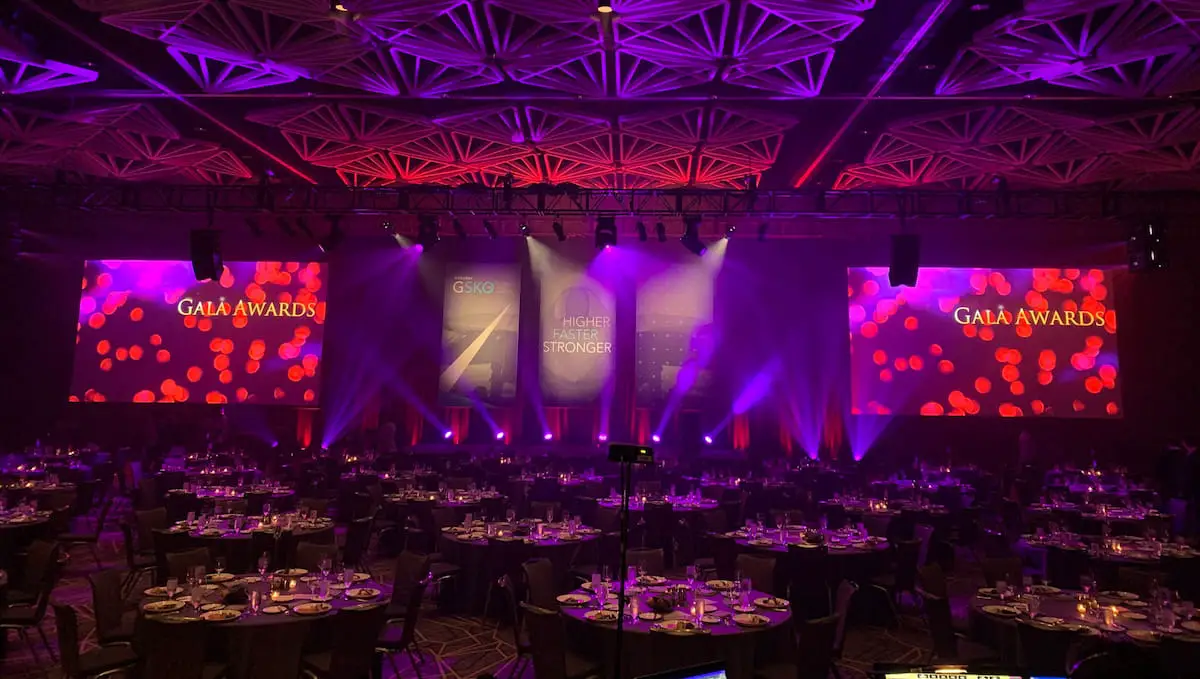
The Grand Meridian Hotel ballroom glittered with crystal chandeliers and the kind of cultivated polish that large corporations like to mistake for character. Light pooled in the stemware, in the silver cutlery, in the faces of people who had spent their entire professional lives mastering the difference between appearing warm and actually being kind.
I adjusted my tie near the entrance and scanned the room until I found my wife.
Sarah stood near the bar in a navy dress, laughing with colleagues from her department, and for a moment everything else disappeared. My chest swelled with the same fierce private pride I always felt watching her in professional spaces. She belonged there. She had worked too hard, too intelligently, and for too long not to.
Pinnacle Financial had only had her for three years, but in that time she had climbed faster than people older than her, louder than her, and more politically connected had expected. She was one of the youngest senior analysts at the firm, and she had earned every inch of that ascent.
Tonight mattered to her. The annual gala wasn’t just a party. It was one of those carefully choreographed corporate rituals where alliances hardened, announcements landed, and people quietly learned whether they were inside or outside whatever future leadership had already started constructing behind closed doors.
Sarah had spent a week pretending she wasn’t anxious about it. I had spent the same week pretending I didn’t notice.
“There you are,” she said when I reached her, her face brightening in a way that still, even after all our years together, made something in me settle. “I was starting to think you’d let me suffer through this alone.”
“Never,” I said. “I came prepared to smile at people with titles and eat whatever dry chicken this hotel is pretending is dinner.”
She introduced me around. Jennifer from compliance. Marcus from risk assessment, already red-cheeked from the open bar. A few more names I recognized from stories she’d brought home over late dinners and tired weeknights.
And then him.
“This is Derek Hoffman,” Sarah said. “Regional vice president.”
Derek stepped forward with the smile polished men wear when they’ve spent years being told that authority and charm are interchangeable. Mid-forties, expensively dressed, carrying himself with the loose confidence of someone who had not encountered meaningful resistance in a very long time.
His handshake lingered just a little too long.
“So,” he said, his tone light but wrong in a way I couldn’t have fully defined in that first second, “you’re the lucky man who snagged our Sarah.”
Our Sarah. Not your wife. Not Sarah. Our Sarah.
My jaw tightened, though I smiled back. “I’m the lucky one,” I said evenly.
Something flickered in his face, gone almost before I could name it. Calculation, maybe. Or irritation that I had not played along with the easy territorial familiarity built into the phrase.
Then the smile returned, and the room resumed moving around us.
Dinner was served. The chicken was exactly as forgettable as I’d predicted, but the wine was excellent. Between courses Sarah translated the room for me the way she always did at events like this, pointing out the CEO Richard Castelliano speaking to board members three tables over, noting which clusters mattered and which only wanted to look as if they did.
She nodded almost imperceptibly toward Derek at the center table, holding court as if the evening had been arranged for him personally.
“He thinks he’s getting the CFO position,” she whispered.
“The announcement’s next week?”
She nodded.
“Then he’s either very confident,” I said, “or very stupid.”
She smiled without looking at me. “Those two things overlap more than you’d think.”
Dinner gave way to the looser half of the evening. People drifted toward the bar, the terrace, the edges of the ballroom where conversations could become more selective. Sarah excused herself to the restroom. I stepped outside to the corridor to check my phone. I ran a cybersecurity consulting firm, and one of my clients had decided that a gala was the perfect moment for their servers to start misbehaving.
I was halfway through typing a response when I heard Sarah’s voice.
Not laughing. Not conversational. Strained.
“Derek, please. I really need to get back.”
I moved before I had fully registered that I was moving.
The corridor to the restrooms was quieter than the ballroom, softly lit. I rounded the corner and saw them instantly. Derek had Sarah pinned in the shallow space between the wall and a decorative side table. One hand planted beside her head. The other rested low on her waist in a way that made clear this was not misread flirtation, not an awkward misunderstanding, not anything accidental.
His face was close to hers. Too close.
Even from twenty feet away I could see the fear in her expression and the professional restraint she was using to try to disguise it.
“Come on, Sarah,” he was saying, his words softened by whiskey and entitlement. “Everyone knows you’re the reason I pushed for that promotion on your team. Don’t you think that deserves a little gratitude?”
His hand moved lower.
“Get your hands off my wife.”
My voice came out so calm it frightened even me.
Derek turned. Surprise flashed across his face, then irritation, then the instant mental scramble of a man recalculating how quickly a private violation had become a public risk. Sarah stepped sideways the moment she had space, moving toward me. I crossed to her in three strides and put myself between them.
“Hey,” Derek said, holding up one hand as if we were equals in some temporary misunderstanding. “You’ve got the wrong idea.”
“I don’t think I do.”
He gave a soft laugh, the kind men like him use to signal that the whole problem exists only because someone less sophisticated has taken them too literally. “We were talking.”
“What I saw was you backing my wife against a wall at your company event while she was asking you to let her go.”
Sarah was behind me now. I could feel the tension in her body without touching her.
Derek dropped his hand but didn’t retreat. That was what struck me most. He was not ashamed. He was not afraid. He was annoyed.
“Look,” he said, lowering his voice as though we might settle this between gentlemen, “making a scene here would only hurt her career. Mine is bulletproof.”
Then he smirked.
That smirk was what changed everything.
Until that second I had been a husband who had just found his wife cornered by a drunk executive. I was furious and ready to drag him into the ballroom if that was what it took. But the smirk told me this was not a lapse. It was pattern. It was comfort. It was a man who had done variations of this enough times that he no longer feared consequence at all.
“You’re right,” I said quietly.
His posture eased.
“Making a scene would be unprofessional.”
His smile widened. “Smart man.”
I looked him in the eye. “I have a better idea.”
I returned to the ballroom, found Sarah, and sat with her at a small table near the side. Her hands were trembling.
“Are you okay?” I asked.
She took a breath that didn’t settle her much. “I’m fine. I just—” She stopped, swallowed, tried again. “That wasn’t the first time.”
The words landed harder than anything Derek had said.
“Has he done this to other women?” I asked.
Her eyes flicked away. “There are rumors.”
“That’s not what I asked.”
She looked back at me. “Yes.”
The answer was barely above a whisper but there was no uncertainty in it. A junior analyst named Rebecca had left suddenly the previous year. An intern before Sarah’s time. Patricia Gomez in senior management avoided him so obviously people had started joking about it. Everyone knew something was wrong. No one did anything because he brought in the biggest clients and the board adored him.
I took out my phone. “I need names.”
She hesitated for only a second. Then she gave them to me.
Rebecca Chen. Melissa Torres. Patricia Gomez. A fourth woman from a different department whose transfer had never made sense at the time.
“Where are you going?” Sarah asked.
“To work.”
The smoking terrace was my first stop. Marcus from risk assessment was exactly the kind of man people in my profession love to meet at corporate events. Ten minutes of harmless-feeling shop talk and he had already told me more than he should have. Pinnacle used a cloud-based HR system. Their VPN was unreliable enough that people complained constantly about re-authentication. Senior executives often bypassed best practices because they hated inconvenience.
From there I moved through the ballroom and learned everything I needed. Derek was the favorite for CFO. Richard Castelliano was notoriously obsessive about public reputation after nearly losing his previous company to an ethics scandal. The hotel’s ballroom displays were routed through a central AV control booth. And, most useful of all, Pinnacle employees were checking company email on unsecured hotel Wi-Fi as if convenience and recklessness had become synonyms.
At 9:30, I slipped into the hotel business center.
I opened my laptop, activated a network scanner, and began mapping the hotel Wi-Fi environment. There were 37 Pinnacle-connected devices in the building. One belonged to Derek Hoffman. The man was accessing work email over hotel Wi-Fi without properly protected session routing. It took almost no time to capture his authentication token and access his active session.
It was one of the sloppiest failures of executive operational security I had ever seen.
What I found in his email was worse than I expected.
Not just the obvious messages. The inappropriate comments, the gradual escalation from faux mentorship to predatory suggestion, the flirting weaponized as leverage. Those were there, and there were many of them. But deeper in the account was a folder labeled HR Confidential.
Inside were three formal complaints filed against him over the last five years. Rebecca’s. Melissa’s. Patricia’s. Detailed, specific, credible, timestamped. Each one logged with case numbers and internal notes, and then quietly neutralized. Rebecca had been transferred out under the pretext of a new opportunity. Melissa had been encouraged to explore other roles. Patricia had been buried inside a process so administrative it disguised retaliation as restructuring.
And Derek knew. He had accessed every complaint using his advisory board privileges. He had read what women said about him. He had watched the system bury those women and had gone on with total confidence because the process itself had become part of his protection.
I downloaded everything. The complaints, the access logs, calendar invites for private dinners with subordinates, expense reports, text messages synced to his email.
Then I found the message from that very night.
Got the attractive new senior analyst backed into a corner tonight. She’ll come around. They always do when their career’s on the line.
My hands shook once. Just once.
I built a comprehensive document. Screenshots with metadata. Mail headers. Session proof. Internal complaints. Access records. Cross-linked context showing that Derek Hoffman had not only harassed women repeatedly but used his access and influence to suppress the evidence against him.
Then I created a secure anonymous email and addressed the file to Pinnacle’s board of directors, HR leadership, legal counsel, and the employment law divisions of three major firms known for representing corporate harassment victims.
I did not send it yet.
Because Derek had told me his career was bulletproof. And when a man like that finally falls, it should happen loudly enough that no one can call it a rumor afterward.
Earlier, during a moment when the room had been distracted by dessert, I had slipped near the AV booth and connected a small device behind one of the ballroom’s auxiliary display lines. It sat dormant now, waiting.
By the time I returned to the ballroom, the CEO was preparing to make closing remarks.
Sarah spotted me from across the room and searched my face. I gave her a small, steady nod. She sat straighter, folded her hands in her lap, and waited.
The lights dimmed slightly. The AV screens shifted to Pinnacle’s logo. Richard Castelliano stepped to the podium and began the kind of speech leaders like him are paid to make sound sincere. He spoke about resilience and integrity and the company’s most important asset being its people.
He spoke of respect with the solemn confidence of a man who did not yet know the word was about to become a weapon against him.
Then he reached the part everyone had been waiting for. The room sharpened instantly. Conversations died. Shoulders straightened.
“And finally,” Castelliano said, looking toward Derek’s table with the pleased confidence of a man about to reward a top performer, “I’d like to recognize Derek Hoffman, whose leadership in the Western region has been exceptional—”
I activated the device.
Three seconds to establish control. Five more to override the screen queue.
Then the Pinnacle logo vanished from every display in the ballroom.
One suspended second of silence. Then the new title appeared in hard black lettering on a white field.
Pattern of Workplace Harassment: Derek Hoffman
Confidential Investigation Report
The room fell silent so completely it felt like something physical had been removed from the air. Castelliano stopped mid-sentence. Derek’s expression shifted from mild confusion toward disbelief.
The document advanced automatically. A timeline of dates, descriptions, internal references, and summary notes. Then the screenshots. Emails from Derek’s own account. Comments about women’s bodies. Crude assessments of who was compliant, who could be pressured through career advantage. Texts about interns. Messages so cavalier in tone they suggested a man who had lived too long without being made to fear consequence.
Gasps broke out. Sharp, involuntary, the sounds people make when private rot is dragged into public light faster than their manners can catch up.
Derek shot to his feet. “What the hell is this?”
No one answered him.
The next slide appeared. Copies of the formal HR complaints. Case numbers, date stamps, resolution notes. Patricia. Rebecca. Melissa. Each complaint credible. Each outcome suspicious. Transfers, quiet departures, organizational euphemism laid over human damage like fresh paint over rot.
Now people were taking out phones. Photographing the screens. The board looked stunned.
Richard Castelliano turned toward the AV booth. “Can we get control of this?”
The technician was already scrambling, but the system was no longer his.
Calendar entries appeared next. Private meetings outside business hours. Dinners with junior employees. Performance reviews scheduled at restaurants, bars, and off-site locations where one person held title and the other held risk.
Derek took a step toward the stage. “This is fabricated,” he snapped. “Someone hacked the system.”
Then the final slide loaded. One screenshot. One message. Time-stamped that evening.
Got the attractive new senior analyst backed into a corner tonight. She’ll come around. They always do when their career’s on the line.
The silence shattered. Every sound in the room arrived at once. Gasps, whispered names, angry questions, chairs scraping, someone near the back saying oh my God as though invoking God might make the moment more understandable.
I stepped into the open space beside the rear aisle.
“My name is Michael Whitmore,” I said, my voice carrying farther than I expected. “I’m a cybersecurity consultant, and I can verify the authenticity of every document on those screens. I’m also the husband of the woman Derek Hoffman assaulted tonight.”
That sentence went through the ballroom like current.
Because truth, once spoken clearly enough in the right room, gives courage to people who have been waiting for its permission, the first woman stood.
“My name is Patricia Gomez.” Her voice was steady, but not easy. “I filed a formal complaint against Derek Hoffman three years ago.”
Then another woman rose. Rebecca Chen. Then another. Each name spoken aloud changed the room.
This was no longer an accusation presented by a husband with technical skill and personal motive. It was now a pattern, a chorus, a structure too large to dismiss as malice or sabotage.
Hotel security arrived. As they moved toward Derek, he looked around as if still expecting the old protections to activate. A board member to wave it off. A room full of professionals to prioritize decorum over what they had just seen.
No one moved to help him.
That, more than anything, broke him.
“You’re finished,” he mouthed at me as security reached for his arms.
I smiled without warmth. “No. Your career is.”
They led him out.
Board Chair Margaret Fisk approached our table ten minutes later with the composure powerful women develop only after spending years being forced to project order through disaster.
The conference room they took us to was smaller than the scandal detonating through their company deserved. Richard Castelliano was already inside, face drawn tight. Legal had been called. HR too. The machinery of corporate containment was grinding into motion, but it was already too late for containment. The best they could hope for now was triage.
Margaret took the head of the table. “What happened tonight is unconscionable.” Then she fixed me with a colder look. “Your method of exposing it was also highly irregular.”
I folded my hands. “Your vice president was accessing company email and confidential HR documents over unsecured hotel Wi-Fi with laughable session hygiene and catastrophically poor credential discipline.”
Richard frowned. “You’re saying you didn’t breach Pinnacle’s systems?”
“I’m saying Derek Hoffman breached your own operational expectations so badly he practically invited documentation. He was using public Wi-Fi without proper VPN discipline, with cached autofill active, with confidential HR complaints accessible in his active mail environment. I did not fabricate anything. I documented what he made available through negligence.”
“What was his password?”
“Pinnacle2023.”
One of the board members closed his eyes.
Sarah spoke next, and the steadiness in her voice made me feel proud and sick at once. “This isn’t really about what my husband did technically. It’s about what your company failed to do repeatedly. Three women filed complaints before me. Maybe more. Derek knew about them. He accessed them. He buried them. He stayed in power because this company valued his profitability more than employee safety. That’s the part you need to confront.”
No one answered immediately because there was no defense that wouldn’t sound grotesque under the weight of the night.
At last, Margaret asked the question every institution asks once denial has failed and damage has become measurable. “What do you want?”
Sarah didn’t defer to me. “Fire him. Publicly. Launch a real investigation. Reach out to every woman who filed or was buried and offer actual accountability. And I want written protection for anyone who comes forward now, including me.”
Richard answered before anyone else could. “Done.”
“Put it in writing,” I said.
“It will be.”
The evidence package went where I had said it would. The email was already timed and moving. If there had been any hope of handling this quietly, it died in that room.
By the next morning, the scandal had a name. By sunrise, financial news outlets were running versions of the same story. By midday, mainstream outlets had picked it up. Pinnacle Financial did not have the luxury of slow response. By 8:00 a.m., Margaret Fisk had confirmed Derek Hoffman’s immediate termination. By 10:00, the board announced an independent investigation. By noon, HR was in crisis meetings. By late afternoon, the first outside employment lawyers had begun contacting Rebecca, Patricia, and the others.
The class action suit formed quickly because the evidence made delay pointless. Seven additional women came forward within three weeks, each telling some version of the same narrative. When the first settlement announcement hit the wires, Sarah found me in my home office holding a tablet. Eight figures. External review. Full HR restructuring. Independent ethics oversight. New complaint channels. Three more women already in confidential discussions.
“Do you think they would have done any of this without that night?” Sarah asked.
“No,” I said.
Derek’s criminal exposure took longer but came too, not because harassment alone always drives prosecutors to act, but because Derek had been arrogant enough to cross into document suppression, abuse of privileged access, and retaliation against formal complainants. That made the case bigger, dirtier, and easier to charge cleanly.
Weeks later, Margaret Fisk called again. The board wanted to establish a permanent position. Director of corporate ethics and security. Independent consultancy. Direct reporting line to her. Full investigative autonomy.
I accepted, with conditions. Total autonomy. Full access to systems and records. No executive exceptions. Explicit whistleblower protections tied directly to the office. She agreed to all of it.
Sarah kept rising. Not as consolation, not as symbolic repair, but because she had always deserved it and now no one could force her achievements to live in a shadow someone else controlled.
Rebecca wrote to us from her new job, saying that for the first time, telling the truth about what happened to her had been treated as evidence of character rather than damage to be managed. Patricia joined a panel on corporate accountability six months later and spoke publicly under her own name. Melissa went to law school.
One evening three months after the gala, Sarah brought two glasses of wine out to the patio where I was shutting down my laptop.
The sky over the city had begun to turn orange at the edges. The air smelled of cut grass and cooling brick. For the first time in months, our home felt unburdened.
She handed me a glass.
“Do you think we changed things,” she asked, “or just one company?”
I thought about the women. The settlements. The reforms. The calls I now took from board chairs who had finally realized culture does not become safe through policy slides alone.
“Both,” I said. “We definitely changed one company. But we also proved something. That rumors are easy to ignore. Proper channels are easy to bury. Quiet suffering is easy to manage. Public evidence is not.”
She raised her glass. “To justice?”
I looked at the wine catching the last light. Then at her. Then at the city.
“To accountability,” I said, and touched my glass to hers.
It felt more honest. Justice is a big word. Too big, maybe, for most real-world outcomes. Too clean. Too final.
What happened to Derek Hoffman was not clean. It was messy and loud and imperfectly timed. It did not restore what had already been taken from the women he targeted. It did not erase fear or redeem the years institutions chose convenience over courage.
But it did something justice too often fails to do quickly enough.
It made a predator stop.
It made a board look.
It made women speak.
It made powerful men understand that access is not the same thing as immunity if someone in the room is willing to drag the evidence into the light and hold it there until nobody can turn away.
People like Derek do not usually fall because systems grow conscience overnight. They fall because someone stops waiting for institutions to become brave and makes cowardice expensive in public.
That was what the gala became. Not a scandal. A correction.
Some nights, Sarah still asked me whether I would do it the same way again.
My answer never changed.
In a heartbeat.
Not because I enjoyed destruction. Not because I believe every wrong should be met with spectacle. But because I know systems. I know how they fail. I know how often proper procedure becomes another phrase for delay, dilution, and quiet burial.
And I know this: when a man tells you his career is bulletproof while his hand is still on your wife, he is not asking for courtesy.
He is betting on your restraint.
Derek Hoffman lost that bet.
And the moment he did, everything he thought would protect him became the very machinery that finished him.

Specialty: Legal & Financial Drama
Michael Carter covers stories where money, power, and personal history collide. His writing often explores courtroom battles, business conflicts, and the subtle strategies people use when pushed into a corner. He focuses on grounded, realistic storytelling with attention to detail and believable motivations.