What Are You Going to Do About It
The air outside looked hard and white, the kind of cold that makes every sound sharper and every breath visible and every silence feel like it means something.
His backpack hung from one shoulder, but he carried it carefully, like the weight of a single notebook might pull him apart.
“Morning,” I said when he opened the passenger door.
He nodded.
He did not smile.
That was the first thing I noticed. Drew was fifteen and generally quiet in the way that boys his age are quiet, selectively, strategically, in the particular language of someone who has decided that the adults around him are not always worth the trouble of explanation. But he had always, in the three years since his mother left and it became just the two of us, found some variation of a smile for me in the mornings. Something small. Something that told me he was still in there.
Not that morning.
The second thing I noticed was the bruising along his jaw. Yellow at the edges, darker near the bone. Not fresh enough to be from that morning, not old enough to ignore.
“What happened?” I asked.
He looked straight ahead at the frosted windshield.
“Practice,” he said.
One word. Flat. Rehearsed.
A man does not serve twenty years as an Army Ranger without learning the difference between an answer and a cover story. I had listened to both in conditions considerably worse than a frozen truck cab in Montana, from soldiers who were trying to protect themselves and from soldiers who were trying to protect other people and from some who were doing both at once. I knew the register. I knew the stillness behind it.
Drew had always been quiet, but he had never been that empty.
I backed out of the driveway and let the silence sit between us. I had learned that too. Sometimes a boy tells you the truth because you push. Sometimes he tells you because you stop pushing long enough for him to breathe. But Drew only watched the road, and I drove us through the frozen morning toward Milwood Creek High School, and I held what I was feeling in my chest the way I had been taught to hold things that needed to stay contained until the right moment.
Milwood Creek was small enough that people waved even when they did not like you. Three thousand people. One main road. Two churches, a diner that closed too early, and a grocery store where half the town learned your business before you got through the checkout line. We had moved there fourteen months earlier, after I retired and after Drew’s mother and I had finished the long, quiet process of becoming strangers to each other and had agreed that Drew should come with me because I was the one who had always been there for the parts of his life that required showing up. The town had accepted us the way small towns accept newcomers: watchfully, with a certain conditional warmth that made it clear there was more to be earned.
It was also the kind of place where power did not have to shout. It just had to be recognized. And everybody recognized the name Gaines.
Sheriff Carl Gaines had been wearing a badge in that county for as long as most people could remember. He had been re-elected four times running and had never, as far as anyone could document, been seriously challenged. He knew who owed money. He knew whose kid got picked up after a party. He knew which families could make trouble and which ones could be made quiet. He had the particular ease of a man who has never been made to account for himself and has come to understand that ease as his natural state.
His son Neil knew it too. Neil was seventeen, big, loud, and always surrounded by two or three boys who laughed before they knew what was funny. He was the kind of kid who leaned into doorways, took up more space than he needed, and watched teachers pretend not to see things. I had noticed him the first week of school when I dropped Drew off, the way he stood near the entrance not quite blocking it but not quite not blocking it either, the spatial language of someone who has been told he does not have to move.
Drew had mentioned him only once. Not by name at first. Just some guys. Then weeks later, Neil. Then nothing. A child stops naming a threat when he realizes naming it does not make adults stop it.
That morning, as we neared the school, Drew’s hand tightened on the door handle.
“Just drop me at the corner,” he said.
“No,” I told him. “I’m walking you in.”
His jaw shifted like he wanted to argue, but he did not have the energy. I noticed that too: the absence of argument from a fifteen-year-old boy is its own kind of signal.
The school sat low and brick against a pale winter sky. A small American flag snapped hard on the pole by the front walk. Kids moved in clumps through the cold, hoods up, backpacks knocking against their shoulders.
Neil Gaines was already there. He leaned against the brick wall near the entrance, laughing with two boys. He did not look at Drew first. He looked at me. Then he smiled.
It was not a kid’s smile. It was a message.
I walked Drew to the door and watched him disappear inside. My hands stayed open at my sides. That was not peace. That was restraint. There is a difference, and I had spent twenty years learning it.
I spent the rest of the day trying to talk myself out of what I knew.
Maybe it was football. Maybe it was horseplay. Maybe Drew had shut down because teenagers shut down and the bruise was from practice exactly like he said and I was reading the situation wrong because I was the kind of father who had spent too long in places where things were dangerous and could not calibrate normal anymore. A parent can lie to himself for a few hours when the truth is too ugly to hold.
By pickup time, I saw the truth walking toward my truck.
Drew was holding his arm tight against his chest. His face had gone pale under the bruises, and every step looked measured, the careful placement of a person who knows that moving wrong will hurt. He climbed in without a word. His breathing caught once, small and sharp.
I turned the truck toward urgent care without asking.
He did not ask where we were going. That told me enough.
The urgent care waiting room smelled like disinfectant and wet coats and burnt coffee from a machine near the wall. A television played low in the corner, but nobody was watching it. Drew sat beside me with his injured arm tucked close, trying to look bored. Trying to look fifteen instead of scared.
When the nurse called his name, he stood too fast and winced. I saw her notice. I saw her eyes move from his jaw to his arm to me. No accusation. Just assessment. The particular attention of someone trained to see the space between what a person says and what their body shows.
After the X-ray, we waited in a small exam room with a paper-covered table and a poster about concussions on the wall. Drew stared at his sneakers. The left lace was untied. I wanted to bend down and tie it the way I had when he was five, standing in the kitchen before school, both of us rushing, the lace always coming undone. I did not. A boy who is trying not to fall apart does not always want tenderness in public.
The nurse returned with the film and a controlled voice.
“Clean fracture,” she said, and turned the screen slightly so I could see it.
The line across the bone was white and sharp and undeniable.
Something in me went very still.
Anger can make a man loud. Fear for his child can make him precise. I felt both, and I let them settle into the place in my chest where I had learned to put things that needed to wait.
“What happened?” the nurse asked Drew gently.
Drew swallowed. “At school,” he said.
His voice broke on the second word.
I did not look away from him. He needed to know I had heard it. He needed to know I had not missed it.
We left with a cast and discharge papers and a copy of the X-ray. The whole drive to the sheriff’s office, Drew sat silent beside me. His injured arm rested against his jacket. The papers lay between us on the seat like evidence waiting for a courtroom.
The sheriff’s office was a low building off Main Street, with a flag out front and salt crusted along the steps. I had walked into worse buildings in worse countries with less anger in my chest.
Deputy Susan Parsons was at the front desk. She looked up, smiled out of habit, then saw Drew. The smile disappeared. Her eyes moved from the cast to the bruising to the folder in my hand.
“He’s in,” she said quietly.
Not I’ll help you. Not Let me take that report. Just He’s in.
It was a warning disguised as information.
I nodded once.
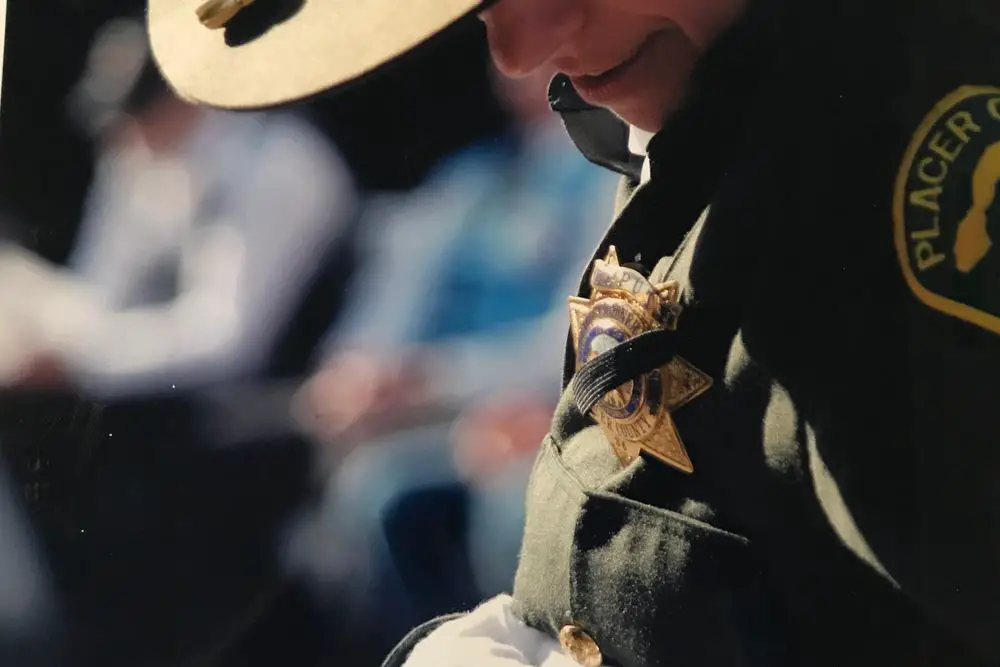
Drew stayed behind me as we entered the sheriff’s office. Carl Gaines did not stand. He sat behind his desk with his boots up and a coffee mug in one hand, uniform shirt pulling tight across his stomach, badge catching the overhead light. He smiled before I spoke.
That smile told me he already knew why I was there.
I set the X-ray on his desk. Laid the discharge papers beside it. I explained that my son had been hurt at school. I explained that Neil Gaines had been involved. I asked to file a report.
The sheriff looked at the X-ray for less than two seconds. Then he leaned back.
“Boys roughhouse,” he said.
Drew flinched behind me. It was small, but I saw it.
I repeated that my son had a fracture.
Gaines chuckled. “Kids today bruise easy,” he said. He looked past me at Drew. “Thin-skinned, maybe.”
My hand closed around the back of the chair in front of his desk. I felt the wood under my fingers. I let go.
That was the first time I chose not to act on rage.
I told him again that I wanted a report filed. I used calm sentences that did not leave room for misunderstanding. He laughed harder, called Neil a natural leader, said sometimes boys had to learn where they stood. Then he said the word joke.
It landed in the room like something rotten.
Drew looked at the floor.
I looked at the sheriff.
“The law doesn’t work that way,” I said.
His smile changed. It did not disappear. It thinned. He leaned forward, elbows on the desk.
“In this county,” he said, “I decide how things are handled.”
Then he smirked. “What are you going to do about it?”
There are moments when a man shows you the whole map by mistake. That was one of them. He thought the office was the battlefield. He thought the badge was the high ground. He thought my silence meant I had no weapon.
I gathered the X-ray and the papers. I stood. I nodded once. Then I walked out with Drew beside me.
Outside, the cold hit hard.
Drew stopped near the truck. “I’m sorry,” he said.
I turned so fast he looked startled.
“You don’t apologize for being hurt,” I said.
His mouth tightened. He wanted to believe me. He was not there yet. That was the part I carried home. Not the sheriff’s laugh. Not the smirk. My son’s apology.
That night, Drew went to his room early. I heard his door close and then nothing — no music, no television, no sounds of a fifteen-year-old boy doing the things fifteen-year-old boys do when they feel safe. Just silence. I sat at the kitchen table with the X-ray and the urgent care papers and my laptop and the particular stillness of a man who has a lot to do and is making himself think before he starts doing it.
The house was quiet except for the refrigerator hum and the wind pushing at the windows.
I had spent two decades in organizations built on force. I understood what it looked like and what it cost and when it worked and when it did not, and I understood that Sheriff Carl Gaines had built his whole position on the assumption that force, or the threat of it, was the only language people who challenged him would understand. He expected me to come back to his office. He expected me to make a scene. He expected me to give him a reason.
I was not going to give him anything he expected.
Documentation. Patterns. Channels. I had been trained for chaos, but this required something colder. People think discipline means taking orders. Sometimes it means not giving a bully the reaction he built his whole trap around. Sometimes the most lethal thing you can do to a man who controls a room is refuse to fight him in it.
I started with the medical records: time of intake, diagnosis, discharge notes, the attending nurse’s name. Then I wrote down everything Drew had told me over the past weeks, even the parts he had tried to soften, the details he had minimized with the careful instinct of a child who has already been told, in one way or another, that making too much of something will only make it worse. The hallway shove in November. The locker room threat in December. The incident after the game when three boys had followed him to the parking lot and one of them had a phone recording it, laughing. The teacher who had looked away. The coach who had told him not to make trouble. The school incident forms that had been marked reviewed in a log nobody seemed to be able to produce on request.
I did not embellish. I did not guess. I did not add color where color was not supported by what I knew. Facts are heavier when you do not decorate them. An embellished account gives a skilled opponent somewhere to stand. A clean, documented, timestamped account does not.
The next morning, I made calls to Helena. Not angry calls. The kind where you ask for names, departments, procedures, and email addresses. I asked where to send medical records involving a minor injured at school. I asked about conflict of interest when the sheriff’s child was named. I asked what state channel handled complaints when a local report was refused.
People transferred me. I wrote down every name, every time, every extension.
By noon I had sent the first packet. By evening, more: photos, dates, names, a copy of the urgent care record, a photo of the cast, a written timeline.
Then I called other parents.
This was the harder part. Making official calls to state offices required only patience and persistence, qualities I had in quantity. Calling other parents required something more careful, because I was asking people to step into a situation where the man they were afraid of wore a badge and knew where they lived and had always, until now, been the only authority available.
I started with the ones whose eyes had changed in the grocery store when Neil’s name came up. Not everyone. Not randomly. The ones who had held a breath a half-second too long when he was mentioned. The ones whose responses had that particular flatness of people who have trained themselves not to react.
One mother cried before she said anything useful. Her son had been shoved into lockers for three months and had started pretending to be sick on the days he knew Neil would be in the hallway before first period. She had gone to the principal and been told that boys that age were hard to manage and that maybe her son needed to work on his social skills.
Another father spoke in a whisper from his garage because his wife did not want the family involved. He said their daughter had watched Neil bully a smaller boy in the cafeteria while three teachers were present and none of them said a word. He said his wife was right that getting involved was dangerous and he said he was going to give me a statement anyway and asked me not to use his name until the investigation had some footing.
A grandmother told me her grandson had transferred to a school thirty miles away after Neil cornered him behind the gymnasium and told him what would happen if he ever repeated what he had seen.
Every story had the same shape. Neil did something. Someone reported it. Nothing happened. Then people learned to keep their heads down.
Fear is not always loud. Sometimes it is a parent lowering their voice in their own kitchen. Sometimes it is a teacher finding somewhere else to look. Sometimes it is a child who stops naming something because he has already learned that the act of naming changes nothing.
I collected statements from the ones brave enough to give them. I did not push the ones who were not ready. I understood fear. I had felt my own version of it in the sheriff’s office when his smirk made it clear how thoroughly he expected me to have no options. I just refused to let it run my house.
Three days after Sheriff Gaines asked me what I was going to do about it, a state vehicle rolled into Milwood Creek. No sirens. No lights. Just a dark SUV moving down Main Street past the diner and the gas station and the grocery store where everybody saw everything.
Then another one came.
By Friday afternoon, state investigation was the phrase moving from booth to booth at the diner. By Friday night, a local news outlet had picked it up. By Saturday morning, it was the only thing anyone in town wanted to talk about while pretending they were not talking about it.
Drew heard it too. He sat at the breakfast table with his cast resting beside his cereal bowl, listening to the quiet buzz of my phone. He did not ask for details. But he sat a little straighter.
That was enough for me.
Around ten, tires crunched in our driveway. I looked through the front window. Sheriff Gaines was getting out of his vehicle. Three officers were with him. His face was red before he reached the porch.
Drew stood behind me in the hallway. “Stay inside,” I said.
I opened the front door before Gaines could knock. Cold air pushed into the house. The small flag beside the porch railing shifted in the wind.
Gaines stepped close enough that the boards creaked under him. “This is your doing,” he snapped. His finger jabbed toward my chest.
The old version of me, the younger version, the version that had not yet learned the real cost of one uncontrolled second, felt something rise. I let it pass through me. Then I met his eyes.
“No,” I said. “This is responsibility.”
Behind me, Drew moved. One step. Then another. He came into the doorway with his cast visible against his sweatshirt, shoulders straighter than they had been in weeks.
Gaines sneered, but it did not land the way it had before.
Drew did not look down.
That was when the state SUV slowed at the curb. Two people in plain coats stepped out with folders in their hands. Deputy Susan Parsons was with them. She looked different outside the sheriff’s office. Not braver, exactly. Maybe just done being afraid in the same room as him.
Gaines turned toward her. “What are you doing here?”
She looked at Drew. Then at me. Then back at the sheriff. “Carl,” she said, “step away from the porch.”
The officers behind him shifted. A boot scraped wood. A hand dropped from a belt. A glance passed between men who suddenly understood the ground had moved under them.
Gaines laughed once, but it came out wrong. Thin. Too high.
One of the state investigators opened a folder. Drew’s name was there. So were others. Not one or two. Several. The folder was thick enough to make the sheriff’s face change.
That is the thing about small towns. Secrets feel permanent until the first person opens a door. Then everybody realizes how many people were standing behind it.
Drew’s good hand was shaking beside me. He was not fearless. Fearless is a story people tell after the danger passes. My son was afraid and standing there anyway. That meant more.
The state investigator spoke then, calm and official. Sheriff Gaines was being directed to cooperate. Records would be reviewed. The refusal to take a complaint involving his own son had already been documented.
He looked at me as if he still expected me to flinch. I did not. He looked at Drew as if a hurt boy should still be easy to frighten. Drew did not look away.
That was the beginning. Not the end. People like Sheriff Gaines do not lose power in one clean scene on a porch. They fight through paperwork. They call in favors. They tell stories about being targeted. He did all of that.
In the days that followed, Milwood Creek split itself open. Some people said I had gone too far. Some said I should have handled it man to man, which usually means quietly enough to protect the wrong person. Some avoided me at the grocery store. Others stopped me in the parking lot with tears in their eyes and folded notes. A coach sent a message through someone else. A teacher asked to speak off the record.
Drew watched it happen from the kitchen table, from the truck, from the school pickup line. He watched adults decide whether they were more afraid of truth or of change.
The investigation did not erase what had happened to him. Nothing could make a broken arm unbroken. Nothing could give back the mornings he had walked into school already bracing for pain. But something shifted.
The first day he returned after the porch confrontation, I walked him to the entrance again. Neil was not leaning against the brick wall. His friends were there, but quieter. They looked at Drew, then at me, then away.
Drew adjusted his backpack with his good shoulder. “You don’t have to walk me all the way,” he said.
I studied his face. Still fear. But something else too. A little anger. A little pride. A boy finding the outline of himself again.
“I know,” I said.
He took three steps, then stopped. He turned back.
“Dad?”
“Yeah?”
“Thanks for not yelling in his office.”
I had not expected that. I thought he would mention the calls or the records or the state vehicles rolling down Main Street. But that was what he remembered. The moment I did not give the sheriff what he wanted.
I nodded because my throat had gone tight.
Then Drew walked inside. He still had a cast. He still had bruises fading along his jaw. He still had a long road ahead in a town that had learned fear by habit. But he was walking under his own power.
And that morning, that was enough.
People asked me later whether I ever answered the sheriff’s question.
What are you going to do about it?
I did answer. Not with a threat. Not with a fist. Not with the kind of rage men like him know how to use against you.
I answered with records. With names. With timestamps. With parents who were tired of whispering. With a boy who finally understood that being hurt was not the same thing as being weak.
In a town built on looking away, the most dangerous thing we did was make people look.

Adrian Hawthorne is a celebrated author and dedicated archivist who finds inspiration in the hidden stories of the past. Educated at Oxford, he now works at the National Archives, where preserving history fuels his evocative writing. Balancing archival precision with creative storytelling, Adrian founded the Hawthorne Institute of Literary Arts to mentor emerging writers and honor the timeless art of narrative.