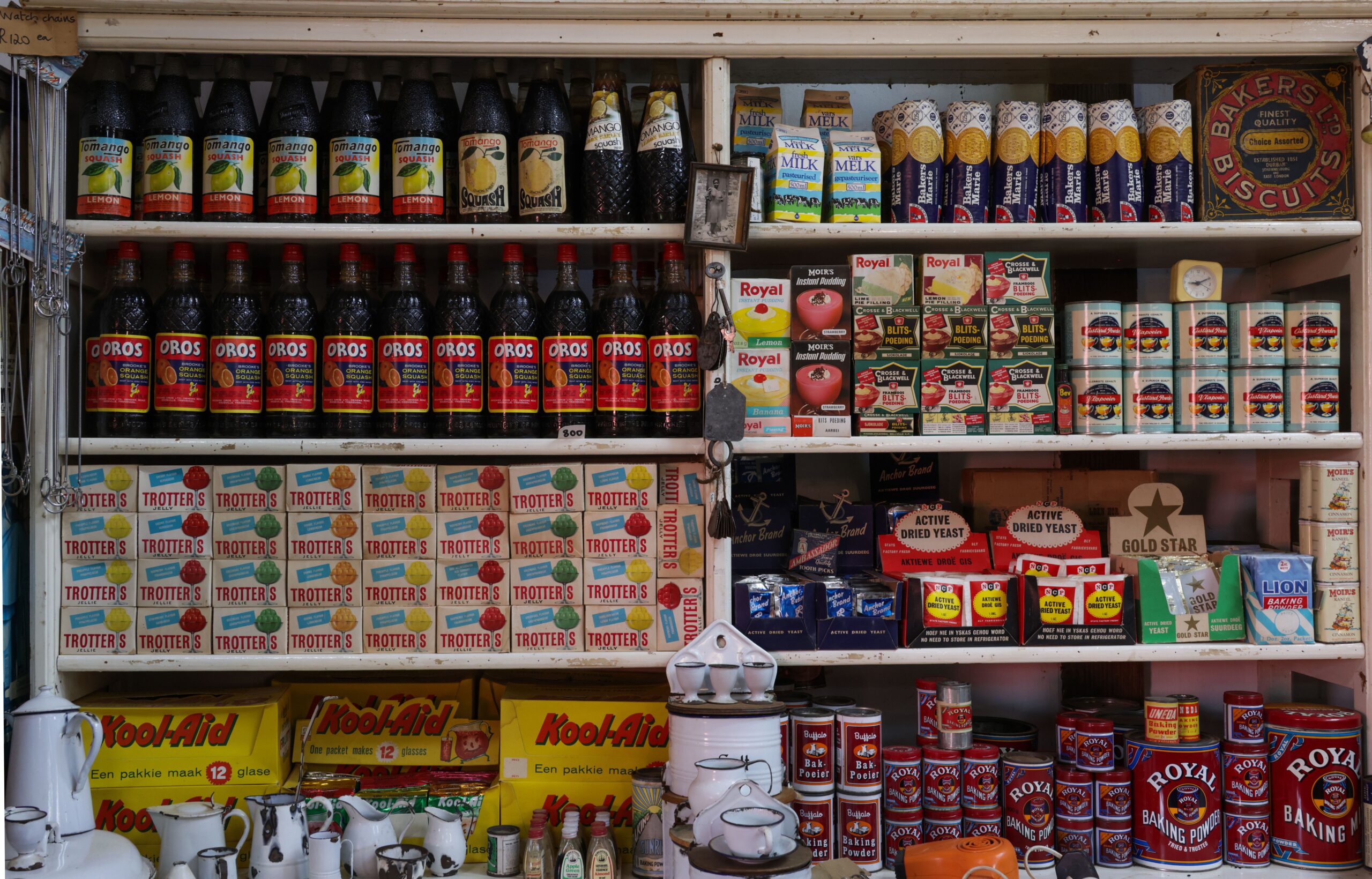
My mother’s name was Catherine. She was twenty-six years old. She had two children under five, a husband who had walked out the previous spring, and forty-one dollars and sixteen cents in her checking account on the Thursday afternoon in October of 1978 when she pushed a shopping cart into the Kroger on Brookpark Road in Cleveland and tried to do the math one more time in her head.
She had been doing the math in her head for three weeks.
The math did not change.
She needed enough food to get the three of us through the next eleven days, when her first paycheck from the new job at the dental office would clear. She had forty-one dollars and sixteen cents. She had two children, one of whom was me, and one of whom was my brother Daniel, who was three years old at the time and who was sitting in the front of the shopping cart in a green corduroy jacket that had a button missing on the left sleeve.
I was four. I was holding the side of the cart with my left hand and a small stuffed rabbit with my right hand. The rabbit’s name was Mr. Whiskers. I had received Mr. Whiskers from my grandmother for Christmas the previous year. I did not go anywhere without him.
I do not remember most of that afternoon.
I remember the rabbit.
I remember my mother stopping in the cereal aisle and standing there for a long time looking at a box of Cheerios.
I remember her putting the Cheerios back on the shelf and picking up a smaller, cheaper box of corn flakes instead.
I remember her doing that several more times in the next twenty minutes. Picking something up, looking at the price, putting it back, picking up something cheaper. Bread. Peanut butter. A small package of ground beef that she put back in favor of a smaller package of ground beef. Milk. Eggs. A bag of apples that she put back entirely.
I remember her counting the items in the cart.
I remember her counting them again.
I remember her closing her eyes for a second at the front of the cart and then opening them and pushing us toward the checkout.
What I do not remember, because I was four years old and did not understand what was happening, is what happened next.
My mother told me about it years later. She told me about it in pieces, in different ways, at different times in her life. Once when I was sixteen and we were sitting at the kitchen table after my high school graduation. Once when I was twenty-three and my first daughter was born and my mother had driven up to see her. Once when she was seventy-one and I had taken her to the hospital for what would turn out to be the first of her chemotherapy treatments, and we were sitting in the waiting room together, and she had been quiet for a long time, and she had finally looked over at me and said, I never told you this part.
But she had told me. She had told me four times before, in slightly different versions, with slightly different details.
The version I am going to tell you now is the version she told me in the chemotherapy waiting room, because it was the last one, and the last one is usually the truest.
She got to the checkout line at the Kroger on Brookpark Road on a Thursday afternoon in October of 1978 with forty-one dollars and sixteen cents in her checking account and a cart full of food that she had chosen with the kind of precision that only desperation teaches.
The cashier was a girl named Linda. My mother remembered her name because Linda was wearing a name tag and because Linda was very young, maybe nineteen, maybe twenty, with a high blonde ponytail and pink frosted lipstick, and because when Linda smiled at my mother and said hi, there had been a moment when my mother had nearly broken down at the kindness of the greeting.
She did not break down.
She watched the numbers go up on the cash register.
The total came to forty-three dollars and ninety-eight cents.
She was two dollars and eighty-two cents short.
She had calculated wrong. She had been doing the math in her head for an entire hour in the store, and somewhere in the cereal aisle or the dairy section or the front of the produce section, she had carried a number wrong.
She stood there with her purse open and her checkbook in her hand and Daniel in the front of the cart and me holding the side of the cart with my rabbit, and she looked at the total on the register, and she said to Linda, very quietly:
I need to put some things back.
Linda said, Oh — that’s okay, ma’am, no problem, what would you like to take off?
My mother started looking at the items on the conveyor belt to decide what to put back. The package of ground beef. The bag of bread. The half-gallon of milk. She was trying to decide whether her children needed milk more than they needed protein. She was making this decision in front of Linda and the people in line behind her and my brother and me, in a Kroger on a Thursday afternoon in October of 1978.
A voice behind her said: I’ve got it.
She turned around.
There was a man standing in the line behind her. He was maybe forty years old. He was wearing a brown corduroy jacket and a gray newsboy cap. He had a small basket with a loaf of bread and a quart of milk and a single pack of cigarettes in it. He had a kind face. My mother said it was a kind face. She did not remember much else about him, in any of the times she told me the story. Just the brown corduroy jacket and the gray cap and the kind face.
He stepped forward. He took out his wallet. He handed Linda a twenty-dollar bill.
He said again, to my mother, quietly: I’ve got it. Please.
My mother started to cry.
She tried to say no. She tried to say she couldn’t accept it. She tried to say she would pay him back, that if he gave her his address she would mail him a check the moment her paycheck cleared in eleven days.
The man looked at her.
He shook his head, very slightly.
He said: Don’t pay me back. Pay it forward someday. When you can. To someone who needs it.
Then he paid for his own items, and he tipped the brim of his cap to her, and he walked out of the Kroger on Brookpark Road in Cleveland, and my mother never saw him again.
She paid for the rest of the groceries with her own money. She walked out of the store with both of her children and a cart full of food and seventeen dollars and eighteen cents left in her checking account.
She sat in the parking lot for ten minutes in the car before she could drive home.
Daniel, who was three years old at the time, asked her in the car why she had been crying.
She told him she had not been crying. She told him she had been having allergies.
I, who was four years old at the time, asked her in the car who the man was.
She told me she did not know.
She drove home.
That was October of 1978.
My mother kept her promise. She paid it forward. She paid it forward for the next forty-three years. She paid it forward in ways she never told us about and ways she did. She kept extra bills in her purse for situations like the one she had been in. She bought groceries for strangers at supermarkets at least six times that I personally witnessed growing up, and probably many more times I never saw. She paid the rent for a neighbor in our apartment building in 1983 when his wife had left him and he was about to be evicted. She paid for the funeral, or part of the funeral, of a coworker’s son in 1991 when the coworker could not afford it. She left twenties in the tip jars of every diner waitress who looked tired. She left a hundred-dollar bill in a Salvation Army kettle every Christmas for as long as I can remember, even in years when the math was not easy for her.
She told us once, when I was a teenager, that she had a running tally in her head.
I asked her what the tally was for.
She said: Two dollars and eighty-two cents. Plus interest.
I did not understand at the time.
She told me eventually. She told me about the man at the Kroger and the brown corduroy jacket and the gray newsboy cap and the kind face. She told me she had been paying him back for forty years and that she was nowhere near finished, because the interest on a kindness like that, she said, compounds.
She died in March of 2021.
She was seventy-three years old.
The cancer that had started in her pancreas had moved to her liver by the autumn and to her bones by the winter, and she had spent the last six weeks of her life in the home she had bought in 1986, in the small bedroom on the second floor that had been my brother Daniel’s bedroom when he was a boy.
She had asked to be in that room.
She did not say why.
I think I know why. I think she wanted to be in the room where her son had slept when he was small and safe, because at the end of a life that had not been easy, she wanted to be near something that had been good.
She died on a Wednesday morning.
Daniel and I were both there. We were holding her hands. She had been unconscious for about two days at that point, and the hospice nurse, a woman named Beverly who was about my age and who had been wonderful, had told us the night before that it would probably be soon.
It was soon.
She went quietly.
I do not want to write about that part. I have written about it before, in other places, and I do not want to write about it here. What I want to write about here is what happened afterward.
About four months after my mother died, in July of 2021, I drove down to Cleveland from where I now live in Pittsburgh to clean out the house and prepare it for sale. Daniel had flown in from Denver. We spent eight days in the house going through her things.
It was the worst eight days of my life.
I have been through worse things in the sense of more dramatic things. I have been through a divorce. I have been through my older daughter’s car accident when she was nineteen, which she survived but which took six months of rehabilitation. I have been through my father’s death, which was complicated for reasons I do not want to get into.
But cleaning out the house of a parent who raised you alone, in the rooms where she raised you, is a particular kind of difficulty that I do not have a word for.
On the seventh day, in a closet in her bedroom, I found a box of grocery store receipts.
It was a shoebox.
It was full of receipts.
There were hundreds of them. They went back to the late 1970s. Some of them were so old the thermal paper had faded almost completely. Some of them were from last year. They were not all from the same store. There were Kroger receipts, and Giant Eagle receipts, and Heinen’s receipts, and the receipts from the little corner store on Storer Avenue that closed in 2003.
I sat on the floor of her bedroom with the box in my lap.
I did not understand at first.
Then I looked more closely.
On the back of each receipt, in my mother’s careful handwriting, was a small note.
Thursday October 19 1978. Stranger paid $2.82.
That was on the first one. The oldest one. The one at the bottom of the box.
The notes on the other receipts said things like:
March 1979. Woman with two kids in line behind me, paid for her milk and bread, $4.67.
August 1981. Older man at the deli counter short on cash for lunch meat, gave him a five.
November 1983. Pregnant girl at the checkout couldn’t afford prenatal vitamins, bought them for her.
December 1986. Family at Christmas, no presents in their cart, slipped a twenty into the woman’s purse when she wasn’t looking.
There were hundreds of these.
She had kept track.
For forty-three years, my mother had kept track. Every time she paid it forward, she had written it down on the back of the receipt, and she had put the receipt in the box, and she had never told anyone.
Daniel found me sitting on the floor with the box.
He sat down next to me.
He did not say anything.
We sat there together for a long time.
When we finally got up, we took the box with us. We took it back to Pittsburgh in my car. It is still in my house, on a shelf in the small office where I do my writing.
It was nine months later, in April of 2022, that the second part of the story happened.
I was at a grocery store. Not a Kroger. A small Whole Foods near where I live in Pittsburgh. I was buying things for a dinner I was hosting that weekend.
I was in the cheese section.
There was an older man standing next to me. He was looking at the same cheeses I was looking at. He was tall, slightly stooped, with white hair under a gray newsboy cap.
The cap caught my eye first.
Then his face caught my eye.
He had a kind face.
I do not know how to describe what I felt, standing there in the cheese aisle of a Whole Foods in Pittsburgh in April of 2022, looking at the face of a man who was somewhere in his eighties, in a gray newsboy cap. There was no reason in the world I should have recognized him. I had been four years old when the only thing I could plausibly have known about him happened. I did not have a memory of his face. I had only my mother’s description, repeated four times across a lifetime: brown corduroy jacket. Gray cap. Kind face.
The corduroy jacket was different. This man was wearing a navy blue cardigan over a button-down shirt.
But the cap was the same. And the face was kind.
I did something I have never done before and have not done since.
I introduced myself to a stranger in a grocery store.
I said: I’m sorry to bother you. My name is Sarah. Is there any chance you used to live in Cleveland?
He looked at me. He smiled, a little surprised.
He said: I did. I lived in Cleveland for thirty-two years. Until 2003. I’m sorry, do I know you?
I said: Did you ever shop at the Kroger on Brookpark Road?
He thought for a moment.
He said: Sure. That was my Kroger.
I started to cry.
I cried right there in the cheese aisle of a Whole Foods. I cried so hard that an employee came over to ask if I was okay. I was deeply embarrassed about this for about two weeks afterward and then stopped being embarrassed because I realized I would do it again.
The man’s name was Walter.
He was eighty-three years old. He had retired from a job as an industrial engineer at a steel manufacturing company in 1998 and moved to Pittsburgh in 2003 to be near his daughter. His wife had died of Alzheimer’s in 2015. He lived alone in a small apartment in Squirrel Hill. He came to that Whole Foods every Saturday morning because the woman who ran the cheese counter was kind to him and remembered his name and asked about his garden.
I told him the story.
I told him about my mother. About the Thursday afternoon in October of 1978. About the forty-one dollars and sixteen cents. About the corn flakes she had chosen instead of the Cheerios. About the way Linda the cashier had said hi. About the moment when he had stepped forward in the line behind her and told her I’ve got it.
I told him about the box of receipts.
I told him about my mother dying in March of 2021.
I told him she had kept track for forty-three years.
He stood there in the cheese aisle of the Whole Foods and listened to all of it without interrupting me once.
When I was done, he was quiet for a long moment.
Then he took off his gray newsboy cap and held it in his hands and looked at it.
He said, very quietly: I do not remember her.
He said: I have done that for many people over many years. I learned to do it from my own mother, who learned to do it from her father, who came over from Ireland in 1912 and had a similar thing happen to him on his first week in this country. I have never kept track of how many times I have done it.
He said: I am sorry. I do not remember your mother specifically. I wish I did.
I told him it did not matter that he didn’t remember her.
I told him she had remembered him.
I told him she had remembered him every day, for forty-three years, two dollars and eighty-two cents plus interest, and that the interest had compounded into hundreds of strangers in grocery stores across two counties of Ohio, who had also not known his name, but who had been carried home with their groceries because he had stood in a line behind her in 1978 and had not been able to bear to watch her put the milk back on the conveyor belt.
He started to cry.
We stood there together in the cheese aisle of a Whole Foods in Pittsburgh, an eighty-three-year-old man I had never met before and a forty-eight-year-old woman whose mother had died thirteen months earlier, and we both cried.
The employee came back over to ask if we were okay.
We both said yes.
We were.
I have his phone number now.
I have had dinner with him three times since that afternoon. I took my daughter to meet him in June. She is twenty-six years old, the same age my mother was on the day Walter paid for her groceries. She listened to him tell stories about his garden for two hours and laughed harder than I had heard her laugh in a year.
Walter does not have any grandchildren. His daughter, the one he moved to Pittsburgh to be near, does not have children. He is the last of his line.
I am not his grandchild. He is not my grandfather.
But I have started to bring him soup on Sundays.
I have started to drive him to his doctor’s appointments when his daughter is traveling for work.
I have started to think of him as someone I am responsible for, in a way I cannot completely explain except to say that there is a kind of debt that does not transfer through bloodlines but does transfer through groceries.
He is going to be eighty-five next month.
I am throwing him a birthday party.
There is a part of this story that I have not told anyone before now, because it does not really fit anywhere else in the telling, but it should be said.
About six weeks before my mother died, in the home where she had raised us, she asked me to bring her the shoebox from the closet.
I did not know what was in the shoebox at the time.
She held it in her lap for a long time, with her hands resting on the top of it. She did not open it. She just held it.
Then she handed it back to me.
She said: Put this somewhere safe. You will know what it is for.
I asked her what was in it.
She said: Receipts.
I asked her receipts for what.
She thought about it for a long moment.
Then she said, very quietly: Two dollars and eighty-two cents. Plus interest.
I did not understand at the time. I thought it was the medication talking. She had been on a lot of medication by that point and sometimes she said things that did not entirely track.
I put the shoebox back in the closet.
I forgot about it.
Three months later, on the seventh day of cleaning out her house, I found it again.
And ten months after that, I found Walter.
I think about this a lot.
I think about the chain of small choices that led from my mother’s empty checking account on a Thursday in 1978 to a cheese aisle in Pittsburgh in 2022. I think about Walter’s mother, and her father, and a small kindness on a dock in Ireland in 1912 that I will never know the details of but that traveled across an ocean and through four generations and ended up paying for my mother’s groceries.
I think about the fact that I have no way of knowing how many people my mother helped over forty-three years.
I think about the fact that those people, most of them, do not know her name.
I think about the fact that someone, somewhere, right now, is paying for a stranger’s groceries because something my mother did, that someone she helped did, that someone they helped did, that someone they helped did, has rippled out and is still rippling.
I think about the fact that none of this would have happened if a man in a brown corduroy jacket had not stepped forward in a checkout line in Cleveland on a Thursday afternoon in October of 1978 and said I’ve got it.
Two dollars and eighty-two cents.
Plus interest.
I do not know what my mother understood, in the last weeks of her life, when she held that shoebox in her lap and told me to put it somewhere safe. I do not know if she had a sense of what would happen, or if she was just hoping someone, someday, would find it and understand what she had been doing for forty-three years.
I think she knew.
I think she had spent her whole life learning that small things matter. That kindness keeps books we cannot read. That you can spend forty-three years paying back two dollars and eighty-two cents and still be in debt at the end of it, because that is how a real debt works — it is not the amount, it is the moment when you needed it and someone gave it to you.
My mother gave it to a lot of people.
She did not need their names.
She just kept track.
And now I am keeping track too.
I have started my own shoebox.
It is on the shelf above the one with my mother’s.
It is not full yet. But it is starting to fill up.
The first receipt at the bottom of mine is dated April 2022.
The note on the back of it says:
Walter. Whole Foods, Squirrel Hill. He paid for my mother once. I bought him a wedge of aged gouda. Started here. Will not stop.
That is how it goes.
That is how it has always gone.
A man in a brown corduroy jacket. A woman with forty-one dollars and sixteen cents and two children. A shoebox full of receipts. A cheese aisle four decades later.
And one small thing, repeated, that turns out to be the only thing that ever really mattered.
Two dollars and eighty-two cents.
Plus interest.

Adrian Hawthorne is a celebrated author and dedicated archivist who finds inspiration in the hidden stories of the past. Educated at Oxford, he now works at the National Archives, where preserving history fuels his evocative writing. Balancing archival precision with creative storytelling, Adrian founded the Hawthorne Institute of Literary Arts to mentor emerging writers and honor the timeless art of narrative.