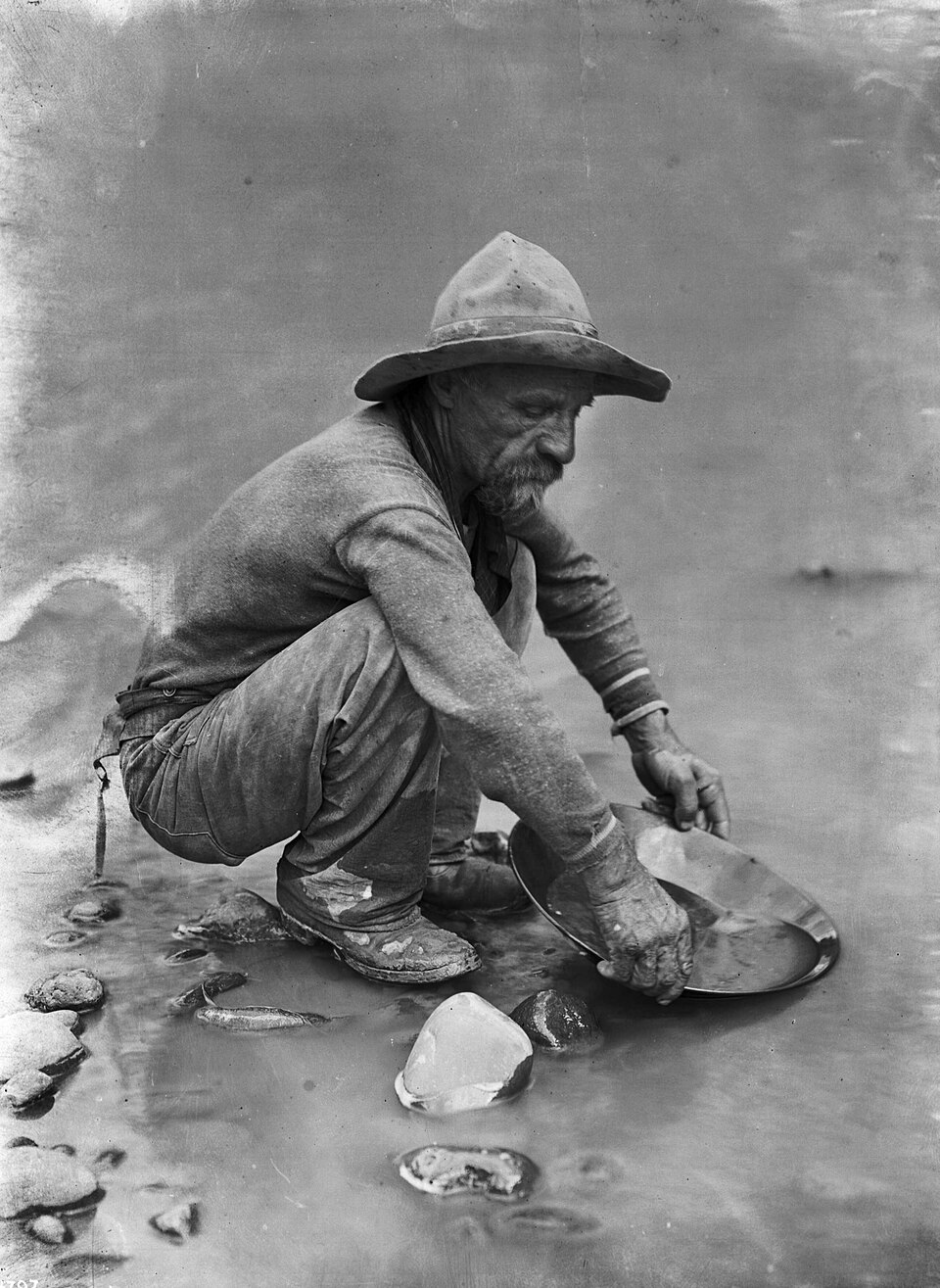
He had $11 left to his name, a cracked tin pan, and a mule that hadn’t eaten in two days.
Every man in the camp had laughed at Thomas Callahan when he staked his claim on the bend of the American River that spring. They called it Fool’s Bend. They said the gravel was wrong, the water too shallow, the color all played out. Old Pete Garvey, who’d been working California dirt since ’49, spat tobacco juice at Thomas’s boots and said, “Boy, the only thing you’ll pan out of that stretch is mud and regret.”
Thomas smiled, tipped his hat, and walked back to his claim.
That was March of 1852. He was twenty-three years old, five months out of County Cork, Ireland, and so broke he’d been eating salt pork and river water for the better part of a week. He had crossed an ocean in the belly of a ship that smelled of tar and disease. He had walked the last forty miles to the diggings after his horse went lame outside of Sacramento. He had buried two men he’d known from the crossing — one to cholera, one to a knife fight over a disputed claim — and he had kept walking.
Thomas Callahan had not come this far to be told where the gold wasn’t.
The World He Walked Into
The mining camps along the American River in 1852 were unlike anything the young Irishman had ever seen or imagined. They were loud, filthy, magnificent, and terrifying all at once. Tents and rough wooden shanties stretched along both banks of the river for miles, smoke rising from a hundred cook fires, the sound of pickaxes ringing against rock from first light until the sun dropped behind the Sierra Nevada and a man simply could not see what his hands were doing anymore.
Men had come from everywhere. There were Chinese miners working claims near the water’s edge, methodical and disciplined, speaking in a language Thomas didn’t understand but had come to respect for its rhythm. There were Mexicans who had been working California soil before California was even American, their knowledge of the land deeper than anyone gave them credit for. There were former sailors, freed slaves, farmers from Ohio and Pennsylvania and Virginia who had walked away from everything familiar on the strength of a rumor and a dream. And there were hundreds of Irish, fresh off the boats, driven west by the same famine and desperation that had carried Thomas across the Atlantic.
By 1852, over 250,000 fortune seekers had poured into California. The territory that had counted fewer than 1,000 non-native residents just four years earlier was now one of the most densely worked pieces of land in the world. The easy surface gold found in the first frenzied months of 1848 and 1849 was long gone, cleaned out by the original wave of forty-niners who had arrived to find nuggets washing freely in the riverbeds, gold so plentiful in those first days that men filled their pockets bending over creek banks. By the time Thomas arrived, a man worked ten, twelve, fourteen hours a day in freezing river water, his back bent, his hands bleeding, and on a good day he might pan out half an ounce. At sixteen dollars an ounce, that was eight dollars for a full day of labor that would have killed a healthy mule.
And a plate of beans and salt pork in camp cost a dollar fifty.
The merchants, Thomas had quickly learned, were the ones getting rich.
He noticed that on his third day in camp, watching a storekeeper named Alderman — fat, pink-faced, smelling of bay rum — sell a single wool blanket to a shivering Chilean miner for twenty-two dollars. The miner paid without argument. What choice did he have? It was late winter, the nights dropped to near freezing, and the nearest alternative was forty miles south in Sacramento. Samuel Brannan, the San Francisco merchant who had famously run through the streets of the city in 1848 crying that gold had been found while quietly cornering the market on every pick, pan, and shovel in Northern California, had become the territory’s first millionaire not by mining an ounce of gold himself but by selling tools to the men who did.
Thomas filed that observation away somewhere behind his eyes and got back to work.
Fool’s Bend
Fool’s Bend was a quarter mile downstream from the main cluster of claims, around a slow curve in the river where the bank widened into a shallow gravel bar maybe thirty feet across. The men upstream had dismissed it because the water ran quiet there, too slow, they said, to carry heavy gold. They worked the faster channels where the current carved deep into the bedrock and deposited its treasure in the cracks and crevices.
Thomas had a different theory.
Back in County Cork, his grandfather had been a millwright, and Thomas had grown up watching how water moved, how it carried things, how it lost its strength around bends and dropped whatever it was holding. He’d spent his childhood throwing sticks into the River Lee and watching where they caught and settled. He wasn’t an educated man. He hadn’t read the geology books that some of the more refined forty-niners carried alongside their Bibles. But he understood water the way a man understands something he has watched his whole life.
The gold, he believed, was dropping out of the current right there at Fool’s Bend. Dropping into the gravel, settling deep, piling up quiet and unnoticed while every ambitious man in California chased the fast water upstream.
He worked the claim alone for six weeks. Morning to dark, every day, the cold river numbing his feet to the ankle by mid-morning and keeping them that way until he dragged himself back to his tent at night. He panned methodically, moving downstream along the gravel bar in careful sections, cataloging what he found. Mostly nothing. Occasional flakes. One small nugget the size of a pea that he held in his palm for a long time before dropping it in his poke and going back to work.
Old Pete Garvey wandered down twice a week to check on his progress and laugh. The second time he came, he brought two friends from the Missouri contingent, and all three of them stood on the bank and watched Thomas work and shook their heads like men watching a dog try to open a door.
“Still nothing?” Garvey called out.
“Still working,” Thomas called back.
Thursday Morning
On Thursday morning, six weeks and two days after he had staked his claim at Fool’s Bend, Thomas Callahan pushed his pan into the gravel at the deepest point of the bar. It sat in a narrow depression between two large flat stones where the river bottom dropped away unexpectedly. He lifted the pan slowly into the current and began to work it in the circular motion he could do in his sleep.
He almost missed it. The light was wrong, still early, the sun not yet over the ridge. He tilted the pan, let the water wash the lighter gravel over the edge, tilted again, washed again, and then stopped.
The bottom of the pan was not showing the dull grey of river gravel.
It was showing yellow. Not a flake. Not a speck. A layer. A thick, unmistakable, impossible layer of color running across a full quarter of the pan’s surface, mixed into dark heavy sand that Thomas recognized immediately as what old-timers called black sand. Black sand settled in the same places and the same ways as gold because it weighed nearly as much. Where you found one concentrated, you found the other.
His heart stopped.
Then it started again, very fast.
He stood in the river for a full minute without moving, the cold water running past his knees, the pan trembling slightly in his hands. Then he looked up and down the bank. Nobody watching. Garvey and his friends wouldn’t be back until tomorrow. The nearest claim was two hundred yards upstream, out of sight around the bend.
Thomas crouched back down into the water. He set the pan aside carefully on a flat rock above the waterline. And then he reached both hands into that narrow depression between the two flat stones and began to feel along the bottom of the river with his bare fingers.
What he felt made him sit down in the water.
There was a shelf. A natural rock shelf running beneath the gravel, invisible from the surface, perfectly shaped to catch anything heavy that the current tried to carry past. And packed into every crack and crevice of that shelf, caught there season after season as the river rose and fell, pushed in by the current and held by the geometry of the rock, was gold. Not flakes. Not dust. Nuggets. Smooth and cold under his fingers, some the size of a thumb joint, wedged into the rock like they had been put there deliberately by someone who intended to come back for them.
Thomas Callahan pulled his hands out of the water and looked at what he was holding.
He started to laugh. And then he stopped laughing because he realized he was crying, and then he didn’t care about the distinction between the two, and he sat in the freezing river in the Sierra Nevada foothills in the spring of 1852 and wept like a child while the current ran around him and the morning light came slowly over the mountains.
What He Did Next
The first thing Thomas did was nothing. He put the nuggets back in the water, covered the depression with gravel, walked back to his tent, and ate breakfast. He ate slowly. He cleaned his pan. He sharpened his pick. He did not tell anyone.
The second thing he did was visit Alderman’s store.
He spent three of his remaining eleven dollars on two things: a good steel crowbar and a bottle of whiskey. He brought the whiskey back to camp, set it outside his tent, and when Garvey and his Missouri friends came by that evening, he invited them to sit down.
“Thought you might like a drink,” Thomas said.
Garvey was suspicious but not suspicious enough. He sat. They all sat. The whiskey went around. Thomas talked about Ireland and the crossing and the camps, and he let them talk about Missouri and the fast water claims upstream and how the real gold was definitely up in the harder rock and not in any silted-up backwater like Fool’s Bend.
“No question about that,” Thomas agreed pleasantly.
He kept them there until it was fully dark.
The next three days, Thomas worked the depression alone. He used the crowbar to pry up the flat stones, exposing the shelf beneath, and worked it systematically, section by section, pressing every crack for what it held. By the end of the third day he had filled a leather pouch the size of his fist with nuggets and coarse gold, and that didn’t count what was still in the ground.
He rode to Sacramento on his half-starved mule and walked into the assay office on J Street at opening time on a Monday morning.
The assayer, a careful German named Hoffmann, weighed everything twice. Then he looked at Thomas over his spectacles for a long moment.
“Where did you say this came from?” Hoffmann asked.
“My claim,” Thomas said.
“This is two pounds, four ounces,” Hoffmann said. “At current rates that is five hundred and seventy-six dollars.”
Thomas had made $576 in three days. At the height of his claim, in the months that followed, Fool’s Bend would produce nearly forty pounds of gold. At sixteen dollars an ounce that was over ten thousand dollars, at a time when a working man in the eastern United States earned perhaps three hundred dollars a year.
What Became of Pete Garvey
Old Pete Garvey came back to Fool’s Bend on that Tuesday and found Thomas waist-deep in the river with his crowbar, the gravel bar torn up from one end to the other, and the look on the young Irishman’s face that told him everything before a word was spoken.
Garvey stood on the bank for a long time without speaking.
“How much?” he finally said.
“Enough,” Thomas said.
Garvey watched him work for a while. Then he said, quietly, without malice, “I’ll be damned.”
“Probably,” Thomas agreed. “But not for this.”
Garvey had the decency to smile at that. He walked back upstream, and Thomas Callahan never had another problem from him or his Missouri friends. Word spread through the camp anyway, as word always did. Men came to watch. Some of them were angry. Some were awed. A few tried to file counterclaims, arguing that Thomas had not properly established his boundaries, but the mining camp’s elected committee reviewed the matter and ruled in his favor.
He had staked the claim legally, worked it alone, and found what no one else had been willing to look for.
What He Built
Thomas did not do what most successful miners did with their money, which was lose it. He had watched enough men do that in his first weeks in camp, seen men pan out a hundred dollars on a good day and spend it at the gambling tables by midnight, the merchants and the card dealers and the whiskey sellers patiently separating the miners from everything they found.
Instead he did what he had watched Alderman do. He opened a supply store in the camp. Then a second one a mile upstream. He used his gold to buy inventory in Sacramento at merchant prices, carried it to the diggings, and sold it at mining camp prices that were dear but fair enough that men preferred his store to the alternatives.
By 1855, when the Gold Rush was largely played out and the mining camps were emptying, Thomas Callahan was the most prosperous merchant on that stretch of the American River. He had sent enough money back to County Cork to bring his mother and his two younger sisters across the Atlantic. He had built a timber-frame house on a hill above the river that could be seen from the main camp, solid and square, with glass windows that caught the morning light.
He never did pull a pan out of Fool’s Bend again after that claim was exhausted. He’d gotten what he came for, and he knew it.
Years later, when his children asked him why he had staked his claim at Fool’s Bend when every experienced man on the river told him it was worthless, he thought about it for a moment before he answered.
“Every man in that camp knew where the gold had already been found,” he said. “I was only interested in where it hadn’t.”

Adrian Hawthorne is a celebrated author and dedicated archivist who finds inspiration in the hidden stories of the past. Educated at Oxford, he now works at the National Archives, where preserving history fuels his evocative writing. Balancing archival precision with creative storytelling, Adrian founded the Hawthorne Institute of Literary Arts to mentor emerging writers and honor the timeless art of narrative.