The worst Saturday of my year turned into the best thing that ever happened to me, and the whole thing started with a craving for a Hershey bar.
I know how that sounds. Stay with me.
My name is Jamie, and that spring I was not doing well. I’d lost a job I’d liked, a relationship I’d thought was permanent had quietly stopped being permanent, and I had moved into a cheap one-bedroom where I didn’t know a single neighbor. I was twenty-nine and I felt like I’d been left behind by my own life.
So when my friend Dani asked if I’d house-sit and watch her dog for ten days while she went to her sister’s wedding out west, I said yes immediately. Honestly, the company was going to be more for me than for the dog.
The truth was, I’d stopped answering my phone. My mother kept calling and I kept letting it ring, because I didn’t have the energy to perform being fine. I’d been sleeping until noon and eating cereal for dinner four nights running. Saying yes to ten days in someone else’s house, with someone else’s dog and someone else’s routines, felt like being thrown a rope. I needed somewhere to be that wasn’t my own quiet apartment, and I needed something that needed me back.
The Dog
The dog’s name was Max.
He was a scruffy, medium-sized mutt — some beagle, some something else, with one ear that stood up and one that flopped, and the soulful brown eyes of a creature who has decided you are the most interesting person who has ever lived. Dani had adopted him from the county shelter a couple of years earlier. “They found him as a stray,” she’d told me once. “No chip, no collar, nothing. Somebody’s good dog, just lost. Their loss, my gain.”
Max and I got along immediately, the way lonely people and good dogs do. He slept on my feet. He followed me from room to room. By the third day I was talking to him out loud like he understood every word, and I half believed he did.
On the second night there was a thunderstorm, and Max climbed onto the couch and pressed the entire length of his body against mine and let out this enormous sigh, and I lay there in the dark scratching his ears and slowly realized I was comforting him and he was comforting me and neither of us was going to admit which of us needed it more. I hadn’t felt useful to another living thing in months. It’s a bigger feeling than people give it credit for.
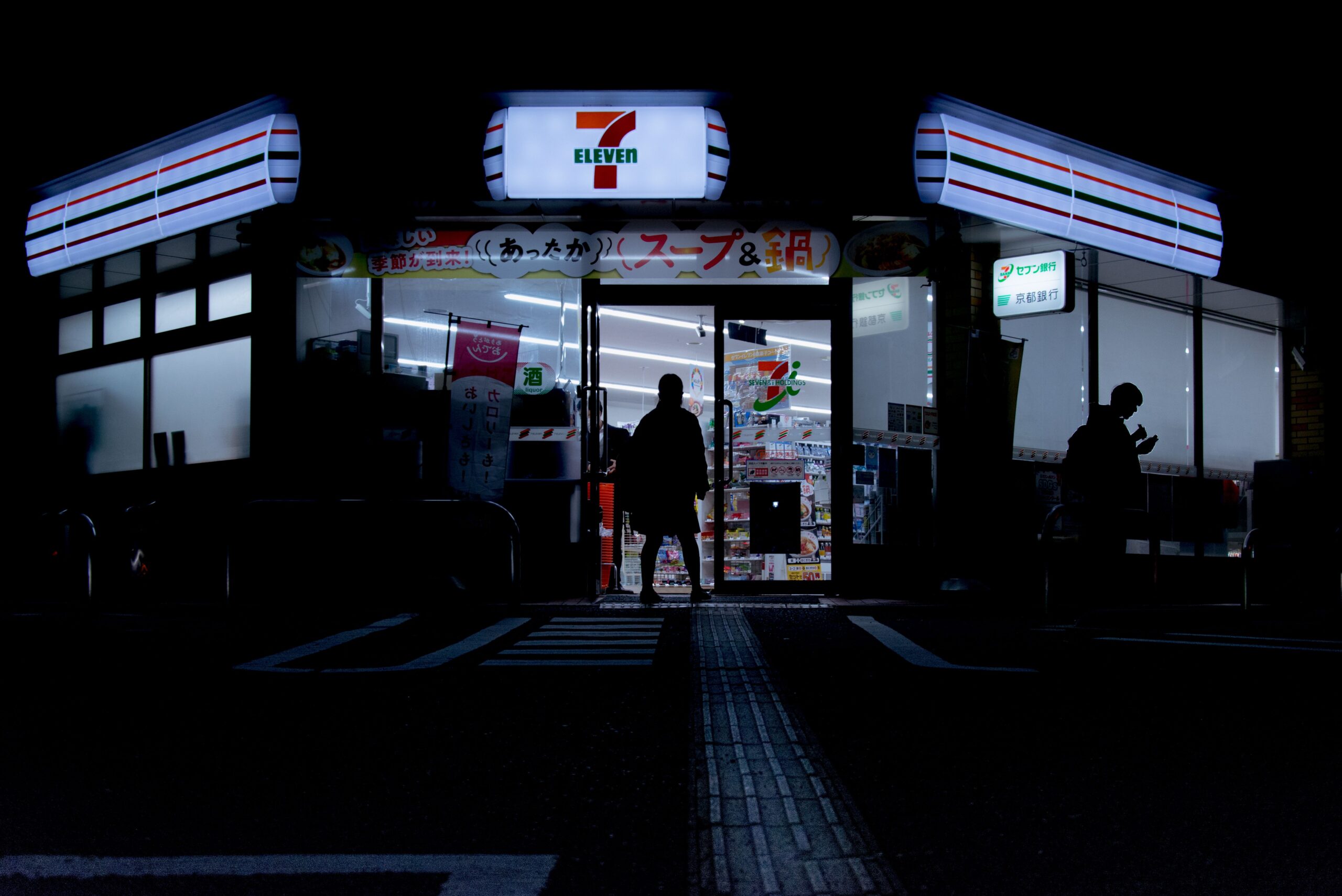
On the fifth day, a Saturday, the weather was perfect and I had a powerful, specific craving: a Hershey bar and an ice-cold Diet Dr Pepper. There was a 7-Eleven about four blocks from Dani’s place. I clipped the leash on Max, because he gave me that one-ear-up look that clearly meant he intended to come along, and we set out.
It was the most ordinary errand in the world. That’s the thing about the moments that change your life. They almost never announce themselves.
The Parking Lot
We made it to the 7-Eleven without incident. I tied Max’s leash to the bike rack out front, told him I’d be thirty seconds, and went in.
I got my Hershey bar. I got my Diet Dr Pepper, the big bottle, ice-cold, the condensation already running down it. I paid in cash and walked back out into the sunshine feeling, for the first time in weeks, something close to fine.
Max was straining at the leash.
Not the happy-to-see-me strain. Something else. He was pulling hard toward the far end of the parking lot, his whole body rigid, making a sound I’d never heard him make — a high, broken whine, the sound a dog makes when it sees something it cannot believe.
I followed his stare. There was an old sedan creeping slowly along the edge of the lot, the kind of beige four-door that elderly people keep for thirty years. It was moving at a crawl, drifting, the driver clearly looking at something other than where the car was going.
The driver was looking at Max.
I had about one second to understand that the car was drifting toward the sidewalk — toward me — and not nearly enough time to do anything useful about it. I got a hand up. I shouted. And then the front corner of that beige sedan caught me at the hip and the curb caught my heels and I went down hard onto the pavement, the Diet Dr Pepper exploding out of my hand and spraying across the concrete like something out of a slapstick movie that was not at all funny from the inside.
The Hershey bar, I would find out later, survived completely intact in my jacket pocket. There is probably a metaphor in there somewhere about the things that make it through a wreck and the things that don’t, but at the time I wasn’t thinking about metaphors. I was thinking about how badly my hip hurt and what a stupid way this was to get hurt on a Saturday afternoon.
On The Ground
For a moment I just lay there, stunned, the wind knocked out of me, my hip screaming and my palms scraped raw.
The car had stopped — it had barely been going five miles an hour, thank God — and a door opened, and I heard the most distraught voice I have ever heard in my life.
“Oh no. Oh no, oh no, oh no — ”
She was tiny. Eighty if she was a day, in a cardigan despite the warm weather, with a cloud of white hair and hands that shook as she lowered herself down toward me far faster than an eighty-year-old should ever move.
“I’m so sorry, I’m so sorry, are you hurt, oh please don’t be hurt — ” She was crying before she even reached me. “I wasn’t — I shouldn’t have — they took my keys, I’m not supposed to be — oh, what have I done.”
I was angry for about four seconds. I had a right to be. I was on the ground in a puddle of my own Diet Dr Pepper with a hip that was going to bruise the color of an eggplant, and this woman had been driving a car she’d just admitted she wasn’t supposed to be driving.
And then I looked at her face, really looked at it, and the anger drained right out of me, because she wasn’t just sorry. She was wrecked. She was looking at me like she’d confirmed something terrible she’d always believed about herself.
“I’m okay,” I said, even though I wasn’t sure yet. “Ma’am, I’m okay. It was slow. Just — let me sit up.”
And that’s when Max, who had been losing his entire mind on the leash this whole time, finally pulled the slipknot loose from the bike rack and came barreling across the parking lot.
The Sound She Made
I braced for him to reach me. He didn’t.
He went straight past me — straight to the old woman — and he hit her so hard with joy that she sat down right there on the pavement next to me, and he was all over her, crying that high broken sound and licking her face and shoving his head under her chin and turning in frantic circles, and she had both her shaking hands buried in his fur and she had stopped breathing almost entirely.
“Biscuit,” she whispered.
I will never forget the sound she made when she said it. It wasn’t a question. It came out of her like something that had been stuck for years.
“Biscuit. Biscuit. Oh my God. Oh my God, it’s you, it’s you, it’s really you — ”
I sat there on the wet concrete, scraped and bruised and completely forgotten by both of them, and I watched an eighty-year-old woman and my friend’s shelter mutt recognize each other after what I would soon learn had been three years apart, and I started to cry. Right there. I couldn’t help it. I didn’t even fully understand yet what I was watching, and I was crying.
Eleanor looked up at me over the dog’s head, tears running freely down all the soft folds of her face, and she said, “I prayed for this. I want you to know that. Every single night for three years, I prayed for exactly this — and somewhere along the way I had given up.”
Because you don’t need the details to recognize a reunion. The body knows one when it sees one.
Why She Was Driving
It took us a while to get up off that pavement. A 7-Eleven employee came out with a first-aid kit and a folding chair, and once everyone had established that I had nothing broken, the woman — her name was Eleanor — told me the whole thing, with Biscuit-who-was-now-Max pressed against her side and refusing to move one inch away from her.
Three years ago, Eleanor’s husband of fifty-one years had died.
They’d had the dog for six years before that. Her husband had picked him out — “He said the dog looked like he had a sense of humor,” she told me, laughing and crying at the same time. After the funeral, Eleanor couldn’t keep up the house alone, and her daughter moved her into an assisted-living apartment.
She told me about him while we sat there — Harold, his name was. Fifty-one years of marriage. He’d been a high school shop teacher, the kind of man who fixed the neighbors’ lawnmowers for free and kept butterscotch candies in his coat pocket for any child within reach. “He always wanted a dog and I always said no, too much mess,” Eleanor said. “Then he retired and looked at me with those eyes, worse than the dog’s, and I gave in. Best thing I ever let him talk me into. The two of them were inseparable. When Harold got sick at the end, that dog never once left the foot of the bed.” She wiped her eyes. “Losing the dog after I lost Harold felt like losing the last warm thing his hands had ever touched.”
It didn’t allow dogs.
“They told me it was the only way,” she said. “They said I couldn’t manage him and the move and the grief all at once. So my daughter took Biscuit to find him a good home, and I signed the paper because I was too sad and too tired to fight, and it is the single greatest regret of my life. I have cried over that dog every single day for three years. Every day.”
Her daughter, it turned out, hadn’t found him a home at all. Overwhelmed herself, she’d surrendered him to the county shelter and told her mother a kinder version. Eleanor never knew. The dog her husband picked out had become a stray with no chip and no collar — somebody’s good dog, just lost — until a woman named Dani walked into that same shelter and fell in love with his mismatched ears.
“So why were you driving today?” I asked.
Eleanor looked almost embarrassed. “A woman at my building. She walks at the park near here, and last week she told me she’d seen a young person walking a dog that looked exactly like the picture of Biscuit I keep on my dresser. I told myself I was being a foolish old woman.” She gripped the dog tighter. “But I couldn’t stop thinking about it. My daughter took my car keys back in the winter — my eyes aren’t what they were. This morning I took the spare from the drawer and I drove over here to look. I’ve been driving these streets for two hours, looking at every dog I passed.”
She looked down at the animal in her arms, then up at me, and the math of it hit us both at the same time.
“I was looking for my dog,” she said slowly, “and I drove right into the person who had him.”
The Phone Call
I want to tell you I handled the next part gracefully. Mostly I just sat in that folding chair with a bag of 7-Eleven ice on my hip and called Dani at her sister’s wedding rehearsal in Arizona and tried to explain, through tears, a story that did not make sense in the order I was telling it.
“Wait,” Dani kept saying. “Wait, you got hit by a car? Are you okay? Whose dog — Jamie, slow down. Max is whose dog?”
I put it as simply as I could. “Dani, I think Max had a family before you. I think I’m sitting next to her. And I think she has spent three years grieving him.”
There was a long silence on the line. I could hear the wedding rehearsal going on behind her, somebody testing a microphone.
Here is the part where I learned what kind of person my friend really is. Because Dani loved that dog. She’d had him for two years. He slept on her feet too. She had every legal and moral right to say no, that’s my dog now, I adopted him fair and square, end of story.
What she said instead, after that long silence, was: “Is she kind? Is she good to him? Tell me about her.”
And when I told her, when I finished, Dani was quiet for a second and then said, “We are not letting that woman grieve a dog who is alive and well and sleeping on my couch. Absolutely not. Get her number.”
So I did. I told her about the cardigan and the shaking hands and the husband who picked the dog out because he looked like he had a sense of humor and the picture on the dresser she’d cried over for three years.
And Dani, six hundred miles away at her sister’s wedding, started crying too, and she said, “Don’t you dare let that woman leave without my phone number.”
What We Worked Out
It would make a tidier story if I told you Dani simply handed the dog over. She didn’t, and I’m glad, because the truth is better.
When Dani got home, the three of us sat in her living room — me, Dani, and Eleanor, with the dog ricocheting between Eleanor’s lap and Dani’s like he couldn’t believe his luck at having both of them in one room. And the two women worked out something better than ownership.
Eleanor’s building still didn’t allow dogs. Dani still loved him. So they decided he would keep living with Dani — but that he was, from that day forward, Eleanor’s dog too. Dani started bringing him to Eleanor’s building three afternoons a week, where it turned out the no-dogs rule had a generous exception for “visiting therapy animals,” and a beagle-something with a sense of humor qualified about as well as any animal ever has.
Eleanor got her dog back. Dani kept her dog. The dog, as far as I could tell, simply concluded that he now had two homes and twice the people, and accepted this as no more than his due.
The first afternoon Dani brought him to Eleanor’s building, I came too, because I was not about to miss it. Word had gotten around the place somehow — these things do, in buildings full of people with time and tender hearts — and a small crowd of residents had gathered in the common room to watch. When Max trotted in and spotted Eleanor in her chair, he did the same thing he’d done in the parking lot: he forgot the entire rest of the world existed. There wasn’t a dry eye in that room. One old gentleman with a walker had to take his glasses off and just stand there holding them. The activities director declared on the spot that Max was the building’s official visiting dog, rules be respected, and made him a little laminated badge with his picture on it. Eleanor framed a copy for her dresser, right next to the old photo she’d cried over for three years.
And me? I’d just been the person standing in the parking lot. The bridge. The one who happened to be walking the right dog at the right 7-Eleven on the right Saturday because I wanted a candy bar.
Except that’s not all I was, as it turned out.
After
Eleanor insisted on paying my urgent-care copay, and she would not be talked out of it, and she added a Hershey bar and a Diet Dr Pepper to the envelope “to replace the one you wore.” That became a joke between us. Then it became a habit. Then it became the thing she does.
Because Eleanor didn’t disappear from my life after that day. None of us let each other disappear.
She is eighty-one years old and she has, against all odds, become one of my closest friends. I go to her building on Tuesdays — the days Dani doesn’t bring the dog — and we play cards and she tells me stories about fifty-one years with a man who picked dogs by their sense of humor. When I finally got a new job that fall, the first call I made was to her. When her daughter and I finally had a long, hard, healing conversation about the shelter and the lie, Eleanor held my hand the whole time.
That conversation was the hardest piece, and it took months. Eleanor’s daughter, Karen, had spent three years living inside a lie she’d told to spare her grieving mother more pain — that she’d found the dog a loving home, when the truth was that she’d been drowning herself and surrendered him to the shelter and could never undo it. When it all came out, Karen was sick with shame. She was sure her mother would never forgive her. But Eleanor had buried a husband and lost three years, and she understood better than any of us that you cannot get the time back by hating each other for how you lost it. “You were trying to carry me,” she told Karen. “You just carried me wrong. Now come here.” I was in the room for that. I have never seen anything braver.
I was twenty-nine and convinced my life had quietly passed me by. I was lonely in a town where I didn’t know a single soul. And then an old woman who wasn’t supposed to be driving knocked me flat on the pavement outside a convenience store, and in doing so handed me an entire family I didn’t know I was missing — a friend who turned out to be made of solid gold, a grandmother-by-accident who keeps my favorite snacks in her purse, and a scruffy dog with mismatched ears who started all of it.
Harold’s been gone four years now, and Eleanor says she still talks to him at night, except these days she has more to tell him. She tells him the dog came back. She tells him about the young person from the parking lot who comes on Tuesdays. I like to think he picked us all out somehow, the way he once picked the dog — that he looked down and saw a lonely old woman and a lonely young stranger and a good dog gone astray, decided the three of us looked like we had a sense of humor, and gave a beige sedan a nudge four blocks toward a 7-Eleven.
People ask me sometimes if I was angry about getting hit. If I ever thought about making a thing of it.
And I tell them the truth.
I went to that 7-Eleven for a Hershey bar and a Diet Dr Pepper. I came home with a life.
It was, and will always be, the luckiest accident that ever happened to me.

Lila Hart is a dedicated Digital Archivist and Research Specialist with a keen eye for preserving and curating meaningful content. At TheArchivists, she specializes in organizing and managing digital archives, ensuring that valuable stories and historical moments are accessible for generations to come.
Lila earned her degree in History and Archival Studies from the University of Edinburgh, where she cultivated her passion for documenting the past and preserving cultural heritage. Her expertise lies in combining traditional archival techniques with modern digital tools, allowing her to create comprehensive and engaging collections that resonate with audiences worldwide.
At TheArchivists, Lila is known for her meticulous attention to detail and her ability to uncover hidden gems within extensive archives. Her work is praised for its depth, authenticity, and contribution to the preservation of knowledge in the digital age.
Driven by a commitment to preserving stories that matter, Lila is passionate about exploring the intersection of history and technology. Her goal is to ensure that every piece of content she handles reflects the richness of human experiences and remains a source of inspiration for years to come.