My name is Rebecca Hayes, and I was twenty-one years old when I became the closest thing my younger sister had to a parent.
People tend to hear a sentence like that and call it inspiring. An older sibling stepping up. Sacrifice and love made visible in daily life. I have learned to accept that framing with a small smile because correcting it is exhausting and the people offering it mean well.
But it was not inspiring. It was survival, two people doing what they had to do because the alternative was worse, and neither of us had been given the option to choose something different.
Our parents did not die. There was no accident, no tragedy with clean edges that family and community could gather around and mourn together. They left. Not simultaneously, not dramatically, but in the incremental way that people abandon things they have decided are too heavy to carry. My father went first, in pursuit of a business venture whose details he never finished explaining before his phone number changed. My mother followed within a year, into a new marriage whose terms apparently included traveling light, which apparently meant without her two daughters.
These are the facts stripped of the version I told myself for a long time to make them bearable.
What they left behind was a house with overdue notices starting to appear in the mailbox and an eight-year-old girl named Lily who came to my bedroom door the third morning after our mother left and stood there in her pajamas with a question on her face that she did not yet have words for.
I was twenty-one. I had been working at a roadside diner since I was sixteen and attending community college on a schedule built around the shifts I could not afford to miss. I had never filed my own taxes independently. I had never negotiated a lease. I had never signed a document on behalf of anyone else. I did not know how any of these things worked with any confidence.
I learned.
There was no other option that I could square with myself, so I did not spend time looking for one.
I found a social worker named Mrs. Carver who helped me understand what guardianship required without making me feel stupid for not already knowing. She was a tired woman in her fifties who had seen enough abandoned children to be unsentimental about the situation and efficient with her advice, and she was the closest thing to an ally I had for the first year. I sat in her office twice and wrote down everything she said in a spiral notebook I still have somewhere in a box, and I left each time feeling like I had been handed a map to a country where I did not speak the language but could at least stop walking in circles.
I picked up additional shifts at the diner. I found a cheaper apartment close to Lily’s school so the bus route would stay familiar and so the distance she had to travel to reach the one remaining constant in her life would be as short as possible. I attended parents’ evenings at her school and sat in plastic chairs sized for people a decade younger than me and answered questions about Lily’s home life in the confident voice of someone who knew what they were doing, because Lily was watching and she needed to believe I knew what I was doing.
I braided her hair from internet tutorials watched at two in the morning with the sound off so I would not wake her, my hands still carrying the fine tremor of a long shift, practicing on my own hair first until I could do a passable French braid without looking. I packed her lunches. I took her to the dentist and the doctor and to birthday parties for children whose parents looked at me with a mixture of sympathy and uncertainty that I learned to ignore because it was not useful.
I signed school forms I did not always understand and then went home and read the relevant portions of whatever regulation they referenced until I understood them well enough. I learned what a dependent meant for tax purposes, and what guardian status required, and how to talk to a school administrator when they had questions about our home situation in a way that closed the question without alarming anyone.
What I did not do was ask for help from family. Not because I was too proud but because the people who might have offered it were the same people who had already demonstrated their willingness to leave when things became inconvenient, and I did not have the emotional reserves to manage their discomfort on top of everything else.
For years it was the two of us. Bills and birthdays and scraped knees and school performances. Lily sleeping in the next room while I sat at the kitchen table going through the finances at midnight and doing the arithmetic of the following month in my head until it balanced or until I found the thing that had to give. She called me Rae, and the way she said it over time changed from the desperate clinging of a child terrified to lose another person to something that carried its own kind of ordinary weight. Rae, do we have orange juice. Rae, I need a permission slip. Rae, I got an A on the history essay.
By the time Lily turned eighteen she was not merely raised. She had become something that I suspect she would have become regardless, because I do not flatter myself into believing I made her who she is. She was brilliant and she was kind in ways I had not been allowed to be at her age, and she was resilient in the specific way that people are resilient when the ground under them shifted early and they learned to keep walking anyway.
She started university on a partial scholarship and the rest of it covered by savings I had been building since she was twelve. I did not tell her the extent to which I had arranged this. She knew I helped. She did not know the specific shape of the help because I had decided a long time ago that she deserved to experience her own achievements as her own.
Then she met Andrew Whitmore, and I first understood what his family name meant when I noticed the particular way that certain people around us began to straighten their posture when he mentioned it in passing.
Old money. The kind that has had several generations to become invisible in the way that very old things become invisible, absorbed into the background of the places they occupy until they seem like a natural feature rather than an accumulation. The Whitmore family had opinions about weddings and venues and guest lists and arrangements that arrived in the planning process as suggestions but carried the weight of expectations, and Lily navigated all of it with a grace I watched with something between admiration and worry.
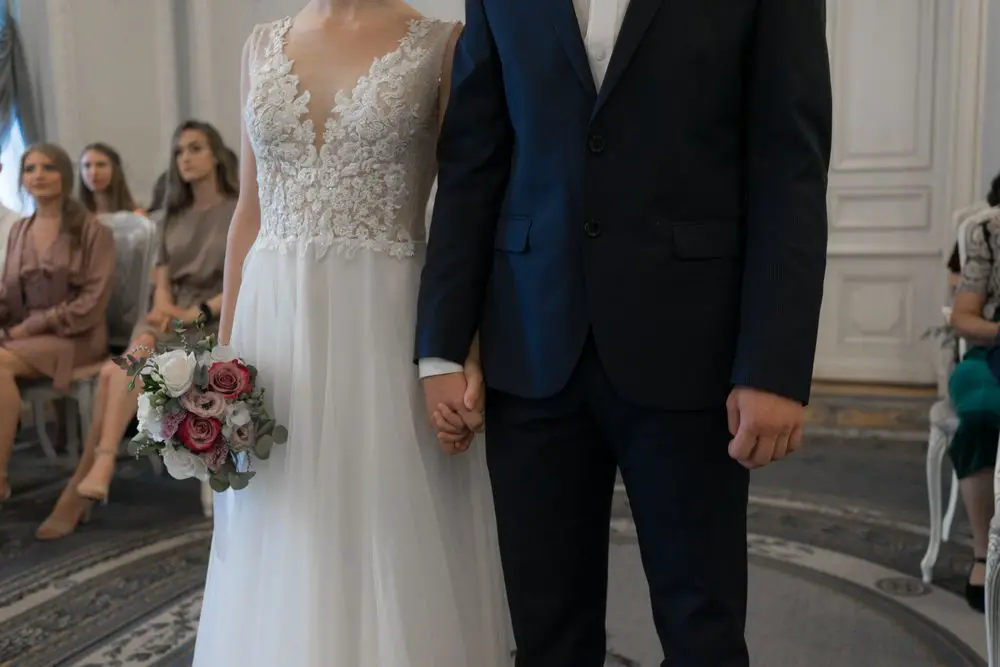
The wedding took place at a country club outside Boston on a clear October afternoon. The kind of venue where the flowers have been assessed by someone whose professional title is floral designer and the light through the windows at a specific hour falls across the room in a way that appears uncontrived but is not. Crystal chandeliers. White orchids in arrangements that cost more than a month of my first apartment’s rent. Champagne towers on the side tables.
I had helped Lily choose her dress. I had sat with her in a fitting room in February while she stood in front of a mirror looking at herself in four different options and needed someone to tell her she was beautiful in all of them and that the choice was real and she could make it. I had done the final hemming myself on the last day before the wedding because the seamstress was sick and I still had the calluses to prove the years I had spent at a machine. That small thing, the two hours bent over her hem the night before, felt more like the wedding than anything that happened in the country club.
But the club itself belonged to Andrew’s family.
His father, Charles Whitmore, made that clear from the moment guests arrived. He moved through the reception with the unhurried authority of a man who is accustomed to being the gravitational center of any room he enters, greeting guests by name and with the particular calibrated warmth of someone who has had a great deal of practice deploying charm precisely and withdrawing it selectively.
I had met him twice before the wedding. Both times he had been courteous in the specific way that manages to convey a hierarchy without stating it directly. He was courteous in the way that the ceiling is courteous: present, well-maintained, and clearly above you.
I had noted this and said nothing about it to Lily because she was in love and happy and it was not yet the moment for that conversation.
The reception moved through its expected stages. The toasts came after the first course. Charles stood at his table with his champagne glass and offered the kind of toast that announces itself as gracious and arrives that way for most of its length. He praised Andrew with a father’s pride that appeared genuine. He welcomed Lily with words that were warm enough to land as sincere. He thanked esteemed guests with the particular precision of a man who has given this speech in various forms many times and knows where the laughs are.
Then his gaze moved from the prepared version of the toast to something less prepared.
It settled on me.
I was sitting three tables from the head table, in a seat that placed me toward the front of the room without being at the center of it, which suited me fine.
“And of course,” Charles said, “we must acknowledge Rebecca, the older sister who raised the bride. Quite the story. Very humble beginnings.”
A few guests made the small, uncomfortable sounds that people make when they want to acknowledge that something is happening without fully committing to which side of it they are on.
Charles took the sound as encouragement.
“I suppose every family has someone who keeps things grounded,” he said. “Even when they arrive without much refinement.”
Forks slowed. Glasses stopped midway to lips. The room did not go fully silent yet but it began moving in that direction, the way a crowd does when it senses that something is happening and has not yet decided what it is.
Then Charles looked directly at me.
He was smiling. The smile of a man who has gotten away with a great many things and has begun to believe that getting away with things is simply his natural state.
“Rebecca, forgive me, but when Andrew told us about you, I pictured someone a little less visible. So you’re the charity case who raised our bride?”
The room went fully silent.
Not the gradual quiet of a gathering settling. The sudden kind. The kind that happens when enough people simultaneously register that something irreversible has been said.
Lily’s face went white. Andrew froze with his champagne glass halfway to the table. Every person in the room seemed to be looking at me in the way people look when they expect the subject of an insult to either dissolve or perform distress, because those are the two responses that allow everything to continue moving forward as though nothing significant has occurred.
I placed my napkin on the table.
I stood.
Not quickly. Not with the forward rush of someone whose anger has gotten ahead of them. I stood the way I stood when I was twenty-two and facing a landlord who was trying to keep our security deposit through creative reinterpretation of the lease. Deliberately. Without apology in the motion.
I met Charles Whitmore’s eyes.
“Do you even know who I am?” I asked.
For the first time that evening, Charles looked uncertain. Not the managed uncertainty of a man choosing to appear humble, but the genuine variety, the brief and revealing moment of a person who has made an assumption and felt it give way beneath them.
He began to say something.
The venue manager, who had been standing near the service entrance and had been listening with the expression of someone watching a car approach a wall at speed, moved toward the nearest microphone.
He did not need it. The room was quiet enough.
“Mr. Whitmore,” he said, “I want to clarify something before this continues. This property was acquired last year by Hayes Hospitality Group. Ms. Rebecca Hayes is the principal owner.”
The silence afterward was the complete kind.
A fork clattered somewhere at the back of the room. Lily’s hand went to her mouth. Andrew looked at his father with an expression that had moved past surprise directly into something harder.
Charles produced a short laugh, the reflexive social cover of a man stalling. “That’s impossible.”
I smiled, not because I enjoyed his discomfort but because I had spent too many years earning the right to stand in any room I chose to feel apologetic about standing in this one.
“It’s not impossible,” I said. “It’s simply information you didn’t gather before deciding what I was.”
His wife Margaret, sitting beside him, said quietly, “Charles, please stop.”
Charles was not yet finished. People rarely are, when their pride is the thing that has to bend. “That’s certainly impressive,” he said, adjusting the lapel of his jacket with the gesture of a man reassembling himself, “but ownership doesn’t erase upbringing.”
I thought of the diner where I worked at seventeen and the kitchen table at midnight with the bills in front of me and the night classes I attended while carrying the smell of the grill in my clothes and the internet tutorials about hair braiding with my trembling hands at two in the morning. I thought about all the rooms I had walked into without being invited and everything I had built in the space between the person I was handed and the person I became.
“No,” I said. “It doesn’t. Mine taught me how to work.”
A sound moved through the room. Not laughter, not quite. Something more like recognition.
I turned toward Lily.
Her eyes were full and I hated that this had happened on her wedding day of all days, in this room full of people she had wanted to see her happy. I had made a private promise to myself a long time ago that I would never be the reason she felt unsafe in a space where she was supposed to feel celebrated.
I softened my voice. “Lily, I’m sorry this happened here.”
She was on her feet before I finished the sentence. She came around the table and took both my hands. “Don’t apologize. You have nothing to apologize for.”
Andrew stepped to her side. He looked at his father and said, in a voice that was entirely controlled and entirely clear, “Dad did.”
Charles said, “Andrew, sit down.”
“No,” Andrew said. He said it once, simply, without drama. “You don’t get to insult my wife’s sister and then tell me to sit down as though nothing happened.”
This was the moment I looked at Andrew Whitmore with complete attention for the first time. Not the suit or the family name or the education his background implied. I looked at the man my sister had chosen to marry and watched him choose her back, plainly and publicly and at a cost to himself, and I understood that Lily had seen something in him that was real.
Charles said he had only made a joke. Lily said it was not a joke. She said it was a warning, and everyone in the room understood what she meant: it was a declaration of where she was expected to stand within his family, which was below it.
Her voice shook slightly but it did not break. “If Rebecca is not respected in your family,” she said, “then neither am I. That’s the only terms I have.”
Andrew took her hand.
Charles looked at his son with an expression that expected intervention and received none. Then he pointed at me and said that I might own the club but I would never belong in rooms like that one.
I let the room be still for a moment. Then I said: “Charles, I didn’t come here to belong in your room. I came because my sister asked me to walk her into hers.”
No one spoke.
Then Lily came around the table and held me the way she had held me when she was eight years old and frightened, except that she was not frightened now. She whispered against my shoulder that I had raised her better than this. I told her she had chosen better than this.
Andrew addressed the room in a voice that shook just slightly but carried. He said that he and Lily were going to continue their reception and that anyone who had come to celebrate them was welcome to stay. He said anyone who had come to rank people by money or background or family history was welcome to leave. He did not look away from his father when he said it.
Margaret Whitmore stood up. She picked up her evening bag and said, in a voice that was quiet but completely audible, that she was staying for her son and daughter-in-law. She said it looking at her husband. Then she sat down.
Charles left.
The door closed behind him and the room exhaled as a single body.
What happened next was something I had not planned for and did not expect. The band began again. People returned to conversation. But the quality of it had changed, as though the room had shed something and the air was cleaner for it. Three different people came to my table in the next twenty minutes to say something kind or to introduce themselves. Lily’s college roommate grabbed my arm and said she had heard the story of how I raised Lily and had always wanted to meet me. A couple at the table behind mine, people I had never met, told me they had a daughter they hoped would grow up with half my backbone, and I laughed because I did not know what else to do with that.
During the sister dance that Lily had insisted on, she cried against my shoulder.
“I hate that he said that to you,” she said.
“I’ve heard worse.”
“That doesn’t make it right.”
“No,” I said. “It doesn’t.”
She pulled back enough to look at me. “Why didn’t you tell me you owned this place?”
I smiled. “Because today was supposed to be about you.”
“But you built all this.”
“I built a life,” I said. “This is a building.”
That answer was true and also incomplete, so I told her the rest of it while we danced, the version I had not explained before because the telling had never seemed more important than the doing. The tiny café I had bought after six years of saving every dollar I did not need for rent or food or Lily’s school expenses, a forty-seat place in a neighborhood that was changing slowly enough that the price was still reachable if you were willing to work the counter yourself for the first two years, which I was. The second location three years later, in a better neighborhood, which I had opened because a commercial tenant fell through and the landlord was willing to negotiate terms that made the numbers work if I was not sleeping much, which I was not. The first event venue after that, a property that had been a banquet hall in the seventies and had been sliding toward dereliction ever since, which I had taken on because I could see what it could be and because I had been underestimating what things could become since I was twenty-one and had no choice but to believe in possibilities that did not yet exist.
The company that had grown from all of it had not been the plan. There had not been a plan in the beginning, only the next problem to solve, the next month to get through, the next property that was available at the right price if you moved fast and were not intimidated by the size of what needed fixing. At some point the accumulation had a name and staff and an accountant who had started looking at me differently at our annual meetings, and I had understood that something I had built in the margins of survival had become something real.
I had not concealed my success because I was ashamed of it. I had concealed it from people I did not yet know because I had learned that knowing what I had before knowing who I was produced a specific kind of attention that was not actually interest in me. Let people show you who they are when they believe you have nothing worth calculating. The information is more reliable.
Charles Whitmore had obliged me generously.
Lily laughed when I told her that last part, laughed through tears, and for a moment she was eight years old again and I was twenty-one and none of the years between had happened yet. Then the song ended and she was a married woman in a wedding dress and I was her sister and we were both exactly ourselves.
Margaret Whitmore found me before dessert. She was a composed woman in her sixties with the careful posture of someone who has spent decades managing the weather around a difficult person, and when she apologized she did it without performing it, which I respected. She said Charles had always worn status like armor, that he had been doing it since before she knew him and that she had failed too many times to challenge it. I told her I appreciated the apology and that it was the right one to give, but that she was not the person who owed it.
She stayed for the rest of the reception. I saw her dancing with Andrew during the last song of the night, and I saw what was on her face when she looked at him, which was uncomplicated love, and I thought that Charles had made a very bad trade for very little.
A week later, flowers arrived at my office. No card. I sent them to the nurses’ station at the hospital two blocks away because the nurses there were actual heroes and deserved fresh flowers more than I needed a gesture without a signature.
Three months after that, Charles asked to meet. I agreed because Lily wanted peace and peace with her husband’s family was worth more to me than any satisfaction I might have taken from refusing. He apologized. It was stiff and imprecise and you could feel the discomfort coming off him in the particular way that discomfort radiates from a person who is not accustomed to needing to apologize for anything. But it was real enough. I believed he had at minimum been confronted with himself, which is its own kind of consequence.
I did not forgive him immediately. I also did not need him to suffer for it. I needed Lily to be safe in her marriage, and Andrew had demonstrated the night of the wedding that he understood what that required. That was the thing that mattered.
Today Lily and Andrew are well. They bought a house in the kind of neighborhood where the neighbors wave when you mow the lawn. They have a dog named after a musician Emily had loved, which is the kind of small private tribute that only the two of us understand. Charles behaves himself at family gatherings with the careful politeness of a man who has learned that certain rooms contain people he underestimated, and that underestimation has a cost. Margaret joins me for lunch occasionally, and she is better company than I expected, with a dry humor she has apparently been keeping in reserve for years.
Lily still calls when she needs to think something through, not because she needs raising anymore but because we have the habit of each other in a way that does not go away simply because circumstances have improved. She calls at inconvenient moments and we talk for too long and I do not mind either of those things.
What I have stopped doing is explaining myself to people who have already decided what I am based on information they gathered without curiosity. I spent twenty years in rooms where my value was visible only in what I produced and not in who I was, and I built something real in that time, and I built it without anyone’s permission or assistance or belief.
People can extend respect freely or they can demonstrate, by withholding it, that they do not deserve access to my time.
Charles Whitmore learned that lesson at his son’s wedding, in the building I own, in front of everyone he had invited to watch him preside.
He was the one who chose the venue.
He simply did not know who he was choosing it from.

Specialty: Legal & Financial Drama
Michael Carter covers stories where money, power, and personal history collide. His writing often explores courtroom battles, business conflicts, and the subtle strategies people use when pushed into a corner. He focuses on grounded, realistic storytelling with attention to detail and believable motivations.