By the time I walked into my parents’ dining room that Thanksgiving, my feet hurt badly enough that I had started pretending they belonged to someone else.
That was how I survived most things back then. I separated myself from the parts that were too uncomfortable to acknowledge directly. The cheap flats that had worn thin across the soles. The black slacks with the coffee stain near one pocket that no amount of cold water had fully removed. The phone I kept face-down all day because the bank app had already told me everything it had to say.
Twelve dollars and fifty cents.
I had checked it at nine-eighteen that morning in the bathroom of my friend Lena’s apartment, standing with my hip against the sink while her kids argued over cartoons in the hallway. I had looked at the number on the screen the way you look at something you know is real but which your mind keeps refusing to ratify. It did not rearrange itself while I stood there. It just sat perfectly still, twelve fifty, not enough for gas without calculating the exact mileage between my second shift and Lena’s couch and my parents’ house and back again, not enough for groceries that would last the week, not enough to feel like a person with options.
My apartment had been gone for a month. The eviction had not been the violent kind from films, no sheriff pounding, no scene. Just a final notice printed in the same administrative font as everything else, a landlord who found the floor more interesting than my face on the last day, and me packing what would fit into my car while neighbors looked at their phones or their dogs or the middle distance. I had asked my mother whether I could stay in the laundry room for two weeks. Not permanently. Not in the guest room. The laundry room, a suitcase against the dryer, a blanket on the floor, just until payday. She had sighed before I finished the sentence.
“Mandy, it’s too crowded,” she said.
Two people lived in that house. My parents. But in my family, crowded had never been a measurement of space. It was a measurement of me. I was the one who made rooms uncomfortable simply by occupying them.
My sister Ashley did not make rooms uncomfortable. She arrived and the air seemed to rearrange itself around her like it had been waiting for her to give it purpose. Three years younger than me, but somehow she had always occupied the family’s emotional future tense. Cream sweaters. Small gold earrings. Perfect thank-you notes on good stationery. A husband named Kevin with polished shoes and the kind of unhurried voice people mistake for steadiness. I had spent years not resenting her, or trying not to, because resentment makes you feel petty even when it is only memory with a pulse.
When Ashley posted photos from weekends at a lake house, I liked them. When she captioned the wide white house with blue shutters as our little escape, I commented that the porch looked beautiful. When she said Kevin’s family had been so generous to let them use the place, I believed her. Why would I not? My mother left heart emojis. My father wrote looks peaceful. Everyone treated it as one more piece of evidence that Ashley’s life was going correctly.
Grandma Dorothy had been overseas for several years by then, visiting old friends, handling family matters she never made a production of, sending cards in handwriting so careful and deliberate that every sentence felt like something she had decided was worth saying before she wrote it. She had raised my father alone after my grandfather died. She had money in the way that people who have worked hard and wasted nothing have money, quietly and without performance. She wore the same navy cardigan for years and tipped in cash and remembered the names of waitresses the way some people remember stock prices.
She had never made me feel like a burden. Which was exactly why I almost did not go to Thanksgiving.
I knew Dorothy was coming back from overseas. I also knew I was not sure I could sit through a dinner where my mother asked careful questions about my next steps in the tone of someone discussing a gap year rather than a life that had fallen through its own floor. But Dorothy had called two days before, and she had said only: “Mandy. I want to see you at dinner.” No qualifier, no softening, just my name spoken like I still had a place somewhere in the world. So I went.
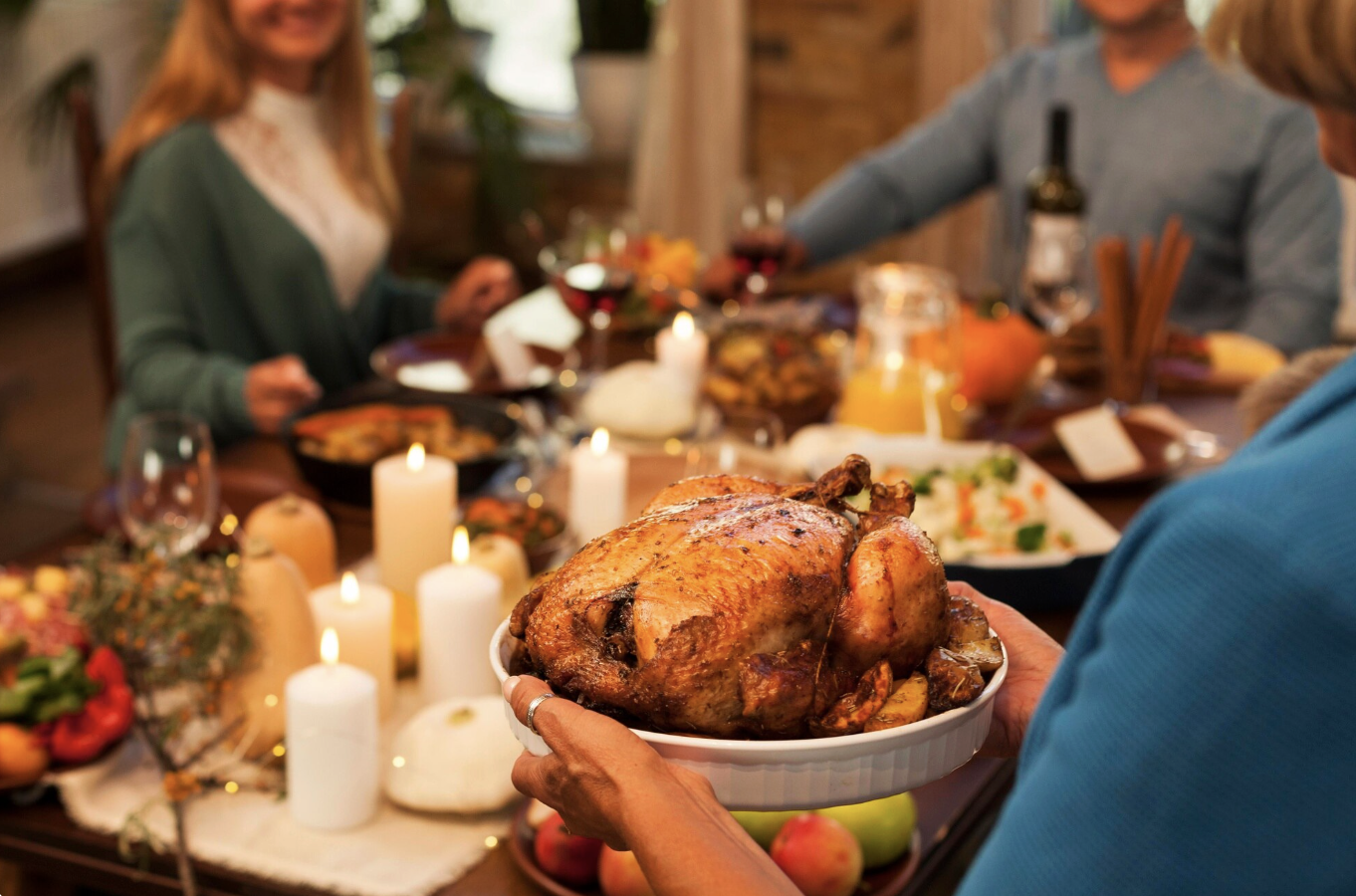
The house smelled like rosemary and melted butter and a quantity of garlic my mother had clearly committed to. She had used the good plates, which meant she expected people to perform well at the table. In my family, china had a kind of moral authority. The table was arranged with the specific care of someone who believed that if the surfaces looked right, the room beneath them could not go wrong. White table runner, cranberry sauce in the glass bowl, candles in the brass holders, turkey at the center shining like it had been briefed.
Ashley was already there in her cream sweater. Kevin sat beside her with one hand resting near hers. My father had opened a bottle of wine he had probably been saving. My mother kissed my cheek without her hands touching my shoulders, which was her version of warmth on difficult evenings. “You made it,” she said. People say that when they are surprised you had the nerve to show up.
Grandma Dorothy sat near the head of the table with a black leather purse beside her chair. She looked tired from travel but not diminished by it. She kept one hand near the purse in a way I noticed without understanding, the way you notice something peripheral that your mind files for later.
Dinner began normally. Normal in my family meant a thousand small agreements to pretend. My mother asked Ashley about the charity drive. My father asked Kevin about work. Kevin said something about interest rates with the authority of someone who had been told his opinions on this subject were valuable. Ashley laughed at exactly the right moment. I cut turkey into pieces small enough to swallow without tasting. My phone stayed face-down beside my napkin.
Then Grandma Dorothy set down her fork.
“Mandy,” she said. “Answer me.”
The table went silent. Not gradually. Immediately. She looked past my parents and past Ashley and past Kevin and straight at me with the focused attention of someone who has been waiting for the correct moment and has decided this is it.
“Why is there an elderly couple I don’t recognize living in the million-dollar lakeside house I bought for you?”
For one disorienting second I thought I had misheard her. I cycled through alternatives. Maybe she said Ashley. Maybe she said something else entirely. Maybe this was someone else’s story, someone else’s granddaughter, someone else’s life that included a million-dollar anything.
The room made a small sound.
My father’s knife slipped off his plate and touched the china. Not loudly. Just finally.
My mother’s fingers moved around the stem of her wineglass until I thought the glass might not survive the pressure.
Ashley went pale the way rooms go dark when a bulb goes out, all at once and without announcement.
Kevin reached for her hand and his fingers found only the tablecloth.
“Grandma,” I said, because my fork had started shaking between my fingers, “I don’t own a house.”
She kept her eyes on mine.
“I was evicted last month,” I said. My voice sounded flat to me, like I was reading someone else’s incident report. “I’ve been sleeping on friends’ couches.”
Something changed in her face. Not sadness exactly. Not shock. Something that had the precision of recognition, the expression of a person whose suspicion has just been confirmed in the worst possible way.
“Evicted,” she said.
My mother made a soft sound and started to speak.
“Dorothy, maybe this isn’t the best time,”
“It is exactly the time,” Grandma said, not looking at her.
I felt the air leave the room.
There are families that explode when the truth arrives. Mine preserved itself. Mine had spent decades hiding cruelty under calm voices and polished silverware, teaching the person with the least power that asking questions out loud made her the problem. My family lied by smoothing napkins and refilling glasses and changing subjects and applying the word ungrateful like a pressure bandage to anything that threatened to bleed in public.
Grandma reached for the black leather purse. Her hands were old, the knuckles raised and the skin thin, but they were steadier than every younger hand at that table. She took out a county recorder printout. A property tax notice. A folded trust summary. A glossy photograph.
She placed them beside the turkey as if she were arranging evidence.
The photo landed closest to me.
Ashley and Kevin standing in front of a wide white lakeside house with blue shutters. Kevin’s parents between them. On the porch railing behind them, a small American flag beside potted geraniums.
I knew that porch. Ashley had posted it in June, then again in August, then at Christmas with garland wrapped around the railing and a caption that said our little escape. I had liked that Christmas photo from my car in a grocery store parking lot after buying only bread and peanut butter because that was what twelve dollars covered.
Grandma tapped the photograph once.
“I bought that property through a trust three years ago,” she said.
Nobody breathed.
“The beneficiary named in the closing packet was you, Mandy. I sent the deed paperwork, tax notices, and maintenance account instructions to your parents because I was overseas and your father told me he would handle the transfer.”
My father said, very quietly, “Mom,”
“No,” she said.
Her voice did not rise. That made it worse. People who have real authority rarely need volume.
“You will not ‘Mom’ your way through this.”
Ashley shoved back from the table. The chair scraped the hardwood with a sound that went through my teeth.
“You don’t understand,” she said. “Mandy wasn’t responsible enough for a house like that. She couldn’t even keep an apartment.”
I felt the table as a thing I wanted to overturn. I felt the specific violent fantasy of turkey and wine and cranberry sauce and good china on the floor and Ashley’s cream sweater ruined with everything she had taken from me. I pictured standing up, sweeping it all with both arms, telling my sister exactly what kind of person smiles in borrowed sunlight while the woman it was meant for sleeps under someone else’s blanket.
I folded my hands in my lap until my knuckles hurt.
That was the habit they had installed in me across years of practice. Take the blow. Create no mess. Be grateful for the room you are barely permitted to stand in.
Grandma turned her head toward Ashley.
Slowly.
“Say that again.”
Ashley’s mouth opened and nothing came out of it.
My mother set down her glass, the base clicking against the table.
“We were protecting Mandy from herself,” she said.
There it was. The family hymn. Protection. Concern. Responsibility. The soft words that people wrap around theft when calling it theft is inconvenient. Not one misguided decision by well-meaning parents. A plan with paperwork. A house with my name buried under three years of their silence.
Grandma opened the trust summary and read from it with the calm of someone who has checked and rechecked the facts and is now simply reporting them.
“Your father acknowledged receipt of the transfer packet on March fourteenth, three years ago.” She read the date like it had weight. “He confirmed the maintenance account on March twenty-second. The first property tax notice came to this house the following November. The second the year after. The third this year.”
Three notices. Three years. Three chances to tell me I had a home. All while I was calculating gas mileage and apologizing for needing a place to sleep.
Kevin looked at Ashley with an expression that was asking a question he had apparently not thought to ask before now. “Ash,” he said quietly. “What is she talking about?”
Ashley shot him a look that told me something. He knew some of it. Not all of it. Maybe he had assumed my parents had some legal authority over the arrangement. Maybe he had never interrogated the terms because people who have been raised to receive gifts without asking where they come from tend to stay comfortable with that practice.
But his parents were in that house.
An elderly couple Dorothy had never met. Living in my lake house.
The phrase did not feel real in my head. It was too large to fit inside any sentence I had been taught to say about myself.
Grandma reached into the purse again and took out her phone.
Everyone watched.
Her thumb moved across the screen with the deliberate focus of a woman who knows exactly what she is doing and has done it deliberately.
“Then you can explain that to the person who drafted the trust,” she said, “because he is already on his way.”
She pressed a button and placed the phone beside the photograph.
For a moment, silence.
Then headlights came through the front window, washing across the table, across the turkey and the photo and the county recorder printout and my mother’s shaking hands.
Dorothy looked at my father.
“Don’t get up.”
The knock at the front door was firm. My father flinched. Nobody moved immediately. Then my mother whispered please to no one in particular, and Dorothy picked up the trust summary and slid it toward me.
“Mandy,” she said. “Stay seated. This was always yours to hear.”
Those six words reached something in me that had been trained for years to apologize for existing. They did not fix anything. They did not restore the lost years or put money in the bank account I had checked that morning or return the nights I had spent being grateful for other people’s couches. But they named me. They placed me at the center of the story I was actually in.
The man at the door was older, with silver at his temples and the unhurried manner of someone who has spent his professional life watching people regret documents. He looked at Dorothy, then at the table, then at me.
“You must be Mandy,” he said.
I nodded because my voice had retreated somewhere.
“My name is Samuel Price. I drafted the trust.”
My father stood.
“Sam, this is a family matter.”
Mr. Price looked at him.
“It became something else,” he said, “when family access was used to interfere with a trust transfer.”
My father looked at the phone on the table and understood, a beat too late, that Dorothy had not merely called ahead. She had kept the line open before Samuel Price arrived. He had heard the room before he knocked.
My father understood this. Samuel Price let him understand it without saying it twice.
He opened the leather folder he was carrying and set documents beside the cranberry sauce. The original trust summary. A beneficiary designation. A correspondence log. Copies of certified mail receipts. A scanned letter addressed to me, my name printed in black ink, dated three years earlier.
“This office sent instructions for Mandy to complete the occupancy transfer with local counsel,” he said. “Your written response stated that she had declined immediate occupancy and wished the property to remain under family management.”
I turned toward my father.
“I never said that.”
“I know,” Mr. Price said.
He pulled out another page.
“This is the email response we received from your father’s account. This is the attached authorization. This is the signature page.”
He paused.
“Your signature appears here.”
I leaned forward.
There it was. My name, or something performing the shape of my name. It slanted wrong. The capital M was too sharp, the y curling in the specific way Ashley’s did when she signed things in a hurry. I had seen her sign birthday cards for both of us when our mother was occupied with something else. I recognized the impersonation immediately because I had watched it happen across smaller occasions for years and had not understood what it was practice for.
“That’s not my signature,” I said.
My voice was quiet.
Everyone heard it.
Grandma closed her eyes for half a second. When she opened them she looked older than she had at the start of the meal, not weaker, but wounded in a way that anger had been holding back until now.
Ashley began to cry. Not loudly and not gracefully. Just tears moving down her pale face while she stared at the forged signature as though it had betrayed her by still being visible.
“I didn’t think it mattered,” she said.
Kevin turned toward her. “You signed her name?”
Ashley shook her head too quickly. “Dad said it was temporary. He said Grandma only bought it because she felt sorry for Mandy. He said if it stayed in the family it was fine.” The words came out in a rush now, the way words come when a structure is collapsing and speed seems like it might help. “Kevin’s parents needed somewhere after they sold their condo, and we were going to fix everything before Grandma came back.”
Grandma looked at my father.
“Before I came back,” she said.
My mother began crying then. Not the way Ashley was crying. My mother cried the way people cry when consequences have arrived without asking permission, offended that the world has declined to absorb what she did into the general category of good intentions.
“We didn’t steal anything,” she said. “We maintained it. We paid utilities. We kept it safe.”
“For whom?” Grandma asked.
The silence that followed that question was complete.
Samuel Price set one final document on the table. A trustee review notice. He explained that the property had remained technically within the trust because the title transfer had never been lawfully completed. This was, he said, fortunate.
My father’s shoulders dropped slightly with relief.
Mr. Price did not let him keep it long.
Unauthorized occupancy. Forged acknowledgment. Misdirection of beneficiary notices. He named them in the same neutral tone, the tone of someone for whom these were categories rather than accusations, because they had already moved beyond the stage where accusation was the point.
I heard those words and they translated themselves inside me into other words. Lena’s couch. The gas light on my car. My mother saying the laundry room was too crowded while strangers slept under the roof Grandma had bought for me. The twelve-fifty on the bank app that morning.
Kevin stood.
“My parents don’t know,” he said. “They think your family arranged it legally. They have no idea.”
Mr. Price told him they would be notified in writing.
Kevin put his hand over his mouth and went to the porch to call them. Through the front window I watched him standing in the cold with his hand pressed to his forehead, the call connecting, and then I saw the moment his mother understood because he pulled the phone away from his ear.
My father said they were not discussing this further tonight.
Grandma picked up her phone.
“You are,” she said.
He looked at her.
She looked back.
That was all.
Then she turned to me.
“Mandy, do you want to read the envelope now?”
The cream-colored envelope had been in the purse since the beginning. I had not noticed it until she set it on the table. Thick paper. A return address embossed in the corner. Across the front, in Dorothy’s careful handwriting: For Mandy Only.
I was tired in the deep way that poverty makes you tired, which is different from ordinary tiredness because it sits below the physical level, in the place where the body keeps track of how long it has been managing without enough of what it needs. I had worked two shifts. My feet still hurt. My life had just been opened in front of people who had spent years teaching me the wound was my fault.
But the envelope had my name on it.
I reached for it. My hands shook, but I did not stop. The paper was thick and the seal gave with a small sound that seemed to fill the whole room.
Inside was a letter, handwritten, dated three years earlier.
Mandy, it began. If you are reading this, then the house is no longer a surprise and I hope you are standing in the kitchen by the lake, wondering why your grandmother bought a porch with blue shutters when she always claimed shutters were a waste of paint.
A sound left me before I could stop it. Half laugh and half sob and something underneath both that had no good name. I pressed my hand to my mouth. Grandma’s eyes shone.
The house is not charity. It is not a reward for being perfect. It is not something you must earn by becoming easier for other people to love. It is a place to land. I bought it because I know what it is to be the woman a family expects to survive on scraps. I do not want that for you.
For years, my parents had told me I was unstable. Ungrateful. Bad with money, too emotional, too proud, too much. They had said it in different registers across different occasions, sometimes loudly and sometimes in the careful indirect way that leaves no single statement to point at, only a cumulative weight. And three years before that Thanksgiving, my grandmother had seen me clearly enough to buy me somewhere to stand.
My mother said my name.
I looked up at her.
For the first time in my adult life, I did not arrange my face into something easier for her to receive.
“No,” I said.
One syllable. It was enough. She closed her mouth.
Samuel Price stayed for almost an hour. He explained rather than threatened, which was worse for my father because it left nowhere to hide. There would be a formal review. Kevin’s parents would receive written notice. The forged signature would be examined by appropriate parties. Records would be preserved, and my father should not delete anything.
At that last instruction, my father looked away.
Samuel Price noted the look. So did Grandma. So did I.
By midnight I had copies of everything: the trust summary, the recorder printout, the property tax notices, the forged acknowledgment, Grandma’s letter. I also had something I had not owned that morning. A direction. Not a solution, not a restoration of the three years already gone, but a direction. Evidence of shape. Proof that the story was navigable and that navigating it was something I was now permitted to do.
Grandma insisted I come with her to her hotel.
My mother said I could stay in the house.
I looked at the laundry room door down the hallway.
Then I looked back at her.
“No,” I said.
It came easier the second time.
Ashley stood by the stairs with Kevin beside her. Her face was blotchy and her eyes were wet and she said, “Mandy, I didn’t think you’d end up homeless.”
I had a great deal I could have said to that. I could have explained that homelessness is not weather, does not blow through randomly over certain rooftops while everyone watches helplessly from warm interiors. That people make specific choices which add up to specific outcomes for specific other people. That withholding information is an action and not an absence of action.
Instead I picked up my coat.
Grandma took her purse.
Mr. Price gathered the documents.
At the front door I turned once. The Thanksgiving table was genuinely ruined. The red wine had crawled across the white runner. The turkey had cooled. The candles had burned down to wax puddles in the brass holders. The photograph still lay beside my plate: Ashley and Kevin and his parents and the American flag and the blue shutters and the porch I had liked from a grocery store parking lot while eating bread and peanut butter.
I took the photograph.
No one stopped me.
The weeks that followed did not feel like revenge. People who have never been powerless imagine justice arriving like weather, sudden and loud and obvious. It does not arrive that way. It arrives in emails and certified letters and scheduled calls and document requests and the slow, grinding repetition of facts that must be stated over and over until they are hard enough to stay where you put them.
Grandma retained local counsel. Samuel Price coordinated the trust review. Kevin’s parents, once formally notified, moved out of the house within the month. Kevin arranged temporary housing for them, which was the most decent thing anyone on that side of the table did in that period. They were humiliated and then angry, first at Ashley, then at Kevin for not having looked more carefully at where the arrangements had come from, then at my parents.
I did not spend much energy sorting their feelings. I was too occupied learning the shape of my own life.
My father admitted in a written statement that he had managed communications with the trust attorney because he believed I lacked financial stability. Ashley admitted she had signed my name at his direction, describing it as temporary and harmless. My mother’s statement used the phrase family discretion to describe three years of hiding my mail, forging my signature, occupying my house, and letting me beg for floor space in a laundry room.
Family discretion.
I stared at those two words for a long time.
They sounded almost tasteful.
The first time I drove to the lake house, Grandma came with me. It was late January, a gray day, the lake flat and cold and the color of old pewter. The porch looked smaller than it had in Ashley’s photographs, but genuinely beautiful, the shutters needing paint, the potted geraniums long gone, scratches near the front lock from a key handled carelessly by people who had never thought about whose key it actually was.
Inside, the house smelled of lemon cleaner and cold wood and the faint residue of someone else’s winter. A mug with a lighthouse painted on it sat in the kitchen cabinet. Shelf liner had been left in the drawers.
I stood in the living room and waited to feel triumphant.
It did not come.
What came was grief. Three winters I could have had heat that belonged to me. Three years of every crisis made harder by a lie sitting quietly at a lakeside address. Grandma stood at the window looking out at the water and did not rush me, and after a while she said, “The first night in a safe place can feel frightening, because your body doesn’t believe it yet.”
She was right.
I slept on an air mattress that first night and woke four times, and each time I lay in the dark looking at the ceiling and reminded myself that I did not have to leave before anyone else’s children woke up, did not have to fold the blanket and pretend the surface beneath me had been comfortable, did not have to monitor a phone for a message asking when I would be gone.
By the time the light came through the window in the morning, pale and winter-thin and falling across the floor without asking anyone’s permission, it was mine. Everything it touched was mine. That was a fact I had to teach my body slowly, across many mornings, until it stopped waiting for the correction.
The house did not fix everything. No house can. I still had debts and the habits of scarcity take longer to leave than scarcity itself. But I had an address. A lock I controlled. A kitchen where the food in the refrigerator belonged to me. A place where my name above the door was not treated as an inconvenience but as a fact.
Ashley tried to contact me several times. Her messages changed shape as the weeks passed. First defensive, then wounded, then nostalgic: did I remember sleeping in the same room during storms when we were small, did I remember her climbing into my bed when thunder scared her. I did remember. I remembered brushing her hair before school because our mother was occupied. I remembered giving her part of my birthday money one year when she wanted a charm bracelet and was embarrassed to ask anyone else.
Those memories did not disappear. They also did not outweigh what she had done. That is the hardest part of betrayal by someone you love: it does not erase the love. It contaminates it, moves through it like something released into water, so that you can still see what was there but cannot drink from it the same way.
My father sent a letter. Not an apology. An explanation for why his judgment had been sound, why he had feared I would sell the house, why Ashley and Kevin represented stability while I was still finding myself. He wrote that he hoped someday I would understand he had acted as a father. I read it once, folded it back into its envelope, and put it in a box I labeled RECORDS. Not keepsakes. Records.
My mother called Grandma instead of calling me. Grandma told her: “You helped make your daughter homeless while telling yourselves you were protecting her from herself.” My mother hung up. Grandma told me this over coffee at my kitchen table, her hands around her cup, watching the lake through the back window, and I laughed and then cried and then laughed again because healing is not graceful. Sometimes it looks like a woman crying into her coffee because she finally has a table no one can ask her to leave.
Months later I painted the shutters. The same blue, because I refused to let Ashley’s photographs own the color. I planted geraniums because I liked them, not because they had been in the picture. I bought a bed, not extravagant, just mine. Lena brought her kids over one weekend and the youngest ran through the living room announcing that the house had stairs, which produced in me a joy so specific and uncomplicated it took me by surprise. I made pancakes and overcooked the first batch and nobody minded.
Grandma sat on the porch with a blanket over her knees and watched the lake with the settled expression of someone who has finally finished a sentence that started three years too late.
One evening I found the glossy photograph in the records box, Ashley and Kevin and his parents in front of my house on a summer day when I had been somewhere else entirely. For months it had been evidence of what was taken. Then, more slowly, it became evidence of something else. Proof that I had not been wrong. Proof that the house had existed before I knew I deserved to stand inside it. Proof that the story had a shape and that shape was legible and true.
I kept it. Not displayed. In the box.
Some evidence belongs in the past without being thrown away.
Thanksgiving came again the following year.
I did not go to my parents’ house.
Grandma came to mine. Lena came with her kids. We ate turkey that smelled of rosemary and butter and the right amount of garlic. I used plain plates because I had not yet owned good china and did not especially want any. No one performed decency at that table. They simply were decent, which is a different and far more restful thing.
At nine-eighteen in the morning, I had checked my bank app out of habit, standing in my own bathroom in my own house. The number was not large. It was enough. I stood there for a moment and let myself feel the full distance between that number and the one I had looked at a year earlier in Lena’s bathroom while her kids argued over cartoons in the hallway.
The house had never been charity. It had never been something I needed to earn by being smaller or easier or more predictable or more willing to be managed. It had been a place to land, bought by a woman who understood what it was to be expected to survive on scraps, given to me with a letter that knew exactly who I was.
They had spent three years keeping me from it.
I had landed anyway.
And every morning when the winter light came through the front window and fell across the floor without asking anything of me in return, I knew that landing was not the end of something.
It was the beginning of what my life actually looked like when no one else was deciding what I deserved.

Sophia Rivers is an experienced News Content Editor with a sharp eye for detail and a passion for delivering accurate and engaging news stories. At TheArchivists, she specializes in curating, editing, and presenting news content that informs and resonates with a global audience.
Sophia holds a degree in Journalism from the University of Toronto, where she developed her skills in news reporting, media ethics, and digital journalism. Her expertise lies in identifying key stories, crafting compelling narratives, and ensuring journalistic integrity in every piece she edits.
Known for her precision and dedication to the truth, Sophia thrives in the fast-paced world of news editing. At TheArchivists, she focuses on producing high-quality news content that keeps readers informed while maintaining a balanced and insightful perspective.
With a commitment to delivering impactful journalism, Sophia is passionate about bringing clarity to complex issues and amplifying voices that matter. Her work reflects her belief in the power of news to shape conversations and inspire change.