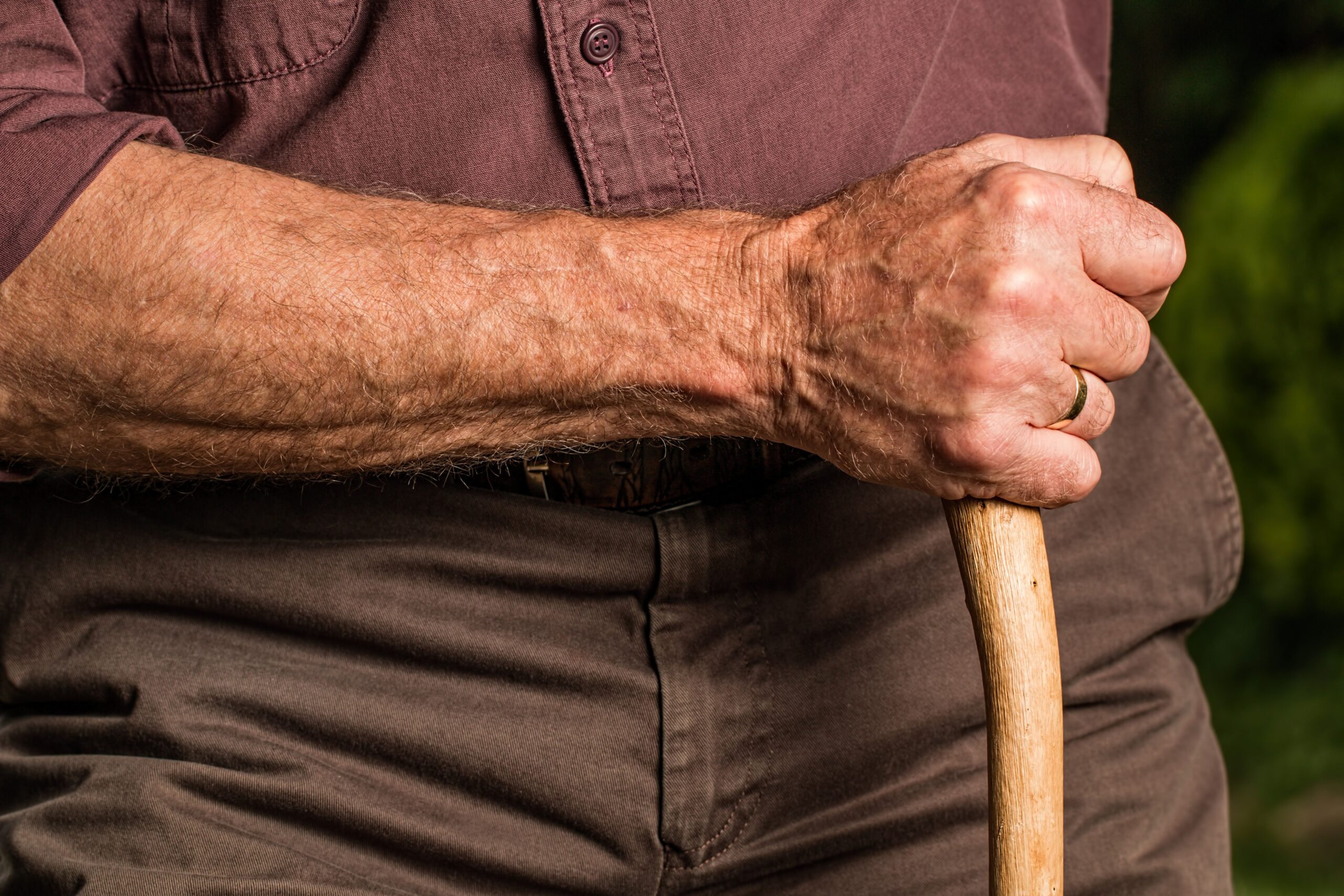
For thirty years I believed my father was a hard man who had simply run out of love for me. That is the story I told myself, the one I repeated to my husband and my children and anyone who asked why Grandpa never called on birthdays, why we never drove out to the farm, why the man in the few photographs I owned always seemed to be standing a careful step apart from the rest of us. It was easier than the truth. And for most of my life, I did not even know what the truth was.
He turned eighty last Tuesday. My daughter Megan was the one who insisted we go. I had every reason not to. The last real conversation I’d had with my father, eleven years before, had ended with him standing on his porch in the cold and me backing the car down the gravel drive, both of us too proud to say the one sentence that might have kept us in the same room. After that there were Christmas cards in his cramped left-handed script, signed only “Dad,” and a phone that rang on holidays and went unanswered on both ends. I had made my peace with it, or I told myself I had, which is a different thing entirely.
But Megan looked at me across the kitchen table and said the thing that children always seem to know how to say without being taught. She set down her coffee and she said, “Mom. He’s turning eighty. How many more of these do you really think there are going to be?”
I didn’t have an answer for that. So three days later we loaded the car and we drove the four hours north, through the towns that got smaller and the fields that got wider, until the land flattened out into the country I had spent eighteen years trying to leave and the rest of my life trying not to think about.
The farm looked smaller than I remembered, the way the places of our childhood always do. The barn my grandfather built had begun to lean toward the west, as if it were tired. The fence line I’d walked a thousand times sagged between posts gone gray and soft with rot. And the big maple by the road, the one I used to climb until my father came out and hollered me down before I broke my fool neck, had lost a heavy limb in some storm I had not been there to see. The wound on the trunk had healed over into a pale knot. Everything had gone on aging without me, patiently, while I stayed away.
And there on the porch, in the same chair he had always sat in, was my father.
He was smaller too. His shoulders, which in my memory had been as wide as the doorframe, had folded inward the way old men’s do, curving him down toward the earth he’d worked his whole life. His hair had gone from iron to snow. When he saw the car turn in, he did not stand. He only lifted one hand, slow and uncertain, the way you wave at someone across a distance when you aren’t yet sure they’re waving at you.
I had not expected the crowd.
My father had outlived nearly everyone I could think of, and somewhere in the back of my mind I’d pictured a quiet afternoon, the two of us and Megan and a store cake, an hour of stiff conversation before we could decently leave. Instead the yard was full. There were a dozen cars and trucks parked along the drive and out into the field. Men I half recognized from the feed store of my childhood, grown stooped and white now. A woman I slowly realized had taught my Sunday school class when I was seven. The Hendersons from the next farm over, all in their seventies themselves, sitting in the lawn chairs they’d plainly brought from home. Somebody had strung a banner between two porch posts. Somebody else had set up folding tables that bowed under casserole dishes and a sheet cake from the grocery in town, the kind with the waxy roses, and a percolator of coffee that never seemed to empty.
And they moved around my father with a gentleness I could not account for. A care, almost a reverence, the way you might tend to something you were afraid of breaking. I stood at the edge of it all holding a paper cup, a stranger at my own father’s birthday, and I could not understand what I was seeing.
A man I didn’t know at all came up to me by the drinks table. He was perhaps sixty-five, weathered dark, with the thick scarred hands of a man who had worked outdoors his entire life. He looked at me for a moment before he spoke.
“You’re Tom’s girl,” he said. It wasn’t a question. “Lord, you favor him. Got his exact eyes.”
I told him I supposed I did. I asked, to be polite, how he knew my father.
He didn’t answer right away. Something moved across his face that I couldn’t read, something that looked almost like grief and almost like awe. He set down his own cup. “Your daddy,” he said finally, “is the reason I’m standing here today. The reason a good number of the people in this yard are standing anywhere at all.”
I thought he meant it the way people mean such things at birthdays and funerals. The vague, kind way we speak of good men. I smiled and nodded and started to angle myself toward the cake table, looking for an exit from a conversation that had gotten heavier than I wanted.
But he wasn’t finished.
“Nineteen sixty-eight,” he said. “You’d have been real small. Maybe not even born yet. There was a fire at the old grain elevator in town. You remember the one they finally tore down, the black one out past the rail crossing?”
I did remember it. It had been a charred ruin my whole childhood, a tall dead thing that my father always, always looked away from when we drove past it into town. I used to watch him do it from the back seat and never once thought to wonder why.
“Four of us were inside when she went up,” the man said. His voice had dropped, and he was not really looking at me anymore but somewhere past me, into the year 1968. “Grain dust. It goes off like a bomb if it catches, and that day it caught. Your daddy was just passing on the road in his truck. He didn’t have one thing in this world that obligated him to stop. Nobody would ever have known if he’d kept driving. But he came in after us. Through a door that was already burning.”
I had gone very still.
“He pulled two men out the first time,” the man went on. “Carried them clear and laid them in the grass and then he turned right around and went back in for the rest of us. Me and another fella named Pruitt, we were pinned in the back where a stack had come down. Your father got to us. He was lifting the beam off my legs when the roof let go.” The man stopped. His jaw worked. “It came down on his right side. His arm, his shoulder. Burned him down to the bone before they could get him out. They didn’t think he’d keep the arm at all. He kept it, but the strength never came back. Not really. Not ever.”
I stood there in the grass with the paper cup going soft in my hand, and I felt the entire shape of my childhood begin to tilt and slide.
Because I remembered the arm. Of course I remembered the arm. I had grown up with it. I remembered a father who could not lift me onto his shoulders the way the other fathers did at the county fair. A father who threw a ball to me underhand and clumsy with his left hand and got frustrated and quit. A father who handed me things across the table instead of passing them, who never once carried me to bed when I fell asleep in the truck, who let my mother do all the lifting and the holding and the rocking. And most of all, I remembered the flinch. The way his whole body would go tight if I grabbed his right hand or threw my arms around that side of him, the way he would pull back, sharp and instant, and set me at a distance with his good hand.
I had spent my whole childhood reading that flinch as coldness. As a man who did not want to be touched by his own daughter. As proof, gathered patiently over years, that whatever was wrong between us was wrong with me. And on that foundation, that single wrong reading of a wound I never knew existed, I had built thirty years of distance and called it his fault.
“He never told you,” the man said, watching my face. It wasn’t a question.
“No,” I heard myself say. “He never told me any of it.”
The man nodded slowly, as if this was exactly what he would have expected of Tom. “No,” he agreed quietly. “He wouldn’t have. Your daddy carried things. He never once set them down where another soul could see the weight.” He reached out and squeezed my shoulder, just once, with the careful and deliberate strength of a man who understood better than most what arms were worth. Then he walked back toward the others and left me standing alone in the yard with thirty years coming apart in my hands.
I want to tell you about a day I had not thought of in decades, a day that came rushing back to me whole as I stood there.
I was maybe six. It was summer, and I had been stung by a wasp out by the barn, and I came running and screaming across the yard the way children do, blind with the bigness of the pain, and I ran straight for my father because he was the closest and he was my father and that is what you do. I threw myself at him. I grabbed for him with both arms, and my hand closed hard around his right forearm, and I hung on.
And he made a sound. I had never heard him make a sound like it before or since, a short, terrible, involuntary noise, and he pulled away from me so fast and so hard that I fell down in the dirt. I remember lying there looking up at him, the wasp sting entirely forgotten, my whole small world reorganizing itself around the fact that my father had thrown me off. He stood over me with his face gone white and strange, and he didn’t reach down to help me up. He just said, in a voice that shook, “Go find your mother.” And he turned and walked into the barn.
I had carried that moment for fifty years as the day I understood my father didn’t love me. Standing in that crowded yard at eighty’s worth of distance, I finally understood it for what it had actually been: a man in blinding pain, a wound not even ten years healed, and a six-year-old’s full weight landing square on the worst of it. He hadn’t thrown me off in coldness. He’d thrown me off the way you jerk your hand back from a stove. And then, because he was who he was, he had walked into the barn so his daughter would not see her father with tears in his eyes.
I found him still in his chair on the porch. The party went on around us, the percolator gurgling and the Hendersons laughing about something and Megan moving easy through the crowd the way I never could, but I climbed the porch steps and I knelt down in the boards beside his chair, the way I used to kneel beside him as a girl when he was mending tack. For a long while neither of us said a thing. The maple moved overhead. The afternoon light came down gold and slow across the fields he had plowed left-handed for fifty years.
“A man told me about the fire,” I said at last. “About the elevator. About your arm. About sixty-eight.”
My father’s jaw worked. He kept his eyes out on the field. “Long time ago now,” he said.
“Why didn’t you ever tell me?” My voice broke on it. “Daddy, I have spent my whole life thinking you didn’t—” I couldn’t finish it.
He was quiet for so long I was sure he wouldn’t answer at all. When he finally did, his voice was nothing like the hard voice I had carried in my memory for half a century. It was thin, and old, and it shook like a man walking out onto ice. “Because you’d have looked at me the way the whole town did after,” he said. “Like I was something broke. Something to feel sorry for. I couldn’t stand the thought of that look coming off my own little girl.” He swallowed hard. “I wanted you to think your daddy was strong. I wanted that more than I wanted about anything.”
“You were strong,” I said. “You ran into a fire.”
“I reckon I went too far the other way,” he said, like he hadn’t heard me, like this was a thing he had said to himself ten thousand times in the dark. “That arm hurt me every single day of my life. Every day for fifty-some years. And every time you reached for it as a little thing, it’d catch me wrong and I’d pull back before I could think. And I watched you. I watched you learn, year by year, not to reach for your daddy anymore. I watched you stop.” He turned then, and looked at me, and his eyes were wet and terrible. “That’s the thing I’d take back if the good Lord let me take back one thing. Not the fire. The fire I’d run into again tomorrow, same as I did. But that. Teaching my own girl not to reach for me. That’s the one that comes for me at night. That’s the one I’ll answer for.”
Thirty years. Thirty years I had been angry at a man for protecting me from a grief he had chosen to carry entirely alone. Thirty years I had read his silence as rejection when it had only ever been a wound too proud and too tender to show his own daughter. He had let me believe he was cold so that I would never have to believe he was broken. And it had cost us nearly everything.
I reached out and I took his right hand. The one I had not truly held since I was small, the one I had been taught a lifetime ago not to reach for. The skin of it was ruined, ridged and pale and slick, fifty years old and more. And he stiffened the instant I touched it, on pure reflex, the old bracing, the old flinch, his whole body getting ready for his daughter to feel the wrongness of him and pull away.
I did not pull away. I held on.
“I’m not looking at something broken,” I told him, and now I was the one whose voice was shaking. “I’m looking at the bravest man I have ever known in my life. And I would give anything, Daddy, anything in this world, to have known it forty years ago.”
He wept, then. The way old men weep when the dam of a lifetime finally goes, silently and with great effort and his whole folded body shaking under my hands. I held his ruined hand in both of mine and I put my forehead down against it, and out in the yard someone called that it was time for cake, time for eighty candles and the song. We let them wait. We let them all wait a little longer, my father and I, on the porch in the gold light, holding the hand that had cost him everything and had finally, finally given me back the truth of him.
He blew out the candles that afternoon with his children and his grandchildren gathered close and a whole yard full of men who were alive because of him singing him the song. Eighty candles. It took him three breaths and Megan’s help to get the last of them, and the whole crowd cheered like he’d won something, and maybe he had. I stood at his right side for all of it, my hand on his bad shoulder, where I had not been allowed to stand in fifty years.
And when the song was done and the smoke was still curling up off the candles into the summer air, my father did a thing he had not done since before I could remember. He didn’t wait for me to reach for him. He turned, and he reached out, and he took my hand in his.
After eighty years, my father reached for me first.
I have thought about little else in the week since. I have wondered how many of us are carrying an old anger at someone for a coldness that was never coldness at all, but only a wound they never learned how to show us. How many fathers are sitting on porches right now, carrying their fires in silence, certain that love means never letting their children see the weight. How many of us spend our whole short lives backing slowly down the gravel drive, when all we ever needed to do was climb the steps and kneel down in the boards and ask.
He is eighty now. I don’t know how many more birthdays we have. Nobody ever does. But I know that I will be there for every single one of them that we are given, standing at his right side, holding the hand he spent a lifetime hiding from me, more grateful than I have words for that I learned the truth of my father while there was still a warm hand left to hold.

Specialty: Legal & Financial Drama
Michael Carter covers stories where money, power, and personal history collide. His writing often explores courtroom battles, business conflicts, and the subtle strategies people use when pushed into a corner. He focuses on grounded, realistic storytelling with attention to detail and believable motivations.