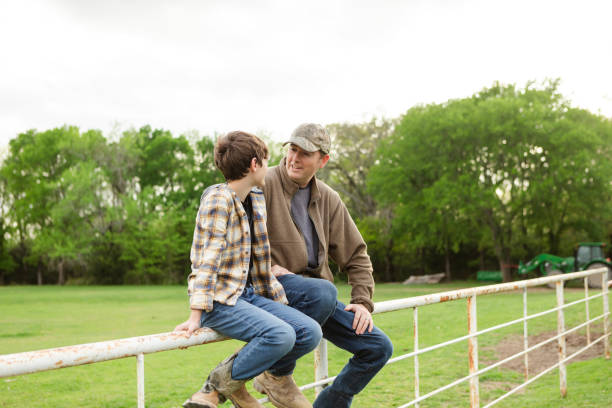
My son’s wife laughed when she saw me fixing the fence in my old work boots.
“This ranch is too much for you now,” she said, smiling over the rim of her coffee cup. “We already found buyers.”
She said it like she was doing me a favor. Like the land beneath her shoes had not carried my family through droughts, funerals, weddings, bad cattle prices, hospital bills, and thirty-eight years of marriage. Like the white farmhouse behind me was just old lumber and not the place where my wife Ruth had planted roses in the hard Texas dirt because she believed even stubborn ground could bloom if you loved it long enough.
Like I was simply an old man in faded denim, too tired to argue and too poor to stop her.
So I let her put the “For Sale” sign by my gate. I even stepped back and gave her room.
The fence post had been leaning since the last windstorm came rolling across Parker County, one of those hard spring storms that rattled the windows, shoved the pecan trees around, and left half the county talking about hail damage at the feed store the next morning. I was halfway through setting the post straight when Lindsay pulled up in her white SUV.
I heard her before I saw her. Gravel popping under new tires. Engine too smooth for a county road. The kind of car that had never hauled feed, never carried a wet dog, never had fence staples in the cup holder.
She parked near the gate but didn’t turn the engine off right away. She sat there for a second, probably finishing whatever phone call she didn’t want me to hear. Then the door opened, and out she came in sunglasses too big for her face, holding a latte in one hand and her phone in the other.
My son, Evan, got out behind her. He didn’t look at the fence. He looked at me. Then he looked away.
That was when I knew the conversation had already happened without me.
A man can learn a lot from his son’s silence. I’d heard Evan tell lies when he was twelve, heard him deny breaking the kitchen window, heard him swear he hadn’t taken the truck before he had a license. He was never good at lying out loud.
But silence? He had grown into that.
“Harold,” Lindsay said.
Not Dad. Not Mr. Mercer. Just Harold, with that flat little edge she used when she wanted to remind me she was educated, polished, and busy.
I drove the shovel blade into the dirt and leaned both hands on the handle. “Morning, Lindsay.”
She glanced at my boots, my gloves, the old sweat-darkened cap Ruth bought me at the county fair fifteen years earlier. “We need to talk about the ranch.”
I wiped my hands on my jeans. “This ranch is doing fine.”
She laughed. Not loudly. That would have been too honest. Lindsay never wanted to look cruel. She preferred the clean, bright cruelty of people who called their ambition “concern.”
“It’s not about doing fine,” she said. “It’s about reality. The fences, the barn, the taxes, the upkeep. You’re seventy-three, Harold.”
“Seventy-two until October.”
She gave me the kind of smile people give when they don’t plan to count your birthdays much longer.
“Evan and I have been talking,” she said, “and we think it’s time to be practical.”
Practical. That word had paid for more betrayals in families than outright greed ever did.
I looked at Evan. He stood beside her with his hands in his pockets, staring toward the pasture like the old mare was about to give him instructions.
“Is that right?” I asked.
He cleared his throat. “Dad, listen. Nobody’s trying to take anything from you.”
That was how I knew they were.
Lindsay stepped closer, her heels sinking slightly into the dirt. She noticed and shifted her weight back toward the gravel.
“This place is too much,” she said. “You can’t keep doing all this by yourself. And honestly, the market is strong right now. My cousin knows a developer out of Austin who’s been looking for acreage west of Fort Worth. He says properties like this are moving fast.”
There it was. Not family. Not concern. A developer out of Austin.
I looked past her at the pasture. The morning was already warming up, but the shade under the live oaks still held a little coolness. Ruth used to sit there in a folding lawn chair with a glass of iced tea, waving at me whenever I drove the tractor by. She’d read church newsletters, seed catalogs, grocery flyers, anything that came in the mail. She said a woman who lived twenty miles from town had to make her own entertainment.
The roses she planted by the porch were blooming that morning, pale pink against the white siding. Some years they struggled. Some years they surprised me. Ruth always said they were like us.
“You could move into something easier,” Lindsay continued. “A condo, maybe. Somewhere close to town. No stairs. No animals. No surprises.”
“I like my surprises outside,” I said.
She blinked. Evan almost smiled, then stopped himself. Lindsay didn’t care for jokes she hadn’t approved.
“Harold, this is exactly what I’m talking about,” she said. “You make everything sentimental. That’s sweet, but it isn’t a plan.”
I leaned my shovel against the fence. “Who signed with these buyers?”
Her smile tightened. “No one signed anything yet.”
“Then you don’t have buyers.”
“We have interest.”
“You have a cousin with a phone.”
Evan shifted. “Dad, don’t make this difficult.”
That one landed harder than I expected. Not because it was new. Because it sounded practiced.
For a second, I saw him at eight years old, standing on the bottom porch step in one boot and one sock, crying because the pony had stepped sideways and scared him. Ruth had crouched down and wiped peanut butter off his cheek with her thumb. “You can be scared,” she told him. “You just can’t let fear make all your decisions.”
I wondered when Evan had forgotten that.
Lindsay walked back to her SUV and opened the rear hatch. That was when I saw the sign.
It was red and white, polished and clean, bolted to a metal frame. FOR SALE in big letters. Under that was Lindsay’s phone number. No realtor’s name. No ranch name. No “coming soon.” Just her number, as if the land itself had appointed her.
She dragged the sign out with both hands.
My son looked at me then. Really looked. There was shame in his face. Not enough to stop her, but enough to prove he still knew right from wrong.
“You don’t mind, do you?” Lindsay asked.
I could have told her to put it back in the car. I could have called Roy Benton, my attorney, right there in front of them. I could have asked Evan if he remembered whose name was on the deed, whose signature was on the trust, whose hands had signed the mineral lease checks into the account that helped pay his college tuition.
But age teaches you something pride does not. Sometimes the fastest way to show people a locked door is to let them run into it.
So I stepped back. “Go ahead.”
Lindsay paused. I had surprised her. People like her expect resistance. They prepare for tears, anger, begging, shouting. They know how to turn all of that into proof that you’re unstable.
Calm makes them nervous.
She carried the sign to the gate. The metal legs scraped against the gravel. She found a patch of softer ground near the split-rail fence and shoved the frame down hard. It leaned at first. Evan moved like he might help, then thought better of it. Lindsay pushed again until it stood straight.
Then she took a picture. “This will move fast,” she said.
“For your sake,” I told her, “I hope you know what you’re doing.”
She laughed again, softer this time. “Oh, Harold,” she said. “That’s the whole point. Someone has to.”
They stayed another ten minutes, long enough for Lindsay to talk about appraisals, market timing, tax exposure, and how “emotion shouldn’t drive asset decisions.” Evan nodded in all the wrong places.
When they finally left, her SUV kicked dust down the county road.
I stood by that sign until the air settled. The ranch was quiet again. A mourning dove called from the wire. The old mare flicked her tail near the trough. Somewhere behind the barn, the wind nudged a loose piece of tin with a soft, tired creak.
I walked back to the house.
Inside, the kitchen smelled faintly of coffee and lemon oil. Ruth’s yellow mixing bowl sat on the open shelf where she had always kept it. Her handwriting was still taped inside one cabinet door, a recipe for peach cobbler written on an index card so stained at the edges I could barely read the oven temperature anymore.
I washed my hands at the sink and looked out the window. The “For Sale” sign stood by my gate like an insult in broad daylight.
Then I went to my desk. It was an old oak thing, too heavy and too scratched for Lindsay’s taste. Ruth found it at an estate sale in Weatherford back when Evan was in high school. The bottom drawer stuck unless you pulled it a certain way. I knew the angle. My hand knew it without thought.
Inside was a blue folder. Family Trust. Mercer Heritage Trust.
Ruth and I had signed the first version twenty years earlier, after her brother lost his farm in a family fight that started with “just paperwork” and ended with cousins not speaking at a funeral.
Ruth came home from that courthouse with her jaw set. “We are not leaving a mess,” she told me.
“We don’t have a mess.”
“Everyone has a mess if they die careless.”
That was Ruth. Soft voice. Steel spine.
We revised the trust when Evan got married. Not because we disliked Lindsay then. We barely knew her. But Ruth had sat across from her at Thanksgiving and watched the way Lindsay corrected Evan’s stories before he finished telling them.
Later that night, while I loaded the dishwasher, Ruth stood beside me with a towel in her hands. “That girl doesn’t want to join this family,” she said quietly. “She wants to manage it.”
I told her she was reading too much into things. Ruth gave me the look she saved for when I was about to be wrong for a long time.
The next month, we drove to Fort Worth and met with Roy Benton.
Roy was the kind of attorney who didn’t advertise much because half the county already knew his number. His office was on the second floor of a brick building near the courthouse, with old framed maps on the walls and a receptionist who remembered your children’s names even when your children did not deserve it.
Ruth sat beside me with her purse in her lap and told Roy exactly what she wanted. “The ranch stays protected while Harold is alive,” she said. “No spouse, no creditor, no impatient child gets to sell it out from under him. If Evan grows into it, fine. If he doesn’t, the land still survives.”
Roy nodded like he had heard that kind of heartbreak before. “There are ways to structure that,” he said.
Ruth leaned forward. “Then structure it like a locked barn in a thunderstorm.”
After her diagnosis, we revised it again. Cancer changes paperwork. It also reveals people.
Evan came more often at first, bringing flowers from the grocery store, asking if we needed anything. Lindsay came once with a casserole in a disposable pan and spent twenty minutes measuring the living room with her eyes.
Ruth noticed. She always noticed.
Three months before she died, we sat together at the kitchen table while rain ticked against the windows. She was thin by then, wearing one of my flannel shirts because she said mine were softer. The blue folder sat between us.
“You’re going to want to give him chances,” she said.
“He’s our son.”
“I know.” Her voice softened. “And I love him. But love is not the same as handing someone a match in a hay barn.”
I didn’t answer.
She reached across the table and put her hand over mine. “Promise me you won’t confuse being lonely with being helpless.”
That was the hardest promise I ever made.
After she was gone, I kept the routine because the routine kept me from disappearing. Coffee before sunrise. Check the trough. Feed the mare. Walk the fence line. Pay the bills on Fridays. Church on Sundays when I could stand people telling me Ruth was in a better place, as if my kitchen was not worse without her.
Evan drifted in and out. He’d call when he needed something. Not always money. Sometimes advice. Sometimes the name of the plumber. Sometimes the number for the tax man. I gave what I could without handing over the steering wheel.
Lindsay never stopped measuring. At Christmas, she suggested the ranch house would make a “perfect short-term rental experience” if I moved into town. At Easter, she asked whether the back pasture had “development access.” At Ruth’s graveside on the fifth anniversary of her passing, Lindsay stood with her phone in one hand and said, “Land like this is a legacy only if someone does something smart with it.”
I remember looking at Ruth’s name carved into granite and thinking, she would have eaten you alive with one sentence and still offered you pound cake afterward.
Now the sign stood by my gate.
I opened the blue folder and read the page I already knew by heart. Then I called Roy Benton.
He answered on the third ring. “Harold,” he said. “You all right?”
“Depends how much patience you’ve got.”
“For you? A dangerous amount.”
I told him everything. Lindsay’s visit. The developer. Evan’s silence. The sign. Roy did not interrupt.
When I finished, he said, “Did she actually put the sign on the property?”
“She did.”
A pause. Then, very calmly, “Good.”
I looked out the window again. “Good?”
“Harold, that sign is not just rude. It is evidence. Did she list herself as contact?”
“Her phone number is on it.”
“Take pictures. From the gate, from the road, close enough to show the number. Don’t touch it yet.”
“I wasn’t planning to. It’s ugly, but it has its uses.”
Roy made a sound that might have been a laugh. “Has she contacted a title company?”
“She said they found buyers. I don’t know how far she’s gotten.”
“I’ll make some calls.”
“Roy.”
“Yes?”
“Don’t scare Evan more than necessary.”
He was quiet for a moment. When he spoke again, his voice had softened. “Harold, sometimes a grown man needs to be scared enough to wake up.”
After we hung up, I went outside with my phone and took the pictures. The light was good. The sign stood bright and foolish in the morning sun.
That night, I ate supper alone at the kitchen table. Pinto beans, cornbread, the last of the tomatoes from a neighbor’s garden. I kept glancing toward the window even though it was too dark to see the gate.
I slept badly. Around two in the morning, I woke thinking I heard Ruth in the hallway. Not a ghost. I don’t believe in that kind of thing. Just memory moving around the house in familiar shoes.
I lay there and listened to the old boards settle. “You promised,” I said into the dark.
By 8:17 the next morning, the title company called Lindsay. I know the time because Roy told me later. He enjoyed that part more than an attorney should.
By 8:22, Evan called me. His voice was lower than I had ever heard it. “Dad,” he said, “what is this trust?”
I was standing at the kitchen sink, rinsing my coffee mug. “What trust?”
“Don’t do that.”
I looked through the window. The sign was still standing.
“Son,” I said, “I have been waiting almost twenty-four hours for one of you to ask me what I owned before trying to sell it.”
Silence. Then, “Lindsay says the title company is confused.”
“No. I expect they are very clear.”
“She’s on her way over.”
“I figured she might be.”
“Dad, what did you do?”
I dried the mug and set it in the rack. “What your mother asked me to do.”
Another silence. Different this time. Evan had always folded at the mention of Ruth. He could argue with me. He could hide from me. But his mother’s name still found the boy inside him.
“Dad…”
“Come over if you want to hear it in person.”
“I’m at work.”
“No, you’re hiding at work.”
He exhaled sharply. “I didn’t want it to go this way.”
“That’s what people say when they were willing to let it go that way until it hurt them.”
I hung up before he could answer.
Ten minutes later, Lindsay’s SUV came flying down the county road too fast for gravel. Dust rose behind it in a long pale ribbon. She parked crooked near the gate. She didn’t bother with sunglasses this time. She got out holding a stack of papers. But she wasn’t smiling.
I was on the porch with my coffee when she marched up the walk. “You need to explain this,” she said.
I sat in Ruth’s old rocking chair. The other chair beside me was empty. It had been empty for six years, but some mornings it still felt occupied.
“Morning, Lindsay.”
She slapped the papers onto the porch table. “The title company said Evan has no authority to sell. They said the property is in a trust. They said any attempted transfer requires trustee approval. They said—”
She stopped because she finally heard herself.
“They said a lot for people who were supposedly confused,” I said.
Her face flushed. “This is ridiculous. Evan is your son.”
“He is.”
“This is his inheritance.”
“Maybe.”
Her mouth opened, then closed. That one had reached her. “What does that mean?”
“It means inheritance is not a coupon you cash while the owner is still breathing.”
She looked toward the gate as if the sign might defend her. “You’re being emotional.”
“No,” I said. “I was emotional yesterday. Today I’m rested.”
Lindsay’s hand tightened around the papers. “We were trying to help.”
“No. You were trying to sell land you didn’t own.”
“We had interested buyers.”
“You had a phone number and confidence. Those are not the same as authority.”
“You’re making this sound criminal.”
“I’m making it sound accurate.”
She stared at me with genuine anger now. Not the polished kind. The real kind that shows up when entitlement discovers a boundary.
“Do you understand what you’re doing?” she said. “You’re humiliating Evan.”
I set my coffee down. That was the first time my voice changed.
“No, Lindsay. Evan humiliated himself when he stood beside you and let you plant a sale sign on his mother’s land.”
Her eyes flickered. Good. Ruth still had weight in this house.
Lindsay took a breath and tried to rebuild her face into something reasonable. “Harold, maybe this got off on the wrong foot. But we all know this place will be Evan’s eventually. Why fight reality?”
“Because reality has paperwork.”
The sound of tires came from the road. Evan’s truck turned in. He drove slower than she had. He parked beside her SUV and sat there for a moment before opening the door.
He looked tired. Worse than tired. He looked like a man who had mistaken pressure for leadership and was now realizing pressure had no loyalty to him.
He came up the walk without his usual office bag. “Dad,” he said.
“Evan.”
Lindsay turned on him immediately. “Tell him this is insane.”
Evan didn’t. That told me the title company had explained enough. He looked at the papers on the table. “Roy called me,” he said.
I nodded.
Lindsay snapped, “Your father’s attorney called you before you called me?”
“No,” Evan said quietly. “The title company called you because you were the number on the sign. Roy called me because my name was on the inquiry packet.”
My eyes moved to him. “What inquiry packet?”
Evan swallowed.
Lindsay spoke too fast. “It was preliminary.”
“What inquiry packet?” I repeated.
Evan looked down. “I signed something.”
The porch went still. Even the old rocker seemed to stop creaking.
“What did you sign?” I asked.
“It wasn’t a sale contract,” he said quickly. “It was just a representation letter. Lindsay said they needed it to start the process, to show there was family interest.”
I looked at Lindsay. She lifted her chin. “It was standard.”
“No,” I said. “Standard is asking the owner.”
Evan rubbed a hand across his face. “I thought because I was named in the trust—”
“You didn’t know what you were named as.”
“I thought—”
“You didn’t think. You hoped.”
That hurt him. I saw it. I did not enjoy it. People think justice feels clean. It doesn’t. Not inside a family. It feels like pulling barbed wire from your own hand.
Lindsay grabbed the papers and shoved one page toward me. “This clause,” she said. “What is this?”
I didn’t look down. I knew which clause she meant. Roy had called it a beneficiary protection provision. Ruth called it common sense.
I folded my hands. “Read it.”
She hesitated. So Evan picked up the page. His voice was rough when he read.
“Any beneficiary who, during the lifetime of the surviving settlor, attempts to sell, encumber, transfer, assign, or represent ownership authority over trust property without written consent of the acting trustee shall be removed from any future trustee position and shall forfeit any direct management rights relating to the ranch property…”
He stopped.
Lindsay’s face had gone pale under her makeup.
I finished it for him. “And the property remains under the control of the trustee or successor trustee named in Schedule B.”
Evan looked at me. “Who’s Schedule B?”
I stood slowly. My knees were not what they had been twenty years ago, but they still knew how to carry me when it mattered. “Come inside.”
Lindsay looked relieved for half a second, as if being invited inside meant the situation had softened. It had not.
The kitchen was cool and clean. Morning light fell across the table where Ruth and I had signed the last amendment to the trust. I took the blue folder from the desk and laid it in the center of the table.
No one sat until I did. Old habits still have power.
Evan sat across from me. Lindsay remained standing for a moment, then pulled out a chair too sharply and sat beside him.
I opened the folder. The top pages were familiar. Trust name. Dates. Signatures. Notary stamps. Legal language that could put a man to sleep if it wasn’t holding his entire life together.
I turned to Schedule A. “The ranch,” I said. “All parcels. Water rights. Mineral interests. Equipment listed by serial number. House and outbuildings.”
I turned another page. “While I’m alive, I am the trustee. Not Evan. Not you. Not a realtor. Not a developer. Me.”
Lindsay stared at the paper like she could hate it into changing.
I turned again. “After I’m gone, if Evan has not violated the terms, he may serve as successor trustee with restrictions. He may live here. He may operate the ranch. He may collect income tied to ranch operations. He may not subdivide it for development for twenty-five years.”
Evan closed his eyes. He knew now. He knew this had never been the jackpot Lindsay described. It had been a responsibility.
I turned to the next page. “If Evan violates those terms before my death, the successor trustee changes.”
“Changes to who?” Lindsay asked.
I let the silence sit long enough for her to feel it. Then I said, “Tomas Alvarez.”
Evan looked up sharply. “Tomas?”
“Tomas has worked this land since you were in college. His father worked it before him. He knows every low spot that floods and every fence line that drifts. He was here when your mother was sick. He came by every Wednesday with soup his wife made, and he never once asked what he’d get out of it.”
Lindsay’s voice sharpened. “He’s not family.”
“No,” I said. “He behaved better.”
Evan flinched.
I turned another page. “Tomas doesn’t inherit the ranch outright. He serves as trustee. The land remains protected. A portion of income supports upkeep. A portion goes to a college fund for any Mercer grandchildren. If there are none, it goes to the county agricultural scholarship Ruth wanted.”
Lindsay looked like I had slapped the air out of her. “You would give your son’s inheritance to a ranch hand?”
I leaned forward. “Careful.”
For once, she heard the warning.
I said it quietly. “Tomas is a man. A good one. And he did not put a sale sign on my wife’s roses.”
Evan was staring at the table. His hands were clasped so tightly his knuckles had gone white. “Dad,” he said. “I didn’t know.”
“No. You didn’t ask.”
“I thought Lindsay had looked into it.”
“And Lindsay thought old men in work boots don’t hire good attorneys.”
Lindsay stood. “This is spite.”
I looked at her for a long time. Then I reached into the folder and pulled out the last envelope. Ruth’s handwriting was on the front.
For Harold, when the day comes that someone mistakes your quiet for permission.
Lindsay stared at it. Evan did too.
I had read that letter only once, two weeks after Ruth died. I had put it back because some words are too alive to handle often. But that morning, I opened it. My hands were steady.
“Your mother wrote this,” I said to Evan. “Not Roy. Not me. Ruth.”
I unfolded the paper. Ruth’s handwriting filled two pages, slanted and neat. I did not read all of it. Some parts were mine. But I read enough.
“Evan is our son, and I love him with everything God gave me to love with. But he is easily led by whoever makes him feel successful. If he becomes a good steward, let him be one. If he becomes a salesman of our life, stop him. Do not let guilt sell what we spent our lives protecting. Land is not just money. It is memory with roots.”
Evan pressed his fingers to his eyes.
Lindsay whispered, “This is manipulative.”
Evan dropped his hand. “Don’t,” he said.
It was the first time all morning he had spoken to her that way.
She turned on him. “Excuse me?”
He looked at her, and for once, he didn’t look away. “Don’t talk about my mother like that.”
The kitchen went silent. Outside, the old mare gave a low nicker from the pasture, as if the land itself had cleared its throat.
Lindsay’s face hardened. “So that’s it?” she said. “We’re just supposed to accept that your father set a trap?”
“No trap,” I said. “A fence. There’s a difference. A trap catches innocent things. A fence tells you where not to cross.”
She grabbed her purse. “This is unbelievable.”
“You’re right,” I said. “I still can’t believe you thought a phone number on a sign could replace a deed.”
She walked to the door, then turned back. “You’ll regret this when you need us.”
There it was. The sentence behind every fake concern. When you need us. Not if you’re lonely. Not if you’re sick. Not if you want family. Need. The word people use when they plan to charge interest on affection.
I stood. “I needed you yesterday,” I said. “I needed my son to say, ‘Dad, this is wrong.’ I needed my daughter-in-law to remember she was standing on land that had buried my wife and raised my boy. I needed one person to ask me before making plans for the roof over my head.”
Lindsay had no answer.
So I gave her one more truth. “I don’t need you to sell me out and call it help.”
She left. The door closed behind her with a bright, hard sound.
Evan stayed.
For a while, neither of us spoke. He sat at the table like he was ten years old again, waiting for punishment. But I was too tired for punishment. Punishment is easy. Consequences take longer.
Finally he said, “I messed up.”
I looked at him. “Yes.”
“I thought…” He stopped.
“Say it.”
He swallowed. “I thought if we sold now, it would solve things.”
“What things?”
He rubbed his palms over his knees. “Debt.”
There it was. The smaller truth under the larger one.
“How much?”
He shook his head.
“Evan.”
He told me. It was more than I wanted to hear and less than Lindsay had probably dreamed of spending after the sale. Credit cards. A bad investment through one of Lindsay’s cousins. Home equity loan. Private school deposits for children they did not yet have. A lifestyle built on monthly payments and photographs.
I listened without interrupting. When he finished, the room felt older.
“Why didn’t you come to me?” I asked.
His mouth twisted. “Because I didn’t want another lecture.”
“Did you prefer a title company?”
He almost smiled, then didn’t. “I was ashamed.”
“That part I understand.”
He looked up. “You do?”
I leaned back. “Son, shame has sat at this table before. Your mother and I nearly lost the north pasture in ’91. Cattle prices dropped, the truck needed a transmission, and I had a tax bill I couldn’t outrun. I drove to the bank in my only clean shirt and sweated through it before I got to the door.”
“You never told me that.”
“You were a kid. Kids deserve some rooms kept shut.”
“What happened?”
“Your mother took a job at the school cafeteria. I sold three bulls I didn’t want to sell. We ate a lot of beans. And we did not sell the ranch to the first man who smiled at our trouble.”
Evan lowered his head. “I’m sorry.”
I believed him. That did not fix it.
“I know you are,” I said. “But sorry doesn’t put the fence back where it was.”
He nodded. “What happens now?”
“Roy files notice with the title company and sends a letter to the developer. The sign comes down. Your authority under the trust is suspended pending review.”
He looked at me. “Suspended?”
“You heard the clause.”
“Dad, please.”
“There it is,” I said softly. “The word everybody saves for after.”
His face crumpled just a little, and for a second I saw the boy with the missing boot. I wanted to reach across the table. I didn’t.
Love without boundaries is how old men lose houses, land, savings, and dignity. I had seen it at church, at the diner, at the pharmacy counter where widows argued with credit card companies over bills their children swore they would handle. I would not become a cautionary story whispered over coffee.
“I am not cutting you out of my life,” I said. “But I am removing you from the driver’s seat until you learn the difference between being family and being entitled.”
He nodded slowly. “What about Lindsay?”
“That is your marriage.”
He gave a bitter laugh. “She won’t see it that way.”
“No. She’ll see it as a lost asset.”
He did not defend her. That told me more than any apology.
Before he left, we walked down to the gate together. The “For Sale” sign stood there bright and ridiculous.
Evan stopped in front of it. “I’ll take it down.”
“No.”
He looked at me. “I’ll do it.”
I walked to the barn, got a pair of gloves and a post puller, and came back. My hands are not young, but they still know work.
Lindsay had pushed the sign in hard. Getting it out took effort. The legs clung to the ground like stubborn lies. Evan reached to help. I let him. Together, we rocked it loose.
When it finally came free, the metal scraped upward with an ugly sound. Evan carried it to his truck and laid it in the bed.
“What should I do with it?” he asked.
“Take it back to your wife.”
He winced.
“Tell her next time she wants to sell something, start with something she owns.”
For the first time in two days, Evan let out a real laugh. It didn’t last long. But it was something.
Over the next week, the county road carried more rumors than traffic. That’s how small places work. Nobody knows your business until everybody knows enough to get it wrong.
At church, Mrs. Hanley touched my sleeve and said, “I heard you’re moving to Austin.”
“I am not.”
“Oh, good,” she said, too quickly. “I told Earl that didn’t sound right.”
At the feed store, a man I barely knew asked if the ranch was “still available.” I told him the ranch had never been available, but I appreciated him revealing who not to trust with news. He laughed like I had joked. I had not.
Roy handled the legal side with a calm that was almost beautiful. He sent letters to the title company, the developer, Lindsay, and Evan. He recorded a notice clarifying trustee authority. He updated the trust file. He also informed me that Lindsay had called his office twice and had been “energetic.”
That was Roy’s word.
“What did she want?” I asked.
“To know whether the clause was enforceable, whether Evan could challenge it, whether you were mentally competent, and whether I understood that this family dispute could become ugly.”
I smiled into the phone. “What did you say?”
“I told her I’ve practiced law in Texas for forty-one years. Ugly has never impressed me.”
Two Fridays later, Evan came by alone. No Lindsay. No pressed office shirt. He wore jeans and work boots that looked almost new, like a man trying to remember something through costume.
I was repairing the barn latch.
He stood awkwardly near the door. “You need help?”
I looked at his boots. “You planning to get those dirty?”
He glanced down. “I guess so.”
“Then hold this.”
We worked for two hours. Badly at first. He had forgotten how to use a wrench without checking if he was doing it right. He had forgotten that work often requires silence. But slowly, his shoulders lowered. His hands got dusty. Sweat darkened his shirt.
At noon, we sat on the tailgate of my truck and ate sandwiches I had made that morning.
He looked out over the pasture. “I used to hate how quiet it was out here,” he said.
“You used to hate anything without a screen.”
He smiled faintly. “Mom would’ve said that nicer.”
“Your mother would’ve handed you a sandwich first.”
He looked down at the one in his hand. “She really wrote that letter?”
“Yes.”
“Did she hate Lindsay?”
“No.” I took a sip from my thermos. “Your mother didn’t waste that much energy.”
He nodded. “She saw something, though.”
“She saw you disappearing when Lindsay spoke.”
That one hurt him. Good truth usually does.
He stared at the ground. “I don’t know how it got like this.”
“It got like this one small surrender at a time.”
He looked at me, and I could see he understood.
That afternoon, before he left, he said Lindsay had gone to stay with her sister in Plano. “She says you destroyed our future,” he said.
“No,” I told him. “I protected mine.”
Three months passed. Summer came hard, as it always does. The grass browned at the edges. The cattle moved slower. The porch fan hummed through the afternoons. The roses by the house bloomed again, stubborn and pink.
Evan kept coming on Fridays. At first, I thought guilt drove him. Then habit. Then maybe something better. He helped mend the south fence. He cleaned out the old tack room. He learned which gate stuck and which trough valve needed persuasion. He stopped answering Lindsay’s calls while standing in my yard.
One evening, he showed me a folder. Not a legal one. A budget.
He had met with a credit counselor. Sold the boat he barely used. Canceled the country club membership Lindsay insisted was “networking.” Moved into a smaller rental after she filed for separation and announced, through her attorney, that she had been “misled regarding family assets.”
Roy enjoyed that sentence for a full week.
Evan did not ask me for money. That mattered.
One cool morning in October, on my seventy-third birthday, he arrived before sunrise with biscuits from the diner in town and a paper cup of coffee exactly the way I drink it. Black. Not because I like suffering, as Ruth used to say, but because good coffee doesn’t need decoration.
We sat on the porch while the first light came over the pasture. The air smelled like damp grass and cedar.
Evan looked toward the gate. “I thought you’d never forgive me.”
“I didn’t say that.”
He turned. “I haven’t?”
“I forgave you before you knew how badly you’d hurt me,” I said. “That’s what fathers do. But trust is different. Trust has to walk back on its own legs.”
He nodded. “I’m trying.”
“I know.”
We sat quietly. Then I told him something I had not planned to say. “I’m revising the trust again.”
His face tightened, but he didn’t argue. “All right.”
“You won’t be successor trustee.”
He swallowed. “All right.”
“Tomas will stay in that role.”
“I understand.”
“But you’ll have the right to live here if you choose, under the trust’s terms, after I’m gone. Not to sell. Not to subdivide. To care for it. If you prove you can.”
His eyes filled, though he turned away fast. “Dad…”
“Don’t make a speech. I’m old, not dead.”
He laughed through it.
Then I said the part that mattered most. “This land is not a prize for being my son. It’s a responsibility for becoming the kind of man your mother believed you could be.”
He looked out over the pasture. “I don’t know if I can be that man.”
“Good,” I said. “Only fools are sure.”
A week later, Roy finished the update. We signed it in his office in Fort Worth, same building, same framed maps, same receptionist, though now her hair was silver and she called me “Mr. Mercer” like I had not been tracking mud into that office for twenty years.
Tomas signed his acceptance as successor trustee. He wore a clean shirt and looked more nervous than I had ever seen him. His wife, Maribel, cried quietly into a tissue.
“This is too much,” Tomas said.
“No,” I told him. “This is a job.”
He nodded at that. Work he could accept. Honor made him uncomfortable.
Evan was there too. He shook Tomas’s hand. Not perfectly. Not easily. But honestly.
Afterward, we all went to a diner near the courthouse. Nothing fancy. Vinyl booths, chicken-fried steak, waitresses who called everybody “hon,” and a little American flag taped to the cash register because the owner’s grandson had just joined the Marines.
We ate lunch like people learning how to sit at the same table again.
Near the end, Evan excused himself and went outside to take a call. Through the window, I watched him stand on the sidewalk, phone to his ear, shoulders straight. I could not hear the words. I did not need to. He spoke briefly. Then he ended the call and came back in.
“Lindsay?” I asked.
He sat down. “Yes.”
“And?”
“She wanted to know if there was still any way to negotiate.”
Tomas looked down at his plate. Maribel raised her eyebrows. Roy smiled into his iced tea.
I asked, “What did you tell her?”
Evan looked at me. “I told her the ranch was never for sale.”
For a moment, I could not speak. Ruth would have loved that. Not because it was clever. Because it was late, but it was right.
That evening, I drove home alone. The sun was going down behind the live oaks when I turned off the county road. The gate stood open, waiting. No sign. No insult. Just weathered wood, wire, dust, and the long familiar shape of home.
I parked by the house and sat in the truck a while. The roses moved gently in the breeze.
Inside, the kitchen would be quiet. The yellow bowl would still be on the shelf. Ruth’s coat would still hang by the mudroom door because some things do not need to be useful to belong.
I stepped out and walked to the gate. There was still a scar in the dirt where Lindsay had hammered the sign legs into the ground. Two small holes, already softening at the edges.
I knelt and pressed my palm over one. The soil was warm.
I thought about how close I had come to letting loneliness make me polite when I needed to be firm. How easy it would have been to say yes just to avoid conflict. How many older parents have smiled through humiliation because the person hurting them was family, and family is the one word that can make decent people doubt their own pain.
Then I thought of Ruth sitting at the kitchen table in my flannel shirt, thin and tired and absolutely clear. Promise me you won’t confuse being lonely with being helpless.
“I kept it,” I said softly.
The wind moved through the grass. Nothing answered. Nothing needed to.
I stood, brushed the dirt from my hands, and walked back toward the house.
The ranch was not saved because I shouted. It was not saved because I proved I was stronger, richer, or smarter than the people who underestimated me. It was saved because my wife and I had loved something enough to protect it before the day came when protection looked rude. It was saved because paper, when signed in truth, can be stronger than a smile full of plans. And it was saved because an old man in work boots let a woman put up a “For Sale” sign, knowing the land beneath it had already made its answer clear.
The ranch was never hers. The ranch was never Evan’s to trade for relief. And as long as I could still walk to that gate in the morning, coffee in one hand, fence pliers in the other, listening to the old mare breathe in the pasture light, it was not finished with me yet.

Specialty: Emotional Turning Points
Rachel Monroe writes character-driven stories about betrayal, second chances, and unexpected resilience. Her work highlights the emotional side of family conflict — the silences, the misunderstandings, and the moments when someone quietly decides they’ve had enough.