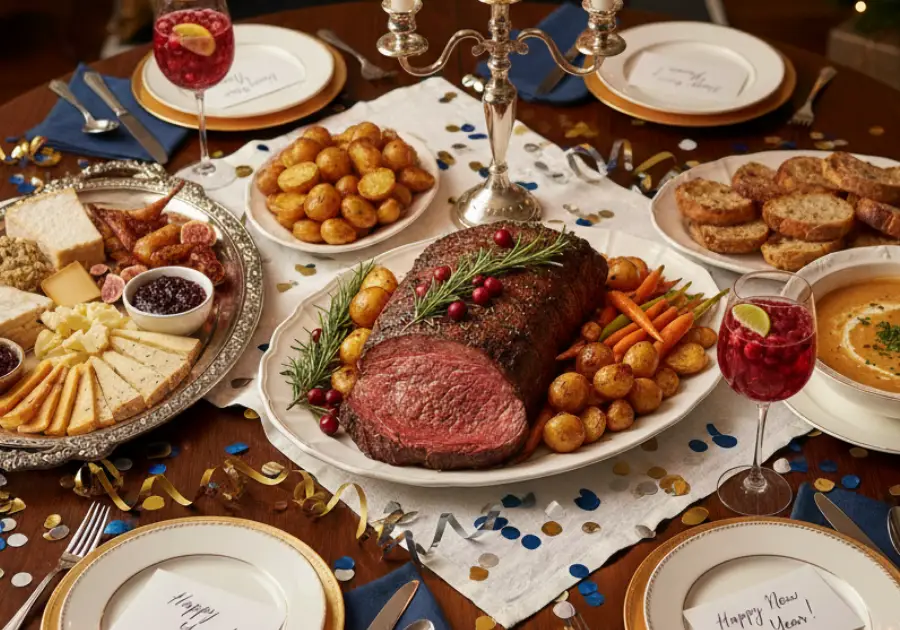
The Christmas table went silent the moment I said I had already gotten married.
It was not the soft, surprised kind of silence families fall into when someone shares unexpected news. It was the heavy kind. The kind that made silverware stop moving and made everyone suddenly aware of the sound of the heater running through the vents.
My mother’s fork froze above her peppermint cheesecake. My father’s smile vanished. Across from me, my younger sister Julia looked down at her plate, but not before I caught the tiny shift in her expression.
Fear. That was the first honest thing I had seen on her face all night.
Christmas dinner at my parents’ house outside Chicago always looked perfect from the outside. My mother, Nancy Thompson, cared deeply about appearances. She had laid out the red linen napkins folded into bows, polished the gold-rimmed plates, lit candles too close to the centerpiece, and arranged the chairs with the precision of someone staging a photo shoot rather than hosting family.
My father, William, liked the illusion almost as much as she did. If the room looked elegant and everyone behaved, he could believe everything underneath it was solid.
It never was.
I had spent most of my life being the daughter who required less. Less praise. Less rescue. Less attention. Julia was the bright center of every gathering, every story, every crisis. If she was happy, the room relaxed. If she was upset, the whole family bent itself around her mood. I was the one who learned early not to need much.
When I met Max, that part of me started changing.
He was the first person who noticed how often I disappeared in my own family’s house. He was steady without being controlling, kind without performing it, and patient in the exact way my family never had time for. He listened closely. He remembered things. He never competed for attention because he did not need the room arranged around him to feel important.
We got engaged on a rainy Sunday in March, in our tiny apartment kitchen, while takeout containers sat open on the counter and the windows fogged from boiling pasta water. He did not get down on one knee in a crowded restaurant. He just took my hand, looked at me with absolute calm, and said he wanted to keep building a quiet life with me if I wanted that too.
I said yes before he finished the sentence.
We could have tried for a bigger wedding. We could have waited another year and saved more. But a big wedding was never what either of us wanted.
I had my grandmother’s old ivory dress tucked away in a garment bag, yellowing slightly with age but still beautiful under the damage. I restored it myself in the evenings, bead by bead, seam by seam, sitting cross-legged on the floor with a lamp beside me and old movies playing in the background.
Max found a courthouse date in Oak Park for October 12. I found a tiny Italian restaurant a few minutes away with warm brick walls, twelve tables, and a private back room we could afford without going into debt.
It was not grand. It was not dramatic. It was ours.
I sent thick cream invitations in early September. I mailed them with tracking because the envelopes were heavy and I was paranoid about them getting bent. One to my parents. One to Julia, who was still using my parents’ address. A few more to close friends, Max’s brother, and an aunt who lived too far away to come but would still want one.
I even stood at the post office counter longer than necessary, smoothing the envelopes in my hands before letting them go. I remember feeling happy that day.
That is the cruelest part of memory. Sometimes what hurts most is remembering how hopeful you were before you understood what was coming.
The first week after the invitations went out, I waited for calls. Nothing came. I told myself people were busy.
The second week, I texted my mother and asked if she had gotten anything from me in the mail. She replied three hours later with a picture of floral swatches and a message about Julia’s final venue changes. She never answered the question.
I stared at the screen longer than I should have.
When I told Max, he suggested calling my parents directly. I almost did. But a familiar instinct stopped me. The one that always whispered not to make a fuss, not to sound needy, not to give anyone the chance to act as if I were overreacting.
So I waited.
A week before our wedding, my father called to ask whether we were coming for Sunday dinner. He spent twelve minutes talking about Julia’s photographer, her seating chart, and the price of custom linens. He never mentioned my wedding.
When I hung up, I sat on the edge of our bed with my phone in my lap and understood, for the first time, that this was not an oversight. Something was wrong.
October 12 arrived bright and cold. I put on my restored dress in the bedroom while Max fixed my veil with hands gentler than mine. He told me I looked beautiful. I smiled. I even laughed once when I stepped on the hem.
Then I checked my phone. No message from my parents. No message from Julia.
At the courthouse, Max’s brother Eli hugged me hard enough to make me breathe again. Our two friends, Nina and Rob, stood as witnesses. The ceremony was short, sincere, and perfect in the way only simple things sometimes are. I married the best man I had ever known with autumn light coming through courthouse windows and my grandmother’s dress brushing my knees.
I should have felt full. Instead, part of me kept listening for the door.
At the restaurant afterward, there were three empty chairs in the back room. One for my mother. One for my father. One for Julia. The waiter asked twice whether anyone else was joining us. I kept saying no with a smile that felt like it belonged to someone else.
Max never let me sit alone in that hurt. He made sure the conversation kept moving. Eli told ridiculous stories. Nina ordered too much wine. Everyone tried, gently, to fill the space my family had left behind.
But there is no pretending when three chairs stay empty through the appetizer, the pasta, the cake, and the closing check.
That night, after everyone left, I sat on the edge of our hotel bed still wearing half my makeup and cried so hard my chest hurt. Max sat beside me and did not offer excuses for them. That mattered. He did not say maybe the invitation got lost. He did not say maybe they were confused. He knew me too well to insult me with false comfort.
He just asked one quiet question. “Do you want proof?”
Yes, I realized. I did.
The next morning, I opened the email from the post office. All the tracking numbers were there. Every invitation to my parents’ house had been delivered on September 10 and signed for within minutes of each other.
I called the courier service and requested the proof-of-delivery signatures. When they arrived, my stomach turned. The looping J on Julia’s receipt looked exactly like the way she signed birthday cards and Venmo reimbursements.
Still, I hesitated. Because proof of delivery is not the same as proof of motive.
Then, three weeks later, motive arrived on its own.
Her name was Leah Sandoval, one of Julia’s bridesmaids and the kind of woman who had spent years covering for Julia because it was easier than fighting with her. Leah texted me on a Thursday night and asked if we could talk.
We met at a coffee shop in Oak Park. She looked exhausted before she even sat down.
“I should have sent this sooner,” she said, sliding her phone across the table. “But I kept telling myself it wasn’t my business. Then I realized that was cowardly.”
On the screen was a screenshot from a group message Julia had sent to Leah and two friends in September.
I read it once. Then again.
I took care of Ava’s little courthouse invitations, Julia had written. Mom and Dad don’t need another daughter event before mine. There was a laughing emoji under it.
A second message followed a minute later. She’ll survive. It’s not like it’s a real wedding.
I felt something inside me go cold and still.
Leah looked miserable. “I’m sorry,” she said softly. “I thought she was being dramatic. I didn’t think she’d actually let your family miss it.”
But she had.
And the worst part was not even Julia’s cruelty. It was how believable she had found our family. She knew exactly how little effort it would take to erase me.
I did not confront my parents right away. I wanted to. I drafted messages. I deleted them. Every version felt too easy for them to deny, too easy for Julia to twist, too easy for the whole thing to become another scene where I ended up apologizing for my own pain.
So I waited.
Christmas gave me the perfect room. It also gave me witnesses.
By the time dessert arrived that evening, Julia had been admired for hours. My mother had glowed over her wedding album. My father had described the reception like a military victory. Julia had accepted all of it like tribute.
Then my mother turned to me with that soft, weaponized smile and asked when my wedding would be.
I told her I had already had it.
Everything after that moved with the strange slowness of disaster.
My father accused me of lying. My mother said they would never miss my wedding.
I opened my blue folder and laid out the delivery receipts one by one. When I unfolded the enlarged signature and turned it toward them, my mother made a small sound and covered her mouth.
It was Julia’s handwriting. Her exact looping J. Her exact careless slant.
Julia tried to recover quickly. “I signed for a lot of things that week,” she said. “I must have set them down somewhere and forgotten.”
Forgotten.
That might have worked on some family. Maybe even on mine, if I had stopped there. But I reached into the folder one last time and placed Leah’s screenshot on the table.
This time no one spoke at all.
My father read it first. His face went rigid in a way I had only seen a few times in my life. My mother leaned over, saw the message, and lowered herself into her chair as if her knees had stopped holding her up.
Julia stood so fast her chair legs scraped the hardwood. “Ava,” she said, and now she sounded frightened. “You don’t understand.”
“Then explain it,” I said.
She looked at our parents instead of me. That told me everything.
My mother’s voice shook. “You hid them?”
Julia’s eyes filled, but not with regret. With panic. “It wasn’t supposed to become this,” she said. “I just—I had worked for months on my wedding. Everything was already about managing people and money and schedules, and then Ava picked a date right in the middle of everything—”
“Six weeks before yours,” I said.
“It still mattered,” Julia snapped. “You always do this. You act like your quiet little choices are somehow more meaningful than everyone else’s plans.”
My father stared at her. “You let us miss your sister’s wedding.”
Julia finally turned to me, anger overtaking fear. “It was a courthouse, Ava. It wasn’t like Dad was walking you down an aisle in a cathedral.”
That sentence settled over the room like ash. Even Max, who had stayed silent beside me the entire night, shifted at that.
My mother looked at Julia as if she were seeing her clearly for the first time. “A courthouse,” she repeated faintly. “So that made it disposable?”
Julia’s mouth opened, then closed.
I should have felt triumph. What I felt instead was grief. Not because Julia had done something cruel. Cruelty from her I understood. It had always been sharpened by competition and polished by entitlement. What broke my heart was realizing how easy the lie had been. She had not needed to build an elaborate scheme. She had only needed to trust that no one would ask enough questions about me.
My father set the screenshot down with trembling hands. “When was the wedding?” he asked me quietly.
“October 12,” I said.
My mother started crying then. Not loudly. Not dramatically. Just a steady, shocked crying that seemed to embarrass her because she could not make it graceful.
“We talked about table linens that morning,” she whispered.
I nodded.
My father looked sick. “And I called you about Sunday dinner the week before.”
“Yes.”
He shut his eyes.
Julia tried one last time to redirect. “I was under pressure. You don’t know what it was like. Everything was on me. Mom was overwhelmed, Dad was stressed, and Ava would have been fine with something simple later—”
I laughed once, softly, because the sentence was too revealing.
That was always the logic. Ava will be fine. Ava is easy. Ava does not need the full version of love.
My mother stood up so abruptly her napkin fell to the floor. “Where are they?” she asked.
Julia blinked. “What?”
“The invitations.”
Julia looked trapped for the first time in her life. Finally she muttered, “In the cedar chest in the garage. I didn’t throw them out.”
My father made a sound of disgust and pushed back from the table. “Go get them.”
“No,” I said.
Everyone looked at me.
I stood, smoothing the front of my dress with suddenly steady hands. “I don’t need to watch anybody dig through a chest for proof anymore,” I said. “I brought what I came to bring.”
My mother stepped toward me. “Ava, please.” For the first time that night, her voice was not polished. It was raw. “We would have come,” she said.
I believed she meant it. That was not the same as forgiveness.
“I know,” I answered. “That’s what makes it worse.”
Because a family can wound you in two different ways. By choosing to hurt you. Or by being so conditioned to overlook you that someone else can hurt you in their place.
Max stood with me. I picked up my bag, left the folder behind, and we walked out while the tree still glowed in the living room and Christmas music still played from the speaker like a joke no one knew how to stop.
My parents came to our apartment three days later. Not with excuses. Not with a performance. With my invitations.
All three had been removed from the cedar chest and placed carefully in a bakery box because my mother said she could not bear to carry them loose. They were still sealed.
She set the box on our table and started crying again.
My father did something I had waited my entire childhood to see. He apologized without defending himself. Not for being deceived. For failing to notice. For making it possible. For accusing me before he asked questions.
My mother admitted that she had treated Julia’s life like a center stage and mine like something that could be folded into the edges if necessary. She said she had told herself it was because I was independent, but independence had become the excuse she used to leave me alone.
Those were the first honest words either of them had ever said to me about our family.
It did not fix the damage. But honesty is at least a place to stand.
Julia called once the following week and left me a voicemail full of tears and blame. She said Christmas had gotten out of hand. She said Leah had betrayed her. She said I could have handled it privately if I had wanted peace.
I deleted the message without answering. Some betrayals do not deserve a softer room.
Over the next few months, my relationship with my parents changed in uneven, careful steps. They asked to see our wedding photos. I let them, though not the first time they asked. My mother cried over the picture of Max helping me with the clasp on my dress. My father stared a long time at the photo of the three empty chairs in the restaurant before quietly asking whether I had saved them for family.
“Yes,” I said.
He nodded once and looked down.
Julia and I did not repair anything. She wanted absolution without consequence. I had spent too many years being trained to offer exactly that. I finally stopped.
On our first anniversary, Max and I went back to the same Italian restaurant in Oak Park. This time the room was full. Eli came. Nina and Rob came. My parents came too, after asking whether they had earned the right to be invited. I appreciated the wording more than they knew.
There were no empty chairs.
My mother brought me a small box with my grandmother’s handkerchief inside, newly pressed and stitched. My father made a toast that did not try to erase the past. He said, simply, that love without attention is not love in its full form, and that he had learned too late how much attention is part of dignity.
I still think about that sentence.
Because what Julia stole was not only a day. She stole witnesses. And maybe that was why Christmas mattered so much. Not because I needed revenge, but because I needed the truth to finally have a room of its own.
Sometimes people ask whether I ever forgave my sister. I do not answer that question the way they expect.
The harder thing to forgive was not what Julia did out of jealousy. It was how long the rest of us lived inside a family pattern that made her believe she could do it and still be understood.
That is the aftershock betrayal leaves behind. Not just who hurt you, but what the hurt reveals about the structure everyone was living in.
I have a marriage now that is quieter than the family I came from and stronger than anything performance ever built. Max still reaches for my hand under tables when rooms get tense. I still restore old fabric when I need my mind to settle. And every October 12, I wear my grandmother’s dress for a minute in the bedroom before dinner, just to remember what was always true even when no one showed up.
A wedding is still a wedding. A promise is still a promise.
And the people who miss your life do not always miss it because they were absent. Sometimes they were right there at the table, looking in your direction, and still failed to see you.

Specialty: Emotional Turning Points
Rachel Monroe writes character-driven stories about betrayal, second chances, and unexpected resilience. Her work highlights the emotional side of family conflict — the silences, the misunderstandings, and the moments when someone quietly decides they’ve had enough.