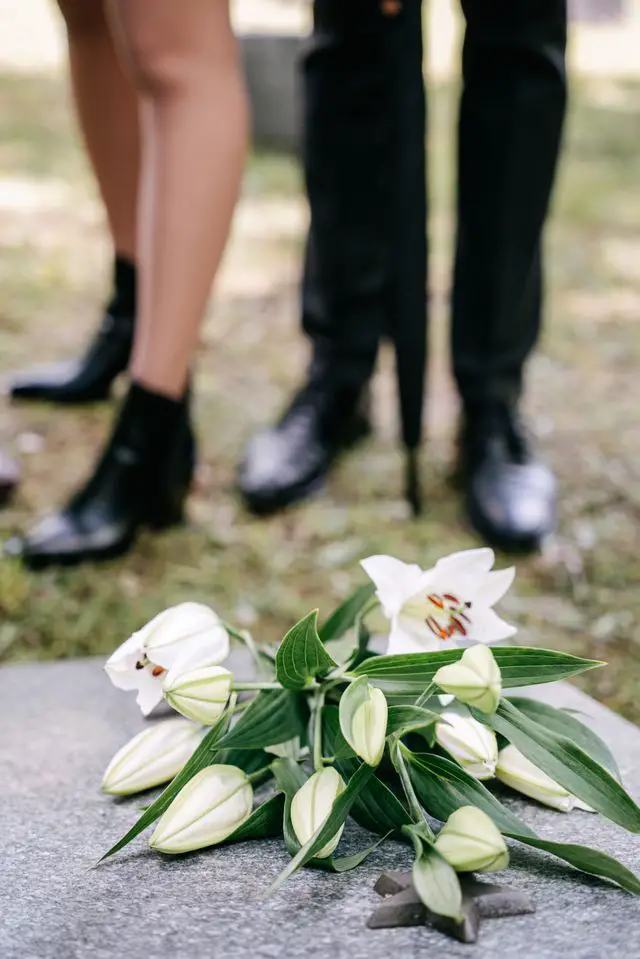
The chapel smelled like lilies and regret. I sat in the front row of St. Helena’s staring at my mother’s casket, draped in white roses the way she had always wanted, while the priest’s voice moved through the room and my chest felt like something had been scooped out of it.
I had worn black twice in less than a year. Eight months earlier I had buried David, my first husband, after a head-on collision on Highway 29. The police told me he hadn’t suffered. I never fully believed them. And now my mother, Margaret Sullivan, seventy years old, three months from the diagnosis to this exact pew.
Garrett squeezed my hand. My second husband. We had married ten months after David died, a courthouse ceremony at the end of six months that had felt, at the time, like being caught by someone just as you were falling. He was a financial adviser, or so he said. Tall, clean-cut, with the kind of smile that persuaded you to believe in it. I had needed to believe in it. That is the only explanation I have for myself now.
“You’re doing great,” he whispered.
I nodded and looked at the casket and thought about how “great” was not anywhere close to the right word.
The reception was at the estate in Napa Valley, one hundred forty-two acres of rolling vineyards and the Mediterranean-style house my mother had built from nothing. Sullivan Vineyards. Twenty-five million dollars a year in revenue. The place smelled like crushed grapes and earth, and she had walked every row of it like a woman who understood that she had made something real. People filled the living room that afternoon with their little plates of cheese and their rehearsed condolences, and I smiled and thanked them until my face ached from it.
My younger sister Sienna stood near the fireplace with a glass of white wine. She was thinner than the last time I had seen her, collarbones sharp, eyes doing that moving thing they did when she was using. Two years of cocaine. Two rounds of rehab. Two relapses. My mother had tried every version of intervention and eventually found that none of them worked. Sienna caught my eye and raised her glass in a small toast, and something about the way she looked at me, detached and faintly calculating, made my stomach pull in a way I could not name.
Garrett was in the kitchen when the guests left, pouring scotch, rolling up his sleeves. He kissed my forehead and told me to rest. I took the scotch and headed upstairs.
On the landing, his phone rang.
I stopped.
His voice drifted up from the kitchen, low and easy.
“Yeah, it’s done. She’s finally gone. The old lady left everything to Eliza. One hundred thirty-five million. Once I get access to those accounts, we’re set.”
My heart slammed so hard I had to grip the railing.
“No, she doesn’t suspect a thing. Give me two weeks. Once the estate-transfer paperwork goes through, we disappear. Bali, maybe. Or the Maldives. Somewhere with no extradition.”
I crept back down three steps and pressed myself against the wall, phone already out of my pocket. I opened the voice memo app and pressed record with my thumb. My hand was shaking.
“Sienna’s on board. She’s desperate, owes some dealer a hundred grand. She’ll do whatever I say. I’ll call you tomorrow. Just keep your mouth shut until this is over.”
The line clicked off.
I stood there staring at the recording timer. Three minutes and forty-two seconds.
I did not go upstairs. I slipped out the back door and walked into the garden, where the air smelled like rosemary and the sun was dropping toward the hills, and that was when I saw them. Garrett and Sienna standing near the stone fountain, too close, her hand on his forearm, his head bent toward hers.
I stayed behind the hedge.
“Two more weeks,” he said. “Then we file the paperwork.”
“And if she asks questions?” Sienna’s voice was tight.
“She won’t. She’s too busy grieving.”
He brushed a strand of hair from her face.
Sienna bit her thumbnail. “I just need this to be over. Matteo’s threatening me. If I don’t pay him soon. If he doesn’t get paid he’ll come for me.”
“You’ll get your money. Once Eliza signs everything over, you’ll have enough to disappear. Start fresh. Isn’t that what you wanted?”
He kissed her forehead. The exact way he had kissed mine an hour earlier.
I stayed hidden until she went inside. Then I sat on the bench by the fountain and let the sky go dark and let myself understand what I had just heard.
The next morning I drove to the office of a man named Harrison Whitfield, my mother’s attorney for thirty years and her friend for longer. Three days after the funeral, he sat across from his mahogany desk and read my mother’s will with Garrett on my right and Sienna on my left and the particular weight of a room where everything is about to change.
My mother had left me the entirety of her trust, forty-seven million dollars, and all three properties: the Napa estate, the Carmel beach house, the San Francisco commercial building. She had also left me full ownership of Sullivan Vineyards, valued at twenty-five million dollars annually. All of it structured in an irrevocable living trust in my name alone.
To Sienna: five hundred thousand dollars, held in a restricted account managed by a financial trustee, contingent on completing a certified rehabilitation program and twelve consecutive months of sobriety.
Sienna shot to her feet before Harrison had finished the sentence.
“Five hundred thousand? That’s it?” She pointed at me. “While she gets everything?”
Harrison explained the documentation quietly: the substance abuse history, two failed rehabilitation attempts, the restricted structure as the most responsible option. Sienna called it being written off. She spat the word legacy like poison and swept her purse from the chair and slammed the door.
Garrett stood and said he would check on her. He kissed the top of my head. His eyes, as he crossed the room, did not carry grief. They carried math.
Harrison waited until the door closed. He removed his glasses and rubbed the bridge of his nose and looked at me with an expression I could not quite name.
“Your mother loved you very much,” he said. “Everything she did was to protect you.”
“I know.”
“Do you?”
He leaned forward.
“She came to see me six months ago. She was already sick, though she hadn’t told you yet. She said she had concerns about people close to you. People who might not have your best interests at heart.”
I kept my voice even. “Did she say who?”
“No. But she left something for you. Something she wanted you to see alone.” He glanced at the door. “Come back tomorrow. Ten o’clock. And Eliza, come by yourself.”
I came alone.
Harrison locked the office door behind us, which told me everything I needed to know before he even opened the drawer.
He set a small tablet on the desk between us and pressed Play.
My mother appeared on the screen.
She was sitting in her study, the floor-to-ceiling bookshelves behind her and the vineyard visible through the bay window. She was thinner than I remembered. The cancer had already started taking pieces of her. But her eyes were sharp.
“Eliza.” Her voice broke something open in me. “If you’re watching this, I’m gone. I’m so sorry, baby. I’m so sorry I couldn’t stay longer.”
I gripped the edge of Harrison’s desk.
“I need you to know the truth about Garrett.”
She told me in order, because she was a methodical woman, a woman who had built an empire because she understood that facts were more useful than feelings in a crisis. Six months earlier she had run a routine annual audit of the estate. She found withdrawals from our joint accounts that I had never authorized. Small at first. Five thousand. Ten thousand. Spread across two years. Eight hundred fifty thousand dollars total, funneled through offshore accounts in the Cayman Islands, through shell companies and fabricated names.
“He stole eight hundred fifty thousand dollars from you, Eliza.”
She had hired a private investigator named Dr. Paige Thornton to confirm it. Paige had confirmed it and found more. Garrett Pierce was not the only name he used. In other records he appeared as Garrett Michael Caldwell. In others, entirely different identities. He had been investigated by the SEC for securities fraud in three different states. He had posed as a financial adviser, defrauded at least twenty clients out of millions, and disappeared before prosecution could reach him.
“He targeted you after David died,” my mother said. “When you were vulnerable. When you needed someone. He saw an opportunity.”
She had been afraid to tell me. Afraid that if she confronted him, he would hurt me. Afraid that if she went to the police, he would run before there was enough to stop him. So she had changed the will, made the trust irrevocable in my name alone, and prepared everything she could.
“But the cancer,” she said. “I ran out of time.”
She looked down at her hands and then back up.
“Harrison has all the evidence. Bank records. PI reports. Everything. Be careful, Eliza. If Garrett realizes you know, he’ll escalate. Men like him don’t walk away from one hundred thirty-five million dollars.”
She paused.
“And baby, I don’t trust your sister either. Paige saw them meeting. Lunches. Coffee. Hours-long conversations. I wanted to believe she was just lost, just struggling. But my gut says it’s more than that.”
Tears blurred her eyes.
“I’m sorry you have to carry this alone. But you are stronger than you know. You’re my daughter. You’re a fighter. Don’t let them take what’s yours. Don’t let them win.”
She reached toward the camera.
“I love you, Eliza. I will always love you.”
The screen went black.
I sat in that office for a long time before I could speak.
Harrison placed a small black USB drive in my palm. Bank records. Screenshots. PI surveillance photos. Witness statements from prior victims. He laid out my options: go to the police, file for divorce, confront Garrett directly, or build the case further.
“I need more,” I told him.
“Then we’ll get it.”
I spent the week that followed becoming someone I barely recognized. I ordered discreet surveillance cameras online using a prepaid card and installed them while Garrett was at work: a smoke-detector camera in the living room, a device inside his desk lamp in the office, a book-spine camera in the wine cellar, tucked between two volumes of The Art of War. I synced them to a private cloud account he knew nothing about.
I met with Paige Thornton at a quiet café in Sonoma. She was mid-forties, sharp gray eyes, the kind of composed alertness that comes from watching people who do not know they are being watched. She had twelve photographs of Garrett and Sienna at various locations around Napa Valley. Their hands on each other. His head bending toward her ear. Her laughing in a way I had never heard her laugh around me. Comfortable. Relieved.
“How long?” I asked.
“At least six months,” Paige said. “Possibly longer.”
I wrote a cashier’s check from the trust and slid it across the table. “I want everything,” I told her. “Every meeting. Every place he goes.”
Then I went home and opened two years of joint bank statements for the first time. Investment transfer, eight thousand five hundred. Investment transfer, six thousand two hundred. Investment transfer, ten thousand. Always labeled the same way, always on the third of the month, always to an account that matched the offshore records on my mother’s USB. He had been stealing from me on a schedule, the way you might pay a subscription.
He was also, that week, bringing me coffee in bed. Cooking dinner. Buying white roses. Giving massages while I pretended to watch movies. It was so precisely the behavior of a man preparing a woman to say yes to a document that I felt cold watching him do it. My mother’s voice in my head: men like him don’t walk away from one hundred thirty-five million dollars.
Two weeks later, I found the poisoned wine.
Garrett had asked me to bring up a bottle of Opus One from the cellar. I had been avoiding the cellar since my mother died: too many memories of walking the rows with her, of the way she talked about vintages as if each one had its own character. I went down.
I found the Opus One easily. But two rows over, the 1982 Château Margaux my mother had been saving caught my eye because it was sitting slightly forward, as if someone had pulled it out and shoved it back carelessly. I lifted it under the light. The wax seal around the cork was cracked, not the slow cracking of age, but fresh. And there was a tiny puncture mark just below it.
I carried the bottle to a private toxicology lab in Oakland two hours away, paid cash, and told them I suspected contamination. The call came three days later.
Ethylene glycol. Approximately forty milligrams per liter. An antifreeze compound. Enough to cause acute kidney failure within twenty-four to seventy-two hours, especially in someone with a compromised immune system.
My mother had had stage-four cancer. Her immune system had been shattered.
She had died of kidney failure. Complications, the doctors had said. Given her condition.
Garrett had injected antifreeze into a bottle of wine he knew she would drink, and then he had watched the cancer take the blame.
I went back to the cellar.
This time I moved along the wall behind the Margaux rack until I felt it: a loose stone, small and easy to miss. I pried it out. Behind it, folded into a narrow gap, was a piece of paper in my mother’s handwriting.
Eliza, if something happens to me suddenly, check the 1982 Château Margaux. I think Garrett tampered with it. I’ve felt strange since drinking it: kidney pain, nausea, confusion. The doctors say it’s the cancer, but my instincts say otherwise. I know my body. This isn’t right. I’m documenting everything.
There’s a panic room behind the wine rack. Code 1982. Use it if you’re ever in danger.
I pray you never need it.
I love you, baby. Fight back.
I sat on the cellar floor and sobbed.
She had known. She had been dying from it and she had written me a letter and hidden it in a wall.
When I could stand again, I found the panel. Four bottles of 1982 Margaux on the top shelf, pulled in sequence: first, ninth, eighth, second. The rack panel clicked and slid aside. A steel door. A keypad. I entered my mother’s birthday.
The room was eight by ten feet, lit by emergency strips along the ceiling. Oxygen tanks, a satellite phone, a laptop, and on the laptop screen a note: If you’re reading this, I was right. Stay safe. Use everything here. Trust Harrison. Don’t let them win.
I opened the laptop.
She had left me everything she had found.
The next morning I called Harrison and told him I needed the FBI.
“He killed my mother,” I said. “And he’s planning to kill me.”
Special Agent David Reeves met me in a conference room in downtown San Francisco with his colleague from the SEC Enforcement Division. Reeves had silver-templed hair and the composed delivery of a man who had done this long enough to know that urgency and panic accomplish different things. He told me that the man I knew as Garrett Pierce had been on their radar for eight months under a different name, Michael Grant, and that he had defrauded at least twenty-two people out of twelve million dollars across multiple states.
“Mostly widows,” the SEC agent said. “Recent divorcees. People who had just come into money and didn’t know how to manage it.”
I placed the toxicology report, the USB, and Paige’s surveillance files on the table.
Reeves read the report twice. “This is enough to open a murder investigation,” he said. “But it won’t convict. Ethylene glycol is in the bottle, not in your mother’s body. There’s no way to prove she ingested it, and no way to prove who put it there.”
“A confession,” Harrison said quietly.
Reeves nodded. “If we can get him to confess clearly and on record, we have first-degree murder, conspiracy, fraud. We can put him away for life. But we need him to try.”
What Reeves proposed was a controlled sting. FBI surveillance equipment installed in the house. Reeves had agents positioned at every exit. I would continue to live with Garrett, behave normally, delay signing the estate documents, and eventually lead him to the wine cellar, where he would do what my mother’s letter said he had planned to do. Flood it with carbon dioxide, the same compound he had used to eliminate her. When he did, I would escape through the panic room tunnel while his own actions condemned him. A federal agent posing as the funeral director he had hired would receive the call he made to dispose of my body.
Reeves did not minimize it. He told me it was dangerous. He told me I would be bait. He told me it was my choice and that they would find another way if I said no.
I signed the waiver.
The FBI installed the surveillance on a Wednesday morning while I sent Garrett to a city that took him three hours round-trip. By the time he came home that evening, the living-room television had a repurposed camera in its firmware, his desk lamp held a device the size of a watch battery, and his car had a tracker under the dashboard.
Reeves called me two hours later with an audio file from Garrett’s car, recorded earlier that afternoon. I listened in the guest bedroom with the door locked.
Garrett’s voice: “Sienna, we have a problem. She’s stalling. If she doesn’t sign by next week, we go to plan B.”
Sienna, quieter: “Plan B?”
“The wine cellar. Just like Margaret. Carbon dioxide. She’ll pass out. We call 911 too late. No one questions it. I’ve done it before. It works.”
He said it the way someone says they know a shortcut.
I’ve done it before. It works.
I called Reeves.
“That’s our confession for the prior murder,” he said. “Combined with what you bring us from the sting, he’ll never see daylight again.”
On October the fourth, I suggested we open something special from the cellar.
The evening was quiet and deliberate, candlelit table, Garrett cooking the way he did when he was managing something. He mentioned the estate paperwork twice and I told him I would sign tomorrow. I meant it to sound like a gift. He smiled with the front of his face.
“I’ll go get the bottle,” he said.
“I can. You cooked.”
He let me.
I descended the cellar stairs with the cool air rising around me and my heart so loud I was certain he could hear it from the kitchen. I found the Opus One. Then I heard him behind me on the stairs.
“I’ll help you find it,” he said.
He came down to the bottom. He looked at the walls. He looked at the door. Then he turned and climbed back up. And I heard it.
The heavy steel bolt sliding into the lock.
“Garrett?”
His voice came through the intercom, calm and cold.
“I’m sorry. This is the only way.”
Then the hiss.
The air pressure shifted. My ears popped.
Carbon dioxide, heavier than air, pooling toward the floor first.
I did not scream again. I ran to the rack.
Four bottles of Margaux on the top shelf. First. Ninth. Eighth. Second. The panel slid open. The keypad. My mother’s birthday.
The door released.
In the panic room, I took one breath from the oxygen mask, grabbed the note off the laptop, and pulled open the tunnel panel. Three feet high. Dark. Emergency lights every ten feet. I crawled on concrete for fifty feet while the air in the cellar behind me turned poisonous.
The trapdoor at the end opened into the gardener’s shed. Two FBI agents in tactical gear caught me before I hit the ground.
“You’re safe,” one said. “We have you.”
From the shed I watched on a tablet as Garrett sat in his office with his eyes on the wine-cellar camera feed, waiting for something on the screen to stop moving. It never had. I had been gone for fifteen minutes by the time he reached for his phone.
I heard the call through the FBI surveillance.
“Frank, it’s done. I need you here in twenty minutes. Wine cellar. Carbon dioxide. She’s been down twenty-five minutes. I need the van. Cremation tonight.”
Twenty minutes later, the van pulled into the circular drive and FBI agents poured out of it.
Garrett was arrested on the terrace while he was still holding his scotch.
He saw me in the driveway as they walked him out. His face went through several things at once. I did not speak. I watched the car door close.
The trial lasted three days.
Prosecutor Sarah Mitchell led with the penthouse recording, eighteen minutes of Garrett and Sienna celebrating my death in the apartment he had kept under a different name for three years. He admitted to injecting ethylene glycol into my mother’s wine three weeks before she died. He admitted to the wine-cellar plan. He described me as easy to manage and my mother as an obstacle he had removed. He clinked glasses with my sister and told her they were free.
The jury heard it twice.
Frank Delgado, the funeral director, had cooperated with the FBI before the arrest. Twenty-two fraud victims testified. Caroline from Portland, who had lost four hundred thousand dollars of her late husband’s life insurance, cried on the stand without apology. The defense had no answer for any of it.
On the third day, I testified.
The defense attorney asked whether I had set a trap. Whether I had entrapped his client.
“No,” I said. “Your client was guilty. I gave him the opportunity to prove it.”
The jury deliberated for two hours.
Guilty on every count.
At sentencing, Judge Carver gave Garrett life without parole plus sixty years, concurrent, and eighteen million dollars in restitution to his victims. Sienna received twenty-five years, eligible for reduction after twenty, with two million in restitution.
I stood when the judge asked if I wanted to make a statement.
“Justice doesn’t erase grief,” I said. “It doesn’t bring back the people we’ve lost. But it matters. It tells survivors that their pain is real. That they are not alone. That someone will fight for them.”
I looked at the fraud victims in the gallery. At Harrison, who had kept my mother’s secret and protected her legacy. At Paige, who had spent six months in parking lots and cafés gathering what I needed. At Dr. Harper, my therapist, who had been teaching me for two months how to put weight on a life that had been picked up and shaken.
“To every survivor watching this,” I said. “You are not alone. Fight. Survive. Win.”
One month after sentencing, I stood in the wine cellar and felt no fear.
The steel door was gone. French doors opened onto the garden now. The ventilation system had been rebuilt with emergency overrides. The racks remained, but they framed a bright tasting room with reclaimed-wood tables and soft lighting. On the far wall hung a bronze plaque.
Margaret Sullivan. Guardian. Survivor. Architect. 1962 to 2025.
I ran my fingers across the raised letters.
The Sullivan Foundation had existed for four weeks. Three hundred twelve people had reached out. Survivors of financial fraud, domestic violence, elder abuse. We had distributed more than twenty thousand dollars in emergency grants, connected forty-seven people with pro bono attorneys, and funded six months of therapy for thirty-two survivors. Harrison managed the legal structure. Paige ran our digital-safety workshop series. Dr. Harper had brought two colleagues on board to handle therapeutic referrals.
The gala that evening was sixty people. Small by design. I did not want spectacle. I wanted the women at those tables to feel like the room had been built for them, because it had.
I spoke without notes.
“My mother spent the last months of her life building a case against the man who was poisoning her. She hid evidence, created an escape route, and prepared me for a fight I didn’t know was coming. She didn’t survive. But she made sure I would.”
A woman named Clare, sitting in the front row in a red dress that looked like armor, stood when I asked if she would share. Three weeks earlier she had arrived at our office with nothing but a restraining order and sixty dollars. Now she had a job, an apartment, and an attorney.
“I thought he had killed the part of me that knew how to fight,” she said. “But I’m standing here. And that means I won.”
The room broke into applause that did not feel performative. It felt like relief.
After the gala, I walked the vineyard with Juniper, my golden retriever, three years old and abandoned twice before I found him. The December evening was cold and clear, the vines bare but the land alive beneath them, preparing for spring. Somewhere in a federal prison in Colorado, Garrett was serving the first weeks of a life sentence. Sienna was in a federal facility in Northern California. I had not spoken to either of them since sentencing. I had no intention of ever doing so.
I stopped at the edge of the property and looked out over the valley my mother had built from nothing.
I was not ready to trust anyone new. I was not sure when I would be. But I had mornings in the vineyard and evenings by the fire and the work of the foundation, which filled me in a way that surprised me with its completeness. I had Harrison, who had returned every phone call for thirty years. I had Paige, who understood instinctively that the work did not end when the verdict came in. I had Clare and the others who had come through those doors and left a little less afraid.
I had a dog who nudged my hand impatiently.
“All right,” I said. “Let’s go home.”
We walked back toward the house. The lights from the tasting room glowed warm in the dusk, and through the windows I could see people still talking, still sitting together. People who had survived. People who were learning, in careful increments, how to rebuild.
I had built this. From the evidence my mother hid in walls and the note she left in a panic room and the tunnel she dug for a daughter she was already dying trying to protect. I had built this from the recording I made on a landing at six in the evening three days after her funeral, shaking, holding the phone with my thumb on record, understanding only that I needed proof and nothing else yet.
She had given me the room. I had built something in it.
I opened the door and stepped inside.
The house was full of light.
And the life I was building, one careful day at a time, was mine.

Specialty: Legal & Financial Drama
Michael Carter covers stories where money, power, and personal history collide. His writing often explores courtroom battles, business conflicts, and the subtle strategies people use when pushed into a corner. He focuses on grounded, realistic storytelling with attention to detail and believable motivations.