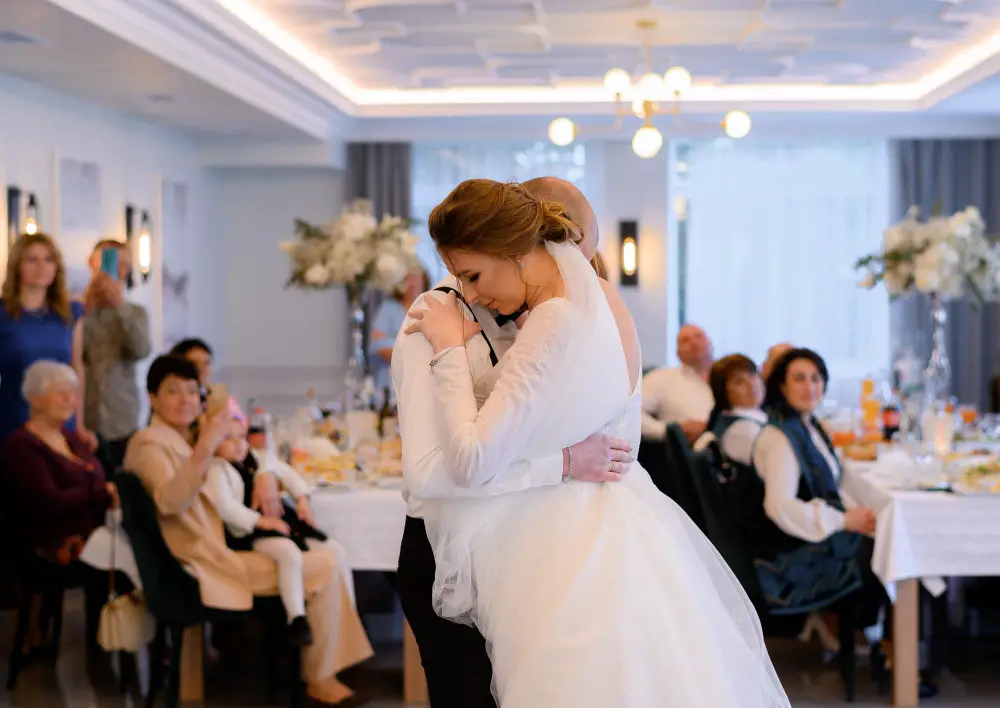
The first sentence said to me at my only son’s wedding, by the woman he had just promised to spend the rest of his life with, was this: “Her family only. You never mattered to him. Please leave.”
I had been standing on the flagstone walkway outside the Hollander estate for approximately four seconds.
I was wearing a pearl-gray dress my tailor in Anchorage had made for me. Her name was Ingrid, and I had been going to her for eleven years. She once told me she could make me look like a woman from a 1940s film poster if I would just stop slouching like a tired accountant. I was trying not to slouch. In my left hand I carried a small velvet gift bag. Inside the bag was a leather box. Inside the leather box sat a pair of platinum cufflinks engraved with the date of my wedding to my late husband Theo, twenty-six years earlier, and my son’s name on the back. I had them repolished at a shop in Midtown Manhattan. The man behind the counter had gone quiet when I told him the story. I cried in the airport afterward, and again during a layover in Hartford, because I am a woman who has managed other people’s emotion professionally for two decades and therefore has almost no capacity left to manage my own.
My name is Desiree Maxwell. I was forty-eight years old. I had flown out of Anchorage at 4:15 that morning and traveled fourteen hours to be there. I had reapplied lipstick in the Hartford airport bathroom under lighting so cold it made every woman at the sink look like she had just received bad news. I had hired a car service and smoothed my dress in the back seat and told myself that whatever distance had grown between my son and me over the last several years, a wedding would soften it. A wedding is the kind of day that softens things. I have built my career on knowing exactly what kind of day a wedding is.
Then Joselyn Hartwell stood in the doorway of the stone-and-glass estate in her champagne-colored dress and told me I did not matter.
She said it the way someone tells a delivery driver they have the wrong address. Polite enough. Mildly inconvenienced. She tilted her head and repeated it when I did not immediately move: “Her family only, Desiree. Please.” Two of her bridesmaids stood three feet away pretending to look at the floral arrangements.
I want you to understand something about me. I have planned eighty-seven weddings. I once talked a bride off a ledge after her mother appeared at the rehearsal dinner wearing the exact dress she had been told, three separate times, not to wear. I once handled a groom’s former girlfriend who arrived at the ceremony by kayak. I have spent eighteen years in a profession that requires you to read a room in seconds and respond to its worst moments without leaving a trace.
But I had never been the woman on the wrong side of the door.
So I did what I do for a living. I read the room. I said, “Of course.” Two words. I think I even smiled, because I was raised in the Midwest, and women like me are trained to smile at our own funerals if the lighting is flattering. Then I turned around and walked back down the flagstone path.
The car service driver was waiting near the gate. He saw my face through the windshield and did not say a word during the forty-minute drive back to the hotel. God bless that man. I should have tipped him significantly more.
I sat on the edge of the hotel bed in my travel coat and held the gift bag in my lap. I could not put it down. Setting it down would have made everything real in a way I was not ready for. My phone buzzed twice on the nightstand. I did not look.
One small thing kept circling. The night before, at the rehearsal dinner, Joselyn’s father Stanford Hartwell had leaned across a plate of dressed asparagus and asked whether my company had ever done business with his commercial real estate firm in Hartford. I said no. We had not. At the time it registered only as an odd question for a man to ask the mother of the groom. The table was loud and the evening was busy and I let it go.
I would not think about it again for six days.
To explain what happened next, I need to go back.
I founded Maxwell and Lyall Events in 2007, after Theo died and left me with two children, four casserole dishes from the funeral, and a mortgage I could not pay. I started the company from the spare bedroom of a rental house, working at a folding card table while my children slept upstairs. Eighteen years later, I was planning weddings for people whose names appeared on hospital wings and alumni halls.
So when my son Bryce got engaged, I knew exactly what a Hudson Valley estate venue cost. I knew exactly what a champagne-colored dress signaled when worn by a bride who understood that photographs outlast manners. None of that knowledge helped me at the door.
My daughter Renee was thirty-two and living in Portland with her husband Femi. They had been trying for a baby for nearly three years, three rounds of IVF, and the third finally worked. When Renee called to tell me, I had to pull over outside the post office because I could not see the road. I sat in that parking lot crying hard enough that a stranger tapped on my window and handed me a bottle of water.
Renee texted Bryce the same day. He answered forty-eight hours later with the word “Congrats” and a single baby emoji.
That was the whole message.
Renee forwarded it to me. Neither of us said much. We both already knew what it meant.
After Theo died, Bryce had changed. He was fourteen then. Something in him went quiet and stayed quiet. He went to Yale. He became polished. He became the kind of young man who can stand at a charity function for ninety minutes holding a wine glass without spilling a drop, which is a useful skill and a way of never being truly present anywhere. He also became someone who did not pick up the phone.
For years I told myself it was grief. Maybe it was. Maybe it was something else, and I was the last person willing to say so.
That spring I started getting calls from a hospitality group out of Atlanta called Aspenwood. They wanted to buy Maxwell and Lyall for $4.2 million. My senior planner Marina Whitam, who had been with me for fourteen years, would stay on as president. The closing was set for November.
I had built that company at a card table in pajamas with two grieving children asleep upstairs. Four million dollars to walk away from it should have felt simple.
It did not.
That summer, Bryce called to say Joselyn had said yes. I met her twice before the wedding. She was pleasant in a way that felt practiced. She used the phrase “your generation” twice in a single sentence, and she talked about her parents’ vision for the wedding in a tone I have heard from mothers of brides who do not have visions so much as expensive Pinterest boards and generalized anxiety about silverware.
In October, four months before the wedding, I called Vivien Tate. Vivien owned the Hollander estate. We had worked together for twenty years. She had photographs of my children on her refrigerator.
I told her I wanted to give Bryce and Joselyn the venue as a gift.
Vivien quoted me her best-friend rate.
On October fourteenth, I wired $185,000 to the Hollander estate.
We agreed she would say nothing to the kids. Let them think Bryce was paying, I told myself. Let him feel proud of himself. Let him feel like a man starting his own life.
Looking back, that is the part where I want to take my former self by the shoulders. Why was I protecting my son’s pride from his own mother’s love? But eighteen years of single-handed parenthood will make a woman do things she would never admit out loud.
The morning of the wedding I had an outfit, a custom dress, a velvet gift bag, a leather box, two engraved cufflinks, and a heart that had not felt that full in a decade.
By that afternoon I was a woman in a hotel parking lot.
The day after the wedding I had a voicemail from Vivien. I saw it when my plane landed. I did not listen. I told myself I would listen later. I told myself the same thing Sunday, Monday, and Tuesday. By Wednesday the message had been sitting there unplayed for nearly five days and I had started thinking of it the way people think of unopened mail from the IRS.
Marina picked me up from the Anchorage airport. She took one look at me, asked nothing, and drove me directly home. At my front door she said, “I’m going to check on you tomorrow and the day after that, and you can’t fire me because I have your signature on file.” Then she hugged me and left.
I closed the door, set the gift bag on the entry table, and sat on the floor of my own foyer like a woman who had forgotten where else to be.
For three days I wore the same pajamas. I ate trail mix for dinner twice. I watched a documentary about a Florida real estate scandal and realized twenty minutes later that I had accidentally paused it. The remote was under a couch cushion next to a fork. I will not attempt to explain the fork.
I also did something I am not proud of. I went deep on Joselyn’s wedding hashtag. Heartwell Hearts. I wish I were inventing that. There were 312 posts. I went through all of them, every caption, every background face. I was a forty-eight-year-old woman sitting on my kitchen floor at one in the morning zooming in on an elbow to determine whether it belonged to a Hartwell cousin.
I was not in a single photograph.
Joselyn’s mother Margot was in seventy-one of them. I counted. She did four solo portraits with the cake. The cake had better representation at that wedding than I did.
Then I found a clip of Bryce’s speech. Someone had posted it with sentimental piano music underneath. He thanked Joselyn’s parents. He thanked her grandparents. He thanked her three brothers by name. He thanked all the family who had flown in to make the day what it was. He did not mention his mother. He did not mention his sister. He did not mention his father, who had been gone eleven years and would have given anything to stand in that room.
That was when I cried the way I had not cried since Theo’s funeral.
On the fourth morning, my doorbell rang. Marina, standing in her work coat with a coffee in each hand and a foil-wrapped frittata.
She saw the peephole move.
“Desiree Annette Maxwell,” she said through the door. “You open this door or I will use my key and I will judge you.”
I opened the door.
She walked in, looked at me, looked at the kitchen, looked at the cracker situation, and set the coffees down.
“We close in three weeks. Aspenwood is doing a final walkthrough next Thursday. I cannot do this without you. Also, I love you. Both things are true.”
She sat me on my own couch and made me eat eggs.
I told her, in pieces, what had happened at the wedding. I had not said it out loud yet. Hearing my own voice say it made it real in a way that the hotel room and the parking lot and the pajamas had not.
Marina listened without interrupting. When I got to the part about walking back down the flagstone path, she put her coffee down very carefully.
“Okay,” she said.
Then quieter: “Okay.”
That was all. But I knew Marina well enough to understand that when she said “okay” like that, somebody was about to have a very bad week.
While she was working at my kitchen island she suddenly frowned at her phone.
“Aspenwood’s CEO just liked one of Margot Hartwell’s charity board posts.”
I looked up.
“Dana Aragon,” Marina said. “She liked a post from your son’s mother-in-law yesterday. Hartford literacy gala in June.”
We looked at each other across the counter.
“Coincidence?” I asked.
Marina tilted her head the way she does when she has already completely decided the answer is no.
That afternoon Renee called from Portland, twenty-four weeks along, one hand resting on her belly, wearing a sweatshirt twice her size. She let me talk through every detail. When I got to the gift bag still sitting on my entry table, she said quietly, “Mom, he doesn’t deserve those cufflinks.”
I did not answer. She did not push.
That was the day I started wondering whether I had spent eleven years raising one child and gently, patiently excusing another.
On day six, I finally showered and put on real pants. I had coffee on my desk and the Aspenwood closing checklist open on my laptop. The deal would not pause for my heart. I had three weeks left to be a professional before I could afford to be a person again.
My phone rang.
The screen said Bryce.
“Hey, Mom,” he said. Light and hurried. The tone of a sixteen-year-old asking to borrow the car. As if nothing in particular had happened.
“Hi, sweetheart,” I said.
I want you to hear that. After everything, I still said sweetheart.
“So, look,” Bryce said. “The Hollander estate billing department has been calling me. There’s an outstanding balance of $74,000. Joselyn and I talked about it, and as my mother, it’s your duty. You need to handle it.”
I sat very still.
As my mother, it’s your duty.
That phrase was not Bryce. I had known that boy since I labored nineteen hours to deliver him during an Anchorage blizzard so severe the doctor arrived in snow boots. I had heard every sentence he had ever constructed. Those words were too polished, too cold, too rehearsed. They sounded like something handed to him.
I told him I would look into it and call him back.
He told me I did not need to look into anything, it was a wedding bill, and Joselyn was really stressed.
I hung up.
I sat on my office floor in real pants while the neighbor’s dog barked and the kettle I had forgotten about whistled thinly from the kitchen, and I did arithmetic.
I had paid Vivien $185,000. I had the receipt, the email confirmation, and her handwritten note still on the shelf in my office. The venue was paid. So what was $74,000?
I called Vivien.
She picked up on the second ring and said, “Oh honey, I was hoping you’d call.”
She told me in order, with times and names and dollar amounts, because Vivien keeps records the way I keep records. Margot Hartwell had arrived at the Hollander estate at nine that morning and had spent the day adding things. A champagne tower. A premium bar extension. An orchestra upgraded from a quartet to a six-piece. Eight additional floral installations brought in from a Hartford florist rather than Vivien’s house designer. An upgraded entree option. A late-night dessert station. By two in the afternoon the additions had crossed $60,000. By the time guests sat down, they were at $74,000.
At 4:30, Vivien had quietly pulled Bryce aside and asked for a card. His American Express declined. A second card declined. He told her he would sort it by the following week and to bill him, and then walked back to the reception.
“Vivien,” I said, “who turned me away at the door?”
Her voice changed. She had not known that happened. She had been inside dealing with the orchestra contract Margot had already torn up. She would never have allowed it. I believed her.
Then I asked her what she knew about the Hartwells.
Vivien went quiet, and then she said, “We need to talk about Stanford.”
The next morning I had a notebook, three pens, and two coffees that had gone cold by the time she was finished talking. Vivien spoke for forty minutes. I wrote down every name, date, dollar amount, and small detail she offered.
Stanford Hartwell owned Hartwell Reston Commercial Real Estate in Hartford. On paper: three office parks, two retail strips, a small medical building. In reality: three refinances in eighteen months, two vendors in payment disputes, and a banking relationship one of Vivien’s contacts described as “not warm anymore.” Margot had been on the social committee of a Hartford charity board for nine years. The previous spring, the board had quietly asked her to step down because her annual pledge had been outstanding for fourteen months. She refused. They let her stay. They were not happy about it.
Vivien told me there is a phrase in Hudson Valley wedding circles for what the Hartwells had been doing.
A comeback wedding. That is when a family on the slide throws a party the size of their old life to convince everyone they have not slid. “The parties on the way down,” Vivien said, “are always bigger than the parties on the way up.”
I looked at the notebook.
“And they thought I was paying for the comeback.”
Vivien paused. “Honey,” she said, “I think they thought you were paying for the whole rebuild.”
I closed the notebook.
There is a particular kind of calm that settles when you realize the people who hurt you are not brilliant. They are not three moves ahead. They are tired people in expensive clothes running a math problem that doesn’t work, and they have just put their math problem on speakerphone with the wrong woman.
Two days later, Renee called.
“Bryce called me Wednesday,” she said. “Two days before he called you. He didn’t ask about the pregnancy. He asked me to lean on you about the venue bill. He said you were being difficult and that he needed me to be his ally.”
Her voice cracked on the word ally.
“I’m twenty-four weeks pregnant,” she said. “And my brother called to ask me to work on you.”
That same afternoon, Margot posted on Facebook. I will not quote it word for word because she does not deserve that precision, but the spirit was this: she suggested that an in-law who struggled with basic wedding obligations was disappointing, and that some families were simply raised differently. She added a rose emoji, as if flowers helped.
Marina called from the office at 4:15.
“Desiree, I saw it. Aspenwood saw it too. Dana Aragon called the office asking if there’s anything she should know that might affect closing.”
Aspenwood was three weeks away from wiring me $4.2 million for the company I had built from a card table. And now Dana Aragon was on the phone asking about my character because a woman who had never met me had posted a public suggestion that I was the sort of person who did not handle bills.
I went into the powder room. I put on Cabernet Reserve, forty-two dollars at Nordstrom, saved for closings and funerals. I drank a full glass of water. Then I called Dana Aragon.
I did not mention the wedding. I spoke about Maxwell and Lyall’s third-quarter numbers, Marina’s retention, two new contracts we had quietly signed in September. I spoke for eighteen minutes in the voice of a woman who had been calm during the worst moments of her life because nobody else had been available to be calm.
At the end, Dana said, “Desiree, I’m sorry I even asked.”
“Don’t be,” I said. “You did your job.”
Marina texted me thirty seconds after I hung up: Closed her out clean. You’re a witch. I love you.
I laughed for the first time in a week.
Then I remembered Stanford at the rehearsal dinner, leaning over the asparagus. Has your company ever done business with mine?
I called Russell Pike.
Russell had been my attorney for nineteen years. He had been Theo’s college roommate at the University of Washington, the best man at our wedding, and the man who read the eulogy at Theo’s funeral. He was sixty-seven years old, six-foot-three, and owned khaki pants and Oxford shirts in three shades of blue. He called me “kid” the way an uncle does. He was, without exaggeration, the reason my children grew up with a father figure who returned phone calls.
I told him I needed advice on a family financial situation. He said, “Kid, come in Monday.”
“Tell me on the phone, Russell. I can’t wait until Monday.”
A lawyer’s pause. Then: “Before I say this, how did the Hartwell family come up?”
“What do you mean, how did they come up?”
“How did Stanford Hartwell’s name come up?”
“Russell. He is my son’s father-in-law as of last Saturday.”
Another pause. Then the sound of a keyboard, the creak of his chair.
“November eighth of last year,” he said, “I received a verification call from Hartford Heritage Bank. They were checking a co-signer signature on a commercial loan application for $1.2 million. The applicant was Hartwell Reston Commercial Real Estate. The co-signer listed was you.”
I made a sound. It was not a word.
“The signature was not yours,” Russell said. “It was a strong imitation, but it was not yours. I knew because I have your signature on file from decades of documents, and because you would have told me before signing anyone’s commercial paper. I told the bank no. I told them to flag the application. Stanford withdrew it within forty-eight hours and apologized, claiming an administrative error.”
“Russell,” I said.
“I did not tell you because I thought it was random identity misuse,” he said. “I had no reason to think that name would ever cross your path again.”
I sat with that for a moment.
Stanford Hartwell had used my name five months before I met him. Five months before his daughter had introduced him to my son.
Here is what I understood in my kitchen with cold coffee on the counter and Russell’s voice in my ear. The Hartwells had not stumbled into my son’s life. They had moved toward it. The loan application was the first attempt to use my financial credibility to plug a hole. The wedding was the second attempt. The daughter was the bridge. The plan had come before the relationship.
I hung up and walked to the kitchen. I drank half a glass of water and poured the rest into a plant I had not watered in three weeks.
I refused to look for the metaphor. I did not have time.
Bryce called again that evening. I let it ring four times, using those four rings to remember who I was before I answered.
“What is going on?” he said. “The estate is calling me three times a day. Did you make this complicated on purpose? Are you doing this to hurt me?”
“Bryce, where is Joselyn right now?”
“Why does that matter?”
“Is she in the room?”
“She’s right here.”
“Did Joselyn tell you to ask me that question?”
The silence that followed is one I will carry for the rest of my life. It was the silence of a son who had just been asked the one question he did not have a good answer to.
“Mom,” he said. “I have to go.”
He hung up.
That evening I drove to Lake Hood at dusk and sat by the seaplane base watching planes come in low over the water, eating crackers from a half-empty box in the passenger seat like a raccoon with good earrings.
For about thirty-five minutes I almost paid the $74,000.
Not because I was weak. Because I was tired. There is a tiredness that comes from being the woman who always handled it, who made the call, packed the lunch, signed the check, closed the deal, swallowed the hurt, and stayed strong because the family required her to be strong. I almost wired the money just to make the noise stop.
Then Renee called.
“Mom,” she said, “the baby kicked so hard this morning I dropped my toothbrush.”
I started crying quietly in the parking lot.
“I need to tell you something,” she said. “The last real conversation I ever had with Dad, I was twenty. You were at the grocery store. He told me he was worried about Bryce. He said Bryce could grow up small if nobody held the line. He said you loved him too much, and not to let you love him into being small. I never told you because I didn’t know what to do with it. I’m telling you now because I think you need it.”
I sat in the car for a long time.
Then Renee said, “Mom, drive home.”
I drove home. I went to my office, opened the legal pad, and wrote one sentence at the top of a clean page.
One call. I say it once.
I underlined it.
Tuesday morning Russell came to my house with the full file and spread it across the dining room table like a surgeon arranging instruments. The loan application. Stanford’s name. My name beside his, with a signature that was not mine. The D in my Desiree loops back on itself. This one did not. I would not have caught it myself. Russell had caught it because he had thirty years of my handwriting memorized.
He laid out my options. A civil case with a public docket. A formal referral to the appropriate authorities, which would move the matter well beyond any private dispute. Or a documented record held in reserve, notarized and filed, activated if Stanford ever tried to use my name again. A sword on the wall.
“What do you want?” he asked.
“Option three for now. I have a daughter who is six months pregnant, a business closing in two weeks, and one son I am about to lose. I do not have the energy this month to become the center of Stanford Hartwell’s public collapse. Put the sword on the wall. I want him to know it is there.”
Russell wrote it down.
“Kid,” he said, “that is the most Theo thing I have heard out of your mouth in fifteen years.”
I almost cried. I did not. I was running out of crying.
Thursday night I slept seven hours for the first time in weeks.
Friday morning I woke at six. I made coffee the slow way, the way Theo used to. I sat at the kitchen island in my navy suit from the Aspenwood meeting. I put on Cabernet Reserve.
At eight Alaska time, eleven Eastern, I called my son.
He picked up on the second ring.
I heard Joselyn in the background, her bright brittle voice moving somewhere nearby.
“Bryce,” I said, “put me on speaker. Joselyn should hear this. So should anyone else in the room.”
A click. The call opened up.
“I’m here,” Joselyn said. Her voice was cool. Prepared. The voice of a young woman who had been told by her mother she was about to win an argument.
“Good morning, Joselyn,” I said. “I’m not going to take much of your time. I am going to say four things in order and then I am going to hang up. You can respond or not. That choice is yours.”
My voice was not loud. Not sharp. It was the voice I use at two in the afternoon when a florist texts to say the dahlias did not arrive. Steady, slow, almost gentle. I was not calm. Ten minutes earlier I had been on the kitchen floor. I had been sick once in the powder room very quietly. The calm in my voice was a costume. It was very well made.
“Number one. On October fourteenth, I wired $185,000 to the Hollander estate. The wire covered the full venue cost, including catering, standard floral, the original quartet, the bar package, and the contracted meal. The confirmation is on file with my bank. Vivien Tate has the matching deposit record. The venue was a gift from me to both of you. I am sorry I did not tell you. I thought I was protecting Bryce’s pride. That was a mistake on my part.”
Someone inhaled sharply. I could not tell who.
“Number two. The $74,000 currently outstanding is not and has never been the venue bill. It represents same-day additions made by Margot Hartwell between nine in the morning and four in the afternoon. A champagne tower, upgraded entree, premium bar extension, orchestra upgrade, eight additional floral installations, and a dessert station. All authorized by Margot. All charged to Bryce. Both card attempts declined at 4:30.”
“Mom,” Bryce said.
“I’m not finished, sweetheart.”
I took a breath.
“Number three. Joselyn, on November eighth of last year, five months before I met your father in person, Stanford Hartwell submitted a commercial loan application to Hartford Heritage Bank in the name of Hartwell Reston Commercial Real Estate. He listed me as co-signer. The signature beside my name was not mine. The bank caught it. My attorney has the documentation notarized and on file. A copy has been delivered to the bank’s review department for its internal record. I have not chosen to make this matter public yet.”
I heard it then. A clatter. A phone hitting a hard surface somewhere in their apartment. Bryce’s voice cracking. Joselyn, pick it up.
I waited. I have waited eighteen years for difficult brides to find their breath in bathroom stalls before walking down aisles. I can wait.
The phone came back. Joselyn’s voice, smaller than before.
“My dad told me you knew,” she said. “He said you co-signed and changed your mind.”
“I know what he told you. I know what he told your mother. Your father’s attorney can call mine. The verification will take ten minutes.”
The silence was so complete I could hear the dishwasher running in their kitchen.
“Number four,” I said. “This is the last thing I am going to say.”
I closed my eyes.
“Bryce, I flew fourteen hours to watch my only son get married. I had a dress made. I brought your father’s cufflinks, engraved with the date he and I were married and your name on the back. I stood at the door of the venue I had paid for, and your wife told me I had never mattered and asked me to leave. I left without a word because it was your wedding day, and I respected that. Six days later you called me and used the word duty. You told me it was my duty to pay $74,000 for additions your mother-in-law made to a wedding I had already paid for in full. That phrase was not your voice, Bryce. I want you to know that I know it. I also want you to know that you said it with your own mouth to your mother, after everything.”
He was crying. I could hear him.
“Here is what is happening effective today. One: I am withdrawing as guarantor on your New York apartment. Russell’s office will notify the landlord by close of business. You will have thirty days to renegotiate without me. Two: the $50,000 gift transfer scheduled for November fifteenth has been canceled. The funds remain mine. Three: you are being removed from the succession plan for Maxwell and Lyall ahead of the Aspenwood close. Renee remains. She always has been part of it. Four: the documentation regarding your father-in-law’s signature issue has been filed. I am not making it public today, but it exists. Stanford knows it exists. He has known since the bank denied that application. He will continue to live with it.”
“Mom, you can’t do this,” Bryce said.
“I am not punishing you,” I said, and I meant it. “I am leaving the way Joselyn asked me to at the door of the venue. I am doing it everywhere now.”
Joselyn’s voice came through, smaller than I had heard it.
“Mrs. Maxwell. I didn’t know about my father. I swear I didn’t know.”
“I believe you,” I said. “I am sorry, Joselyn. You have a great deal to figure out, and none of it involves me anymore. You and Bryce have a marriage. Build it with each other. Do not build it with your mother, your father, or with me. We have all had our turn.”
Then I spoke to my son for what I understood might be the last time for a long while.
“Bryce, I love you. I always will. If you have children one day and you decide you want me there, I will be a grandmother to them. But I will not fund your marriage to a family that planned to use my name before they ever met me.”
I took one last breath.
“Goodbye, sweetheart.”
I set the phone face down on the kitchen island and walked to the sink. I poured a glass of water and drank it slowly. Outside the window stood the birch tree Theo had planted the summer before he got sick. The leaves had gone gold. A magpie sat on the lowest branch and watched me through the glass as if taking notes.
I said out loud to my empty kitchen, “Okay. That’s it.”
That was all.
On November twenty-first, the wire hit at 3:51 in the afternoon, Eastern time. $4.2 million. Marina called from the conference room, crying. I was not. I think I had simply run out of tears for the year and would need to wait for the next shipment.
That night I bought one thing: a pair of vintage pearl earrings from an estate sale, six hundred dollars, the kind my grandmother used to wear. I wear them every Sunday.
In February I flew to Portland on a one-way ticket. Renee labored for nine hours. The baby was eight pounds and three ounces. They named him Theo.
I held him in the hospital room for forty minutes and did not put him down. Femi eventually had to take him from me so the baby could eat. I would like to publicly apologize to Femi for the look I gave him at that moment.
That same month, Russell called on a Tuesday. Stanford Hartwell had attempted to refinance the Hartford house using another unauthorized signature. This time the name belonged to his own daughter. The bank pulled my earlier file and asked whether I wanted to expand the existing complaint into a formal referral.
I said yes.
Russell sent me one line by email that evening.
Kid, you can take the sword off the wall now.
In March, Vivien called. Joselyn had filed for divorce. She had moved out of the Manhattan apartment in February, the day after she opened a piece of her father’s mail by accident and found a signature that was not her mother’s.
She rented a one-bedroom in Brooklyn and paid for it herself.
She sent me a short letter through her attorney.
I’m sorry. I didn’t know.
I had Russell send back one line.
I believe you.
I did not need anything more than that.
In April, a Hartford business publication ran a story about a civil case involving Hartwell Reston Commercial Real Estate and a regional credit union. Two of Stanford’s office parks entered receivership. The third sold in May for significantly less than he had once told people it was worth. His commercial real estate license was suspended pending the review.
The Hartwell house in West Hartford went on the market shortly after. Six bedrooms, nearly five baths, twelve acres, empty staging photographs. It sold in nine days. The family moved to a rental an hour outside Hartford.
Margot was voted off the Hartford literacy board by unanimous voice vote. She has not been invited to a charity luncheon since, at least according to Vivien, who knows those circles the way I know wedding seating charts.
Bryce sent me four messages over six months. I read them once. I archived them in a folder on my phone called Later. He took a position at a smaller firm in Stamford. He lives in a studio in Queens. A college friend of Theo’s mentioned to me that Bryce is in therapy.
I hope that is true.
One day I will be ready to talk to him. I am not ready yet.
Margot unfriended me on Facebook in March. This was interesting because I had never accepted her friend request in the first place. I looked up whether a person can unfriend someone who was never their friend. Apparently, you can. I would like that noted for the record.
I sold the Anchorage house in April and bought a smaller place in Portland with a guest room that has a crib, a rocking chair, and a basket of board books. Theo’s photograph sits on the dresser. I tell my grandson about his grandfather every time I babysit. He is nine months old and will not remember a word I say. I will remember all of it.
Maxwell and Lyall by Aspenwood is doing better than we did. Marina is president. She brought me on as senior strategic adviser: one day a month, four trips to Atlanta a year, good food on the company card, my opinion on three things, then home. It is the best job I have ever had.
I wore Cabernet Reserve to the closing dinner. I will wear it on every important day of my life until my hand is no longer steady enough to apply it.
And the cufflinks.
They are still in the leather box, sitting in my top drawer beside Theo’s watch.
Not because Bryce will never receive them. But because he has not yet become the man who could put them on and understand what they cost. Not in money. In everything else.
If he becomes that man, if he finds the courage to hold the whole truth without reaching for someone else’s script, I may decide they belong to him after all.
Until that day, they wait.
The engraving on the back still reads his name.
That part I did not have changed.
Some things, I have decided, are worth keeping ready.

Lila Hart is a dedicated Digital Archivist and Research Specialist with a keen eye for preserving and curating meaningful content. At TheArchivists, she specializes in organizing and managing digital archives, ensuring that valuable stories and historical moments are accessible for generations to come.
Lila earned her degree in History and Archival Studies from the University of Edinburgh, where she cultivated her passion for documenting the past and preserving cultural heritage. Her expertise lies in combining traditional archival techniques with modern digital tools, allowing her to create comprehensive and engaging collections that resonate with audiences worldwide.
At TheArchivists, Lila is known for her meticulous attention to detail and her ability to uncover hidden gems within extensive archives. Her work is praised for its depth, authenticity, and contribution to the preservation of knowledge in the digital age.
Driven by a commitment to preserving stories that matter, Lila is passionate about exploring the intersection of history and technology. Her goal is to ensure that every piece of content she handles reflects the richness of human experiences and remains a source of inspiration for years to come.