The cold came off Lake Michigan the way it always did in February: not gradually but all at once, moving through the streets of Chicago’s South Side in hard, deliberate gusts that found every gap in a coat, every inch of exposed skin, every seam where fabric had been washed too many times and no longer held its shape the way it was supposed to.
Khloe Davis stood in a line outside the Southside Community Hope Center and tried not to count the people ahead of her. Counting made the waiting feel longer. She focused instead on Lily, which is what she had been doing for three years: narrowing the whole of her attention down to one small person, keeping that person warm, keeping that person fed, keeping that person from understanding the size of the situation they were standing inside.
Lily was three years old and bundled into a pink winter coat two sizes too large, with frayed cuffs and a collar that had faded from bright to dull. One button was missing, replaced by a length of thread Khloe had pulled from an old scarf and worked through the buttonhole with numb fingers in the back seat of the car. The hat did not match the mittens. The mittens were worn thin. But Khloe had washed every piece in public bathroom sinks, wrung them dry as carefully as she could, and dressed her daughter each morning with the same attention she had given Lily’s clothes when they had a washing machine and a drying rack and drawers that closed properly.
The little girl had her arms around Khloe’s neck and her face pressed against the side of her mother’s jaw. She was not afraid, exactly. She was trusting. That was almost worse.
The line moved slowly, inch by inch, in the way of things that cannot be hurried. Snow came down in scattered flurries and caught in the street lamps. The person directly ahead of Khloe was an elderly man she had not seen before, hunched inside a coat with a torn shoulder seam, his hands trembling where they gripped his lapels. He turned when Lily shifted on Khloe’s hip, and he looked down at the child with the unhurried attention of someone who had been waiting long enough to notice small things.
From his coat pocket, he produced a peppermint candy, slightly crushed from its time in that pocket, and held it out.
“For the little lady,” he said.
Khloe’s throat tightened. “Thank you.”
Lily took it with both hands as though she had been given something significant, because to her, she had been. She pressed it to her chest and looked up at the old man with the complete seriousness of a child granting someone a high honor with her attention.
Six months before this night, Khloe would not have recognized the life she was now living. She had a modest apartment in a quiet neighborhood, a steady job as a receptionist at a dental clinic, and the kind of small, ordinary stability that is easy to underestimate until it is gone. She had Lily and the carefully maintained routines of a single mother who understood that routine itself was a form of protection: the same time for breakfast, the same song for bathtime, the same specific sequence of events each morning that told a three-year-old that the world was predictable and therefore safe.
She had been building something. Not extravagantly, not quickly, but deliberately and in the right direction.
Then the daycare closed without warning, the way small businesses close when the numbers stop working, and Khloe found herself missing shifts she could not afford to miss, calling in to explain circumstances that a sympathetic supervisor could only absorb for so many weeks before it became a question of what was fair to the clinic. The conversation, when it came, was kind. The envelope was thin. Without a paycheck, the bills came due in the familiar sequence: first the ones with grace periods, then the ones without, then the late notices, then the final notices, and eventually the eviction notice taped to the door that she had known was coming and was still not prepared for.
Lily’s father had left before Lily was born. He had made his position clear the week Khloe told him she was pregnant, and when she declined to accommodate his position, he packed what was his and left. In three years, there had been nothing: no calls, no letters, no birthday acknowledgments, no child support, no evidence that he had given any thought to the child he had helped create. Khloe had stopped expecting any of it and had channeled the energy she might have spent on anger into the daily project of keeping Lily alive and well and unafraid.
Her parents had died in a highway collision when she was barely eighteen, leaving her without family and without anyone who could open a spare room or write a check or simply be present in the way that parents are present when adult children find themselves in crisis. She had spent her twenties building everything herself, carefully and without a safety net, learning as she went, making mistakes she corrected without anyone’s help.
For months after the eviction, she and Lily moved between the city’s shelters when beds were available. The shelters were clean enough, staffed by people who were trying to do something genuinely difficult, and they provided a mattress and a meal and a temporary address. But beds filled quickly and did not stay available, and there were nights when they were turned away and Khloe carried Lily back to the car without letting the child see her face fully until she had composed it.
She covered Lily in thrift-store blankets and called it camping.
“We’re sleeping under the steel trees,” she would whisper, pointing at the city skyline through frost-covered glass.
She made shadow puppets against the windows. She sang quietly. She kept her face arranged in expressions that communicated safety, because she understood that a child’s sense of whether the world is dangerous comes directly from reading her mother’s face, and she refused to let Lily read what was actually there.
After Lily fell asleep, Khloe lay in the cold and thought about the things she could not say out loud.
The night she joined the line outside the Hope Center, the temperature had dropped close to zero. The car had become genuinely dangerous, and she had known it. The community kitchen was not merely warmth. It was the only option she had left, and she had walked toward it in the specific way of a person who has run out of alternatives and has not yet found the word for what it feels like to admit that.
At least Lily would eat something hot. At least they would sit inside heated walls for an hour. Khloe told herself this over and over as the line moved forward.
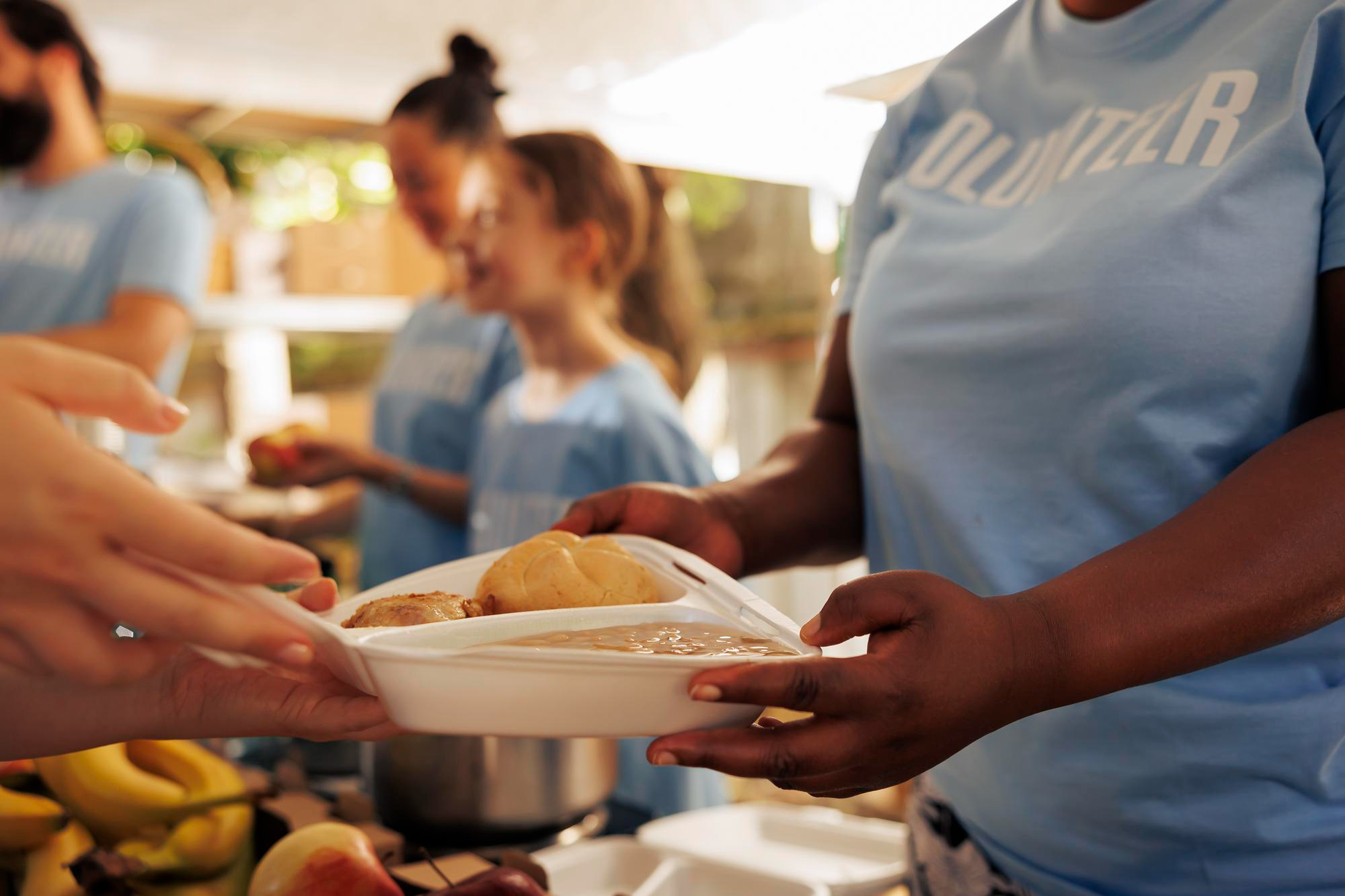
When they finally crossed the threshold, heat came over them in a wave that Khloe felt in her lungs before she felt it anywhere else. The room smelled of roasted chicken and root vegetables and coffee and the particular dense warmth of a crowded space where the cold has been successfully kept out. Spoons scraped against bowls. Boots moved across the floor. Low conversations ran along the walls. And through the space behind the serving counter, volunteers moved with the efficient kindness of people who have done this work long enough to do it well.
Khloe shifted Lily on her hip and moved toward the serving line.
Then she saw him.
She recognized him before her mind caught up with what her eyes were telling her. The profile first: the dark hair, shorter now and more carefully kept, the strong jaw that had matured from the features of a boy into the features of a man who had grown into himself. The particular way he moved, deliberate and at ease in whatever space he occupied.
He was wearing a canvas apron over an expensive wool sweater, and he was holding a silver ladle above a pot of soup, and he had the watch of a man who had gone somewhere significant in the decade since she had last seen him.
Luke Mitchell.
She had loved him in the specific, total way that belongs to the young, when you have not yet learned to protect any part of yourself from feeling and you simply feel everything at full volume. They had grown up on the same South Side streets, gone to the same high school, sat under the same stadium lights on Friday nights talking about the lives they were going to build.
Then college had taken him one direction and life had taken her another, and the distance had done what distance does.
She had not allowed herself to think about him in years. Not because the memory was painful, exactly, but because what she remembered most clearly was the version of herself that existed when she knew him, and that version of herself felt like evidence of something she had lost.
Now she was standing in a soup kitchen line, holding her hungry child, and he was three feet away with a ladle in his hand.
She turned to go.
Lily chose that exact moment to stop holding herself together.
The cry came out sharp and sudden, the specific cry of a three-year-old who has reached the end of her capacity and has nothing left to hold back. Lily pressed her tear-streaked face into Khloe’s neck and clutched her collar with both fists.
“Mommy. My tummy hurts. My toes are too cold. I don’t want to walk anymore.”
Khloe stopped.
She stood in the middle of the community kitchen with her daughter crying against her throat and understood, with the absolute clarity of a person who has run out of options for avoiding truth, that she could not leave. She had promised Lily a warm meal. That promise was the only thing she still had to give, and she was going to give it.
She turned back toward the counter. She kept her eyes low. She prayed, without quite meaning to, that she would not be seen.
The line moved her forward.
When she reached the counter, she was looking at the scuffed linoleum floor.
She heard the ladle stop moving.
She heard him go still.
Then she heard her own name in a voice she had not heard in ten years.
“Khloe?”
She looked up.
Luke was watching her with an expression she had not expected. Not the embarrassment she had feared, not the well-meaning condescension of someone who has prospered looking at someone who has not, not pity wearing the face of kindness. He looked stunned. And underneath the shock, something that moved across his face before he could entirely contain it, something that looked like grief.
“It’s been a long time,” she managed.
He recovered enough to look at Lily, whose crying had quieted into small, exhausted sniffles. He looked at her the way adults look at children who have earned the particular tenderness that belongs to people who have clearly been through something.
“Who’s this?” he asked.
“My daughter. Lily. She’s three.”
“She’s beautiful,” he said.
There was no performance in the words. He filled two deep bowls with soup and added generous pieces of crusty bread and slid the tray across the counter.
“There’s a table by the brick radiator in the back corner,” he said. “It’s warmer there.”
Khloe took the tray and moved away before she started crying in front of the room.
She found the table and helped Lily out of her coat and watched her daughter eat. The moment the first spoon of warm broth touched Lily’s mouth, the child changed. The shaking stopped. She leaned over the bowl with complete focus, eating with the particular concentration of someone who has been too cold and too hungry and has been handed something that addresses both at once.
Khloe watched her and felt something that was not quite relief and not quite sadness but contained both.
She did not notice Luke crossing the room until his shadow reached the table.
He was carrying a small tray. On it were two mugs of hot chocolate, a plate of frosted cookies, and a soft brown teddy bear with a tiny red heart stitched to its chest. He set it down and kept his hands on the table’s edge.
“I thought the little one might like something extra,” he said. “I hope I’m not intruding.”
Lily stared at the bear with the expression of a child who has decided something is hers before she has touched it yet. “Is that for me?”
“All yours,” Luke said.
She grabbed it and pressed her face into the fur.
Luke sat down across from Khloe slowly and carefully, the way you sit down across from someone you are trying not to startle. He waited. Then he asked, in a voice low enough that only she could hear it: “What happened?”
The question opened something.
She told him. She told him about the daycare, the job, the eviction notice, and the car. She told him that Lily’s father had left. She told him that her parents were gone and had been gone since she was eighteen. She told him about the shelters and the nights and the stories she told Lily about camping under steel trees. She told him because the weight of it had been building for months with nowhere to go, and because something in the way he asked made it feel possible to say.
When she finished, he was very quiet.
“And Lily’s father,” he said. “He’s completely gone?”
“Three years. Not one word.”
He looked toward Lily, who was feeding imaginary soup to the teddy bear with a seriousness that suggested the bear’s nutrition was a pressing concern. Something moved across Luke’s face that was not pity. It was the specific kind of anger that belongs to someone who cares about a person and has just understood the shape of what they have been through.
He told her quietly that he funded the center. That his foundation covered the meals, the heating, the staff support. That he came to volunteer every week because he had decided a long time ago that wealth carried an obligation to stay close to what it could prevent, and that the best way to honor that obligation was to be physically present in it.
Khloe looked at him for a long moment. The wool sweater, the watch, the ease with which he occupied the room. The boy she had known on those bleachers had become someone who had gone somewhere considerable in the decade since she had last seen him. She had tracked none of it. She had been focused on other things.
“I spent ten years thinking about you,” he said. “I didn’t know how to find you. I told myself it was because we had grown up and moved on, but that was easier than admitting I simply didn’t do what I could have done to look.”
She looked at the table.
“I’m not that girl anymore,” she said. “Look at me, Luke.”
“I’m looking,” he said.
His voice did not waver. He was not performing patience. He was simply patient.
“What I see,” he said, “is a woman who has been fighting without anyone behind her, for a very long time, for a child who does not have the faintest idea that the world is anything but safe, because her mother made it that way. That is not failure. That is the most difficult kind of strength there is.”
He paused.
“It’s also the kind that doesn’t always get acknowledged, because it looks like ordinary survival to people on the outside. It is not ordinary. It is extraordinary, and it has cost you everything you had.”
Khloe’s eyes filled. Her pride told her to stand and walk back out into the cold, because pride was the last currency she still had full control over. But pride had not kept Lily warm. Pride had not answered when she lay awake in the frozen car at two in the morning. Pride was a thing she had maintained at considerable personal expense and it had not, in any meaningful way, helped.
She nodded.
What followed in the weeks after that night was not a rescue in the way that word is usually understood. Luke arranged for her and Lily to move into a bright apartment in a building he owned, telling her the unit had been vacant for over a year as if that made it smaller. It did not. It had heat that responded to a dial, a refrigerator stocked with actual groceries, thick blankets, clean towels, and a small bedroom painted pale yellow for Lily with a white bed and curtains printed with daisies.
When Lily ran across the carpet and threw herself onto the mattress for the first time, Khloe sat down on the floor and cried until her body ran out of it.
Mrs. Higgins, the building manager, took to Lily within the first week with the efficiency of a woman who had raised four children and was not intimidated by small people. She brought cookies and a knitted scarf and a stack of picture books and told Khloe that if she needed an hour to herself she should knock on the ground-floor door, because one little girl with a teddy bear was not going to be a problem for someone who had survived four boys.
Khloe laughed. She had not laughed in months and it felt like something she had forgotten she knew how to do.
Luke stayed present without being suffocating. He came by with groceries and claimed accidents of overpurchasing that neither of them believed. He fixed things that needed fixing. He assembled Lily’s small table and chairs and sat on the floor to do it, which Lily supervised with great seriousness. He sat with Khloe at the kitchen table and helped her rebuild her resume, filling in the gaps with language that framed her interruption as what it was rather than what she feared it looked like.
He connected her with Sarah, a career counselor who worked with women returning to employment after crisis. Sarah was sharp and direct and she did not soften things unnecessarily, which was exactly what Khloe needed. In their first meeting, she told Khloe: you are not begging for an opportunity. You are qualified. You had a crisis. Those are not the same thing.
Khloe wrote it on a piece of paper and taped it to the bathroom mirror.
Three months after the night at the community center, she signed an employment contract for a senior office manager position at a marketing agency downtown. Stable salary, benefits, predictable hours, enough to cover rent and daycare and groceries and a savings account that started small and was still a savings account.
She sat in her car after signing it and cried for nearly an hour.
She was not surviving anymore. She was rebuilding, which is different and harder and better.
The evening after her first real paycheck, she cooked dinner and invited Luke. Roasted chicken, mashed potatoes, green beans, and an apple pie made from a recipe Mrs. Higgins had written on an index card in her careful handwriting. Lily set the table with crooked napkins and announced that the teddy bear would be joining them.
After Lily fell asleep, Khloe and Luke sat at the kitchen table with coffee between them. She told him she wanted to start paying market rent, or find her own apartment. She was working now. She needed to know she could stand on her own.
He listened to all of it. Then he reached across the table and held both her hands.
“You are standing on your own,” he said. “The apartment doesn’t change that.”
He told her then that he had loved her when they were seventeen, and that he had spent the decade after trying to convince himself he had moved on and failing, and that he had built things and gone places and sat in rooms with important people and come home feeling like the most significant part of his life had already happened on a different set of bleachers. He said he was not asking her to love him because he had helped her. He was asking her not to walk away because she was afraid that accepting help had made her smaller, because it hadn’t, because watching her fight for Lily had done the opposite of making him think less of her.
She searched his face for pity. There was none.
“I love you too,” she said. “I think I always did.”
They were married a year later inside the same community center, the room transformed with white tablecloths and small jars of yellow daisies. The brick radiator still hissed in the corner. The space still smelled of coffee and soup and old wood. Sunlight came through the windows. Arthur sat in the front row in a clean suit that Luke had quietly arranged. Mrs. Higgins cried into a handkerchief. Sarah stood beside Khloe and smiled like a woman watching someone arrive somewhere they had been working toward for a very long time.
Lily walked down the aisle with a bouquet nearly too large for her arms and the grave expression of someone who understands that she has been given an important job. When she reached Luke, she handed him a flower with great ceremony and then stood beside him as though this were the arrangement she had been working toward.
The judge who handled Luke’s adoption of Lily smiled when Lily asked if she could write Mitchell on her drawings now.
“If that’s what you want,” the judge said.
Lily looked at Luke.
“I want it,” she said.
Luke cried openly. He was not the kind of man who hid that.
In the years that followed, Khloe became deeply involved in the foundation’s work, eventually helping Luke expand it into a comprehensive support network for single mothers across Chicago. Emergency housing, childcare grants, job training, interview clothes, transportation assistance, counseling, legal support for women who had found themselves one unexpected crisis away from losing everything they had built. The foundation’s intake process had been designed without her, and when she read it she found the language clinical and the requirements burdensome for someone already in crisis. She rewrote it with the specific knowledge of a person who had stood on the other side of the counter.
Khloe insisted on one rule above all others: no woman asking for help would ever be made to feel small for asking.
She knew what it cost to walk through those doors. She knew the precise texture of shame that accompanies the moment you accept that you cannot do it alone. She had felt it as a moral failing, as evidence of inadequacy, as proof of something she had not quite been able to name. Years later, she understood it differently: asking for help is not the failure. Surviving long enough to ask is the harder thing, and it deserves to be met with dignity rather than condescension.
At the opening of the foundation’s family resource center, she stood at a podium in a navy dress, her hair pinned back, her hands steady. Lily sat in the front row beside Luke, the teddy bear, now much loved and showing its years, held on her lap. Luke had his arm around Lily’s shoulders and was watching Khloe the way he had watched her since the night in the community kitchen: with the specific attention of a person who has decided that this is where his attention belongs.
Khloe looked out at a room full of volunteers, donors, mothers with children on their laps, shelter workers, career counselors, and people who understood with their whole bodies the distance between stability and desperation.
She told the truth.
She told them about the line outside the community center, and Lily in her mismatched mittens, and the shame she had felt crossing the threshold. She told them she had nearly turned back. She told them what had made it impossible to leave: the sound of her daughter’s voice, saying her stomach hurt, saying her toes were cold, saying she didn’t want to walk anymore. She told them that she had turned back to the serving line because her child’s hunger was larger than her pride, and that turning back had been the most important decision she ever made.
“We are taught to believe strength means carrying everything alone,” she said. “That needing help is a character flaw. That the right kind of person figures it out themselves and does not ask.”
She paused.
“I believed that. It almost cost me everything.”
The room was quiet.
“Asking for help is not failure. Surviving long enough to ask takes courage. Accepting kindness does not erase your dignity. Sometimes it is the only road back to it.”
She looked at Lily in the front row.
“And when you finally find warmth, you reach back for the next person still standing in the cold.”
After the ceremony, in the car on the way home, Lily fell asleep against the window with the bear in her arms. Luke drove with one hand on the wheel. Khloe sat beside him and watched the city move past outside and thought about the woman she had been on the night she stood in that line.
She did not think of her with embarrassment anymore. She thought of her with something that had taken years to arrive at and that she now held without ambivalence. That woman had been exhausted and frightened and had not asked for any of this and had still, every single day, chosen to keep going. She had called it camping. She had made shadow puppets. She had smiled until her face hurt, so that her daughter would not be afraid.
That was not someone who had failed. That was someone who had fought with everything she had, and then crossed a threshold when crossing it took more courage than she knew she had, and accepted a bowl of soup from the hands of someone who had once loved her and turned out to still be worthy of it.
Khloe looked at Lily sleeping, and at Luke driving, and at the city lights moving past the glass, and felt the specific, ordinary peace of a person who has come through something and arrived on the other side in a life that is genuinely, completely, unreservedly hers.
It had not been given to her. It had been built, piece by piece, in the cold and the difficulty and the years of making do, and in the moment she stopped walking away from the door and walked through it instead.
That was where it began.
Everything else was just what came after.

Sophia Rivers is an experienced News Content Editor with a sharp eye for detail and a passion for delivering accurate and engaging news stories. At TheArchivists, she specializes in curating, editing, and presenting news content that informs and resonates with a global audience.
Sophia holds a degree in Journalism from the University of Toronto, where she developed her skills in news reporting, media ethics, and digital journalism. Her expertise lies in identifying key stories, crafting compelling narratives, and ensuring journalistic integrity in every piece she edits.
Known for her precision and dedication to the truth, Sophia thrives in the fast-paced world of news editing. At TheArchivists, she focuses on producing high-quality news content that keeps readers informed while maintaining a balanced and insightful perspective.
With a commitment to delivering impactful journalism, Sophia is passionate about bringing clarity to complex issues and amplifying voices that matter. Her work reflects her belief in the power of news to shape conversations and inspire change.