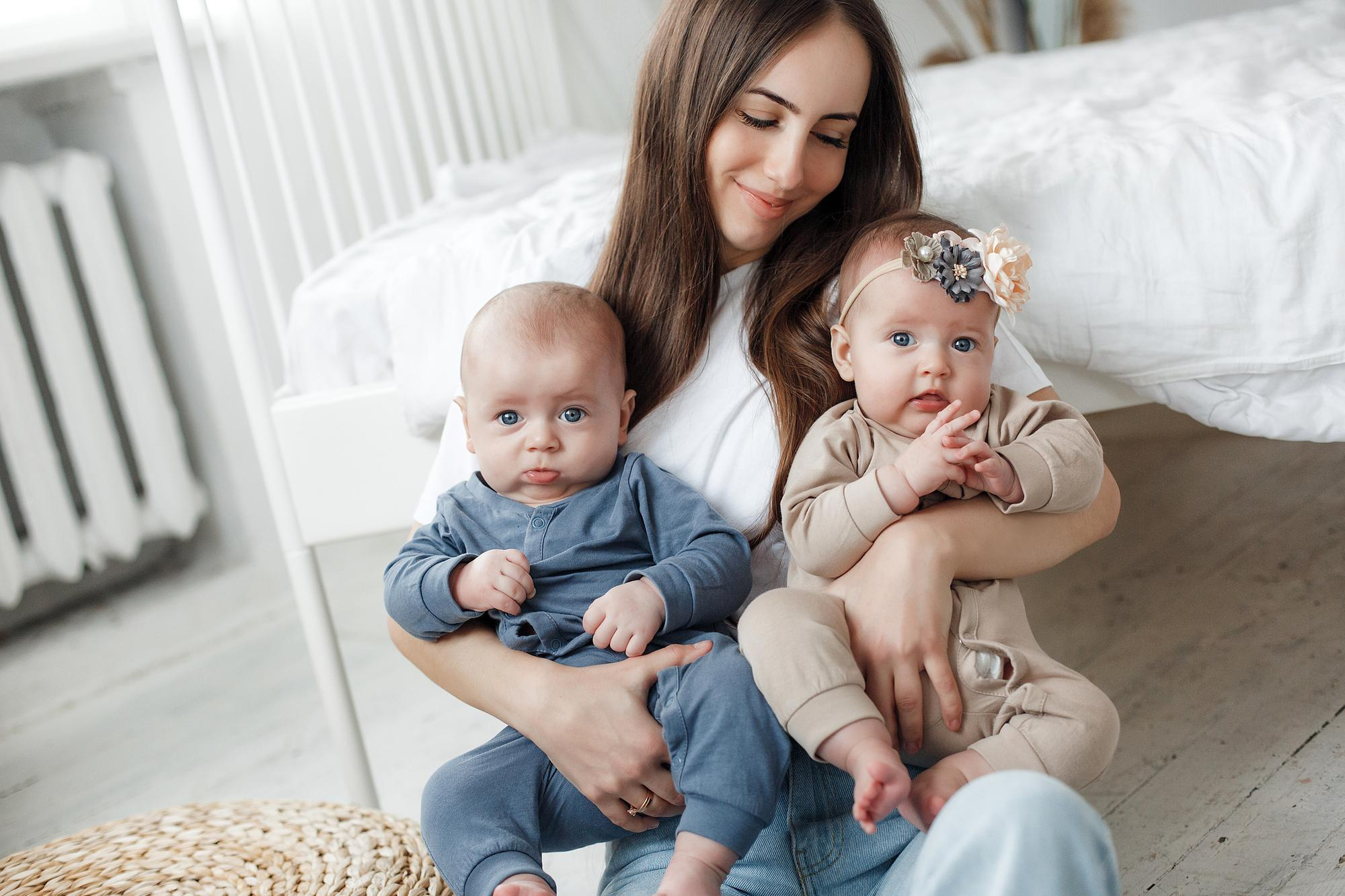
The living room smelled like warm formula, sour laundry, and the paper coffee cup Hannah Harper had reheated three times without drinking. One of her newborn daughters was finally latched against her. The other slept in the bend of her arm, making those soft, uneven breaths that newborns make when they are too small to understand the terror they cause just by being fragile.
Hannah had not slept more than ninety minutes at a time in almost three weeks. Her body still felt like it belonged to a hospital discharge packet instead of to her. Her hair was twisted into a knot that had stopped being a hairstyle two days earlier. The couch was covered in burp cloths, tiny socks, folded washcloths, and one pacifier she had been looking for since noon.
Beside the door sat a half-packed diaper bag. She had started packing it for the twins’ next appointment, then stopped when both babies finally quieted down at the same time. Under the lamp, open and waiting, was the mortgage folder. That folder had become a kind of third baby. It kept her up at night. It needed attention, feeding, checking, protecting.
She had become obsessed with the numbers inside because the numbers told a story that Matthew’s words never would.
At 3:06 a.m. two nights earlier, Hannah had sat on this same couch with one daughter asleep on her chest and the other pressed against her thigh, screenshotting bank emails with one trembling hand. There were mortgage servicer notices. There were late-fee warnings marked with urgent red text. There were transfer confirmations showing money leaving her accounts. There were calendar reminders she had created because Matthew always said he would handle something and then forgot until the problem had a due date and penalties attached.
The down payment had come from Hannah’s savings. She had worked for six years at an insurance company to accumulate that money. She had skipped expensive lunches with coworkers, driven an older car that smelled like old french fries, and bought generic everything. That down payment represented years of denying herself small comforts so that she and Matthew could own something together. Seventy-eight percent of every monthly payment had come from her accounts since then. Matthew had always had a reason why his contributions could not reach their portion. He was between contracts. He was networking. He was waiting for a call. He needed the right opportunity, not just any opportunity. The right opportunity never came.
Hannah had believed him for longer than she liked admitting. Love makes excuses sound like patience until the bill arrives and you realize the person you were protecting had been watching you drown the whole time.
She had given him passwords because she thought marriage meant trust. She had added his email as a backup access because she thought partnership meant convenience. She had told herself that keeping score was ugly, that good wives did not tally contributions like a small business owner tracking expenses. That thinking about money constantly made her a materialistic person. That questioning where her paycheck went made her difficult.
Her mother had warned her during the engagement. Not warned exactly. Hannah’s mother did not warn. She had simply said, “He is charming, Hannah. Make sure he is also responsible.” Hannah had heard this as her mother not trusting her judgment. She had chosen to prove her mother wrong by trusting Matthew harder.
Then the twins came home, and the score started keeping itself automatically. Every bottle of formula. Every copay. Every gas receipt to drive to appointments alone because Matthew’s car was being fixed and had been being fixed for three months now. Every mortgage reminder that arrived to her inbox while Matthew slept with his phone turned face down on the nightstand, deliberately unreachable.
She had started printing statements at work when no one was looking. She had created a private email account that Matthew did not know about. She had been slowly, systematically building a case against her own husband without even admitting to herself that she was doing it. That was how bad it had gotten. That was how far she had fallen into protecting him.
That afternoon, he walked into the apartment with his hands in his pockets. He looked calm. Too calm. Hannah knew that face intimately. It was the face he wore when he had already decided something and planned to treat her reaction like the problem. She had seen that face before when he announced that his mother would be staying with them for a month. When he said he had quit his job but found something better that paid less. When he told her that his brother needed to borrow money and it was coming from her savings account.
“Get your things together,” Matthew said. “We are moving to my mother’s house.”
Hannah looked up from the couch. One baby was still latched. The other shifted in her arm, her tiny mouth twitching in sleep. “What are you talking about?” Hannah asked quietly. She kept her voice soft, the way you speak to someone standing on a ledge.
Matthew glanced at the diaper bag as if it proved she was already halfway packed. As if she had been expecting this. As if there was some part of her that had known all along that this was coming. “Evan and his family are taking this apartment,” he said. His voice was so casual. Like he was telling her about the weather. “You will stay in the storage room at Mom’s place with the twins.”
For one moment, Hannah did not understand the words as a sentence. She heard each piece separately. Evan. Apartment. Storage room. Twins. The refrigerator hummed behind him. A bottle clicked softly as it settled against the coffee table. The late afternoon light sat on the carpet in one pale square, dividing the room into shadow and illumination.
Hannah stared at her husband and waited for him to correct himself. She waited for the moment when he would laugh and tell her this was a joke. That he would never. That he was just testing her reaction. He did not correct himself.
“You cannot be serious,” she whispered.
“It is already settled,” Matthew said. The phrase did something to the room. Already settled meant conversations had happened without her. Already settled meant his mother Denise had known, probably for weeks. Already settled meant Evan, his brother, had known. Already settled meant Hannah had been nursing newborns in a home everyone else was discussing like it was merely a unit to be reassigned. A problem to be solved by moving the inconvenient person to an inconvenient place.
“Mom says the babies are too loud,” Matthew continued, as if this was a reasonable explanation for anything. As if newborns were supposed to be silent. As if Hannah was supposed to apologize for the fact that she had given birth to tiny humans who cried. “Evan’s lease fell through. His kids need space. She is willing to let you stay there, so honestly, Hannah, you should be grateful.”
Grateful. She looked around the apartment. Her apartment. She saw the nursery corner she had painted while pregnant, one hand braced against her lower back because standing too long made her hips ache during those last weeks. She had chosen a soft sage green, a color that felt calm and welcoming. She had painted it imagining two little girls sleeping peacefully in white cribs that now sat against that wall like a promise she had made to them.
She saw the curtains she had hemmed herself because the store-bought ones dragged on the baseboard and she could not afford anything else. She had spent hours sitting at her mother’s old sewing machine learning how to make the stitches straight. She saw the small bookshelf where she had stacked board books no one was old enough to read yet, but she had bought them anyway, imagining future bedtimes, future stories, future moments that belonged to this space.
“How long have you been planning this?” she asked. Her voice sounded far away from her own body.
Matthew’s jaw tightened. “It does not matter.”
“It matters to me.”
“Do not make this dramatic,” he snapped. “Evan has three kids. They need space.”
“And my children do not?”
Matthew’s eyes dropped to the babies. For one second, Hannah thought fatherhood might reach him. That the sight of two tiny girls who depended entirely on him would trigger some instinctual protection. Some primal understanding that a father was supposed to shield his children, not move them into storage rooms. Then he said, “They are babies. They do not even know where they are.”
The words entered her slowly. They were not loud. They did not need to be. Some sentences are cruel because they shout. Others are cruel because the person saying them sounds completely reasonable.
Hannah’s fingers tightened around the blanket until the seam pressed into her palm. One twin stirred. Her tiny mouth slipped loose, and Hannah went still until she settled again. She wanted to stand. She wanted to lift the mortgage folder and throw every statement at Matthew’s chest. She wanted to ask what kind of father could look at two newborn daughters and decide how little room they deserved. She wanted to scream.
But she did not move. Because she was holding them. Because rage is allowed to wait when two tiny bodies are counting on your hands to stay steady.
Matthew mistook her stillness for surrender. That was one of his oldest mistakes. He had always believed silence meant he had won. In the early days of their relationship, before the ring but after the promises, Hannah had been proud of being the steady one. She was the one who remembered birthdays, paid bills before late fees, wrote down passwords, kept spare diapers in the car, and knew which drawer held batteries. Matthew called her organized when it benefited him. He called her controlling when it exposed him.
After the twins were born, the difference between what she was doing and what he was doing had become impossible to miss. He liked the idea of being a father. He liked the photos. He liked the comments from people saying the girls looked like him. He had posted a picture of himself holding them in the hospital, and people had congratulated him as if he had done something remarkable just by being present. But he did not like the crying at 3:00 a.m. He did not like formula prices climbing every month. He did not like being asked to rinse bottles while Hannah’s incision still pulled when she stood too quickly.
Denise made it worse. She visited once during the first week, stood in the doorway with her purse still on her shoulder, and said the apartment smelled like a daycare. She held one baby for eight minutes, handed her back when she fussed, and told Matthew he looked exhausted. Not Hannah. Matthew. As if he was the one who had been cut open and stitched back together. As if he was the one hemorrhaging, the one leaking, the one falling apart in the shower because his body no longer belonged to him.
Evan had three kids and a habit of turning every inconvenience into a family emergency. When his lease fell through, Denise treated it like a weather event everyone else had to shelter him from. Hannah did not know until that afternoon that the shelter was supposed to be her home. Or rather, her non-home. The storage room. A place meant for things you did not want to look at.
“Where exactly do you expect the bassinets to go?” Hannah asked. She needed to understand the logistics of her own displacement.
Matthew sighed. The sigh was familiar. It was the sound he made when she was forcing him to explain the part that made him look bad. “Mom will move some boxes,” he said casually. “There is room.”
“In a storage room.”
“For now.”
“How long is for now?”
He looked away. That was the answer. Indefinite. Open-ended. The kind of temporary that becomes permanent when people stop fighting it.
Hannah swallowed hard and glanced at the mortgage folder. Inside it were the printed pages she had finally gathered because tired women are often treated like confused women. She had documented every payment she could find. She had labeled screenshots by date. She had printed the mortgage servicer emails. She had circled her own account numbers in blue ink, highlighting her own contributions to the life they were supposed to be building together.
At 3:06 p.m., before Matthew came home that afternoon, she had sent three files to her brothers. Not a dramatic message. Not a speech. Just the screenshots and four words. I need you now.
Julian replied first. On our way.
Weston replied thirty seconds later. Do not sign anything.
Hannah had put the phone face down after that and kept nursing her daughters. She had not told Matthew. She wanted to see how far he would go when he believed she had no witness. She wanted to understand the full scope of what he was willing to do when he thought she was alone.
Now she knew.
Matthew moved toward the folder on the coffee table. “Let me see that,” he said.
Hannah did not reach for it. She could not, not without shifting both babies. But before his hand touched the top page, the doorbell rang.
Matthew flinched. Not a little. His whole body jerked like the sound had punched him in the chest. Hannah watched him. “Who is that?” she asked.
He did not answer. The bell rang again. One baby whimpered against Hannah’s shirt. Matthew’s phone lit up on the coffee table. Denise. Then Evan. Then Denise again. The names flashed across the screen in quick, nervous bursts, like they had been waiting by the phone for this moment.
For one frozen second, the room held everything at once. The buzzing phone. The half-packed diaper bag. The mortgage folder. The newborn breathing against Hannah’s chest. The man who had just learned that quiet did not mean alone.
Matthew wiped his hand down his shirt. He walked to the door slowly. When he opened it, afternoon light spilled in from the porch. Two men stood there in dark suits. Julian Harper. Weston Harper. Hannah’s brothers. The ones she had texted at 3:06 a.m. The ones who had said yes without any question, without any explanation needed.
Matthew’s mouth opened, but no words came out. His face had gone pale in a way that almost looked like guilt.
Julian looked past him and saw Hannah on the couch with both newborns tucked against her. His expression hardened. Weston saw the diaper bag by the door. Then he saw the mortgage folder under the lamp. His face changed. Not loudly. Not theatrically. It simply went still in the way that happens when someone sees something they did not want to see.
Julian crossed the threshold. Weston stepped in behind him and closed the door. Matthew moved back as if the apartment had somehow become smaller. The space between them felt charged, loaded with understanding.
“What are you doing here?” Matthew asked. He tried to sound commanding. He sounded like someone who had suddenly realized he had made a terrible miscalculation.
Julian did not answer that question. He looked at Matthew’s hand, which had drifted again toward the papers. “Matthew,” he said, calm and low, “take your hands off that folder.”
The room went silent. Matthew froze. Hannah felt one of the twins soften against her, warm and heavy with sleep. The baby’s weight was grounding. It was proof. It was everything.
Weston came to the side of the couch and bent just enough to meet Hannah’s eyes. “Are the girls okay?” he asked. His voice was gentle in a way that made her almost break.
Hannah nodded. It was the only answer she trusted herself to give.
Matthew tried to recover. He tried to access some authority he thought he still had. “This is a family issue,” he said.
Julian’s eyes did not leave him. “She is family.”
It was not a loud sentence. That made it worse for Matthew. Shouting would have given him something to fight. Calm gave him nowhere to hide.
Weston reached into his jacket and unfolded a printed page. He placed it beside the mortgage folder. It was the email Hannah had sent at 3:06 a.m., with the payment history attached. Her transfers were marked in yellow. Her down payment was marked in yellow. The late notices were marked. The page did not accuse Matthew. It proved him. Numbers did not lie. Records did not forget. The truth sat on the coffee table in typed text and financial documentation.
Matthew stared at it. “You sent them our private finances?” he whispered. There was something almost wounded in his voice, as if the real betrayal was not that he had planned to move his newborn twins to a storage room, but that his wife had documented it.
Hannah almost laughed. There was no humor in it. Only exhaustion. “You were moving my newborn daughters into a storage room,” she said. Her voice was steady now. Something had shifted inside her the moment her brothers walked through the door. The fear was still there, but it was no longer the loudest thing.
Weston’s voice stayed quiet. “You were trying to remove her from the apartment she paid for while she was three weeks postpartum.”
Matthew looked toward the door again, as if calculating whether he could leave. His phone buzzed. Denise. Again. She was probably calling to confirm that the storage room was ready. That the boxes had been moved. That Hannah would be properly shoved out of sight.
Julian picked up the phone from the coffee table and turned the screen toward Matthew without answering. “Your mother seems anxious,” he said. There was almost a smile in his voice. Not kindness. Understanding.
Matthew’s lips parted. No explanation came. Because explanations are easy when nobody has receipts. They get harder when the paper is already on the table and being examined by people who love you.
Hannah shifted one baby higher against her shoulder. Her muscles trembled from the effort. Weston noticed and reached for the burp cloth without being asked. That small motion nearly undid her. Not the confrontation. Not the documents. The burp cloth. The ordinary kindness of someone seeing what needed to be done and doing it.
Julian turned one page in the mortgage folder. Then another. His eyes moved carefully, like he was reading a contract in a boardroom instead of standing in a living room that smelled like formula and fear and the debris of trust shattered.
“Where were you planning to put the cribs?” he asked Matthew.
Matthew swallowed. “It was temporary.”
“Where?”
“At my mother’s.”
“Where at your mother’s?”
Matthew did not answer. Weston did. “The storage room.”
The words sat there. No one rushed to soften them. No one suggested that perhaps this was not so bad. No one offered that babies were resilient, that Hannah was strong, that maybe this arrangement could work if she just tried harder. They let the words sit in their ugliness.
Hannah looked at Matthew and realized he was waiting for her to rescue him from the sound of his own plan. She had done that for years. She had translated his laziness into stress. She had translated his silence into being overwhelmed. She had translated his selfishness into needing support.
Not anymore.
Matthew rubbed both hands over his face. “Evan has kids,” he said, weaker now. It was the final argument of a man running out of defenses.
Julian nodded once. “Hannah has kids.”
“They are babies.”
Julian’s expression hardened. “Careful.”
That single word did more than a threat could have done. Matthew stopped talking. The phone buzzed again. This time, Hannah looked at it and felt nothing like fear. Denise had helped build this moment. She could wait outside it.
Weston slid the printed page closer to Matthew. “Here is what is going to happen right now,” he said. His voice carried the kind of authority that came from actually knowing how to take care of people. “You are not moving Hannah. You are not moving the babies. You are not touching these documents. And you are not calling your mother into this room to pressure a woman holding two newborns.”
Matthew’s face flushed. His hands clenched. “You cannot come into my home and tell me what to do.”
Hannah heard herself speak before either brother could answer. “Your home?”
Matthew turned. It was the first time since the door opened that he really looked at her. Really saw her. Hannah’s voice was tired. It was also steady.
“I paid for the down payment,” she said. “I paid seventy-eight percent of the mortgage. I paid the utilities when you said the job lead was almost there. I paid the late fee when you forgot the transfer. I paid the property taxes. I paid the homeowner’s insurance. I paid while you told your mother I was difficult. I paid while you told everyone we were a team.”
Matthew looked at the floor. She kept going.
“I trusted you with passwords. I trusted you with backup access. I trusted you to be a father before you had earned the word.”
The second baby opened her eyes. For a tiny moment, the whole room seemed to shrink around that newborn stare. Those eyes that did not yet know how to be afraid. Those eyes that did not yet understand that the world could be this cruel. Hannah kissed the top of her head.
Then she looked back at Matthew.
“I am not taking my daughters to a storage room.”
Nobody moved. That was the line everything turned on. Not the brothers. Not the folder. Not the phone buzzing itself desperate on the table. Hannah saying no while sitting on a couch with milk on her shirt and two babies in her arms.
Matthew sank onto the arm of the couch. He did not cry. He did not apologize. He simply looked smaller than he had ten minutes earlier. That was the thing about borrowed power. When the people behind it stop speaking for you, it collapses fast.
Julian put the papers back in order with the care of someone handling evidence. Weston zipped the diaper bag halfway, then stopped. “Appointment?” he asked.
Hannah nodded. “In forty minutes.”
“Then we will drive you,” he said.
Matthew looked up sharply. His voice cracked. “You are taking my children?”
Hannah answered before anyone else could. Her words were clear and precise. “I am taking our daughters to their pediatric appointment.”
Our daughters. She said it clearly because she wanted him to hear the word he had tried to use as decoration instead of duty.
Julian looked at Matthew with something that was not quite contempt. It was worse. It was indifference. “While she is gone, you can call whoever you need to call. But when she comes back, this apartment will not be packed for Evan. This apartment will look exactly as it does now.”
Matthew said nothing. For once, his silence belonged to him.
Weston helped Hannah stand. It took longer than she wanted. Her knees shook. Her back ached. One baby fussed, then quieted when Hannah tucked her closer. Julian lifted the diaper bag with one hand and the mortgage folder with the other. Matthew watched the folder leave the coffee table. His eyes followed it like it was the apartment itself, like it was proof evaporating before his eyes.
At the door, Hannah paused. Outside, near the mailbox, a small American flag on the porch moved lightly in the afternoon air. It was an ordinary day to everyone else. A delivery truck rolled by. Somebody’s dog barked down the street. A neighbor’s SUV door slammed. Inside Hannah’s apartment, Denise’s name flashed again on Matthew’s phone, now alone on the coffee table like a confession.
Hannah did not look back at it. She looked at Matthew. “When I come home,” she said, “your brother’s family will not be here.”
Matthew’s mouth tightened. He wanted to argue. Then he looked at Julian. He looked at Weston. He looked at the folder tucked under Julian’s arm and understood finally that his power had been an illusion all along. It had never been his. It had belonged to Hannah the entire time, and she had simply not known how to claim it yet.
And for the first time all afternoon, Matthew seemed to understand that Hannah’s silence had not been weakness. It had been protection. It had protected the babies from her rage. It had protected the evidence from his hands. It had protected the exact moment when he would reveal, in front of witnesses, what kind of husband and father he had chosen to be.
Hannah stepped onto the porch with both daughters held close. The sunlight felt too bright at first. Then it felt clean. Like stepping out of a cave into the world again.
She did not know everything that would happen next. She knew there would be calls to make. Passwords to change. Accounts to secure. Hard conversations waiting in rooms she had not entered yet. Lawyers. Court dates. Probably a custody battle where Matthew would claim that Hannah had been vindictive for sharing financial records with her family. Probably a narrative where he was the real victim because his wife had dared to protect herself.
But she also knew one thing with a certainty that settled deeper than exhaustion. Her daughters were not going to grow up learning that love meant making yourself small enough to fit inside someone else’s storage room. They were not going to learn that being married meant disappearing. They were not going to learn that you protected the person hurting you instead of protecting yourself.
That night, the cribs stayed where they were. The curtains Hannah had hemmed stayed in the windows. The bookshelf stayed in the nursery corner. And the mortgage folder, once a thing that kept her awake with anxiety, became something else.
Proof. Not just of payments. Not just of numbers. Proof that she had been carrying more than anyone wanted to see, and that the moment she finally let someone else witness it, the whole lie lost its balance.
Weeks later, Hannah would still remember the doorbell. She would remember Matthew flinching. She would remember Julian’s voice telling him not to touch the folder. She would remember Weston reaching for the burp cloth without being asked, that small gesture that said someone finally understood the weight she had been carrying.
Most of all, she would remember the weight of her daughters in her arms and the quiet truth that arrived with her brothers on that porch. Rage can wait. Self-respect cannot disappear. And no child of hers would ever be taught that being loved meant being shoved out of sight.
By spring, Hannah had her own apartment in a different city. She had hired a lawyer who specialized in family law. She had changed every password. She had opened accounts in her daughters’ names. She had written down everything she could remember about the financial abuse. And slowly, carefully, she had built a life that belonged entirely to her.
She did not hate Matthew anymore. Hate required energy that she needed for her daughters. She did not forgive him either. Some things were not meant to be forgiven. They were meant to be learned from. They were meant to be remembered so that you never made that mistake again.
Her mother called one evening when the girls were finally asleep. “I told you so” was not what she said. What she said was, “I am proud of you.”
Hannah cried into the phone, not from sadness, but from the relief of being seen by someone who loved her. Her mother had been right all along. Not about Matthew being a bad person. But about needing to ensure he was also responsible. About not giving her entire self to someone who was not giving back.
The storage room that Matthew had planned haunted Hannah for a long time. She would imagine it sometimes. The concrete walls. The cardboard boxes. The bassinets squeezed between holiday decorations and forgotten things. Her daughters, tiny and helpless, breathing in that recycled air.
But then she would remember her own voice saying no. She would remember her brothers standing in the doorway. She would remember that the moment she stopped protecting everyone else’s comfort, everything changed.
That was the real lesson. Not that Matthew was cruel. Not that Denise was controlling. But that Hannah had the power all along to refuse. She had the power to say no. She had the power to walk out carrying her daughters into the clean air and never look back.
Years later, when her daughters were old enough to understand, she would tell them the truth about their father. Not to hurt them. But to teach them something essential. She would tell them that love was not about staying small. Love was about taking up space. Love was about knowing your own worth and refusing to diminish it for anyone.
And they would grow up understanding that their mother had loved them enough to leave.

Sophia Rivers is an experienced News Content Editor with a sharp eye for detail and a passion for delivering accurate and engaging news stories. At TheArchivists, she specializes in curating, editing, and presenting news content that informs and resonates with a global audience.
Sophia holds a degree in Journalism from the University of Toronto, where she developed her skills in news reporting, media ethics, and digital journalism. Her expertise lies in identifying key stories, crafting compelling narratives, and ensuring journalistic integrity in every piece she edits.
Known for her precision and dedication to the truth, Sophia thrives in the fast-paced world of news editing. At TheArchivists, she focuses on producing high-quality news content that keeps readers informed while maintaining a balanced and insightful perspective.
With a commitment to delivering impactful journalism, Sophia is passionate about bringing clarity to complex issues and amplifying voices that matter. Her work reflects her belief in the power of news to shape conversations and inspire change.