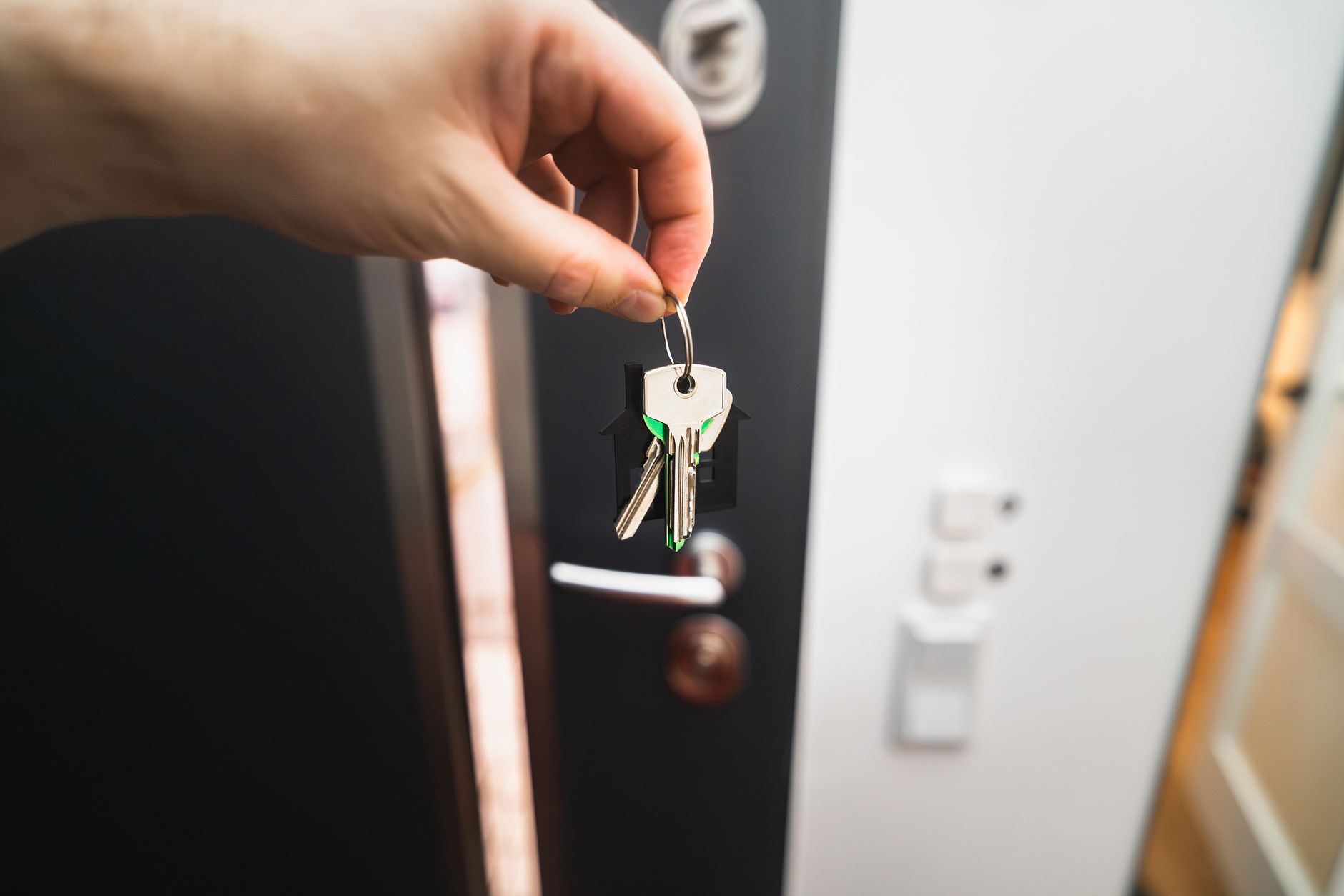
I want to tell you about the morning my key did not turn in the lock, and the man standing behind the glass who watched me try it three times before he opened the door just wide enough to say the thing he had been waiting months to say.
His name is Brandon. He married my daughter Megan four years ago, in a backyard I paid to have re-sodded so the chairs would sit level. He is the kind of handsome that photographs well and ages into nothing, and he has a way of smiling at you while he takes something out of your hands. I did not see it for a long time. Mothers do not always see it. We are too busy being grateful that our daughters are not alone.
I am sixty-seven years old. My husband Raymond died nine years ago this spring, and he left me a house in town and a small portfolio that a careful woman could stretch across a long life if she did not do anything foolish with it. I had spent forty-one years being careful. I balanced the checkbook to the penny. I knew the price of ground beef in three different stores. When Raymond got sick, I learned the cost of everything a body needs at the end, and I paid it without flinching, and when it was over I sat in a quiet house and decided that the rest of my money would go toward the only thing that ever mattered to me, which was my girl.
So when Megan called me, two years into the marriage, crying because the rent in their apartment had gone up again and Brandon’s commission checks were not what he had promised her they would be, I did the foolish thing. I will not pretend I did not know better. I knew. But I have only one child, and I had a house’s worth of money sitting in an account doing nothing but making a number bigger on a statement I read alone at my kitchen table. So I told her to stop crying. I told her I would help them buy a house.
That is where this begins. Not with the locks. With me, sitting at that table, deciding to be generous.
The house they wanted was on Hollow Creek Lane, a two-story colonial with white siding and black shutters and a front porch wide enough for the rocking chairs I imagined my grandchildren would one day be rocked on. The asking price was three hundred and forty thousand dollars. Brandon and Megan had eleven thousand dollars to their name, and most of that was a wedding gift I had already given them.
I put down two hundred and ten thousand dollars. Cash, from Raymond’s life. The rest they financed, and I co-signed the loan because Brandon’s credit was thin and Megan was between jobs again. I want you to understand the size of that number. Two hundred and ten thousand dollars is most of what a frugal widow has. It is the difference between a long safe old age and a short frightened one. I handed it over at a closing table in a strip-mall office, and I signed where the woman pointed, and I watched my daughter cry happy tears for the first time in two years, and I thought, this is what the money was for. This is the point of having saved it.
Here is the part that matters, and it is the part Brandon forgot. At that closing, I was not just a gift-giver. The lawyer Raymond and I had used for thirty years, a careful man named Edward Pruitt, had a long talk with me before the closing about how to structure the help. He did not like the idea of me handing over two hundred thousand dollars and walking away with nothing but a thank-you card. He had seen too much. So we did it his way.
The deed to that house was put in three names. Brandon’s. Megan’s. And mine.
Not as a gift. As a joint owner with a one-third undivided interest, with my contribution documented in a written agreement that Edward drew up and all three of us signed, notarized, on the same afternoon as the closing. The agreement said in plain English that my two hundred and ten thousand dollars was a capital contribution toward the purchase, that I held legal title alongside them, and that no sale, refinance, or encumbrance of the property could happen without the written consent of all three owners. Edward made copies. He kept one in his office safe. He told me to keep mine somewhere I would not lose it and would not throw away.
I put my copy in the cedar chest at the foot of my bed, the one Raymond bought me on our tenth anniversary, under the quilt my mother made, in a manila envelope I labeled in my own handwriting. And then I forgot about it for two years, because I am a trusting woman and I did not think I would ever need it.
Brandon never read it. I am almost certain of that now. He signed where he was told to sign, the way men like Brandon sign things, with the confidence of someone who believes paperwork is a formality that happens to other people. He thought I had given them a house. He did not understand that I had bought a third of one and let them live in all of it.
For the first two years it was lovely. I do not want to skip past the lovely part, because it was real and because it is what made the rest hurt the way it did. I had a key. I came on Sundays for dinner. I planted hydrangeas along the side of the house, the blue ones, because the soil there was right for them. I babysat their daughter, my granddaughter Lily, who was born thirteen months after they moved in, and I rocked her on that wide front porch exactly the way I had imagined. I bought the crib. I bought the good car seat, the expensive one, because I read the safety reports. I was at that house three days a week, and it felt like mine because in a way it was, and I never once said so out loud, because I did not want Megan to feel like she owed me.
That was my mistake. I never said it out loud. I let it be a gift in everyone’s mouth so that no one would feel small. And a gift, Brandon decided, is something the giver no longer owns.
The trouble started the way trouble always starts in families, which is to say slowly, and over money, and underneath words that were technically about something else.
Brandon’s commission job ended. He had a stretch of unemployment, and then he took a new job that paid less, and the mortgage that I had helped make possible started to feel heavy to them. I offered to help with a few payments. I did help, twice. And somewhere in there, Brandon’s gratitude curdled into something I did not have a name for at first. He started to resent the help. A man who needs his mother-in-law’s money and knows it can start to hate her for having it. I have seen it in other families and I never thought I would feel it in my own.
He began to make small comments. At dinner, with Lily in her high chair, he would say things like, “Well, some of us have to actually work for what we have.” Or he would refer to the house as “our house” with a little weight on the our, looking at me when he said it, the way you press on a bruise to see if it still hurts. Megan would change the subject. Megan always changed the subject. My daughter has many fine qualities and a spine is not reliably one of them, and I say that with love and with grief.
The day it broke open was a Tuesday in October. I had come by to drop off a casserole because Megan had mentioned she was tired, and I let myself in with my key the way I had a hundred times, and Brandon was home, sitting at the kitchen island with his laptop, and he looked up at me with an expression I had never seen on him before. It was not anger. Anger I could have worked with. It was contempt, cold and settled, the look of a man who has decided something about you and is only waiting for the chance to say it.
“You can’t just walk in here,” he said.
I stood in the doorway with the casserole dish warm against my forearms. “I knocked, Brandon. I have a key.”
“That’s the problem,” he said. “You think a key means something.”
Megan came down the stairs then, and she saw my face and she saw his, and she did the thing she always did, which was nothing. She stood on the third step with her hand on the rail and she let her husband talk to her mother like that and she said, “Mom, maybe you could call before you come over from now on.”
Call before I come over. To the house I bought.
I set the casserole down on the counter. I did not slam it. I am proud of that, looking back, that I did not slam anything. I said, “All right. I’ll call.” And I left, and I drove home, and I sat at my kitchen table where this all began, and I cried the kind of crying you do quietly so that no one will hear, even when there is no one in the house to hear you.
I told myself it would blow over. I told myself Brandon was stressed about money, which he was, and that Megan was caught in the middle, which she was, and that families have rough patches and you do not throw away your only daughter over a bad Tuesday. So I called before I came over. I shrank myself down to fit the new rule. I came on Sundays only, and I knocked even though I had a key, and I felt like a guest in the only place on earth my granddaughter lived.
And it was not enough. It is never enough, when someone has decided to push you out. The rule was not really the point. The rule was just the first inch.
In November, Brandon and Megan stopped inviting me on Sundays. There was always a reason. Lily had a cold. They were going to Brandon’s mother’s. They were just tired. I went three weeks without seeing my granddaughter, and when I called Megan to ask if I could come by, she got quiet in a way that told me Brandon was in the room, and she said, “Now’s not really a good time, Mom.”
In December I tried to drop off Lily’s Christmas presents. I had wrapped them at my kitchen table, three of them, a wooden train set and a stuffed rabbit and a little red coat with a hood, because the safety report on the train set was good and because every little girl should have a red coat. I drove over on a Saturday and I pulled into the driveway of the house I had paid two hundred and ten thousand dollars for, and I walked up the steps past the blue hydrangeas I had planted, and I put my key in the lock.
It did not turn.
I thought it was the cold. The lock had stuck before in winter. I jiggled it the way you do. I pulled the key out and looked at it and put it back in and it would not turn, and then I understood, the way you understand bad news a half-second before you let yourself believe it, that the lock had been changed.
I rang the doorbell. I could hear Lily inside, the particular pitch of a toddler’s laugh, and it went through me like a wire. Brandon came to the door. He did not open it. He stood behind the glass storm door, in a gray sweater, with his arms crossed, and he looked at me holding three wrapped presents, and he smiled.
“The locks are new,” he said, through the glass.
“Brandon. Let me in. I brought Lily’s Christmas presents.”
“You can leave them on the porch,” he said. “And then I need you to stop acting like this is your house. It’s not. It’s ours. You gave us money. That’s all you did. People give gifts. They don’t get to own you for it.”
I want to tell you exactly how that felt, standing on the porch I had imagined my grandchildren being rocked on, holding a little red coat, looking at my daughter’s husband smiling at me through a pane of glass he had locked me out from behind. It felt like being erased. Not hurt, erased, like a name being wiped off a list. Like the last nine years since Raymond died, all the carefulness, all the love I had poured into this one family because they were all I had left, were being handed back to me as if they were nothing. A gift. That’s all you did.
I asked to see Megan. He said she was busy. I asked to see Lily. He said now wasn’t a good time. I stood there for another minute, and then I did the only thing left to do with dignity, which was to set the three presents down on the cold concrete of the porch, and turn around, and walk back down the steps past my hydrangeas to my car, and drive home with my hands shaking on the wheel.
He thought that was the end of it. I know he did, because of how the next part went. Brandon believed he had won, cleanly and permanently, the way a man wins who does not understand that the game is not the one he thinks it is. He had decided I was a sentimental old woman who had given away her money and now had no recourse but to cry about it. He was half right. I was crying. But I was not without recourse, and he did not know that, because he had never read the thing he signed.
I drove home, and I sat at my kitchen table, and I let myself fall apart for exactly one evening. I gave myself that. Raymond used to say that you are allowed to feel sorry for yourself, but only until the coffee gets cold, and then you get up. So I cried until the coffee got cold, and then I got up, and I went into my bedroom, and I knelt at the foot of my bed, and I opened the cedar chest.
The quilt my mother made was on top. Under it, the manila envelope, exactly where I had put it two years before, with my own handwriting on the front. I sat on the edge of the bed and I opened it and I read the agreement I had signed at Edward Pruitt’s instruction, every line of it, by lamplight, and somewhere around the third paragraph I stopped crying entirely. Because there it was. My name. On the deed. A one-third undivided interest in the property at Hollow Creek Lane. No sale, no refinance, no encumbrance without the written consent of all three owners. Notarized. Witnessed. Filed with the county.
Brandon had locked me out of a house I legally co-owned. You cannot do that. It turns out you cannot do that at all.
I called Edward Pruitt’s office on Monday morning. Edward had retired, but his daughter Caroline had taken over the practice, and she pulled my file, and she called me back within the hour, and the first thing she said was, “Mrs. Calloway, do you still have your copy of the co-ownership agreement?” And I said yes, I was holding it, and she said, “Good. Don’t let anyone tell you that you gave them a gift. You bought a third of that house, and they cannot lock a co-owner out of her own property. That’s not how any of this works.”
I am going to tell you what I did, because I think there is a lesson in the order of it, and the lesson is patience.
I did not call Brandon and threaten him. I did not call Megan and cry. I did not show up at the house and make a scene on the porch for the neighbors to watch. I had done enough standing on porches. Instead, I let Caroline do it the right way, in writing, on letterhead, the way Edward had taught me things should be done.
The first letter went out a week before Christmas. It was addressed to Brandon and Megan jointly, and it was very calm, which is what made it terrible. It stated that I, Eleanor Calloway, was a legal co-owner of the property, holding a documented one-third interest pursuant to the recorded deed and the co-ownership agreement of record. It stated that changing the locks to exclude a co-owner from her own property was an unlawful exclusion. It demanded that I be provided a working key within ten days, and it noted, in the flat language lawyers use to say enormous things quietly, that if my rights as a co-owner continued to be violated, I was entitled to pursue a partition action, in which a court could order the property sold and the proceeds divided according to each owner’s interest.
A partition action. That phrase. I did not fully understand it the first time Caroline explained it, so let me explain it the way she explained it to me, because I suspect Brandon understood it even less. When more than one person owns a property and they cannot agree on what to do with it, any one of the owners can ask a court to force the sale of the whole property and split the money. One owner cannot trap the others. One owner cannot lock the others out and keep the house. If I wanted to, I could go to a judge and say, I own a third of this house and I am being excluded from it, and the judge could order the entire house sold out from under all of us, and I would get my third of the proceeds, which on a house that had appreciated to north of four hundred thousand dollars was a number considerably larger than the two hundred and ten thousand I had put in.
Brandon, who had locked me out to teach me that the house was his, had instead handed me the power to sell the house out from under him.
He did not believe it at first. Caroline told me he would not, and she was right. The response to the first letter came not from a lawyer but from Brandon himself, in an email he sent to Caroline’s office, and she forwarded it to me, and I have it still. It said, and I am quoting it because I want you to hear his voice, “Eleanor gave us money as a gift toward our home. She has no legal claim to our property and these threats are harassment. We will be seeking our own counsel.”
Our property. Our home. He still did not know. He had signed the agreement at the closing table with my granddaughter not yet born, signed it without reading it, and two years later he was so certain it had been a gift that he wrote it down in an email to a lawyer. Caroline read me that email over the phone and then she was quiet for a moment and she said, “Mrs. Calloway, I have been doing this for fourteen years, and I have rarely had a case this clean. He put it in writing. He has no idea what he signed.”
I asked her what would happen next, and she told me, and I told her to do it.
She pulled the recorded deed from the county. There it was, public record, three names, mine among them, recorded the same day as the closing two years prior. She pulled the co-ownership agreement. She sent a second letter, this one with the recorded deed attached, and a copy of the notarized agreement, and Brandon’s own email in which he had called it our property, and she added one sentence that I will remember for the rest of my life. She wrote: “Please be advised that my client holds recorded legal title to a one-third interest in the property. The enclosed documents are a matter of public record and were signed by your client at closing. We trust this clarifies the nature of Mrs. Calloway’s interest.”
The phone rang at my house two days later. It was Megan.
She was crying. She said, “Mom, what did you do?” And I said, very calmly, because I had had a week to find my calm, “I didn’t do anything, sweetheart. I just kept my paperwork. Your husband locked a legal owner out of her own house. I’m only asking for a key.”
There was a long silence, and then she said the thing that told me she had finally, after two years, read the agreement her husband never had. She said, “Brandon didn’t know. He didn’t know your name was on the deed.”
“I know he didn’t,” I said. “He never read it. But I did, and I signed it on purpose, because Edward Pruitt is a careful man and he raised a careful daughter and they did not let me give away my whole life on a handshake. I love you, Megan. I have always loved you. But I will not be locked out of a house I paid for and told I am acting like I own something I do not own, when I do own it. I will not.”
I could hear Brandon in the background. I could hear him asking her what I was saying, his voice climbing, and I could hear in Megan’s silence the particular weather of a marriage where one person has just realized the other was wrong about something enormous and said it out loud with the confidence of a man who is never wrong. I almost felt sorry for him. Almost.
I want to be honest with you about what I wanted, because it is the part I am least proud of and the part I had to pray on. For about a week, I wanted to do it. I wanted to file the partition action and force the sale and walk away with my third and watch Brandon explain to my daughter why they were renting a two-bedroom apartment again. I wanted him to feel the floor go out from under him the way he had pulled it out from under me on that porch. I sat with that want for a week, and it was sweet, and it was poison, and Raymond would not have known me if he had seen the look on my face thinking about it.
But there was Lily. There is always a Lily. My granddaughter did not lock me out of anything. My granddaughter slept in a room in that house with a window that looked out over the hydrangeas I planted, and if I forced the sale to punish her father, the person who would lose her home was a three-year-old who had done nothing but be born into a family with one weak parent and one cruel one. I could win and lose everything that mattered, or I could use what I held to fix the actual problem, which was not the house. The house was only ever the place where the real problem lived. The real problem was that Brandon believed he could erase me, and Megan believed she had to let him, and I had spent two years making myself smaller to keep a peace that was not peace at all. It was just my own disappearance, dressed up as keeping the family together.
So here is what I did, and it is the part I am proud of.
I told Caroline to draw up new papers. Not a partition action. An agreement. I would not force the sale, and I would not be made invisible either. The new agreement, which Brandon and Megan would both have to sign in front of a notary or I would file the partition the next morning, did three things. First, it formally acknowledged my recorded one-third ownership, in writing, signed by Brandon, so that it could never again be called a gift in that house. Second, it guaranteed me a key and standing access to my granddaughter, named in the document, not as a favor but as a co-owner’s right, with a clear schedule. And third, it set out a buyout: if Brandon and Megan ever wanted me off the deed, they could buy out my third interest at fair market value, the real number, not the two hundred and ten thousand I had put in but the full appreciated third, and until they did, I remained an owner of record with every right that carried.
Caroline called it generous. She said most people in my position would have taken the partition and the larger check and never looked back. I told her I was not most people. I was Lily’s grandmother, and I had not spent two hundred and ten thousand dollars to win a fight. I had spent it to be part of a family, and I was not going to let Brandon’s cruelty turn me into someone who would burn the family down to prove I had been right about him. I had the deed. I did not need to use it like a match. I only needed him to know I was holding it.
They signed. Of course they signed. Brandon signed in front of a notary at Caroline’s office on a Thursday afternoon in January, and Caroline told me his hand was not quite steady, and that he did not make eye contact with anyone, and that when it was done he left without a word. Megan signed after him and then sat in the chair and cried, and Caroline, who is a kind woman under all that letterhead, brought her a cup of water and let her cry.
A working key came in the mail to my house a week later, in an envelope with no note. I did not need a note.
I would like to tell you that Brandon and I made our peace, that he apologized, that we are warm now. We are not. He is civil to me, in the careful way of a man who has learned exactly how much he underestimated someone, and that is its own kind of justice, sweeter and quieter than the partition I did not file. He does not call the house our house in front of me anymore. He does not say things at dinner about who works for what they have. He pours my coffee when I come over and he does it with the particular politeness of a man who knows the woman across the table could sell the floor out from under him with a phone call and chooses, every single day, not to. Let him sit with that. I find I do not mind it at all.
Megan and I are slowly mending. It will take time, because the thing I had to forgive her for was not the locks, which were Brandon’s, but the silence, which was hers. She let him talk to me that way for two years and said nothing, and that is a deeper wound than any lock. But she is my daughter, and she did finally read the paperwork, and she did finally understand that her mother is not a sentimental old woman who gave away her life, but a careful one who protected it, and there is a new respect in how she speaks to me now that I will take, late as it came.
And Lily. Oh, Lily. I have my key, and I have my schedule written into a legal document, and I rock my granddaughter on the wide front porch every Sunday afternoon among the blue hydrangeas, and she does not know, and never will if I can help it, that there was a December when her grandmother stood on the other side of a locked glass door holding a little red coat, erased.
I think about that cedar chest a lot now. About how close I came to never opening that envelope. About the version of me that handed over two hundred and ten thousand dollars on a handshake because she was too soft to insist on paperwork, and how that woman would have stood on that porch in December and had no recourse at all, and would have spent the rest of her life being told that her love was a gift and her gift was nothing.
Edward Pruitt is the one who saved me, really, a careful old lawyer who would not let a grieving widow give away her life without a document to stand on. I sent Caroline a card to pass along to her father. I wrote, “Thank you for not letting me be foolish.” He wrote back, in a shaky hand, one line. He wrote, “I have buried too many trusting people. Keep your papers.”
I keep my papers. I want you to keep yours. If you take one thing from a stranger’s story, let it be this: love generously, give freely, help your children with an open hand. But put your name on the deed. Sign the agreement. Keep the copy in the cedar chest under your mother’s quilt where you will not throw it away. Because the people who would erase you are counting on the fact that you never read what they signed, and that you are too kind to remind them. Be kind. Be kind to the bone. And keep your papers.
The locks are new again, by the way. I had them changed last month, after the buyout terms were settled and everyone calmed down, and I paid for it, and I gave Brandon and Megan each a key. I am a co-owner. It was my right to change them. I did not do it to make a point.
But I did keep a key for myself. I will always keep a key.

Specialty: Emotional Turning Points
Rachel Monroe writes character-driven stories about betrayal, second chances, and unexpected resilience. Her work highlights the emotional side of family conflict — the silences, the misunderstandings, and the moments when someone quietly decides they’ve had enough.