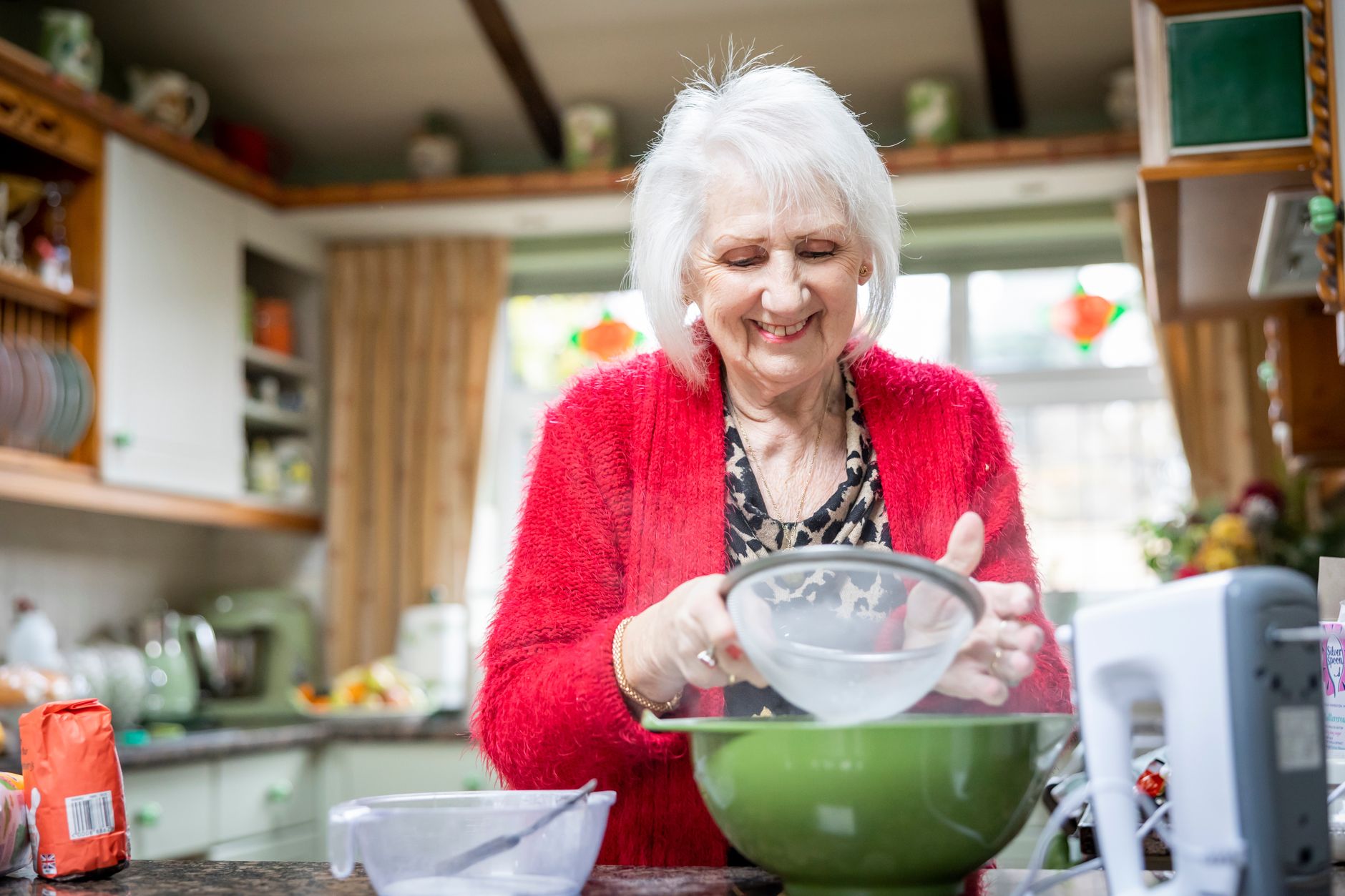
The morning I signed the lease on the empty storefront, my hands were shaking so badly I had to set the pen down twice. The realtor, a kind young man named Curtis who could not have been more than thirty, pretended not to notice. He slid the papers a little closer and said, “Take your time, Mrs. Calloway. There’s no rush.”
But there was a rush. There was the rush of seventy years pressing on my back, and the rush of a thousand people in my head telling me I was too old, too tired, too late. I picked the pen back up. I signed my name. Eleanor Calloway, in the loopy cursive my mother taught me at the kitchen table when I was six, the same hand that had signed my marriage license, my husband’s death certificate, and now, finally, the lease on a bakery I had dreamed about for fifty years.
I want to tell you the whole story, because I think there are women reading this who have a dream folded up small in a drawer somewhere, the way I did. And I want you to know it is not too late. It was not too late for me, and I was seventy years old and freshly widowed and so frightened I could barely breathe.
Let me start at the beginning. Or rather, let me start at the end of my old life, because that is where this one began.
## The Recliner and the Quiet
My husband Walter died on a Tuesday in February. We had been married forty-eight years. People say that number to me and their faces do a thing, a soft folding, like they cannot imagine it. I cannot imagine it either, and I lived it. Forty-eight years is not a length of time. It is a country you live in. It has its own weather and its own language and its own roads you could drive blindfolded.
And then one Tuesday the country was just gone, and I was standing in the kitchen holding a coffee cup I had poured for a man who would never drink it again.
For the first few months I did what widows do. I let the casseroles pile up in the freezer. I wrote the thank-you notes. I sat in Walter’s recliner in the evenings because it still smelled like him, like cedar and the peppermints he kept in his shirt pocket, and I watched television I did not see. My daughter Patrice called every night from Charlotte. My son Daniel flew in twice. The church ladies came by with their kind eyes and their kinder hands, and they sat with me, and they meant every word.
But here is the thing nobody tells you about grief. It is not only sad. It is also boring. It is long flat afternoons that go on and on with nothing in them. It is the clock on the stove that you start to hate. It is realizing that you have nothing to get up for, and that you might not, for the rest of your life, and that the rest of your life could be twenty more years.
I was sixty-nine when Walter died. I turned seventy that summer, alone, with a grocery-store cake I bought for myself because it felt worse not to.
And it was sitting there, in the recliner, on that birthday, with a slice of mediocre store cake going dry on a plate in my lap, that I thought about the bakery for the first time in years.
## The Dream in the Drawer
I should tell you that I have wanted a bakery my entire life.
When I was a girl, my grandmother baked. She had come over from a small village in the old country with two suitcases and a recipe box, and the recipe box was the more valuable of the two. She made bread that people drove forty minutes to buy. She made a sour cherry kuchen with a lattice top that I have never, in seventy years, tasted the equal of anywhere. Her kitchen was the warmest room I have ever stood in, and I do not only mean the oven.
I learned at her elbow. I learned to feel when dough was ready by the way it pushed back against my palm. I learned that you do not rush proofing, that yeast keeps its own time and you keep yours. I learned that the secret to her cherry kuchen was a half-teaspoon of almond and a pinch of salt most people leave out because they are afraid of it.
I wanted to open a bakery the way other girls wanted to be movie stars. But I grew up in a time and a place where girls did not open bakeries. Girls got married. So I married Walter, who was a good and steady man, and I raised Patrice and Daniel, and I baked for the church and the school and the neighbors, and everyone said, “Eleanor, you should sell this,” and I laughed and said, “Oh, someday,” and someday was a word I put in a drawer and closed.
Forty-eight years that drawer stayed closed. I baked thousands of loaves and never charged a soul. I was happy, I want to be clear about that. I do not tell this story as a sad one. I had a good life and a good husband. But there was always that drawer, and inside it that one folded-up word, and on my seventieth birthday, alone with my store cake, I pulled the drawer open and looked at it.
Someday.
I said it out loud in the empty house. “Someday.” And then I said, “When, Eleanor? When is someday?”
Because here is what seventy teaches you that thirty does not. Someday is not a promise. Someday is where dreams go to be quietly buried. And I had buried enough that year. I had buried the only man I ever loved. I was not going to bury this too.
## Telling the Children
I told my daughter first, because Patrice is the one who worries, and I knew if I could survive telling her I could survive telling anyone.
“Mama,” she said, in that careful voice, “that’s a wonderful idea. For someone in their forties. With a business partner. And savings.”
“I have savings,” I said.
“You have retirement savings. That’s different. That’s supposed to last you.”
“Last me for what, Patrice?” I asked her. “What am I saving it for? The exciting years ahead?”
She was quiet. Then she said, “I just don’t want you to get hurt. Or to lose it all and end up with nothing.”
And I understood her. I did. She loved me and she was scared, the way I was scared, and her fear had a perfectly reasonable shape. A seventy-year-old widow sinking her savings into a small-town bakery is, on paper, a foolish thing.
My son Daniel was blunter. Daniel is an accountant in Atlanta. He sent me a spreadsheet. An actual spreadsheet, with columns, showing me how a new bakery typically loses money for the first two years and how a third of them close in the first year. He meant it kindly. Daniel shows love in spreadsheets the way other people show it in casseroles.
“Mom,” he said on the phone, “I ran the numbers. I’m not trying to crush your dream. I’m trying to protect you.”
“I know, sweetheart,” I said. “But you ran the numbers on a bakery. You didn’t run the numbers on me.”
He did not have a column for that.
## The Storefront on Maple
The town I live in is called Harmony Falls, and it is small, and it is the kind of place where the same families have run the same shops for generations. Maple Street is the heart of it, four blocks of brick storefronts, and right in the middle of those four blocks, between the hardware store and the place that used to be a video rental and was now nothing, sat an empty shop with butcher paper in the windows.
It had been a flower shop once, years ago. Then it had been empty. It had good bones, as my grandmother would have said. High tin ceilings. A long front window that caught the morning light. And in the back, when Curtis the realtor walked me through, there was a room that had clearly been a kitchen, with old tile and the ghost of a stove hookup on the wall.
I stood in that back room and I could see it. I could see the ovens. I could see the racks of cooling bread. I could see the front case full of kuchen and rolls and the bear claws Walter used to love. I could smell it, which is a strange thing to say about an empty dusty room, but I could. Some part of me that had been asleep for fifty years woke all the way up in that room and said, this one, this is the one.
The rent was reasonable, because nobody in Harmony Falls believed in that block anymore. Curtis told me, gently, that the last three businesses to try Maple Street had not made it. “People drive out to the highway now,” he said. “The big stores. I just want you to go in with your eyes open.”
Everyone wanted me to go in with my eyes open. I have never had my eyes so open in my life. That was the trouble. I could see exactly how foolish it was. I signed anyway.
## What I Spent and What It Bought
I will be honest about the money, because I think women are not honest enough with each other about money, and we should be.
I spent a great deal of it. I spent most of what Walter and I had set aside that was not the house. I bought two used commercial ovens from a bakery two towns over that was closing, and the man who sold them to me, an old baker named Gus with flour permanently in the creases of his knuckles, looked at me for a long moment and then knocked four hundred dollars off the price.
“Why?” I asked him.
“Because somebody did that for me once,” he said. “Forty years ago. You’ll pass it on someday.”
There was that word again. Someday. But this time it had a kindness in it.
I bought a glass display case, a little dinged but sound. I bought mixing bowls and proofing baskets and sheet pans and a scale. I paid a man named Hector and his two sons to retile the kitchen and run the gas line and paint the front room a soft butter yellow that I picked because it was the color of my grandmother’s kitchen. I sewed the curtains myself on Walter’s mother’s old machine. I hand-lettered the sign because I could not afford a sign maker, and it came out crooked, and I left it crooked because it was mine.
The Cherry Branch, the sign said. For my grandmother’s cherry kuchen, and because a branch is a thing that grows out of an old tree, and I was an old tree, and this was my branch, growing late.
The whole thing took four months and most of my savings and nearly all of my courage. The morning before I opened, I stood in the dark in my finished kitchen with the ovens warm, and I cried for a while, and then I started the first batch.
## The First Day
I will tell you the truth about the first day. Almost nobody came.
I had baked since three in the morning. Cherry kuchen, of course, the lattice tops golden and bubbling. Crusty round loaves. Cinnamon rolls the size of my fist. Bear claws. Soft white sandwich bread for the people who like that. The case was full and beautiful and the shop smelled the way my grandmother’s kitchen smelled, like warm sugar and yeast and something underneath it that I can only call home.
I turned the crooked sign to OPEN at six in the morning. And then I stood there.
The first hour, nobody. The light came up gray over Maple Street. The hardware store opened next door and old Mr. Pruitt who ran it gave me a little wave through the window and then went back inside, and I thought, well, at least one person knows I exist.
At seven, a woman I did not know came in to get out of a sudden rain. She had not meant to come in. She stood dripping by the door, a little embarrassed, and looked at the case, and said, “Oh my. What is all this?”
“It’s a bakery,” I said, and my voice cracked on the word, because it was the first time I had ever said it as a fact and not a dream. “It’s my bakery. I opened today.”
She bought a cherry kuchen. She did not come for it and she did not need it and she bought it because I think she saw something in my face. And she stood at the little counter and ate a piece right there, out of the rain, and she went very still, and then she looked up at me and her eyes were wet.
“This tastes like my mother’s,” she said. “My mother died eleven years ago and I have not tasted this since. Where did you learn to make this?”
“My grandmother,” I said.
She bought three more to take home and she hugged me on the way out, a stranger, a wet stranger in a raincoat, and that was my first day. One customer. One kuchen, plus three to go. Eleven dollars, and a hug.
That night I sat in Walter’s recliner and I added up what I had taken in against what I owed, and the number was so frightening that I laughed, because there was nothing else to do with it. And then I got up, and I set my alarm for two-thirty in the morning, and I went to bed, and I got up, and I did it again.
## The Slow Turn
I want to be honest that it did not get better overnight. There was no magic. There was a long string of small mornings.
The second day, two customers. The wet woman in the raincoat, whose name was Doreen, came back and brought her sister. The third day, four. By the end of the first week I was selling maybe a dozen things a day, which was nowhere near enough, and I knew it, and I kept going anyway, because the alternative was to admit Patrice and Daniel had been right, and I was not ready to do that.
But Doreen had told her sister, and her sister told the book club, and somewhere in the second week a thing started to happen that I did not engineer and could not have. The town started to find me.
It went by word of mouth, the oldest advertising there is. Someone tasted the kuchen and could not stop talking about it. Someone brought a loaf to a church supper and three people asked where it came from. The high school principal stopped in for coffee and a bear claw before work and then started stopping in every day, and he brought a teacher, and the teacher brought another.
By the third week I had to bake more. By the fourth, I had a line some mornings, an actual line, four or five people waiting when I turned the sign. I would look up from the register and see them through the glass in the early dark, stamping their feet against the cold, waiting, for me, for the thing I made, and I had to go in the back and compose myself more than once.
## Gus Comes Back
In the second month, the old baker Gus, the one who sold me the ovens, drove the two towns over to see me. He walked in with his flour-creased hands and he looked around at the butter-yellow walls and the full case and the line, and he did not say anything for a minute.
Then he said, “I retired because I was tired. I want you to know I’m un-tired just standing here.”
He came back the next week and asked, almost shy, if I needed help in the mornings. I did. Lord, I did. I was seventy years old and getting up at two-thirty and I was running on fumes and stubbornness. Gus came on three mornings a week, and we baked side by side, two old people in a warm kitchen before dawn, and he taught me a few things and I taught him a few, and some mornings we did not talk at all, and those were the best ones.
I paid him what I could, which was not enough, and he took it, which I think he did so I would not feel like charity, the same way I had taken his four hundred dollars off the ovens.
That is a thing about kindness I did not fully understand until I was old. It moves in a circle. Gus did me a kindness with the ovens, and I gave him a reason to be un-tired, and he gave me his mornings, and the circle just kept going around, and I was inside it now, where for so many flat gray afternoons I had been outside of everything.
## The Boy with the Bicycle
Let me tell you about Marcus, because Marcus is the part of this story I think about most.
Marcus was fourteen. He started showing up in the afternoons, after school, hanging around outside the shop with his bicycle. I noticed him because he never came in. He would stand at the window and look at the case and then ride off. Three, four days of this.
On the fifth day I went out with a cinnamon roll on a napkin and I said, “You look like a man who could use one of these.”
He went red and said he did not have any money. I said, “I didn’t ask you for any. I made too many. You’d be doing me a favor.”
He ate it on the curb. We got to talking. His mother worked two jobs. His father was not in the picture. He was a quiet, watchful, hungry boy in a hard year, and I knew that year, I had lived a version of that year, and I think he could tell.
I told him if he wanted, he could sweep the front and wipe the case down after school, and I would pay him a little and feed him more than a little. He said yes so fast it broke my heart.
Marcus came every afternoon for the rest of that year. He swept. He learned the register. He started, when it was slow, to drift into the back and watch me bake, and one day he asked, very carefully, like he was asking for something he was not allowed to want, if I would show him how.
I taught Marcus to bake bread the way my grandmother taught me. I put his hands in the dough and showed him how to feel when it pushed back. He was good at it. He had the patience, which most people do not, the willingness to let the yeast keep its own time. By spring he was making the sandwich loaves himself and they were as good as mine.
His mother came in one evening near closing. She had not known, fully, how much time he spent with me. She stood in the doorway and watched her son pull a tray of golden loaves from the oven with the focus of a surgeon, and she put her hand over her mouth, and when he was not looking she came to the counter and gripped my hand hard and could not speak.
“He’s a wonderful boy,” I told her. “You did that. I just gave him a kitchen.”
## What Patrice Saw
My daughter Patrice flew up in the spring, six months after I opened. I had not told her how it was going, not really. I had been vague on the phone, because I was afraid that if it failed I did not want her to have watched it fail, and if it was succeeding I did not quite believe it enough to say so out loud.
She came on a Saturday morning, which is the busiest time, and I did not know she was coming, she meant it as a surprise. She told me later that she stood across the street first, for a long time, before she came in.
She stood across the street and she watched the line out the door of The Cherry Branch. She watched Mr. Pruitt from the hardware store come out with his coffee and his bear claw. She watched Doreen and her sister and the book club. She watched Marcus, fourteen and proud in a flour-dusted apron, carrying a tray to the case. She watched, through the long front window, an old woman in a butter-yellow shop, her mother, laughing with a customer, alive in a way Patrice told me later she had not seen since before her father got sick.
When she finally came in I was behind the counter and I looked up and there was my daughter with tears running straight down her face, not even wiping them, just standing in my doorway crying in front of everyone.
“Mama,” she said. “Mama, look at this. Look what you did.”
I came around the counter and I held my girl in the middle of my full and noisy shop, and over her shoulder I could see the line and the case and the morning light coming through the curtains I sewed, and I said the only thing that was true.
“I had to,” I said. “I couldn’t take the drawer being closed anymore.”
She did not understand the drawer. I told her about it later, the someday folded up small. She cried again. Daniel, when he heard, sent no spreadsheet. He sent flowers, and a card, and the card said only, “I forgot to run the numbers on you. I’m sorry. I’m so proud.”
I keep that card by the register. I see it every morning.
## A Year In
We are a year in now, as I write this. I want to tell you the honest shape of it, because I do not want anyone to think I am pretending it was easy or that the money rains down.
It is hard work. I am seventy-one and I get up at two-thirty in the morning and my back hurts and some days I am so tired I could weep. The bakery does not make me rich. It makes enough. It pays Gus and it pays Marcus and it pays its rent and it pays me a modest living, and at the end of most months there is a little left over, and a little left over after the year I had is a miracle I do not take for granted.
But the money was never really the point, and I think you know that by now.
Here is what The Cherry Branch actually is. It is the warmest room in Harmony Falls, the way my grandmother’s kitchen was the warmest room of my childhood. It is where Doreen comes every single morning and where the book club meets on Thursdays and where the high school principal grades papers in the corner. It is where a young father came in last winter, gray with exhaustion, with a colicky newborn, and I made him sit down and I held that baby and walked her around the warm shop until she slept, so he could drink one cup of coffee with both hands. It is where Marcus, who is fifteen now and talking about culinary school, found out he was good at something. It is where a town that had given up on a block on Maple Street remembered how to gather.
People did doubt me. My own children doubted me, and they were right to, on paper. I was too old and too tired and too broke and too sad. Every reasonable person in my life told me, kindly, that it was foolish. And it was foolish. I want to say that plainly. It was a foolish thing to do, and I would do it again a hundred times, because the alternative was to sit in a recliner that smelled like a dead man and wait for the clock on the stove to finish me off.
## The Cherry Kuchen
I started selling my grandmother’s cherry kuchen for real, the lattice-top one, the one with the half-teaspoon of almond and the pinch of salt people are afraid of. It is the thing The Cherry Branch is known for now. People drive in from other towns for it the way they once drove forty minutes for my grandmother’s bread. I make it the same way she did, by hand, no shortcuts, and when I lift the lattice top onto the cherries I think of her every single time, her flour-dusted hands over mine, telling me yeast keeps its own time and you keep yours.
I have been keeping my own time for seventy-one years. For sixty-nine of them, someday stayed folded in a drawer.
I want to tell you what it is like to open that drawer late. I want to tell you because I think there is a woman reading this who has a drawer of her own, who has been told she is too old or too tired or too late, who has a folded-up someday she has stopped believing in.
It is not too late. I promise you it is not. I was seventy and widowed and frightened and broke, and I opened the drawer, and inside it, after all those years, the dream was not dead. It had just been waiting. It had been keeping its own time, the way yeast does, the way my grandmother said.
The Cherry Branch is open six mornings a week. The sign is still crooked. I have decided I will never fix it. A young man named Marcus is learning to make my grandmother’s bread, which means it will outlive me, which is the only kind of forever I have ever believed in. An old man named Gus is un-tired. A town that forgot how to gather is gathering again, in a butter-yellow room, around the smell of warm sugar and home.
And an old woman who buried her husband and then almost buried her own last dream stands behind the counter every morning in the early dark, watching the line form through the long front window, and feels, for the first time in a very long time, entirely awake.
It is not too late. Open the drawer. Whatever is folded up small inside it has only been keeping its own time, waiting for you to be ready. I was seventy. You have time. Start over. Start now.
I did, and the whole town watched me do it, and it turned out the whole town had been waiting for me too.

Specialty: Emotional Turning Points
Rachel Monroe writes character-driven stories about betrayal, second chances, and unexpected resilience. Her work highlights the emotional side of family conflict — the silences, the misunderstandings, and the moments when someone quietly decides they’ve had enough.