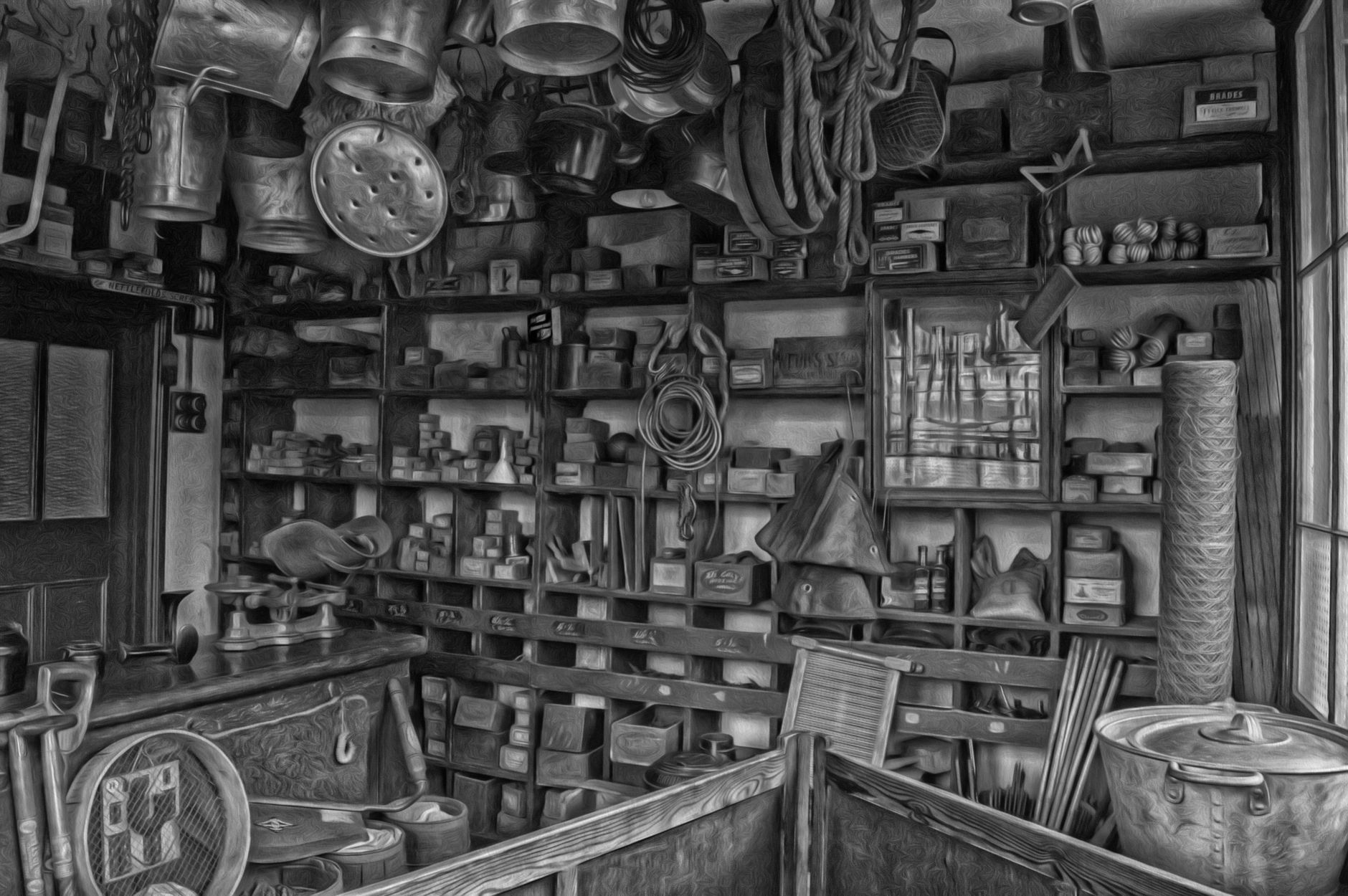
For forty-one years my father stood behind the long oak counter at the front of Aldous Hardware, and in all that time I never once saw him let a man leave without what he came for.
If you were short three dollars on a fence stretcher in the dry summer of a bad cattle year, my father wrote your name in the green ledger and told you to come back when the rain did. If your furnace quit on the coldest night in February and you had four children under a quilt and no way to pay until the mill check cleared, he handed you the part across the counter and said pay me when you can, and he meant it, and most of the time you did, and the times you couldn’t he never said a word about it again. The store sat on the corner of Quarry Street and Halloran Road in our little town of Esker Falls, the only hardware between the grain elevator and the county line, and it was as much a part of this town as the water tower or the brick Methodist church with the crooked weathervane.
My name is Verna Aldous Kessler. I am sixty-three years old. I swept the floor of that store as a girl, ran the register as a young woman, and learned to cut glass and thread pipe and mix paint from a man named Orin Aldous who believed that a town was not a collection of houses but a collection of promises people kept to each other.
And I am going to tell you how my own brother, Royce, tried to take all of it from me by forging the signature of a man who was already cold in the ground. I am going to tell you what he said to my face in the back office, in a voice so calm it frightened me worse than any shouting ever could. And I am going to tell you what happened on a Tuesday morning in October when this town, the town my father spent his whole life serving, walked through that front door one after another and would not stop coming.
But I have to start at the beginning, because you cannot understand what the town did at the end unless you understand what my father built, and what my brother was willing to burn down to own it.
—
My father came home from Korea in 1954 with a limp he never explained and eighty-seven dollars in his pocket, and he bought the failing feed-and-hardware on the Quarry Street corner from a widow named Halsey who wanted to move south to her sister. He paid her in installments for nine years. My mother, Lurline, kept the books in a spiral notebook at the kitchen table, and the two of them turned a dusty front room with three shelves into the place that kept Esker Falls running.
I grew up in the apartment above the store. I fell asleep to the sound of my father moving stock after closing, the scrape of crates and the clink of nails being sorted back into their bins. There were two children. Me, born in 1962, and my brother Royce, born four years after.
Royce was the bright one, everybody said so. He had our mother’s quick tongue and a way of making grown men laugh, and from the time he was small he could not stand to be still or to be ordinary. While I learned to cut keys and patch screens, Royce learned to leave. He went to the city for college and then for a finance job, and he came back to Esker Falls twice a year in a car that cost more than my house, and he would stand in the middle of the store he had grown up in and look at it the way a man looks at a coat he has outgrown.
I stayed. I married a good quiet man named Tobias Kessler who drove a propane truck for the co-op, and when Tobias died of a heart attack at fifty-one I went back to working the store full days beside my father, because my father was getting older and the work was getting heavier and there was nobody else.
For the last six years of his life, my father needed me, and I was there.
I want you to understand what those years were, because Royce would later stand in a lawyer’s office and act as though he had been an equal partner in our family all along. He was not. When my father’s hands began to shake too badly to count change, I counted it. When his knees gave out and he could no longer climb the rolling ladder to the high stock, I climbed it. When he forgot, more and more often, where he had put the order forms, or stood in the paint aisle for ten minutes not remembering what he had come for, I covered for him so quietly that customers never knew, and I drove him to the doctor in Carmody forty minutes each way, and I sat in the parking lot afterward while he cried, because a proud man does not want his daughter to see him cry and I let him think I had not.
Royce came home for two of those doctor visits. He took photographs of the store on his phone. I did not understand at the time why a man would photograph the shelving and the counter and the old hand-lettered price signs my father had painted himself. I understood later.
My father, Orin Aldous, died on a Thursday morning in March, in the upstairs apartment, with his hand in mine and the first warm light coming through the same window I had watched the snow fall past as a girl. He was eighty-nine. The last thing he said to me was about the store. He said, you keep it good, Verna. You keep it like I kept it. I told him I would. I have never broken a promise to that man in my life, and I was not about to start at his deathbed.
We buried him in the Lutheran cemetery on the hill, next to my mother, on a raw day with the wind coming off the stubble fields. Half the town came. The line of cars stretched from the cemetery gate all the way back past the feed store. Men I had known my whole life, farmers in their one good suit, stood in the cold with their hats in their hands. The owner of the diner, a woman named Ferd Pelletier who everyone just called Pelletier, closed the place for the afternoon and put a sign in the window that said GONE TO BURY ORIN. Nobody in this town needed it explained.
Royce flew in the morning of the funeral and flew out the next day. He wore a black suit that fit him like water and he shook every hand and he cried in front of the right people, and I remember thinking, watching him, that my brother grieved the way other men golf. With form. With an audience in mind.
I did not know then what he had already done.
—
The lawyer’s office was in Carmody, on the second floor over the pharmacy. The lawyer was a careful old man named Augustin Thorne who had drawn up my father’s will twenty years before and updated it twice since. I sat across the wide desk from Royce, who had flown back in, and Mr. Thorne put on his glasses and read us the will my father had signed.
It was simple. My father had divided his savings, what little there was, evenly between us. And he left the store, the building, the inventory, the name, the whole of Aldous Hardware, to me. To Verna. By name. Because, the will said in my father’s own plain words that Mr. Thorne read aloud, she has kept it and she will keep it.
I did not gloat. I want you to know that. I did not even feel triumph. I felt the floor of my life settle into place, the way it does when something you have feared is decided and you find you can breathe. The store would go on. I would keep my promise.
I looked over at my brother, expecting grief, or even anger, and what I saw on Royce’s face was nothing at all. A smooth, pleasant, waiting nothing. He folded his hands. And he said, in that easy boardroom voice of his, well, that’s the old will, isn’t it.
Mr. Thorne looked up over his glasses.
Royce reached into a leather folder he had brought with him and slid a single sheet of paper across the desk. It was dated the previous November, four months before our father died. It was a deed of transfer, conveying the building and the business of Aldous Hardware to Royce Aldous as sole owner, with a notation that the transfer was made in consideration of a loan Royce claimed to have made to keep the store solvent. A loan I had never heard of. A loan that did not exist.
And at the bottom of the page, in ink, was my father’s signature.
I knew my father’s signature the way I knew his voice. I had watched that hand sign forty thousand receipts. And I will tell you the truth, the forgery was good. It was very good. Royce had studied. But I knew, the way you know a copy of a song that is one note wrong, that my father had never signed that page. The O in Orin had a little hitch at the top that my father’s O never had. And more than that, my father could not have signed it in November, because by November his hand shook so badly he could not sign his own name to a birthday card without me steadying his wrist.
I said, that is not real. Royce, that is not real and you know it is not real.
And my brother looked at me across that desk, with the pharmacy smell coming up through the floorboards, and he smiled the smallest smile, and he said the thing I will hear in my head until I die.
He said, prove it.
He said it so gently. He said, prove it, Verna. You can’t, can you. There’s no way to prove a dead man didn’t sign a piece of paper. He said it the way you might tell a child there is no use crying. Then he stood, and buttoned his expensive coat, and told Mr. Thorne that his attorneys in the city would be in touch, and that he intended to sell the building to a man who was assembling parcels along Quarry Street for a dollar store and a parking lot, and that he expected the keys within thirty days.
He did not raise his voice once. That is the part I could not get past for a long time afterward. He stole my father’s store and our father’s name with a forged signature, and he did it the way another man would order coffee.
—
I will not pretend the next weeks were anything but the worst of my life since I buried Tobias.
Mr. Thorne told me the law, and the law was not kind. A forged document, once it exists, is a thing you have to fight, and fighting costs money I did not have. Royce had hired a firm in the city. The man buying the parcels, a developer named Sherrod Quayle, had already filed paperwork. There was a notary stamp on the forged deed, from a notary three counties away who, it turned out later, notarized whatever Royce paid him to notarize and asked no questions. On paper, it looked real. On paper, my brother owned my father’s life’s work, and I had thirty days.
I kept the store open. I did not know what else to do with myself. Every morning I unlocked the front door at seven, the way my father had, and I turned the hand-painted sign to OPEN, and I stood behind the long oak counter and I waited for the day they would make me stop.
The town knew. Of course the town knew. In a place like Esker Falls there is no such thing as a private trouble. Pelletier at the diner knew, and the man at the grain elevator knew, and old Sigrid Ahlberg who had bought paint from my father for fifty years knew. They came in, those weeks, more than they needed to. They bought a single box of screws they did not need just to put a few dollars in the register and to look at me with their kind worried faces. I would catch them murmuring by the paint chips. I thought they were pitying me, and I was too proud and too tired to want it.
I was wrong about what they were doing. They were not pitying me. They were getting ready.
Royce came back to town on the last Friday of the thirty days. He came into the store at closing time, alone, and he walked the aisles slowly with his hands in his pockets, and he looked at the high shelves and the rolling ladder and the brass register, and I understood he was not seeing a store. He was seeing a parcel. A number on a page.
He stopped at the counter where I stood and he said, you’ve kept it nice. I’ll give you that. Sentimental, all of it, but nice. He told me Quayle’s people would come Monday to inventory the building for demolition. He told me I could keep the register if I wanted it, for old times. And then he said, almost kindly, you should have left when I did, Verna. You gave this place your whole life and it was never going to give it back. I’m doing you a favor, if you were honest enough to see it.
I did not answer him. I had no answer. I locked the door behind him and I sat down on the stool behind my father’s counter in the dark, and for the first time since the funeral I let myself cry the way my father had cried in that parking lot in Carmody, with nobody to see.
What I did not know was that across the street, in the back booth of Pelletier’s diner, eleven people were sitting around two pushed-together tables with the lights low, and they were not crying. They were writing things down.
—
It was a woman named Imelda Strock who started it. She was seventy-nine years old, a widow, sharp as a tack, and her late husband had been my father’s friend since the Korean days. She had been buying nuts and bolts and birdseed at Aldous Hardware for fifty-five years, and when she heard, from Pelletier, who heard from the notary’s own sister two counties over feeling guilty, what Royce had actually done, Imelda Strock did not get sad.
She got organized.
Here is the thing my brother never understood about this town, because he left it before he could learn it. He thought a store was a building and a number. But my father had spent forty-one years writing names in a green ledger and telling people to pay him when they could. And a town remembers. A town remembers every furnace part handed across a counter on faith. A town remembers who carried it through the bad years.
Imelda Strock remembered. And she went around to the people who remembered with her, and she asked each of them one simple question. Do you remember the last time Orin Aldous signed something for you. Do you remember when, and do you have the paper.
You see what she was doing. Royce’s whole crime rested on one lie. That our father had signed that deed in November, with a steady hand. Strip that away and the forgery fell. And the only people on earth who could strip it away were the people my father had served, the people whose receipts and credit slips and special-order forms sat in their kitchen drawers and tin boxes and family Bibles, every one of them signed and dated in my father’s own hand.
A town’s longtime customers keep their receipts. Especially country people. Especially old country people who do not throw away a paper my father signed.
So they went home, those eleven, and then the dozens they each told, and they dug through drawers and shoeboxes and glove compartments. And they brought back to Pelletier’s diner a stack of paper that told the true story of my father’s last year in his own shaking hand.
There was a credit slip from October, the month before the forged deed, where my father had signed for a roll of fence wire he carried out to Delphine Auchterlonie’s truck himself, and Delphine had kept it because that was the day after her husband’s stroke and she kept everything from that week. The signature on it shook so badly it ran off the line.
There was a special-order form from December, a month after the forged deed, where a young farmer named Cobb Niedermeyer had ordered a part for his baler, and my father’s signature on it was three trembling letters and then a line, because by December he could not finish his own name.
There was a check my father had signed in November, the very month of the forged deed, made out to the propane co-op, that Pelletier’s nephew at the bank pulled and that showed the same broken, shaking hand.
And there was the forged deed, which Royce’s own lawyers had filed at the county seat where anyone could request a copy, with my father’s signature flowing across the bottom of it smooth and strong and steady as a man of fifty.
Side by side, you did not need to be a handwriting expert. You needed eyes. The dead man on the real papers could barely hold a pen. The dead man on Royce’s deed signed like an athlete. They could not both be true.
But Imelda Strock and the people of Esker Falls did not take it to a lawyer first. They could have. Mr. Thorne told me later they should have. But this town does not work that way, and besides, they wanted Royce to see their faces. They wanted him to understand exactly who he had robbed.
So they waited for Monday. The day Quayle’s people were coming to inventory my father’s store for the wreckers.
—
Monday, October the twentieth.
I opened the door at seven the way I always did, though I did not know why I bothered, and I turned the sign to OPEN. At nine o’clock a long white truck pulled up out front and three men in matching jackets got out with clipboards and tape measures, and behind them, in his beautiful car, came Royce. And behind Royce, in a gray sedan, came the developer Sherrod Quayle, in a topcoat, looking at his watch.
Royce came in first. He was pleasant. He told the inventory men to start in the back. He told me it would be easier on everyone if I just stepped aside. He told Quayle the building was sound and the lot was deep. He was, I will say it, enjoying himself.
And then the bell over the front door rang.
Imelda Strock walked in. Seventy-nine years old, in her good wool coat, with a manila folder under her arm. She did not look at Royce. She walked up to the counter, to me, and she set the folder down and she said, loud enough for the whole store, Verna, I have here the receipt your father signed me for fence wire on the eighth of October, the year he died. His hand shook so I had to help him to the truck.
And the bell rang again.
Delphine Auchterlonie came in, with her own folder, and her grown son holding the door. And behind her, Cobb Niedermeyer with his baler order. And behind him, old Sigrid Ahlberg with a fistful of paint receipts going back a decade. And the bell kept ringing, and they kept coming, the people of Esker Falls, one after another after another, until they filled the aisles of that store shoulder to shoulder, farmers and widows and the man from the grain elevator and Pelletier in her apron and the Lutheran pastor and the boy who pumped gas at the co-op, every one of them with a paper in their hand that my father had signed in his last year of life, every signature on it broken and shaking and true.
Royce stood by the back office with his pleasant smile slowly going stiff.
It was Imelda Strock who turned to him. She held up her receipt, October the eighth, and she said, Royce Aldous, you say your father signed a deed in November with a hand like this. And she laid her shaking-signed receipt on the counter. Then she nodded, and Delphine laid hers down. And Cobb laid his down. And Sigrid. One after another they came to the long oak counter where my father had stood for forty-one years and they laid down their papers in a growing pile, each one dated within weeks of Royce’s forged deed, each one signed in the trembling hand of a dying man.
And then a man named Ansel Brubaker, who ran the elevator and who never raised his voice in his life, held up a clean white photocopy of Royce’s own filed deed, with the strong smooth false signature on it, and he held it up next to Imelda’s receipt where everyone could see, and he said, in the quiet, these are the same week. You tell us, Royce. Which one of these is your father’s true hand. The man who could barely sign for a roll of wire, or the man who signed away his whole life like he was twenty years old.
Nobody shouted. That is what I want you to understand. There was no mob. It was worse than a mob, for Royce. It was the whole town of Esker Falls, standing silent in the store our father built, holding up the proof of who he really was in his last days, and waiting for my brother to explain the lie to their faces.
Royce opened his mouth. He closed it. The pleasant boardroom voice that had said prove it to me in the lawyer’s office had nowhere to go, because the proof was standing in the aisles, sixty people deep, holding it up in their own hands.
Sherrod Quayle, the developer, looked at the pile of papers on the counter, and looked at the silent crowd, and looked at Royce. He was not a sentimental man. But he was a man who did not want to be standing in the middle of a forgery when it came apart. He said, quietly, I think I’ll need to see clear title before we go further. And he turned up the collar of his topcoat and he walked out, and the bell rang behind him, and he did not come back.
—
It came apart fast after that.
Mr. Thorne took the whole pile of dated, shaking-signed papers, the receipts and the credit slips and the canceled check, and he laid them beside the forged deed in front of the county attorney, a woman named Honora Vance. She did not need a handwriting expert either, though she got one, and the expert said in plain language what every farmer in that store had already seen. The hand on the deed and the hand on the receipts could not belong to the same man in the same season of his life. The notary three counties over, faced with it, admitted he had stamped the deed without ever seeing my father, who had been by then too sick to leave the apartment for weeks. That admission was the end of it.
The forged deed was voided. The transfer to Royce was undone. The store, the building, the name, all of it came back to me, to Verna, exactly as my father had written it down. Just as he wanted it, the will said. She has kept it and she will keep it.
Royce was charged. Forgery, and fraud, and the notary along with him. I will not pretend I felt nothing watching my own brother stand in a courtroom in Carmody. He was still the boy I had shared an apartment with above the store. But when the judge asked him how he pleaded, and he stood there in a suit that fit him like water and could not meet my eyes, I thought of my father crying in that parking lot, too proud to let me see, and I did not feel sorry. He took a plea. He paid back the legal costs and he served his time and he is, the last I heard, somewhere in the city, and he has never once come home to Esker Falls, and he never will, because there is not a door in this town that would open to him now.
I keep the store. I am still here behind the long oak counter every morning at seven, and I turn the sign to OPEN, and I cut glass and thread pipe and mix paint, and I write names in the green ledger when a man is short in a bad year, because that is how my father did it and I made him a promise.
But that is not the part I think about.
The part I think about is the bell over the door, ringing and ringing on that Monday morning, and the people of this town coming through it one after another, my father’s people, with their shoeboxes and their tin boxes and their family Bibles, carrying the proof of a kept promise in their own hands. My brother thought the store was a building. He thought it was a number on a developer’s page. He never understood, because he left before he could learn it, that what my father really built in forty-one years on the corner of Quarry Street was not a store at all.
It was a town that would not let a good man be robbed, even after he was in the ground.
I framed Imelda Strock’s receipt. The one from October the eighth, the roll of fence wire, the signature that shakes so badly it runs off the line. It hangs behind the counter now, beside the register, where my father stood. People ask me sometimes why I would frame a torn old credit slip with a name on it nobody can hardly read.
I tell them it is the most beautiful signature I have ever seen. It is my father’s true hand, at the end, when it was hardest for him to sign, and it is the thing that saved everything he built.
And then I ring up their screws, and I write their name in the ledger if they are short, and I tell them to come back when they can.
They always do. That is what a town is. That is what my father knew, and what my brother never learned, and what I will keep behind that counter until they carry me up the hill to lie beside the two of them in the Lutheran ground.
You keep it good, Verna. You keep it like I kept it.
I did, Daddy. The whole town helped me keep it.

Adrian Hawthorne is a celebrated author and dedicated archivist who finds inspiration in the hidden stories of the past. Educated at Oxford, he now works at the National Archives, where preserving history fuels his evocative writing. Balancing archival precision with creative storytelling, Adrian founded the Hawthorne Institute of Literary Arts to mentor emerging writers and honor the timeless art of narrative.