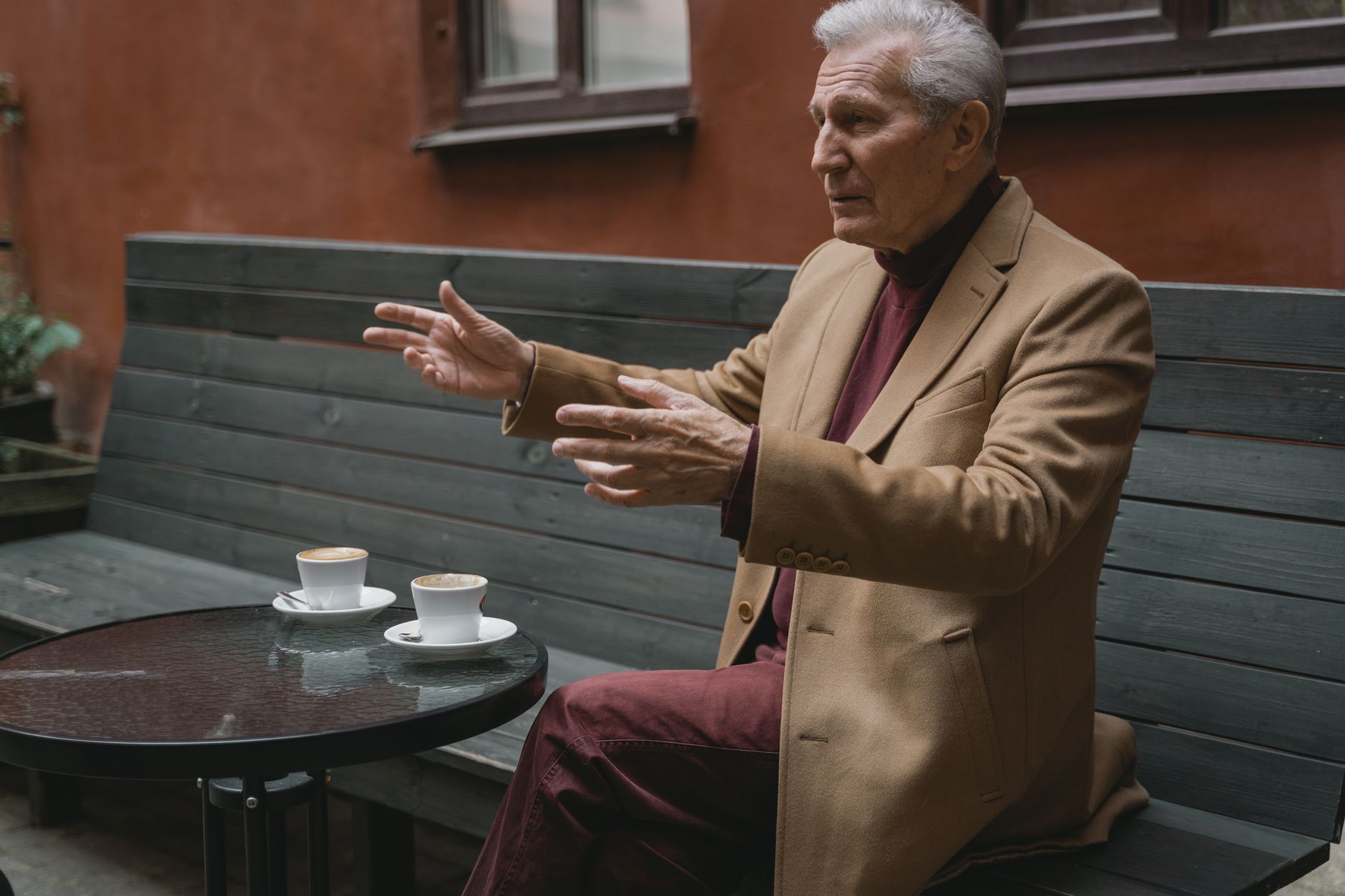
I am seventy-one years old, and until this past spring I believed I had reached the age where nothing new could happen to me. I want to tell you how wrong I was, and I want to tell you about the casserole, the dog, the broken gutter, and the photograph my grandson chose without asking me. But mostly I want to tell you about Marguerite, because if you had told me a year ago that the woman I had spent a decade pretending not to see would end up sitting at my kitchen table on a Sunday morning, laughing so hard she had to put down her coffee, I would have told you to have your head examined.
My name is Walter. I lost my wife, Eleanor, three years ago this October. She was sixty-eight, and she went the way she did everything, quietly and without making a fuss, in her sleep, with the reading lamp still on and a library book open on her chest. I found her in the morning. I will not dwell on that part. I only mention it because you have to understand where a man is, three years out from the only love of his life, before you can understand why he would do something as foolish as what I did, or rather, what my grandchildren did to me.
For three years I had what I would have called a system. I had a routine, and the routine was the thing that got me from one end of the day to the other. I got up at six because Eleanor and I always got up at six. I made coffee in the percolator she liked, the one that takes too long, because the waiting was part of it. I read the paper. I walked to the end of the block and back, because the doctor said walking, and I did the crossword, and at five o’clock I made myself a real dinner and sat at the table and did not turn on the television, because Eleanor hated the television at dinner and I was not about to start now.
It was a good system if your goal was to feel nothing. That was, I see now, exactly the point of it.
The Sunday they ambushed me
My daughter, Karen, has three children. Tyler is nineteen and at the state university studying something with computers that I do not pretend to understand. Brooke is sixteen and the most opinionated person I have ever met, and I say that with love and a certain amount of fear. And little Sam is eleven and still thinks I hung the moon, which I intend to enjoy for as long as it lasts.
They came over for Sunday dinner the way they do, the whole loud lot of them, and Karen brought a roast and Tyler brought his laptop, which I did not think anything of at the time, because Tyler always has his laptop. We ate, and we talked, and after the dishes the kids did not scatter the way they usually do. They lingered. Brooke kept looking at Tyler, and Tyler kept looking at his mother, and Sam was practically vibrating in his chair, and a man does not live seventy-one years without learning to recognize an ambush.
“Grandpa,” Tyler said, in the careful voice you use on a dog that might bolt, “we made you something. And before you say no, just look at it.”
He turned the laptop around.
There, on the screen, was my own face. It was a photograph Eleanor had taken of me at Tyler’s high school graduation, four years ago, when I still had most of my color and I was laughing at something off camera. Underneath it, in cheerful letters, was a profile. My profile. On one of those dating websites for people my age. It said my name was Walter, that I was seventy-one, a retired civil engineer, that I liked fishing and crossword puzzles and old westerns, and that I was, and I am quoting the children directly here, “a young heart looking for someone to share the second act with.”
I felt my face go hot.
“Turn it off,” I said.
“Grandpa.”
“Turn it off, Tyler.”
“We didn’t post it yet,” Brooke said quickly. “It’s just a draft. We wanted to show you first.”
That was a lie, and I would find out it was a lie soon enough, but I did not know it yet. What I knew was that my dead wife had taken that photograph, and these children, my children, had taken her photograph and pinned it to a website where strangers would look at my face and decide whether I was worth their time. I felt something I had not felt in a long while, which was anger, and underneath the anger, which is always where it lives, I felt grief, fresh and total, the way it comes when you least expect it.
“Your grandmother,” I started to say, and then I could not finish, and the kitchen got very quiet.
Karen put her hand on my arm. “Dad,” she said. “We weren’t trying to replace her. Nobody could ever. We just. You’re alone in this house, and we worry. We see you, Dad. We see how it is.”
And that was the thing, you understand. That was the thing that took the wind out of me. Because I had spent three years building a system precisely so that nobody would see how it was, and here was my daughter telling me the system had never worked at all. They had seen the whole time. They had just been too kind to say.
“It’s a joke, mostly,” Sam offered, helpfully. “Tyler said it would be funny.”
“Sam,” said three people at once.
I looked at the screen again. At my own face, laughing. At the words a young heart looking for someone to share the second act with. And I will tell you the truth, because there is no point in this story otherwise: a small, traitorous part of me, a part I was deeply ashamed of, did not want them to turn it off.
“Leave it as a draft,” I said finally. “I’m not promising anything. Now somebody get me the pie.”
They cheered like I had agreed to run a marathon. I should have known then that “draft” was not a word that meant anything to a nineteen-year-old.
The notification
Three days later my phone made a sound it had never made before.
I had a smartphone because Karen insisted, but I used it for the weather and for calling people and for the occasional photograph of a fish, and that was the whole of it. So when it chimed in this new and unfamiliar way while I was standing in the cereal aisle of the grocery store, I had not the faintest idea what was happening. I am being honest with you. That is precisely how lost I was in those days, a man who could read a topographical survey blindfolded and could not work out why his own pocket was singing.
I fished the phone out of my pocket. There was a little banner on the screen. It had the cheerful logo of the dating website on it, the one the children had sworn was only a draft. And it said: *You have a new message from Marguerite, age 69.*
I stood there in the cereal aisle for what must have been a full minute. An employee asked if I needed help finding anything. I told him no, thank you, I was just having a small heart event, and he laughed because he thought I was joking.
I did not open the message. I put the phone back in my pocket like it was a hot coal and I finished my shopping with my hands shaking, and I drove home, and I called Tyler.
“You said it was a draft,” I said.
There was a pause on the line, the particular pause of a young man calculating exactly how much trouble he is in.
“Okay,” he said. “So. We may have. Activated it.”
“You may have activated it.”
“Grandpa, somebody messaged you? Already? On the first try? That’s incredible, that never happens, the algorithm must really like you, what does she look like, did you open it, you have to open it.”
“I am going to drive to your dormitory,” I said, “and I am going to take back the toolset I gave you for Christmas.”
But I did not hang up, and Tyler, who is not a stupid boy whatever else he is, heard that I did not hang up. He talked me through it gently, the way you talk someone down off a ladder. He stayed on the phone while I opened the message. And here is what it said, and I have it memorized, because I have read it more times than I will admit:
*Hello Walter. I do not usually do this, and I almost did not write at all, but your profile made me laugh, and I have not laughed in a while, and I thought a man who lists old westerns and crossword puzzles as his great passions might understand that. I will not take up your time. I only wanted to say that you have a kind face. Wishing you well. Marguerite.*
“What does it say?” Tyler asked. “Grandpa? You’re being quiet. Quiet is bad. What does it say?”
“It says she has a nice way with words,” I said. And then, because the name had been knocking at the back of my skull since the grocery store, I asked the question that would change everything. “Tyler. Does it say where she lives?”
“Hang on. Yeah. It says, like, a town. Says she’s in Cedar Falls.”
Cedar Falls is where I live. Cedar Falls is a town of nine thousand people.
“Tyler,” I said slowly. “Is there a last name on there?”
“You have to be matched to see the. Oh. Wait, she put it in her bio. Hang on. Marguerite. Marguerite Devereaux.”
I sat down. I had to. Because Marguerite Devereaux was not a stranger from the internet. Marguerite Devereaux was the woman who had lived in the blue house directly across the street from me for the past ten years, and for those entire ten years I had done everything a man can do, short of digging a moat, to avoid speaking to her.
Why I had avoided her for ten years
I need to back up, because I do not come out of this part looking good, and you deserve to know exactly the kind of fool you are dealing with.
Marguerite moved into the blue house the same autumn that Eleanor first got her diagnosis. The first one, the one we beat. And I will be honest with you, the timing was the whole problem. Marguerite arrived as a stranger at the precise moment my entire life was contracting down to one hospital and one woman and one terrible word, and so when she came across the street that first week with a casserole and a bright, hopeful, brand-new-neighbor smile, I was short with her. I was not cruel. But I was short, and I was cold, and I took the casserole the way you take a parking ticket, and I did not invite her in, and I did not return the dish for two months, and when I did I left it on her porch without knocking.
She tried again, of course she did, because she was that kind of woman, although I did not know that then. She tried at Christmas. She tried when Eleanor’s hair came back and we were out in the yard for the first time in a year, and she called across the street, “It’s so good to see you both out,” and Eleanor waved and I steered us back inside.
And then a thing happened that I have never told anyone, and I am only telling you now because I think the shame of it is finally smaller than the wanting to be honest. One evening, the first spring Marguerite lived there, I came out to get the mail, and she was on her porch, and she said, “Walter, isn’t it? I keep meaning to properly introduce myself. I’m Marguerite. I lost my husband two years before I moved here, and I know that look on your wife. If you ever need anything, even just someone who has walked it, I’m right across the road.”
She was being kind. She had read the situation exactly right, because she had lived it. And I, in my fear, heard it as a vulture circling. I heard a single woman across the street being too interested in a married man whose wife was sick, which was monstrously unfair of me and says far more about the state of my own heart than it ever did about hers. I said, “We’re managing fine, thank you,” in a voice you could have stored meat in, and I went inside, and from that day forward I treated Marguerite Devereaux as a feature of the landscape, like a fire hydrant. I waved if waving could not be avoided. I timed my mail runs to her schedule so they would not overlap. When Eleanor died, Marguerite left a card and a plant on my porch, and I never acknowledged either one.
Ten years. A decade of a good woman living forty feet from my front door, and I had made myself a stranger out of nothing but fear and stubbornness and a misplaced loyalty that Eleanor, who never met a neighbor she did not feed, would have been ashamed of.
And now that woman had looked at a photograph of my face on the internet, not knowing it was me, not connecting the laughing graduation man to the cold fish hydrant across the street, and she had said I had a kind face.
I want you to sit with the size of that. Because I did, that night, for a very long time.
What I did, and what I almost did not do
The cowardly thing, and the thing every instinct I had was screaming at me to do, was nothing. I could close the website. I could tell Tyler to delete the whole account. I could put my phone back to weather and fishing and never think of it again, and Marguerite Devereaux would go on living across the street believing she had traded one kind sentence with a kind stranger in another town, and she would never, ever know.
That is what the Walter of the past three years would have done. That Walter had a system, and the system was built to make sure nothing like this could ever reach him.
But I sat at Eleanor’s kitchen table, with Eleanor’s slow percolator clicking off behind me, and I thought about my daughter’s hand on my arm. *We see you, Dad.* I thought about Sam saying it was a joke, mostly. I thought about ten years of a card and a plant I never thanked her for. And I thought, for the first time in longer than I could remember, that I did not want to be a man who did the cowardly thing.
So I wrote her back. It took me four hours and eleven drafts, and Tyler was no help at all because every suggestion he made sounded like it was written by a nineteen-year-old, which it was. In the end I turned the phone off and wrote it on paper first, the way I would have written anything that mattered, and then I typed it in slow with one finger.
I will not give you the whole thing. But the part that mattered said this:
*Dear Marguerite. Thank you for your kind words. I have to tell you something, and I hope you will forgive the strangeness of it. My grandchildren made this profile as a joke, without telling me, using a photograph my late wife took. I did not even know it was active. But your message reached me anyway, and I think that may be the first lucky thing to happen to me in three years. Because I do know you, Marguerite. I have known you for ten years. I am the man in the brown house across the street, the one who took your casserole and never properly thanked you, and never returned your kindness, and let a good neighbor become a stranger because I was afraid and grieving and, I am sorry to say, foolish. I do not deserve a kind word from you. But I find I would very much like to earn one. Would you let me make you a cup of coffee, and apologize to your face for ten years of bad manners? Yours, Walter. The brown house.*
Then I turned the phone off entirely and put it in a drawer, because I did not think my heart could survive watching the little dots that mean a person is typing.
The longest morning
I did not sleep. I will tell you that plainly. I got up at six, made the slow coffee, and I sat with the phone face down on the table because I could not bear to turn it over, and the percolator clicked, and the paper went unread, and at seven fifteen there was a knock at my front door.
Not a message. A knock.
I knew before I opened it. Of course I knew. There is only one person who knocks on a door instead of answering it from forty feet away, and that is a person who has read your apology and decided it deserved a face.
She was standing on my porch in a green coat, holding a casserole dish.
Not a new casserole. *The* casserole dish. The very one she had brought ten years ago, the one I had left on her porch without knocking, washed and dried and waiting all this time. She held it out to me with both hands, and her face was doing something complicated, somewhere between crying and laughing, the way faces do when they cannot decide which thing is bigger.
“I never threw it out,” she said. “I kept thinking, one day that man is going to bring this back properly, and I am going to be ready.” She pushed it toward me. “I filled it. It’s a tuna noodle. I figured we should start exactly where we left off.”
And I, who had not cried in front of another human being since the morning I found Eleanor, stood in my own doorway at seven fifteen in the morning and wept like a child over a tuna noodle casserole, and Marguerite Devereaux set the dish down on my porch step and put her arms around me, a near stranger, a woman I had dodged for a decade, and held on, and said, “There now. There now. It took us long enough, didn’t it.”
The coffee that lasted four hours
We did not have one cup of coffee. We had a pot, and then another pot, and the slow percolator never worked so hard in its life.
She came in. She looked around at Eleanor’s kitchen, at the curtains Eleanor sewed and the calendar still turned to a month two years gone, and she did not say a careful, pitying thing the way people do. She said, “She had wonderful taste. I used to see her in the garden. She waved at me even when you wouldn’t.” And she said it with a smile, so I would know it was forgiven, and that, I think, is when I understood I was in the presence of a person of real and uncommon grace, the kind of person who can forgive a decade of bad manners over a single pot of coffee and never once make you grovel for it.
We talked for four hours. I learned that her husband, Raymond, had been a high school history teacher, and that he had died of the same thing that took my Eleanor the second time around, which is a terrible thing to have in common and also, strangely, a kind of bridge. I learned she had two sons, both out west, both good boys who called on Sundays. I learned she did the crossword too, in pen, which I found alarmingly attractive. I learned she had watched me for ten years time my mail runs to avoid her and had found it, in her words, “the single most ridiculous courtship-in-reverse a woman ever endured.”
“I wasn’t courting you,” I protested.
“No,” she said, “you were anti-courting me. It takes real dedication to avoid a person that thoroughly for that long. I was almost flattered.”
I learned that the casserole, the original one, had not been a hopeful single woman circling a married man. It had been exactly what it looked like, a new neighbor being kind to a household in crisis, and the only person who had ever read anything else into it was me, alone, in the dark of my own fear.
“I knew Eleanor was sick,” she said gently. “I lost Raymond. I knew that look. I wasn’t after your husband-ness, Walter. I was offering to be a friend to two people who were about to need every friend they could get. And you wouldn’t let me. And then she was gone, and you still wouldn’t let me, and I thought, well. Some men just decide to grieve alone, and you can’t make them do otherwise. So I left a plant and I let you be.”
“I never thanked you for the plant.”
“No,” she said. “You did not.” And she said it with such dry, forgiving humor that I laughed, and she laughed, and that was the laugh, the one she had to put her coffee down for, the one I told you about at the very beginning.
The gutter, the dog, and the rest of it
I told you I would tell you about the broken gutter and the dog, so I will, because they are how the rest of it happened, and because I want you to understand this was not a fairy tale where one casserole fixes a decade. It was slower and sillier than that.
That same week, a spring storm tore the gutter off the front of my house and left it hanging like a broken arm. The old Walter would have called a man and paid him too much money to avoid having to ask anyone for anything. The new Walter, the one who had wept over tuna noodle, walked across the street and knocked on a blue door and said, “Marguerite, I have a gutter situation and no ladder tall enough, and I have decided to start asking for help instead of dying of pride. Do you know anyone?”
She did. She knew her own ladder, and she held it while I climbed it, and she called up corrections about which screws I was missing in a way that should have been irritating and was instead the nicest hour I had spent on a ladder in my life.
And the dog. Marguerite has a small, elderly, deeply unimpressed dachshund named Biscuit, who had spent ten years barking at me across the street as the strange cold man who would not say hello. The first time I came over properly, Biscuit growled at me for an hour and then, with the suspicious dignity of the very old, climbed into my lap and went to sleep, and Marguerite looked at the dog, and looked at me, and said, “Well. He’s never wrong about people. I suppose that settles it.” And it did, somehow. I had been vetted by a dachshund and found acceptable, and I have rarely been prouder of anything.
What my grandchildren did
I have to give the children their due, because none of this happens without them, and I had been so ready to be angry that I almost missed the size of the gift.
When I told Karen, the whole story, the message and the casserole and the gutter, she cried, and then she got very quiet and said, “Dad. I have to tell you something. The photograph. We didn’t pick it by accident. Mom took it. We picked it on purpose, because it was the last picture we had of you really laughing, and we wanted whoever saw it to see *that* Dad, the one who laughs, not the one who’s been hiding in that house. We weren’t trying to replace her. We were trying to give you back to yourself.”
Tyler, when I called to tell him, was insufferable for about forty seconds, crowing about his algorithm and his matchmaking genius, until I told him the woman was the neighbor I had been avoiding for ten years, and then there was a long silence, and he said, in a completely different voice, “Grandpa. That’s not the algorithm. That’s not even a coincidence. That’s. I don’t know what that is.”
“It’s your grandmother,” I said. “It has her fingerprints all over it. She always did want me to thank that woman for the casserole.”
I do not know what I believe about the next world. Eleanor would have had opinions, and she would have shared them. But I know this: my wife took the photograph that her grandchildren used to pull me out of the house she could no longer keep me alive inside of, and that photograph reached the one woman in nine thousand who had been waiting ten years for me to come to my senses, and if that is a coincidence, then it is the kindest coincidence that ever happened to a foolish old man, and I have decided to stop arguing with it.
Brooke, the sixteen-year-old, the opinionated one, had the last word, the way she always does. She looked at me over Sunday dinner a month later, with Marguerite sitting at Eleanor’s table passing the potatoes like she had always been there, and she said, “So basically, Grandpa, you spent ten years and a whole dating profile to talk to a woman who lived across the street. You could have just walked over.”
“Yes, Brooke,” I said. “Yes, I could have.”
“Adults are so dumb,” she said, with enormous satisfaction, and everybody laughed, and Marguerite reached over and squeezed my hand under the table, and I thought, she is right. She is completely right. I could have just walked over. For ten years I could have just walked over.
What I know now
I am seventy-one years old, and I have learned something I did not expect to learn at this age, which is that the systems we build to keep ourselves safe are the same systems that keep ourselves alone, and that the difference between the two is sometimes just one knock on one door, one apology, one tuna noodle casserole carried across a road that took ten years to cross.
Marguerite and I are not in a hurry. We are too old to be in a hurry and too smart to pretend otherwise. She has her blue house and I have my brown one, and most evenings now we sit on one porch or the other, with Biscuit between us and the crossword between us, doing it in pen, arguing about seven down. I make her the slow coffee. She brings the casserole, a different one every time now, because we have officially run out of needing to start where we left off, and have started, instead, going forward.
I still get up at six. But now I have a reason to look across the street and see if her light is on, and most mornings it is, and most mornings she is looking back, and we wave. We actually wave. After ten years of me pretending she was a fire hydrant, we wave like two people who are very glad the other one is still there.
If you are reading this, and you have built yourself a system to keep from feeling anything, and there is a person forty feet away you have decided it is safer not to know, I want to tell you the thing it took me a decade and my own grandchildren and a joke that backfired into a blessing to learn.
Just walk over. The casserole dish is waiting. It has been waiting the whole time.
My name is Walter, and I have a kind face. A good woman told me so, and it turns out she was right, and it turns out it was never too late, and it turns out the second act is real, and it is happening to me now, across the street, in the blue house, in pen.

Laura Bennett writes about complicated family dynamics, difficult conversations, and the quiet moments that change everything. Her stories focus on real-life tensions — inheritance disputes, strained marriages, loyalty tests — and the strength people find when they finally speak up. She believes the smallest decisions often carry the biggest consequences.