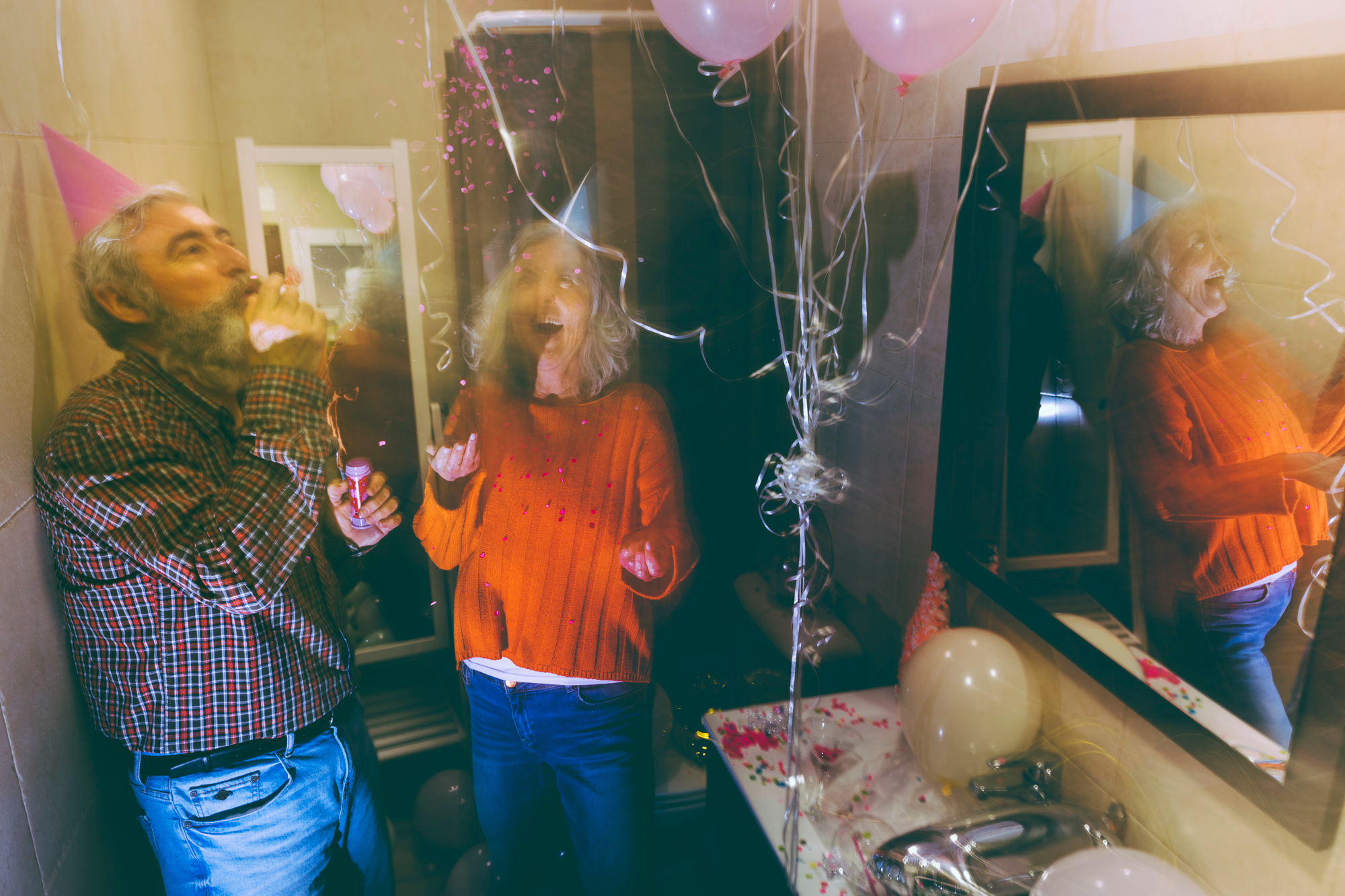
My father announced the end of my own birthday party at 7:43 in the evening, in my living room, in my lake house, in front of thirty-one relatives who suddenly looked like they wished they had stayed home.
“Party’s over,” he said, not to me but to the room. That was how Robert Parker had always handled my life, as though I were a messy public situation that needed his voice to restore order. “Everyone go home. My lawyer is on his way.”
He pulled out his phone like it was a weapon he trusted completely. Around us, thirty untouched glasses of champagne still fizzed on tables. Plates of food hovered in people’s hands. Cousins, aunts, uncles, in-laws stood frozen between the kitchen island and the floor-to-ceiling windows overlooking the lake, all of them wearing the expression people wear when they are watching a collision happen and wondering if they are standing too close.
My sister Claire stood in the center of the room in a champagne-colored dress, holding actual champagne, and she did not look humiliated or worried. She looked prepared. She looked like a woman who had rehearsed this moment and expected me to fold on cue.
“She’ll come around,” Claire told my father, loud enough for the room. “She always does.”
My father nodded with the satisfied authority he used whenever he believed the world was about to confirm his version of events. My mother Sandra stood near the couch with her soft concerned face, the one she wore whenever something cruel was happening and she wanted to look like she was merely worried about feelings.
And me? I just nodded.
Not the old nod. Not the tired, fine, take it, you win nod I had spent most of my adult life producing whenever my family cornered me long enough. This was different. This was the quiet nod of a woman who had been expecting exactly this for four days and had used every one of those days to prepare with the precision you develop when you build security systems for a living.
My father mistook my silence for hesitation. That was his first mistake.
His second mistake was not knowing about the other call I had made twenty minutes before the first guest arrived. That call went to Detective Raymond Cho at the Lakewood precinct, a calm and professional man who had listened carefully three days earlier when I sat across from him with six hours of cloud-stored night-vision footage and a trespassing report already drafted.
His third mistake had happened four days before my birthday, but I need to explain who I am before I explain what happened.
My name is Denise Parker. I am thirty-eight years old, and I have been building things since I was nineteen. First I built a reputation in the Parker family as the daughter who did not need anything from anyone. That reputation was useful for a while, but it was also lonely, because in my family, Denise doesn’t need anything slowly became Denise gets nothing, which eventually became Denise’s things are available for redistribution.
Then I built something better.
Parker Security Systems began in my apartment bedroom in 2009 with a laptop, a soldering iron, and one belief that has since made me very successful: most people dramatically underestimate what a camera can see. My company designs integrated smart security for high-net-worth residential and commercial clients. Custom camera arrays, AI-assisted motion detection, cloud storage with forensic-grade timestamps, smart locks with individual access logs tied to biometric data. We now have forty-one employees, offices in Seattle and Austin, and annual revenue that would substantially revise my father’s estimation of me if he ever bothered to ask the actual number.
He stopped asking about my career around the time it became clear he might have to update his opinion.
I designed and installed the security system in my lake house myself. Not symbolically. Physically. Thirty-two cameras, interior and exterior. Smart locks on every entry point, each with its own access code logged to the cloud. Motion sensors on all three floors. Audio capture in the main living spaces, legally permitted for a homeowner recording on her own property in that county. I had always believed documentation was the most reliable form of self-protection. The lake house is in Lakewood, Washington. I paid $1.47 million for it in 2019. Four bedrooms, three and a half bathrooms, a wraparound deck facing the water, and glass walls that make sunset look like something painted specifically for you.
My family had visited twice in four years.
Both times they made clear, in that warm indirect way families use when they want to insult without leaving fingerprints, that they considered the house wasted on me. My father called it underutilized. My mother said the guest room was such wasted space. Claire said almost nothing but walked through every room slowly and carefully, studying the layout with the focused attention of someone memorizing something for future reference.
I noticed. I always notice. I filed it in the back of my mind under things to monitor, which has always been my default category for anything I don’t yet have enough evidence to act on.
To understand what happened on my birthday, you need to understand the architecture of my family.
My father Robert Parker is sixty-six and has been the gravitational center of our family since before I was born. He is a retired commercial contractor who made decent money and converted it into a self-image requiring constant reinforcement to remain standing. He has spent decades making decisions for other people and calling it love. His decisions about me always followed the same logic: Denise is strong, Denise is independent, Denise doesn’t need help, therefore Denise should sacrifice.
My sister Claire is thirty-four, charming, and constitutionally resistant to consequences. She has lived rent-free in three different situations over the past five years, leaving each when it became too formal or inconvenient. She currently has a one-bedroom apartment in Tacoma that she considers beneath her not because she earned something better but because our parents raised her to believe that wanting something was nearly the same as deserving it.
My mother Sandra is softer and in some ways more dangerous. She smooths the edges off my father’s demands while quietly supporting every one of them. She speaks in a mild, concerned voice that makes you feel like she is on your side even while she is helping position the instrument. In our family, my father issued verdicts. My mother made them sound reasonable. Claire collected the benefit.
Those were the three people standing in my living room on my thirty-eighth birthday while my father declared the party canceled because I had refused to give Claire my lake house.
I had expected them to try something. I had not expected them to try it in front of thirty-one witnesses and a security system that had been recording continuously for ninety-six hours.
Four days before the party, I came home from a business trip to Austin at 2:17 in the afternoon. I knew something was wrong before I opened the door. There is a quality to the air in a house that has been occupied while you were away, a warm disturbance of stillness that you feel before you can prove it.
I walked through the house slowly without touching anything, only cataloging.
In the kitchen, two glasses in the sink, rinsed but not washed. A smear near the coffee machine. On the second shelf, a specific brand of herbal tea that Claire drinks and I do not buy.
In the living room, my reading chair blanket folded in a shape I never leave it in. A faint ring on the side table from a glass without a coaster, which anyone who knows me would know I would never allow to stay.
In the guest room, Claire’s perfume. Not a trace from a quick visit. The concentration of a scent that has settled into fabric over multiple nights of sleep.
Then I went to the wine cellar.
The 2018 Chateau Pichon Baron I had been saving for a specific occasion was gone. Eight hundred dollars retail, and it was not the money that made my chest go cold. It was the empty space on the rack and the comfort it implied in whoever had decided to fill it with themselves.
I went directly to my security system, pulled up the recordings, poured a glass of water, and watched.
Day one: my father at my front door at 11:24 in the morning, with a key. Not the emergency key I had given my parents for genuine emergencies, which I had changed eight months earlier after a previous incident involving Claire and a borrowed parking pass. This was a duplicate, cut from the old key without my knowledge. I watched my father unlock my door and walk inside. Claire came in behind him, stepped into my living room, stretched her arms wide, and turned a full slow circle in the center of my floor as though she were taking inventory of something that already belonged to her.
Day two: my mother arrived alone at 2:30 in the afternoon. She let herself into my kitchen, made tea, and sat at my table for forty minutes. Then she went upstairs and into my bedroom.
I watched her open my jewelry drawer.
There is a reason that camera exists, and the reason is longer than this story requires. She took out a gold bracelet I had bought in Italy and held it up to the light, turning it against her wrist.
Then she put it back.
That time.
Day three: all three of them, together, from 6:00 to 9:00 in the evening. That was the night they took the wine. I watched Claire open the cellar door, walk along the racks with her phone’s flashlight, and select the Pichon Baron with the unhurried confidence of someone who has decided there will be no consequence for what she is doing.
My father sat at my kitchen table eating a meal that appeared to have been prepared in my kitchen from my groceries. My mother sat on my couch watching my television.
Then the audio from the living room sensors came through.
Claire: Denise is so naive. Once we establish facts on the ground, she won’t dare kick us out. She’ll worry about appearances. This house is ours.
My father’s laugh.
My mother, softer: Just make sure it looks reasonable when you bring it up. Pick the right moment.
I sat at my desk for a long time after the footage ended. I did not cry or shake. What I felt was colder and more useful than either of those things. It was the heavy, clarifying weight of a suspicion I had been carrying for years finally becoming a confirmed fact.
My family had not misunderstood my boundaries. They had studied them, tested them, and determined that the right amount of pressure applied at the right moment would make me hand over what they wanted. They had been right about this before. They had calculated that they would be right about it again.
I called my attorney the next morning. Vivian Okafor has practiced real estate and property law in Washington state for twenty-two years. She does not overreact and she does not underreact. I sent her the footage and walked her through the timeline. She was quiet for a moment and then said: this is very clean documentation. The duplicate key constitutes criminal trespass under Washington state law regardless of familial relationship. The theft of the wine, combined with the other removed items, gives us a solid basis for a report. How do you want to handle this?
I told her I was planning a birthday party for Saturday.
Another pause.
Tell me more about that, she said.
I told her everything.
She said, and I have thought about this sentence several times since: in twenty-two years of practice, I have never had a client this prepared.
I told her I designed security systems for a living. She said she would have the documentation ready by Friday.
Friday afternoon I called Detective Raymond Cho at the Lakewood precinct. Eighteen years on the force and the calm, unshockable manner of someone who has heard every version of every family story and is no longer capable of being surprised by any of them. He reviewed the footage. He reviewed Vivian’s documentation. He told me the trespassing and theft reports were solid, that his department could send a response unit Saturday evening if I confirmed the subjects were present on site, and that I should call his direct line when I needed them to move.
You understand, he said, that once we respond, this becomes a matter of public record.
I understand, I said.
And you want to proceed?
Detective Cho, I said, I have wanted to proceed for approximately fifteen years. I simply did not have the evidence until this week.
He made a sound that might have been a laugh. We’ll be ready at 7:30, he said. You call, we move.
I thanked him and hung up and went to finalize the catering order for thirty-two people.
The three days between the footage and the party were the strangest I have spent recently. I went to work. I answered emails. I had a product development meeting on Wednesday about new smart lock firmware and contributed useful things and no one in that room could have known I was running a parallel track in my mind that involved the criminal prosecution of my own family.
I want to tell you what those three days actually felt like, because I think the feeling is the most honest part.
They felt like the three days before a product launch when you know you have done everything correctly and you are simply waiting for the sequence to execute. That particular combination of alertness and calm that comes not from certainty about how other people will behave but from certainty about your own preparation. I have felt it before product presentations, before court filings involving intellectual property claims, before client security audits where I knew the system would perform exactly as designed.
I had never felt it in relation to my own family.
That was its own kind of education.
I also changed every digital access code on the property. Not the physical lock cylinders: I wanted the evidence of the duplicate key to remain intact for Detective Cho’s case file, which required the original physical evidence to be undisturbed. But the smart lock override, which I can trigger remotely from my phone and which deadbolts every entry point simultaneously, I set that function as a phone contact labeled Done. My father’s duplicate key would still fit the physical cylinder. The moment I pressed that contact, it would be irrelevant.
I set the trigger up on a Thursday afternoon. Then I went to order the birthday cake.
Lemon with elderflower frosting, which is my actual preference rather than the vanilla sheet cake my mother always ordered for my childhood birthdays because, as she explained once when I was about eleven, Claire preferred vanilla and it was simply easier to get one cake. I remember this explanation being delivered in the warm, logistical tone that my mother used for most of the decisions that consistently routed around me, as though the outcome were not a preference at all but simply the efficient solution to a scheduling problem.
I ordered lemon. I ordered it for thirty-two people. I arranged for it to be picked up Friday afternoon and I drove out to the lake house that same evening to let myself in, to walk through each room, to confirm that everything was exactly as I had left it, and to set up the connection between my security server and the living room monitor, which took approximately twenty minutes and which I had been planning since Wednesday morning.
I invited the whole family because thirty-one witnesses seemed like exactly the right number. I invited Uncle Greg because he had always seemed faintly uncomfortable with how his brother operated but had never said so directly. I invited Aunt Ruth because she was sharp and direct and had on more than one occasion looked at our family dynamics with the clinical expression of a doctor not permitted to give unsolicited diagnoses. I invited every cousin, every in-law, every person who had ever attended a Parker family function where I was present but not quite central, where decisions were made around me rather than with me, where my things were discussed as though my opinion of them was a courtesy rather than a requirement.
I wanted witnesses. I wanted the record to be human as well as digital.
I invited the whole family. My father’s brother Greg, a quiet, observant, retired teacher who had always seemed faintly uncomfortable with how his brother operated but had never said so directly because doing so would have required a confrontation he was not prepared to have. My mother’s sister Ruth, who was sharp and direct and had on more than one occasion looked at our family dynamics with the clinical expression of a doctor not permitted to give unsolicited diagnoses. Cousins, second cousins, the full assembled apparatus of the extended Parker family arranged in my living room like a jury I hadn’t formally convened.
My father’s attorney arrived at 8:04 in a navy suit. Morris Greer. Civil practice, Seattle office, the practiced confidence of a man who had spent twenty years making people feel the law was on his side before the specific situation had been fully established. He stepped into my living room, scanned the room with professional efficiency, and settled on me with an expression I recognized immediately. The slightly pitying, already know how this ends look of a man who has been told he is walking into a soft target.
Denise, he said, smooth and warm. Your father has explained the situation. Given the size of this property and your circumstances as a single resident, refusing to accommodate your sister’s housing needs could be interpreted as contrary to family obligation under certain
Before we discuss any of that, I said, I need to show everyone something.
I picked up my phone. One tap.
The seventy-inch monitor on my living room wall, which I had connected to my security server that afternoon, lit up.
The room went completely quiet. Not the polite quiet of a gathering paused for a toast. The held-breath, no-one-move quiet of a room that has just understood something has permanently changed.
Night-vision footage filled the screen, the timestamp glowing white in the upper left corner. My front door. My father with a key. The door opening. Claire turning a slow circle through my living room with her arms spread wide. My mother in my bedroom with my jewelry drawer open and my gold bracelet tilting toward the light.
Then the audio.
Denise is so naive. Once we establish facts on the ground, she won’t dare kick us out. She’ll worry about appearances. This house is ours.
My father’s laugh.
My mother’s gentle agreement.
Claire’s voice bouncing off the walls of my living room, playing back into it with the acoustic clarity of a system installed by someone who knew exactly what she was building.
My Aunt Ruth made a sound as though she had been struck. Uncle Greg set his plate down with the deliberate control of a man managing a physical reaction. Morris Greer’s fountain pen fell from his fingers and hit my hardwood floor.
He did not pick it up.
My father’s face moved through shock, then recalibration, then the specific reddening of a man who is furious at being caught and is reframing the catching as the offense. That footage is taken out of context, he started.
The doorbell rang.
Three police cruisers were in my driveway, their light bars painting the room in shifting red and blue through those floor-to-ceiling windows my family had been studying for three years.
I walked to the door and opened it myself.
Detective Cho was on the porch. Miss Parker. You called.
I did. I handed him my phone with the preloaded case file Vivian had prepared. Footage timestamps, trespassing documentation, inventory of items removed from my property including one bottle of 2018 Chateau Pichon Baron, current market value eight hundred and seventy dollars, and three items from my jewelry collection photographed and valued the previous Thursday.
All footage is uploaded to the case file on record, I said. The subjects are present.
Behind me, Claire said: you set us up.
I turned around. She was standing in the center of my living room, my living room, with her face stripped of the performance she had been maintaining all evening. What was underneath it was not remorse. It was the specific, disbelieving fury of someone who has always had consequences redirected away from her and is encountering for the first time a situation where redirection is unavailable.
Yes, I said. The key my parents had for emergencies, the one you duplicated eighteen months ago. I had marked it with a trace notch on the bow. I knew it had been copied. I knew what you would do with it and when because you had been discussing this house for three years and I had been watching the pattern.
Morris Greer snapped his briefcase shut. He looked at my father with the expression of an attorney who has just completed a rapid cost-benefit analysis and reached a clear conclusion.
Robert, he said quietly, there is nothing I can do here.
He picked his fountain pen up from my floor, walked past the officers without making eye contact with anyone, got into his car, and drove away. I watched him go with a certain professional respect. He knew a lost case when he saw one.
Claire attempted to go upstairs. An officer stepped in front of her with the calm efficiency of someone who has done this many times and finds it neither dramatic nor complicated. When his colleague checked Claire’s bag before she left, she removed three additional items: a card holder I kept in a dish by the entryway, a pair of vintage earrings from my jewelry drawer, and a sealed bottle of moisturizer from my bathroom cabinet.
Those were going to be gifts, Claire said.
My Aunt Ruth, who had been standing near the fireplace with the contained expression of a woman who has a great deal to say and is exercising considerable discipline about when, looked at Claire for a long moment.
To whom? she said.
Nobody answered.
My father was walked to the cruiser maintaining the expression of a man who has encountered the limits of his own assumptions and found them much closer than he expected. Not guilt. I want to be accurate. The open, uncomprehending expression of someone who never once believed the rules applying to everyone else would be applied to him.
They applied anyway.
My mother went quietly, which I found, in some ways, harder to watch than my father’s bluster. The composure she kept all the way down my driveway, the stillness she preserved even as the evening entirely collapsed around her, the way she never once looked at me.
The living room afterward was very still. Uncle Greg put his hand briefly on my shoulder without saying anything, which was the right instinct. Then someone cut the cake, which was lemon with elderflower frosting, and we ate it standing around the kitchen with the slightly stunned, slightly giddy energy of people who have just collectively witnessed something they will be talking about for years.
The party had not ended when my father announced it was over. It lasted three more hours. I blew out the candles at 9:15.
I did not make a wish. There was nothing left to wish for. Everything I needed, I had already built.
The criminal charges were filed the following Monday. Criminal trespass, theft, unauthorized key duplication. Separate representation for all three. Seven months of proceedings ending in a plea arrangement with fines, restitution for the wine and jewelry, and formal no-contact requirements regarding my property.
Vivian told me at the conclusion that she had never seen a trespassing case this thoroughly documented. I told her I had built the documentation system myself. She said she was recommending me to two other clients who she thought could use better residential security. I sent her a firm brochure.
Uncle Greg called me the week after the party. We talked for two hours, the first real conversation I had ever had with anyone from my family about the actual shape of the preceding thirty-eight years rather than the managed, performative version that holiday dinners required. He said he was sorry he hadn’t said more sooner. I told him I understood. We are having dinner next month.
My Aunt Ruth sent a card. You handled that with more grace than most people would, it said. Don’t let them tell you otherwise. I keep it on my desk.
I have not spoken to my father, mother, or sister since the night of the party. This is not a dramatic declaration. It is an accurate account of current conditions, arrived at after considerable reflection and several useful sessions with my therapist, who made the observation in our third meeting that I had spent my entire adult life building systems to protect things I owned because no one had ever taught me I was allowed to protect myself.
I am working on that.
The security system still runs. Thirty-two cameras, smart locks with access logs, cloud storage with forensic-grade timestamps. There is currently exactly one person with an access code to my front door. A very short guest list, and I have found, somewhat to my own surprise, that a very short guest list is an extraordinarily peaceful thing to come home to.
The lake is the same. The windows still go floor to ceiling. The morning light comes through at an angle that makes the whole room gold for about forty minutes every clear day, and I sit in that light with my coffee, and I think about what I’ve built. The company. The house. The boundaries. The case.
This is mine, I think. Not underutilized. Not wasted. Not available for redistribution.
Mine.
My father said the party was over.
He was wrong about that too.
There is one more thing I want to say, about the word underutilized, because my father used it about this house and I have thought about it many times since.
Underutilized was his word for a $1.47 million lakefront property occupied by one person rather than available to the full apparatus of the Parker family as a shared resource. It was also, I understood even then, his word for me. He had been using some version of it my entire life. Denise doesn’t need much. Denise is fine alone. Denise has the independence thing. It was said with a kind of approval that masked the fact that my independence had always been treated less as a character trait worth respecting and more as a logistical feature that made me available for sacrifice.
Strong people do not need protecting. Strong people do not require accommodation. Strong people can absorb whatever they are asked to absorb, and if they object, the objection is itself evidence of weakness because a truly strong person would simply handle it.
That is the architecture of that particular trap, and I had been inside it my entire life without fully naming it until I sat at my security system desk watching my father let himself into my house with a key he had copied without my knowledge.
Documentation broke the trap. Not because it gave me power over them, but because it gave me clarity about what was actually happening rather than what I had been told was happening. The camera did not lie. The audio did not editorialize. The footage was simply what it was: three people who believed that Denise would fold, doing the thing they had always done when they believed she would fold.
They were wrong this time because I had stopped folding.
Not loudly. Not dramatically. Just by pressing Done on my phone and waiting for the sequence to execute.
That is, it turns out, the most effective security system I have ever designed.

Specialty: Legal & Financial Drama
Michael Carter covers stories where money, power, and personal history collide. His writing often explores courtroom battles, business conflicts, and the subtle strategies people use when pushed into a corner. He focuses on grounded, realistic storytelling with attention to detail and believable motivations.