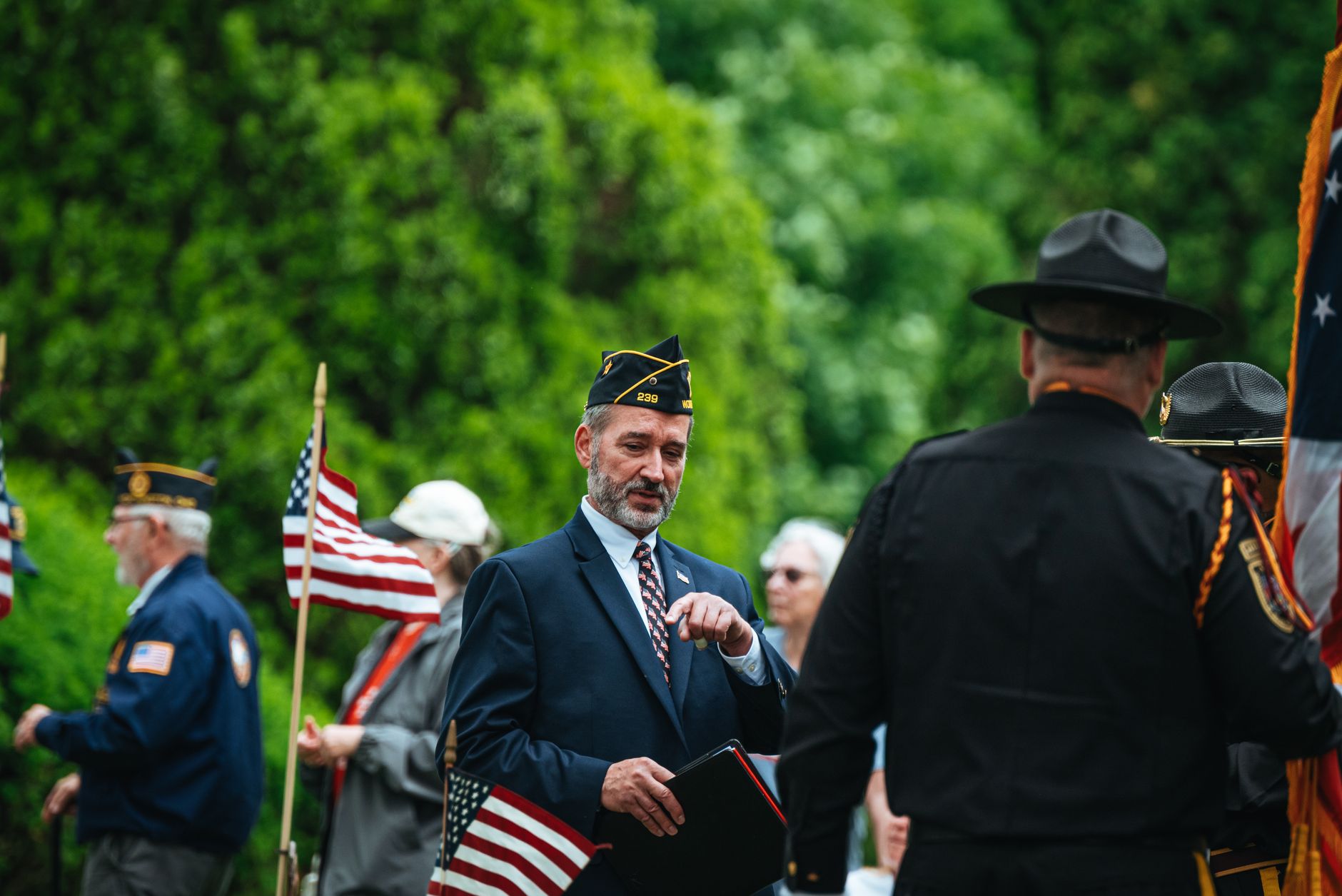
Merle Hatcher stood up in the middle of the VFW hall on Memorial Day, pointed his coffee cup at me, and told the whole room that I never fired a shot in Vietnam, that I typed papers in an air-conditioned office while real men bled.
I was seventy-one years old. I had heard some version of that sentence from Merle for close to forty years, and I still felt it land the same way it did the first time, low in the gut, like a boot heel. The hall went quiet the way a room goes quiet when everyone already knows the joke and is waiting to see if the man it is about will finally break.
I did not break. I never had. That was the whole problem, and it was also, I would learn before the day was over, the reason I had spent four decades letting a man ruin my name.
Let me back up.
My name is Leland Crews. I was born in 1955 in a little town called Ewell Springs, in the low green hills of eastern Kentucky, the kind of place where the road out of town and the road into town are the same road, and everybody has known your people for three generations. My father worked the coal tipple until his lungs gave out. My mother kept the books at the Baptist church and grew tomatoes that could make a grown man weep. I was the middle of five, the quiet one, the one who read too much and talked too little.
I was drafted in early 1971, right after I turned nineteen. That is the honest part of the story, the only part I ever told anybody. I went into the Army, I served, I came home. Corporal Leland Crews, United States Army. When people asked what I did over there, I said what I always said, which was, “Not much worth talking about.” I meant it as a door closing gently. Most people took it as a door closing gently. Merle Hatcher took it as an invitation.
Merle and I grew up two farms apart. He was a year older, loud where I was quiet, big where I was narrow, always at the center of whatever was happening. In high school he was the boy the coaches loved and the girls followed to their cars. He had a way of making you feel like the sun had swung around to point at you, and then a way of making you feel like it had swung away and left you cold. I had watched him do it to other boys. I never thought he would do it to me. We were friendly enough. Our mothers canned together.
Merle did not go to Vietnam. His number came up the same as mine, but Merle had a bad knee from football, or so the letter from the doctor said, and everybody in Ewell Springs knew the doctor was his uncle. That is not a secret and it is not a slander. It is just what happened, and in a town our size, everybody knew it, and nobody said it, because you did not say those things about the Hatchers.
When I came home in the spring of 1973, I was not the same boy who left. I had a stillness in me that had not been there before. I did not sleep well. I did not like crowds or loud sounds or men standing behind me. I did not talk about any of it, not to my mother, not to the girl I would marry, not to the pastor, not to anybody. I got a job at the feed store, I married Dorothy Ann Sizemore, I raised two children, I went to church, I paid my taxes, and I kept my mouth shut about the fourteen months I spent in the Central Highlands.
And Merle Hatcher decided that my silence meant I had nothing to say.
It started small, the way these things do. A comment at the feed store. “Leland here, he had it easy over there, didn’t you, Leland. Pushing a pencil.” A laugh. I let it go, because I have always let things go, because a man who has seen what I saw does not have the room in him to argue about who saw what. But letting it go, I have learned, is a kind of permission. Merle took the permission and he built a whole story on it.
By the time I was in my thirties, Merle Hatcher was telling people I had been a clerk. By my forties, he was telling people I had never left the base. By my fifties, when we both started going to the VFW, of all places, Merle had refined it into a routine. He would wait until there was an audience, some younger fellow just back from the Gulf, some visitor, and he would clap me on the shoulder and say, “Now Leland, he served, sure, but Leland’s war was mostly paperwork, wasn’t it, buddy. Typed a lot of memos. Real climate-controlled combat.” And the room would laugh, because Merle made it sound like affection, like ribbing, and I would smile the thin smile of a man who has decided that his dignity is not worth a fight, and I would say nothing.
Here is the thing nobody understood, and the thing that makes me ashamed even now. Every single time Merle said it, a small mean part of me was relieved. Because as long as they believed I typed papers, they did not ask me what I actually did. And I would rather have been the town’s fake soldier for forty years than answer that question one time.
My wife knew. Not the details, but she knew there was a room in me with the door shut, and she was wise enough never to knock. I met Dorothy at a church supper the year I came home, and I want to tell you something about her, because she is half of why I am able to tell any of this at all. The first time I woke up hollering in the night, maybe six months after we married, thrashing and swinging at a wire that was not there, most women would have shaken me hard and demanded to know what was wrong. Dorothy did not. She got up, she went to the kitchen, she put the kettle on, and when I came into the kitchen shaking she just poured two cups and set one in front of me and did not say a word about it. She did that for forty-eight years. Somewhere in there she figured out, without me ever telling her, that the worst nights came in the spring, and she never asked why, and I never told her that it was because it was spring when the wire got cut and the men came through it. She just made the tea.
Dorothy passed in the fall of 2021, four years before the Memorial Day I am telling you about. Cancer, the slow ugly kind. I sat up with her the last three months, in a hospital bed we put in the front room where the good light came in, and I fed her ice chips and read her the county paper and held the pan when the nausea took her, and I did it gladly, because she had held the pan for me in a thousand ways she never once mentioned. In her last month, when the morphine had her floating somewhere between here and gone, she took my hand one night and said, “Leland, you are going to have to let somebody in before you die. It doesn’t have to be everybody. But it has to be somebody.” I told her I would. I was lying, and she knew I was lying, and she squeezed my hand anyway. The last thing she ever said to me that made full sense, two days before the end, was, “You are a good man, Leland Crews, no matter what Merle Hatcher says.” She said it with a little smile, like a joke between us, but her eyes were not joking, and I have thought about that smile every day since.
After she was gone, I did what men like me do. I got quieter. I went to church, I tended her tomatoes, and once a week I went to the VFW hall on Route 9, because it was the one place I could sit among men who had at least stood near the thing I had stood inside of, even if they thought I had watched it from an office window.
And every week, Merle Hatcher was there, holding court, and every week, sooner or later, he found a way to work in the joke.
The younger men had picked it up by then. That is what a story does over forty years. It stops being one man’s cruelty and becomes just a fact everybody knows. “Leland typed papers.” A new member would join, some fellow in his fifties who did two tours in Iraq, and within a month he would be grinning at me and saying, “Heard you had the cushy job, Crews,” because Merle had told him, because Merle told everybody, because Merle had made my life’s deepest wound into the local comedy.
I want to be fair to Merle, even now, even after everything. I do not think he woke up every morning wanting to hurt me. I think it was easier than that, and worse. I think somewhere in him, a man who used his uncle’s signature to stay home while the boy two farms over got on the bus, a man who then watched that boy come home changed and go silent, I think that man could not stand the silence. Because silence is a mirror. My quiet made Merle look at something in himself he did not want to see. And the easiest way to break a mirror is to decide there was never anything worth reflecting. If Leland typed papers, then Merle missed nothing. If Leland’s war was a joke, then Merle’s bad knee was just good luck.
He needed me to be a fraud so that he would not have to be a coward.
I did not understand any of that at the time. I only understood it later, in the quiet after. At the time, I just knew that I dreaded Tuesdays.
Which brings me to Memorial Day, this past May.
The VFW hall did it up the way it does every year. Flags on every table, a color guard from the high school JROTC, a potluck with three kinds of green beans and a ham the size of a truck tire. The women from the auxiliary had made a poster board with photographs of every member’s service, and there was a little ceremony where the post commander, a good man named Ray Whitt, read the names of the members we had lost that year and rang a brass bell for each one.
I almost did not go. Since Dorothy passed, holidays sit on me like wet wool. But she had made me promise to let somebody in, and I had not, and somehow going to the hall felt like the closest thing to keeping the promise, so I put on my good shirt and my old field cap, the one with the unit crest that I keep the pin low on so nobody can read it too close, and I drove out Route 9.
It started fine. It always starts fine. I sat with Ray and a couple of the older fellows, and we ate, and the JROTC kids did their thing with the flags, and it was decent. And then Merle Hatcher came in late, the way he always does, so the room turns to look at him, and he had a plate in one hand and a coffee in the other, and I felt the old dread crawl up my back before he even said a word.
He worked the room for a while. And then a young woman stood up, one of the JROTC cadets, a serious girl about seventeen with her hair in a tight bun, and she said she was doing a school project, interviewing veterans, and could she ask a few of us what we did in the service. She had a little recorder. She was polite as could be. And she came to our table, and she looked at me, at the old man in the field cap, and she asked me, in front of God and Merle Hatcher and everybody, “Sir, what did you do in Vietnam?”
And Merle laughed. He was three tables away and he laughed loud enough to carry, and he said it, the thing he had said a thousand times, except this time he said it to a seventeen-year-old girl holding a recorder, and this time he added a flourish I had not heard before.
“Honey, don’t waste your tape on Leland,” he said. “Leland Crews never fired a shot in his life. Typed papers in Saigon. Air conditioning and a coffee pot. Real men bled over there. Leland shuffled paper.”
The room laughed. It always laughed.
And the girl, this seventeen-year-old with her serious bun and her recorder, she did not laugh. She looked at Merle, and then she looked back at me, and she said, quiet and clear, “That’s not what I asked him. I asked him.”
Nobody had ever done that before. Nobody in forty years had ever looked past Merle Hatcher and asked me.
I opened my mouth to give my line. Not much worth talking about. I had said it ten thousand times. It was already on my tongue. But Dorothy’s voice was in my head, plain as the day she said it, You are going to have to let somebody in before you die, and this girl was looking at me like she actually wanted to know, and I was seventy-one and tired, and I thought, if not now, then I will die with the door shut, and I promised her I would not.
So I did not give my line. I just sat there, and my hands started to shake, the way they do, and I could not make the words come.
And that is when the other thing happened, the thing I never saw coming in forty years.
Merle Hatcher stopped laughing.
He was watching my hands shake. And something moved across his big loud face, something I had never seen there, and he set his coffee down on the table hard enough that it slopped over the rim, and he said, not loud this time, so quiet the room had to lean in, “Aw, hell.”
And then Merle Hatcher, in the middle of the VFW hall, on Memorial Day, in front of the color guard and the potluck and the poster board and the seventeen-year-old girl with the recorder, told the truth.
“I’m gonna tell you what Leland Crews did,” Merle said, and his voice was not the ringmaster voice anymore, it was cracked down the middle. “Because I’ve known it for forty-six years and I have been calling him a paper-pusher for forty of them, and I am too old and too close to my own reckoning to carry it one more day.”
I said, “Merle, don’t.” I did not want it. I had spent my whole life not wanting it.
He did not stop. “In 1975, when the both of us was young men, I was working the loading dock in Ashland, and a fella came through, a supply sergeant, retired, and he’d served in the same country as Leland here, and we got to talking, and I mentioned I knew a Crews from Ewell Springs, and this fella went pale. He said, Crews. Corporal Leland Crews. He said, son, do you know what that man did?”
The room was so quiet I could hear the flags moving in the fan.
“He told me,” Merle said, “that in the spring of 1972, Leland’s position got overrun in the night. Mortars, then men in the wire. Half his squad was hit in the first two minutes. And the fella said the medic was down, shot through both legs, out in the open past the wire where nobody could reach him, screaming. And he said everybody was pinned, and the lieutenant was dead, and it was Leland, this quiet boy from Kentucky, who went out. Not once. Four times. He crawled out into that field under fire four separate times and he dragged men back, one at a time, the medic and three others, and the last time he went out he took a round through the shoulder and he dragged the last man back anyway, with one arm, in the dark, with his own blood filling up his boot.”
Merle’s voice broke clean in half.
“The Army put him in for the Silver Star,” Merle said. “And Leland Crews wrote them a letter and asked them not to give it to him. Because the medic he pulled in first, the one he crawled out for before anybody, that boy died in his arms two hours later. And Leland decided that if that boy did not get to go home, then he was not going to stand up in front of a band and take a medal for the worst night of his life. He asked them to bury it. And they did. And this supply sergeant only knew because he pushed the paperwork.”
Merle turned and looked at me, and there were tears running down into the creases of his big old face, and he said the thing I will hear in my head until the day they put me in the ground.
“Leland typed papers,” Merle said. “That’s what I told everybody for forty years. And the only paper Leland Crews ever typed in that war was a letter asking the United States Army not to honor him. Because he couldn’t stand to be honored for a night that killed a nineteen-year-old boy he couldn’t save. And I knew. I have known since 1975. And I called that man a coward every week of his life because I could not stand next to a real one.”
The hall did not laugh.
Nobody moved. The seventeen-year-old girl had both hands over her mouth. Ray Whitt was gripping the edge of the table. And Merle Hatcher, seventy-two years old, a big loud man who had used his uncle’s signature to stay home, stood in the middle of that room and he said, to me, in front of everybody, “I stayed home, Leland. My knee was fine. You know it was fine. Everybody knows it was fine. I stayed home and you went, and you did that, and I couldn’t live next to it. So I made you small so I could feel big. And I am sorrier than I have got words for.”
I want to tell you that I stood up and forgave him grandly, that there was music. There was not. What actually happened is that I sat in my chair and I shook, and forty years came up out of me all at once, and I put my face in my hands, my old ruined hands, and I wept in front of the whole VFW hall on Memorial Day, and I could not stop, and I did not want to stop, because Dorothy was right, the door had to open before I died, and it turned out the man who forced it open was the same man who had spent a lifetime holding it shut.
The girl with the recorder came around the table and she knelt down next to my chair, this child, and she put her hand on my arm, and she said, “Thank you for going out four times, sir.” And that undid what was left of me.
That is the story. That is what Merle Hatcher did on Memorial Day. But it is not the end of it, because the end of it is what happened after, and the end of it is the part I actually needed, the part I did not know I was starving for.
Ray Whitt got up. He is not a man of many words, Ray. He walked to the front of the hall, to the poster board with all the photographs, and he stood there a minute, and then he said, “We ring the bell for the men we lost this year. I want to ring it one time for a man we lost forty-six years ago and never knew his name.” And he asked me, would I say the name of the medic. The boy who died in my arms.
I had not said that boy’s name out loud in forty-six years. I had said it in my head every single night, but never out loud, because saying it out loud made it real and I had spent a lifetime keeping it from being real.
I stood up. My knees do not work the way they did. And I said, “His name was Danny Ochoa. He was from Del Rio, Texas. He was nineteen. He wanted to be a schoolteacher. And he was the best of us, and he died because I was ten seconds too slow, and I have been sorry for that every day of my life.”
And Ray Whitt rang the brass bell, one clear long note, for Danny Ochoa of Del Rio, Texas, forty-six years late, in a VFW hall in the hills of eastern Kentucky, and every man and woman in that room stood up, and the note hung in the air a long time before it faded.
I do not have a tidy bow for what came after Merle and I made our peace, because peace between two old men is not tidy. We did not become friends. Too much water, too many years. But something changed, and it changed for both of us, and I have come to believe that some of the truest reconciliations are not the warm ones. They are the ones where two men who wronged each other, in different directions, finally set the whole ugly load down in the same place at the same time and just stand there together, empty-handed, in the quiet.
The story did not end in that hall. In some ways it started there.
The Monday after Memorial Day, Merle Hatcher drove out to my place. He had never once set foot on my farm in fifty years, and there he was, standing on my porch in his church clothes, holding his hat in both hands like a boy sent to apologize to a teacher. I did not ask him in. We stood on the porch. He said he wanted to make it right, all of it, publicly, however I wanted. He said he would stand up at every post meeting for the rest of his life and say what he did if that was what I needed. I told him I did not need him to make speeches. I told him the speeches were how we got here in the first place, both his and my lack of them. What I needed, I said, was for him to just be a decent quiet neighbor for whatever years the two of us had left, and to never again tell a soul something about my life that was not true. He nodded and he cried a little more, and then he did a thing that surprised me. He asked me about Danny Ochoa. Not to perform sympathy. He asked what the boy had been like. And I stood on my own porch and I told Merle Hatcher, of all the people on this earth, about a nineteen-year-old from Del Rio who kept a paperback of poems in his flak jacket and read them out loud in a bad Texas accent to make us laugh, and Merle listened to every word, and when I was done he said, “Thank you for telling me about him.” And he put his hat on and he drove home. It was not friendship. But it was something, and it was more than I had expected to ever have.
Then there was the letter. Ray Whitt, it turned out, had a nephew who worked for a congressman, and Ray, without asking me, made some calls. About six weeks later I got an envelope from the Department of the Army. My hands would not open it, so I set it on Dorothy’s side of the kitchen table and I looked at it for three days before I finally cut it open with a paring knife. They had reviewed the record. The recommendation from 1972 was still in the file, right where it had been, along with the letter I had written asking them to let it lie. And they said, in that flat Army way, that the citation stood, that it had always stood, and that they would be honored to present it whenever I was willing to receive it, if I ever became willing. There was a photocopy of the original citation. I read what that lieutenant, dead within the hour of writing it, had put down about me in the last minutes of his life, and I had to sit on the kitchen floor.
I will not tell you yet what I decided to do about the medal, or what the men of the post did the following Memorial Day, the one that came a year later, because that is the deepest part of the payoff and I have learned, at last, that some things are worth holding until the right moment. But I decided. After forty-six years, I decided.
I will tell you the part that matters most, the part Dorothy was after all along.
For forty years I let a man tell my town I was a fraud because the truth cost more than the lie. I thought the silence was strength. I thought carrying it alone was the honorable thing, the manly thing, the thing Danny Ochoa would have wanted. I was wrong. Danny Ochoa did not want me to spend fifty years alone in a shut room with his death. Dorothy knew that. The girl with the recorder knew it without knowing anything. Even Merle, God help him, knew it, which is why he finally could not carry his own lie one more day either.
Here is what I know now, at seventy-one, that I did not know at thirty-one or fifty-one.
Silence is not the same as strength. Sometimes silence is just a wound we have decided to guard instead of heal. The bravest thing I ever did was not crawling into that field four times in 1972. Any frightened boy might have done that, and did, all over that war, boys braver than me who never came home to have anybody argue about them. The bravest thing I ever did was sitting in that chair on Memorial Day and letting a seventeen-year-old girl ask me a question, and not reaching for my line, and letting the door come open after forty-six years.
Merle Hatcher spent forty years making me the town’s fake soldier so he would not have to be the town’s real coward. And in the end, the same man, the very same man, stood up and gave me back my name. I would not have wished the forty years on anybody. But I have made a strange kind of peace with them, because I have come to see that the man who takes something from you and the man who gives it back can be the same man, and that the giving back, when it finally comes, does not erase the taking. It just lets you finally set it down.
I keep Danny Ochoa’s name on my lips now. I say it out loud. I told the girl with the recorder his whole story, for her school project, and she cried, and I did not stop her, and I did not stop myself.
And every night now, before I sleep, in the house Dorothy and I shared, I open the door to the room I kept shut for fifty years, and I let somebody in.
I promised her I would.

Specialty: Quiet Comebacks & Personal Justice
David Reynolds focuses on stories where underestimated individuals regain control of their lives. His writing centers on measured decisions rather than dramatic outbursts — emphasizing preparation, patience, and the long game. His characters don’t shout; they act.