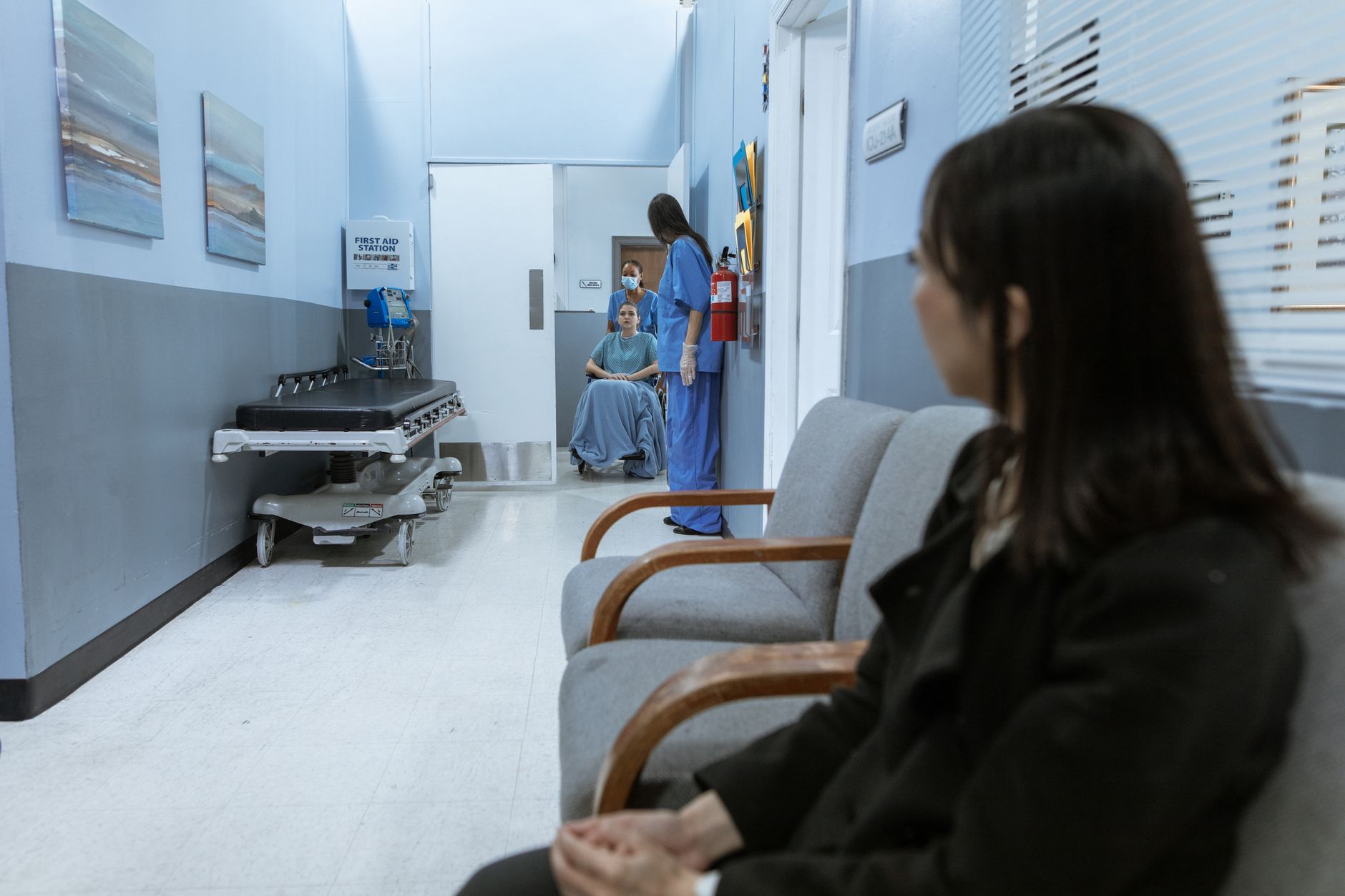
Renata Rhodes stood at the nurses’ station of Coyle County Hospital, put her hand flat on the counter like she was closing a deal, and told the charge nurse, “Family only, and he’s not blood.” She said it with me standing ten feet away in the corridor, holding my wife’s reading glasses in one hand and her house shoes in the other, because Pauline cannot stand the hospital socks with the rubber treads and I knew she would want her own things when she woke up.
He’s not blood. Thirty years of marriage, and that is what it came down to in a hallway that smelled like coffee and floor wax. Not blood.
I want to tell you the whole of it, because the woman who said those words is not a monster, and the woman lying in that room raised her better than that, and before this story was over, my wife found a way to answer her own daughter without ever raising her voice. Pauline always could do that. She could settle a room with a look. It turned out she could settle one from behind a closed door she could not even speak through, with an envelope she had sealed eleven years before.
But let me back up and do this right.
My name is Curtis Vann. I am sixty-eight years old, and I have lived my whole life in Tullis, Georgia, a town of about four thousand people, two red lights, one Piggly Wiggly, and more churches than gas stations. I spent thirty-four years as a heavy equipment mechanic for the county road crew. If a grader or a backhoe broke down anywhere in Coyle County between 1979 and 2013, odds are I was the man lying under it in the heat with a wrench, and I am not ashamed to say I was good at it. Machines make sense to me. You listen to them, you learn their sounds, and when something is wrong they will tell you if you pay attention. People are harder. People will run broken for years and smile at you the whole time.
I met Pauline in the fall of 1994 at a fish fry behind Mount Pisgah Baptist. She was forty years old then, a third grade teacher at Tullis Elementary, and a widow of three years. Her first husband, Dexter Rhodes, had been a foreman at the pallet plant, a big laughing man from what everybody tells me, and he dropped dead of a heart attack at forty-six with no warning at all, leaving her with two teenagers and a mortgage and a grief she carried the way she carried everything, upright, without spilling it on anybody.
I was thirty-six and had never married. I am not going to pretend there was some tragic reason. I was shy, I worked long hours, and I lived with my mother until she passed, and in a town like Tullis, by the time you look up from all that, the years have gone by. I had made a kind of peace with it.
Then Pauline Rhodes handed me a paper plate of fried catfish and told me I was standing in front of the hushpuppies.
I would like to tell you I said something smooth. What I said was, “Yes ma’am,” and moved about eight inches to the left, and she laughed, and that laugh went through me like current. It took me two months to work up the nerve to sit near her at church, four months to offer to look at the knocking sound in her Buick, and almost a year to ask if I could take her to supper at the fish camp out on Route 9. She said she would have to think about it. She thought about it for exactly one day and then called my house and said, “Friday. And you’re wearing a collared shirt.”
That was Pauline. She decided things, and then the world arranged itself around what she had decided. Third grade teachers are like that. She spent thirty-one years telling eight-year-olds to line up single file, and eight-year-olds do not care what you want unless you carry a certain weather with you, and Pauline carried it. The whole town had sat in her classroom or sent a child to it. To this day grown men at the hardware store call her Mrs. Rhodes first and correct themselves to Mrs. Vann second, and she never once minded. “They learned my name when they were eight,” she said. “You can’t undo third grade.”
Her children were another matter.
Cedric was nineteen when I started coming around, already off at Fort Valley State, and he took my measure over a couple of Thanksgivings the way young men do, decided I was harmless, and then decided I was useful when his transmission went, and somewhere between the transmission and his wedding we became something like friends and then something like family. Cedric is a deacon himself now, over in Macon. He calls me Pop when nobody’s listening and Curtis when everybody is, and I understand the arithmetic of that and have never once held it against him.
Renata was seventeen. And Renata had been her daddy’s whole heart, and he had been hers.
I want to be fair to her here, because it would be easy to make her the villain of this story, and the truth is more tender and more sad. Renata was a senior in high school when her father died. He had promised to walk her into the father-daughter dance at Tullis High that spring. He had a dress picked out with her, layaway at a shop in Milledgeville. He died in October, and she went to that dance in the spring on the arm of her uncle, in that same dress, because Pauline told her that grief does not get to take the dress too. That is the kind of mother Pauline is. But something in Renata sealed over that year, the way a road patch seals over, harder than the road around it.
And three years later, here came Curtis Vann in a collared shirt, sitting in her father’s pew.
She was never ugly to me in the early years. That is not Renata’s way. She was correct. She was cool. She shook my hand at the wedding in 1996 like I was a claims adjuster. She sat in the second row, not the first. When she left for Atlanta after college and made a real career for herself in commercial insurance, her visits home had a schedule to them, and I learned my part in the choreography, which was to be pleasant and to be slightly elsewhere. I carried her bags up. I fixed whatever was squeaking. I said it was good to see her, and I meant it, and then I found a reason to be in the yard.
Thirty years, I did that. I am not complaining. I am telling you the price of the thing so you will know what it was worth.
Because here is what those thirty years were, aside from Renata’s cool hand at holidays. They were Pauline reading library books out loud to me on the porch in the summer with her feet in my lap. They were three thousand Sunday dinners. They were her grading papers at the kitchen table while I rebuilt a carburetor on newspaper at the other end, neither of us saying a word for two hours and neither of us lonely. They were the year she had her rotator cuff surgery and could not lift her right arm, and I learned to braid her hair. I want to say that plain because I was fifty-five years old and my hands were rough as pine bark, and I stood behind my wife every morning with a comb and did it badly, and then less badly, and she never once laughed at me except the once, and we both laughed till she had to sit down. They were her hand finding mine in the dark of the sanctuary at every funeral we ever sat through together, and in a town like Tullis you sit through plenty.
And they were this, too. Every fall for four years, I drove a borrowed county pickup to Atlanta with Renata’s furniture when she moved apartments, because a daughter will accept a truck even when she will not accept a man. I hauled that girl’s same green sofa up four different stairwells. She would say thank you, Curtis, correct as a business letter, and I would say anytime, and mean it, and drive home. Pauline never asked me to do it. I never told Pauline everything Renata didn’t say. That was between me and the sofa.
The morning it happened was a Sunday in March.
Pauline was at the kitchen counter in her slip and her church blouse, and she was doing what she does every Sunday, which is fix her deviled eggs for the fellowship table while telling me things I already know about people we already know. I was at the table with my coffee. And her voice went strange in the middle of a sentence about the Hendersons’ grandbaby. Not stopped. Strange. Like a record slowing. I looked up and the left side of my wife’s face was sliding, and the bowl went off the counter, and I do not remember crossing the kitchen but I remember catching her, and I remember the eggs all over the linoleum, and I remember her eyes. Her eyes were awake in there and afraid, and her mouth could not find the words, and Pauline Vann had never in her life been unable to find the words.
I called 911 and held her on that floor and talked to her the whole nine minutes, and I will tell you what I said because it matters later. I said, “I’m here. I’ve got you. You don’t have to say nothing. I’ll do the talking till you’re ready to take it back over.” And her right hand squeezed my hand. The left one lay there like it belonged to somebody else.
The ambulance took her to Coyle County Hospital, which is a small county hospital, sixty beds, and I will not have a word said against the people who work there, because a nurse practitioner named Dionne Whitlow recognized the stroke in the driveway of our ambulance bay and had that clot-buster medicine going inside the hour, and the doctors will tell you that hour is why my wife is alive and talking today. The medicine did its work. But a stroke is a fire, and even a fire that gets put out fast takes some of the house with it. They moved her up to the intensive care unit, sedated, on monitors, with the first days being what the neurologist called the tell-us-more period. Swelling. Waiting. Watching.
The ICU at Coyle County has four beds and a rule: immediate family, two visitors, short visits. I rode in behind the ambulance and I was there before they even had her settled, and for the first few hours, nobody questioned that the gray-headed man wearing one brown shoe and one black shoe (I had dressed off the floor of a dark closet with my heart going like a jackhammer) was her husband, because I was. I sat with her. I held the hand that could still hold back. I called Cedric, who prayed with me on the phone and started driving. And I called Renata.
I have thought a lot about that phone call since. I was gentle as I knew how to be, and she went quiet, and then her voice came back with all the feeling pressed out of it, which I have learned over thirty years is how Renata sounds when she is most afraid. She said, “Which hospital.” Not a question mark on it. I told her. She hung up without saying goodbye, and I did not think a thing of it, because her mother had just had a stroke, and who among us is judged by that hour.
She got there at four in the afternoon with her heels clicking on the tile like a clock, and she looked at her mother through the glass for a long time, and I stood beside her and made the mistake of putting my hand on her shoulder.
She stepped out from under it like my hand was weather.
The next morning is when it happened. I had gone home at midnight because the ICU makes you, and slept three hours in Pauline’s recliner because our bed without her in it was a country I did not have papers for, and I was back in that corridor by six-forty with her reading glasses and her house shoes. And Renata was already at the nurses’ station with a folder. A folder. She had driven down from Atlanta into the worst day of her life and packed a folder, and if that does not tell you everything about how that woman handles being afraid, I cannot help you.
I heard the tail end of it. “Family only, and he’s not blood.”
The charge nurse that morning was young, and she looked from Renata to me and back, and Renata opened the folder. Inside it was a photocopy of an old advance directive from 1993. Before me. From the year after Dexter died, when Pauline, a new widow with two teenagers, had done the responsible thing at the urging of the funeral home man and signed a paper naming her daughter as her healthcare decision-maker, because her daughter was the family she had. Renata had kept a copy for thirty-three years. She slid it across that counter and said her mother’s wishes were on file and her mother’s wishes were that family make her decisions, and family, she repeated, in case the young nurse had missed it, meant blood.
Now. I am going to tell you what I know now, which is that the paper meant nothing. A later marriage, a spouse standing right there, thirty years of joint everything. The hospital’s own lawyer would have laughed that photocopy out of the building eventually. But eventually is a word that does a lot of quiet cruelty in a small hospital on a Monday morning. The charge nurse was twenty-six years old and had a folder in front of her and a family dispute on her hands, and the path of least resistance in every hospital in America is written on a little laminated card, and it says: when the family fights, restrict and escalate. Visitation paused pending clarification. Patient advocate notified. The advocate works Tuesdays and Thursdays.
They asked me to wait in the corridor. Pending clarification.
I want to be careful how I say what those three days were, because Pauline hates a man who wallows. I sat in that corridor. There is a bench across from the ICU doors, wood-look laminate with a seam in the middle that finds your hip bone at the second hour, and I can tell you every water stain on the ceiling tiles above it. I sat there from six in the morning until they made me leave at night, and I held her glasses and her house shoes, and twice a day I would ask, polite as my mother raised me, whether the clarification had come, and the nurses would look at me with a kindness that was worse than rudeness, because every one of them knew. Dionne Whitlow snuck me word of her vitals like contraband. An aide named Tremaine, whose truck alternator I had once fixed in the church lot, walked slow past me on his rounds and would say, low, “She rested good,” and keep walking. The whole floor knew what was happening. The machine of the place just could not stop itself. Renata sat inside the glass, correct and cool, with her mother’s limp left hand in hers, and she did not look at me through that window one time. I think now she could not afford to.
Cedric arrived Monday night and about lost his religion in that hallway. He went in to see his mother (blood, you see, no folder required) and came out and stood in front of his sister, and I watched through the glass as thirty years of birthday dinners came apart in one quiet, furious conversation. It did not move her. If anything it set the patch harder. Renata is not built to reverse under pressure. Pressure is what built her.
Cedric came out to my bench and sat down beside me and put his head in his hands and said, “Pop, I’m sorry.” First time he ever called me Pop with the lights on.
It was Tuesday night, home alone in the recliner, that I remembered the envelope.
Eleven years ago, Pauline had a spell. A small one, what the doctors call a TIA, a warning shot. Her words went sideways for about ten minutes on a Wednesday evening and came back, and we spent two nights at the medical center in Macon, and she was cleared and fine, and we drove home, and she was quiet the whole way, which is not her. And that next month she did things. She said, “I have seen how fast the phone lines go down,” and she went to see Rosalind Pryor.
Rosalind Pryor, Esquire, has a law office on the square in Tullis between the tax place and the flower shop, and has done the wills and deeds of half the county for forty years. Pauline spent two afternoons in there and came home and set a fat envelope on the kitchen table and told me three things. One, there were new papers, done right, and Rosalind kept the originals. Two, I was not to worry myself about the particulars. And three, this one she said with her hand on my face, “If it ever comes to it and I can’t talk, you go see Rosalind before you argue with anybody. I have done the arguing already.”
Then she made cornbread, and we never spoke of it again, and eleven years went by, and I forgot the way you forget a spare tire.
Wednesday morning I was on the square when Rosalind’s paralegal unlocked the door at eight-thirty, and by nine Rosalind had the file open on her desk, and she looked at it, and looked at me over her glasses, and said, “Curtis, sit down.” And then Rosalind Pryor, who is seventy-two years old and has the courtroom voice still, read me the cover memo, and I had to hold the arm of the chair.
There was a durable healthcare power of attorney, 2015, naming Curtis Vann, husband, as her agent. Sole. Notarized, witnessed, filed. It revoked, by name and date, the 1993 directive. Pauline had remembered that old paper for twenty-two years. She had remembered the funeral-home man and the form and her daughter’s name on it, and eleven years ago, in a lawyer’s office between a tax place and a flower shop, my wife had quietly gone back and closed the door her grief had once left open, because she had seen exactly, exactly, what could come through it.
And there was an envelope. Sealed. Pauline’s handwriting on the front, that teacher’s cursive that could shame a font. It said: “To be opened only if I cannot speak for myself. Read it out loud, Rosalind. To all of them at once.”
Rosalind stood up and got her keys and her good jacket and said, “I’ll drive.”
What happened at the hospital that afternoon happened in the family conference room off the ICU, with the patient advocate (it was Thursday-adjacent enough, suddenly, when a lawyer called ahead), the hospital’s risk manager on speakerphone, the charge nurse, Cedric, Renata, and me. Rosalind laid the power of attorney on the table first and let the speakerphone have a minute with it, and the speakerphone got very agreeable very fast, and the visitation matter was resolved before the letter ever came out, and I want to be honest and tell you that. The law fixed the door. The law did not fix the family. The letter was for that.
Rosalind put on her glasses and opened the envelope with a pocketknife, neat as a surgeon, and read my wife’s words out loud in that little room, and I am going to give them to you the way I have them, because Pauline has read this and says I may.
“If Rosalind is reading this, then I am somewhere with my mouth shut, which everyone who loves me knows means something has gone badly wrong. And if she is reading it to the people I asked her to read it to, then I already know what has happened, because I knew eleven years before it happened. Someone I love is standing in a hallway telling someone in a uniform that Curtis Vann is not my family.
“So let me speak, since I apparently cannot.
“Blood is how a family starts. It is not how a family is kept. A family is kept the way a garden is kept, by who shows up in the heat. And I am going to tell you who showed up.
“When I could not lift my right arm for four months, Curtis Vann learned to braid my hair. Badly, and then well. When my mother was dying in Eatonton, he drove me there every Friday for a year and sat in the truck in the yard for hours because Mama was old-fashioned about a man in the house, and he never once complained about the heat. He has hauled a green sofa up four staircases in Atlanta for a girl who never once asked him in for a glass of water. He knows I take my coffee with one sugar until the first cold morning of October and two sugars after, and he has never in thirty years gotten the date wrong, because he watches the weather for it. That is my family. I signed the papers that say so, but the papers are just the fence around the garden.
“Renata, my baby. I know it is you in that hallway. I have known since you were seventeen years old that the day would come, and I have prayed all this time to be wrong, and I would have loved to be wrong. You are not defending me from Curtis. You are defending your daddy from forgetting, and sugar, that is not a job anybody gave you. Dexter Rhodes does not need defending. He is not diminished one inch by that man in the hallway holding my house shoes. I did not replace your father. There is no arithmetic where one love subtracts another. You are grown now with a whole heart of your own, so hear your mother: the seat beside my bed is not your daddy’s seat. It never was. It is whoever-loves-me’s seat. There is room on that side of the bed for every one of you, but no one, no one, decides who sits there but me.
“And I have decided. I decided in 1996 in front of God and Mount Pisgah, and I decided again in this office today, with my blood pressure fine and my mind sharp, so no one can ever say I did not mean it.
“Let my husband in the room.
“And Renata, when I can talk again, and I intend to, come sit on my other side. I will want both my hands held. It has always taken all of you to hold all of me. Love, always, your Pauline, your Mama.”
Rosalind folded the letter, and that room was so quiet you could hear the ice machine down the hall.
I was not looking at the risk manager’s speakerphone or the advocate or the door. I was looking at Renata, because everyone was trying not to. And I watched my wife’s letter do what nothing living had been able to do for thirty years. Renata sat with her back straight and her folder squared in front of her, and her face held, and held, and then it did not hold. It came down slow, like the patch finally giving over the soft place in the road. She put both hands over her face, this correct, formidable, fifty-year-old woman, and she cried like the seventeen-year-old in the layaway dress, and Cedric got to her before I could even stand up, and over his shoulder she looked at me, the first time she had looked straight at me all week, and she said, “You kept her house shoes with you.”
Of all of it, that was the thing. The house shoes.
I said, “She can’t stand the socks with the treads.”
And Renata laughed, a wet, wrecked laugh, and said, “I know. I know she can’t,” and that was the whole conversation, and it was somehow thirty years long.
They walked me in at 4:15 that afternoon. Six days after the eggs hit the linoleum. Dionne Whitlow held the door herself and did not even pretend not to cry. Pauline was awake by then, off the sedation, and she was diminished, I will not lie to you, small in that bed with the tubes and the monitor light making her skin gray-gold, and her mouth still pulling to the left. But her eyes were her own. Her eyes were awake in there, same as the kitchen floor, only not afraid now. They found me the second the door moved, like she had been aimed at that door for days.
I put her glasses on the tray table where she could see them. I put her house shoes side by side under the bed rail where her feet would find them, whenever her feet were ready. And I sat down in the chair on her right side, the whoever-loves-her seat, and took her right hand, and her hand squeezed mine, strong, and I said what I had said on the kitchen floor. “I’m here. I’ve got you. You don’t have to say nothing. I’ll do the talking till you’re ready to take it back over.”
And Pauline Vann, six days out from a stroke, mouth pulling left, wires everywhere, worked that mouth like a stuck door and made it move by pure schoolteacher will, and got out three words, slow and slurred and clear enough for the record.
“Talking. Too. Much.”
The nurse heard it. The monitor tech heard it. My wife was two minutes back into speech and she was already correcting me, and I laughed and cried at the same time in a way I had not done since my mother’s funeral, and somewhere behind me I heard Renata, in the doorway, do the same.
I will not stretch this next part into more than it was, because recovery is not a movie, it is a job. Pauline did four weeks of rehab at the center in Milledgeville. Speech came back first, then the leg, most of the way. The left hand has stayed lazy, that is her word, lazy, and she carries it in her lap now like a sleeping cat and has learned to do with one hand what most people cannot do with two. I braid her hair every morning now, not because her shoulder is bad, but because the lazy hand cannot hold the third strand, and I have gotten good at it, and neither of us laughs anymore except when we do.
Renata came every weekend of those four weeks. Every one. Atlanta to Milledgeville is not nothing. The first Saturday she was correct and quiet and brought a folder, because Renata is going to Renata, only this folder had rehab research in it, the best exercises, a speech app for the tablet, and she sat on her mother’s left side, the lazy side, and worked that hand for an hour like it was billable. Pauline told me later that was the day she knew her letter had landed, because Renata took the hand that could not squeeze back and held it anyway.
The talk between Renata and me came in the parking lot of that rehab center in April, both of us leaning on her car in the evening cool, and it was not long and I will keep most of it, but I will give you the middle of it. She said, “I spent thirty years thinking if I let you in, I was letting him out.” She was looking at the sunset over the pines when she said it, because looking at me was still hard, and that is all right. Some things arrive on a delay, like thunder.
I said, “Renata, I have spent thirty years trying to keep that man’s tools oiled.” She looked at me then. And I told her what I had never told anybody, that in our shed, on the pegboard, Dexter Rhodes’s hand tools hang cleaned and oiled to this day, because they came with the house and the marriage, and a man’s tools deserve keeping, and every time I used his three-quarter-inch wrench in thirty years I said, out loud, alone in the shed like a fool, “Thank you, Dexter.” Because he built the first half of the garden I got to grow old in.
She cried on her car in that parking lot, and this time I did put my hand on her shoulder, and this time she stayed under it.
Pauline came home the first week of May. The church had cut our grass and loaded our freezer, because that is what Mount Pisgah does, that is the machine of that place, and it only runs one direction. She walked up our own porch steps on a cane with her jaw set like a graduation. And on the first Sunday in June, Renata drove down without an occasion, no holiday, no folder, and stood in our kitchen and made her mother’s deviled eggs herself, wrong at first, then less wrong, with Pauline sitting at the table running her mouth the whole time like the foreman of the world, one sugar in her coffee because it was warm out, and me at the other end with a carburetor on newspaper.
At one point Renata looked down the table at me and said, “Curtis. You’re out of paprika,” which does not sound like much, unless you have waited thirty years for a woman to say your name like you live there.
Here is what I know now, at sixty-eight, that I could not have told you in March.
Blood is a fact. Love is a decision. And a family is just the place where enough people keep making the same decision until it looks like a fact. Pauline decided in 1996 and again in 2015 and again in that hospital bed with three slurred words. Renata, it turned out, had been deciding all along too, only her decision was aimed backward, at a big laughing man who died before he could walk her into a gym in a layaway dress, and I cannot fault a heart for standing guard on a door long after the house is safe. You just have to hope somebody who loves you leaves a letter that tells you the war is over. You can come inside now. There is room on that side of the bed.
They let me in that room on a Thursday. But the truth, the real truth my wife had sealed in an envelope eleven years before, is that I was never out of it. You cannot bar a man from a room he has lived in for thirty years. You can only make him wait in the hallway, holding her house shoes, until she wakes up and asks for him.
She woke up. She asked. I was there.
I am still there. Both hands held, one of them lazy, all of her home.

Laura Bennett writes about complicated family dynamics, difficult conversations, and the quiet moments that change everything. Her stories focus on real-life tensions — inheritance disputes, strained marriages, loyalty tests — and the strength people find when they finally speak up. She believes the smallest decisions often carry the biggest consequences.