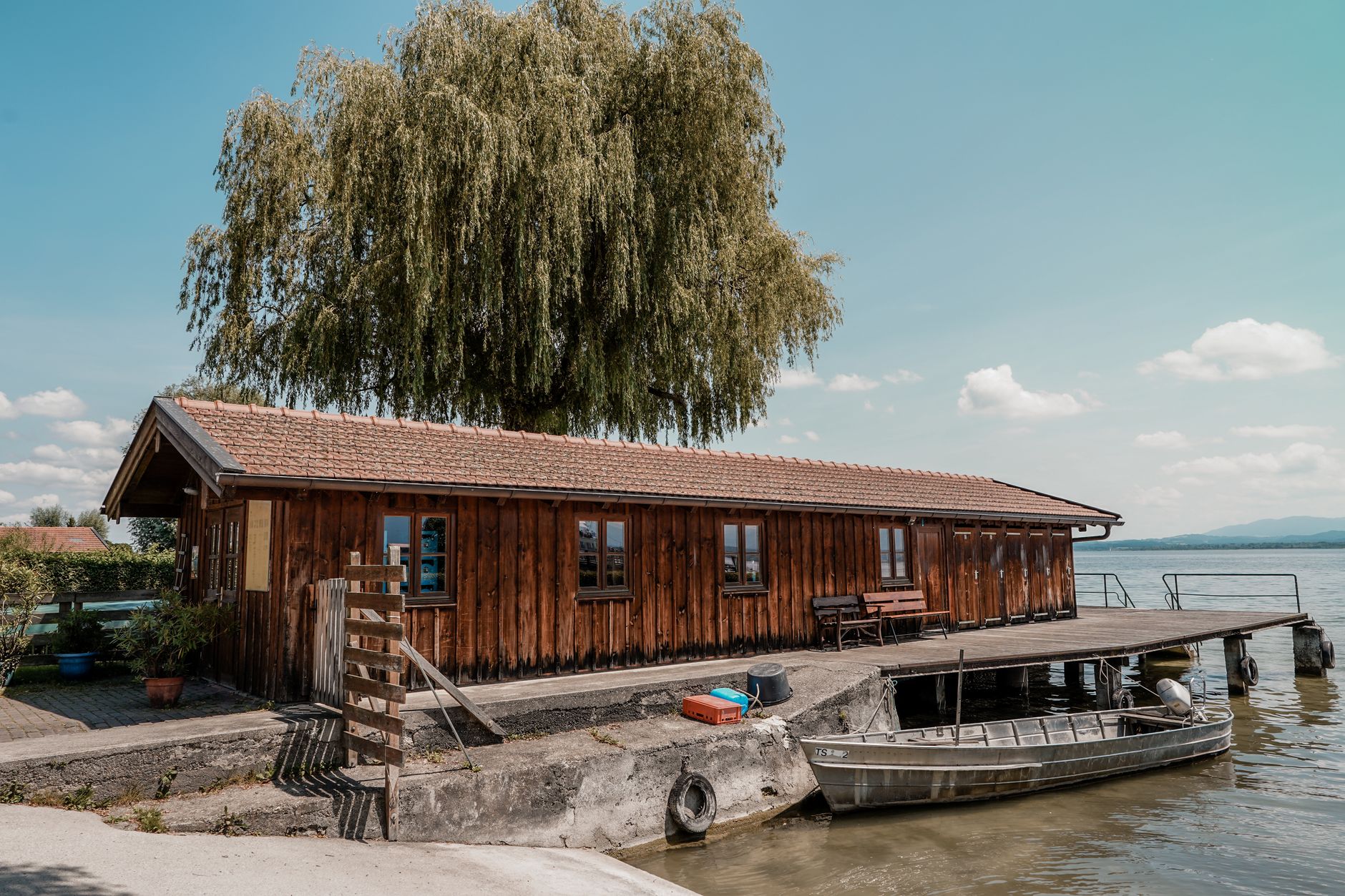
My son Brad stood on the dock where I taught him to bait a hook and told his sister the cabin was “just sitting there costing money,” and he said it the way you’d talk about a broken lawnmower, not the one place our family had gathered every Fourth of July for forty years.
I was not supposed to hear it. I was supposed to be up at the hardware store in Grand Rapids buying the propane fittings for the grill, the way I did every year on the third of July, so the burners would be clean and blue by the time the grandkids showed up. But I had left my reading glasses on the kitchen table, and I came back for them, and the screen door on the porch does not slam anymore because I fixed the spring myself two summers ago, so nobody heard me come in.
That is the whole thing, when I lay it out plain. A spring I fixed. A pair of glasses. Forty feet of gravel between the porch and the dock. That is all that stood between me finding out and me signing away the only home my wife ever loved without knowing what I was signing.
Let me back up. My name is Walt Nyberg. I am sixty-seven years old. I have buried a wife and I have raised two children, and until the third of July this year I would have told you those two children were the best things I ever made. I would have said Brad, my boy, forty-one, worked too hard and worried too much about money, but that his heart was in the right place. I would have said Lindsey, thirty-eight, was sharp as a tack and a little cold sometimes but that was just how she carried herself. I would have defended them to anyone. I did defend them. For years.
The cabin sits on the north end of a lake in Itasca County, up where the pines get so thick the road goes dark at two in the afternoon. My father bought the lot in 1961 for less than the price of a decent used truck, and he and my uncles built the place over three summers, hauling the lumber in on a flatbed and mixing the concrete for the piers by hand. It has a stone chimney my father laid himself, each rock hauled up from the shoreline in a wheelbarrow, and if you look close at the mantel you can still see where he carved the year into the wood before it fully cured. 1963. He was proud of that chimney. He should have been.
My wife Ellen and I took over the place in 1986, the year Brad was born. We drove up from the Twin Cities every summer, three hours each way in a station wagon with no air conditioning, both kids sweating and fighting in the back seat, and the second we turned onto that gravel road they’d go quiet, because they knew. They knew what was coming. The lake. The dock. The smell of the water and the pine pitch. Ellen used to roll the window down on that last stretch and just breathe it in with her eyes closed, and she’d say, every single time, the same thing. “There it is, Walt. There’s the world the way it’s supposed to be.”
We spent every Fourth of July at that cabin for forty years. I want you to understand what that means, because when Brad said “just sitting there,” that is the thing he was talking about, and that is the thing he did not understand at all. Forty Fourths of July. The little ones learning to swim off the end of the dock with the orange life vests we kept in the boathouse. The card games that went past midnight while the mosquitoes hummed against the screens. The one year the fireworks over the lake got rained out and we made our own with sparklers and a coffee can, and Ellen laughed so hard she had to sit down in the wet grass. The year my father, in the last summer before he passed, sat in his chair on the porch and watched the whole town’s fireworks reflect off the water and said, quiet, just to me, “This was the best thing I ever did, this place.” He was not talking about the wood or the chimney either. He was talking about all of us, standing in the light of it.
Ellen died four years ago. Ovarian cancer, and it was fast and it was ugly, and the last coherent thing she said to me that I could hold onto was in that cabin, on the porch, in the second week of June, when she was still strong enough to sit up. She took my hand and she said, “Promise me the kids keep coming up here, Walt. Promise me they don’t let it go.” And I promised her. I promised her the way you promise a dying woman, which is with your whole chest, no fingers crossed, no fine print.
So maybe you can start to see why the third of July hit me the way it did.
I had driven up two days early to open the place for the holiday. That was my job now, since Ellen. I aired out the rooms, I ran the water till it stopped coming out rusty, I checked the dock boards for rot and swept the mouse droppings out of the boathouse. Brad and Lindsey were driving up separately, both of them arriving the afternoon of the third with their families for the big Fourth. That was the plan. That had always been the plan.
Brad got there before Lindsey. I heard his truck on the gravel around eleven in the morning, and I called out from the kitchen that I was heading into town for the propane fittings, and he waved me off and said take your time, Dad, and I did. I took my time. I got most of the way to Grand Rapids before I realized I’d left my reading glasses on the kitchen table and I could not read the part numbers on the fittings without them, so I turned around and drove the twenty minutes back.
Lindsey’s car was in the drive by then, next to Brad’s truck. I remember being glad. My whole family, or the grown half of it, up at the lake, early, the holiday stretching out ahead of us. I remember I was smiling when I got out of the truck.
The screen door did not slam. I have to keep coming back to that, because everything turned on it. I fixed that spring myself. If I had not fixed it, the door would have banged shut behind me the way it did my whole childhood and my kids’ whole childhood, and they would have heard it, and they would have stopped talking, and I would have walked out onto that porch and picked up my glasses and driven back to the hardware store none the wiser. I would have signed the papers three weeks later thinking it was all above board. I would have lost the cabin and kept my son.
Instead the door swung shut soft, and I stood in the kitchen, and through the window over the sink I could see the two of them down on the dock, and I could hear them, because sound carries over water and up a gravel bank in a way that people who did not grow up on a lake do not account for.
“He’s not going to fight it,” Brad was saying. “He doesn’t have the energy anymore. Since Mom, he just goes along.”
I stood very still.
“You’re sure about the number?” That was Lindsey.
“Rick already had it appraised. Four-forty, maybe four-sixty if we don’t wait. That’s two-twenty each, roughly, after the fees. That’s a down payment on the lake house we actually want, Linds, one with heat and a dishwasher and cell service, not this falling-down museum Dad keeps pouring money into.”
“It is just sitting there,” Lindsey said. “It’s just sitting there costing money.”
And Brad said, “That’s exactly it. It’s just sitting there costing money. Nobody’s going to say that to his face, but that’s what it is.”
I want to tell you I felt rage right then. I didn’t. What I felt was a kind of falling, like the floor of the kitchen had tilted and I was sliding toward the window and there was nothing to grab. My hand found the edge of the counter. My father’s chimney was thirty feet away through the glass. My wife had died on that porch begging me not to let this place go, and my son was standing on the dock I taught him to fish from, calling it a falling-down museum, arranging to sell it out from under me, and the worst part, the part that took my knees, was the phrase itself. Just sitting there costing money. He said it twice. Lindsey said it. They had clearly said it to each other before, many times, until it had worn smooth as a stone in their mouths.
I did not go out there. I have thought a hundred times about why I didn’t, and the honest answer is I was afraid of what my face was doing, and I did not want them to see it. I picked up my reading glasses off the kitchen table, and my hands were shaking so bad I dropped them once, and I bent down and got them, and I went back out to the truck the same soft way I’d come in, and I drove to Grand Rapids and I sat in the hardware store parking lot for forty minutes without going inside.
Here is where I have to tell you about the phone, because without it none of the rest happens.
I am not a technology man. Ellen ran all of that when she was alive, and after she passed, Brad set up a new phone for me so I could see pictures of the grandkids. He put a few things on it I never learned to use. But one thing I did learn, because my hearing had started to go and I missed things at the doctor’s office, was how to hit the little red button that records. My audiologist showed me. I’d record the doctor’s instructions and play them back for myself at home. It was in my shirt pocket the whole time I stood in that kitchen. And somewhere in the falling, in the sliding toward the window, some old animal part of my brain that was not in shock, that was cold and clear and already thinking about survival, reached up and pressed that button through the fabric of my shirt.
I did not decide to do it. I want to be clear about that, because people ask. I did not stand there and calculate. My hand did it. But it did it, and when I sat in that parking lot forty minutes later and finally worked up the nerve to check, there it was. Eleven minutes of audio. My son’s voice, clear as the lake. Rick already had it appraised. Just sitting there costing money. He’s not going to fight it, he doesn’t have the energy anymore, since Mom he just goes along.
I played it four times in that parking lot. By the fourth time I was not falling anymore. I was something else. I was a man who had spent forty years being kind and going along and giving his children the benefit of every doubt, and who had just been handed, by his own trembling hand, the one thing that makes kindness dangerous to the people who count on you not having it. Proof.
Now, I need to explain what they had actually set in motion, because I didn’t learn all of it until later, and it was worse than the dock.
Rick is Lindsey’s husband. He is a real estate man down in Rochester, the kind who is always between deals and always sure the next one is the one. What I pieced together over the following two weeks, partly from the recording and partly from documents I had every legal right to see and had simply never bothered to look at, was this. The cabin and the lot were in a family trust Ellen and I had set up back in 2009, on the advice of a lawyer, to keep the place out of probate and pass it clean to the kids. I was the trustee while I lived. But there was a provision, a successor-trustee clause, and after Ellen died, in the fog of that first terrible year, Brad had come to me with a stack of papers “to keep everything in order, Dad,” and I had signed them at the kitchen table without reading them, because he was my son and I trusted him and I could barely see the words through the grief anyway. One of those papers named Brad co-trustee. Another gave him authority to act on the trust’s behalf if I was “unable or unavailable.”
They were building a case that I was unable. That was what “since Mom, he just goes along” was really about. It was not just cruelty. It was groundwork. Rick had lined up a buyer, a couple from the Cities who wanted to tear the cabin down and build one of those glass boxes on the lot. The plan was to have me sign a listing agreement I would think was something else, a “trust maintenance authorization,” Brad was going to call it, more papers to keep everything in order. And if I balked, if I fought it, they had the co-trustee clause and a story ready about how poor Dad hadn’t been himself since Mom passed, how he was letting the place fall apart, how it was really for his own good.
That is the thing that still takes the wind out of me. It was not a moment of weakness on Brad’s part. It was a plan with steps. My son had sat down and figured out how to take the one thing his mother died asking me to protect, and he had figured out how to do it in a way that would let him keep thinking of himself as a good person doing a practical thing for his difficult old father. Just sitting there costing money. The phrase was the permission slip he’d written himself.
I did not confront them on the Fourth of July. I have gone back and forth on whether that was strength or cowardice, and I have landed on this: it was neither. It was strategy. I had spent my whole life being the man who reacted with his heart, and look where that had gotten me, signing papers I couldn’t see because my boy said trust me. This one time, I was going to be the man who reacted with his head.
So I cooked the brats. I cleaned the grill burners till they ran blue. I watched my grandchildren swim off the end of the dock in the orange life vests, the same vests Brad wore when he was their age, and I did not let my face do the thing it wanted to do. Lindsey hugged me and said, “It’s so good to be up here, Dad,” and I said it was good to have everybody home, and I meant the grandchildren, and only the grandchildren. That night we watched the town’s fireworks reflect off the water the way we had every year, the way my father did in his last summer, and I sat in his chair on the porch and I thought about the eleven minutes of audio on the phone in my shirt pocket, and I felt, for the first time in four years, something that was not grief. I felt purpose.
The morning of the fifth, everybody packed up and drove home. I stayed. I told them I wanted a few quiet days at the lake, which was true, and they thought nothing of it, because since Mom, you know, Dad just goes along.
I did not go along. I drove to Grand Rapids on the sixth and I walked into the office of a lawyer named Sandra Petrofsky, whose name I got out of the phone book, a woman about Lindsey’s age with a firm handshake and a coffee mug that said WORLD’S OKAYEST GOLFER. I put the phone on her desk and I played her the eleven minutes. She listened to the whole thing without saying a word. When it was done she took a breath and she said, “Mr. Nyberg, do you have any idea what you’re holding?”
I said I had some idea. I said I mostly wanted to know if there was any way they could still take the cabin.
What Sandra explained to me over the next hour is that the recording changed everything, and not the way you might think. Minnesota is a one-party consent state, which meant that because I was present for the conversation, I had every legal right to record it, and it was admissible. But the recording did more than prove they were planning to sell. It proved they knew I would not consent, and that they were planning to work around my consent using the co-trustee authority I’d signed over in my grief. That was the ballgame. A trustee has what the law calls a fiduciary duty. Brad, as co-trustee, was legally bound to act in the interest of the trust and its beneficiaries, which included me, the person living in and using the property. Planning to sell it out from under me, engineering my signature on documents I didn’t understand, building a paper case that I was “unable” so they could act without me, all of that was not just cold. It was a breach of that duty, and the recording was him confessing to the intent in his own voice.
“They didn’t just plan to hurt you,” Sandra said. “They planned to hurt you in a way that has a name in the statute. You want to save the cabin. What you actually have here is enough to save the cabin, remove him as trustee, and make sure it can never happen again.”
We moved carefully. Over the next two weeks, while Brad texted me the usual once-a-week check-in and I texted back the usual fine, Dad’s fine, I met with Sandra three more times. She drew up a petition to remove Brad as co-trustee for breach of fiduciary duty. She drew up a full restatement of the trust that would make the cabin’s protection airtight, with a clause that it could not be sold while I lived, and provisions after that requiring the unanimous agreement of all beneficiaries plus a genuine appraisal and a right of first refusal for anyone in the family who wanted to keep it. And she drew up one more thing, which was the thing I cared about most, though I could not have told you why at the time. She revoked the successor-trustee authority I’d signed in the fog and named a neutral third party, a trust company, to step in if I ever truly became unable. Not Brad. Never Brad again.
I signed all of it on the twentieth of July, in Sandra’s office, with my reading glasses on, reading every single word.
Then I called a family meeting.
I did it at the cabin. I want you to understand the deliberateness of that. I could have done it at a restaurant, or over the phone, or in a lawyer’s conference room. I chose the porch. I chose my father’s chair. I chose to make my son sit in the place he had called a falling-down museum and hear what I had to say to him with the lake right there behind him, the dock right there, the water doing what it has always done.
They came up on a Saturday, both of them, thinking it was, I don’t know what they thought it was. Brad brought the papers. That is the detail that I keep returning to. He actually brought the “trust maintenance authorization,” the fake one, in a manila folder, ready to slide it across the table to his old father who just goes along. He set the folder on the porch table between us like he was doing me a favor.
I let him talk first. He gave me the whole speech, and it was smoother than I expected, and crueler for how reasonable it sounded. The cabin was old. The upkeep was a burden on me. Property taxes only went up. Wouldn’t it be smarter, Dad, to free up that money, maybe get a place closer to town, easier to manage, and we could all still, you know, gather. He actually said gather. As if a Marriott by a different lake was the same as the chimney my father laid by hand. Lindsey nodded along beside him. She said, gently, like she was talking to a child, “It’s just sitting there, Dad. It’s just sitting there costing money.”
And there it was. The phrase. Out loud. To my face this time.
I did not raise my voice. I have thought about this a great deal, and I believe the not raising my voice is the reason it landed the way it did. I reached into my shirt pocket and I took out the phone and I set it on the table next to Brad’s manila folder, and I said, “Before you slide that over here, I want you both to listen to something.”
And I pressed play.
I will never forget my son’s face for as long as I live. I have seen that boy fall off a bike and split his chin open. I have seen him at his mother’s graveside. I have never seen his face do what it did on that porch when he heard his own voice come out of that little speaker, clear as the lake, saying he’s not going to fight it, he doesn’t have the energy anymore, since Mom he just goes along. He went white and then he went gray. Lindsey put her hand over her mouth. Neither of them moved. The recording played all eleven minutes because I let it play all eleven minutes. I made them sit in it. Rick already had it appraised. Four-forty, maybe four-sixty. Two-twenty each. Just sitting there costing money. Just sitting there costing money.
When it finished, the only sound was the water against the dock pilings.
I let the silence sit for a while. Then I said the thing I had driven up two weeks early in my head to say. I said, “Your mother died on this porch asking me to promise the two of you would keep coming up here. She made me promise you would never let it go. And I have spent four years keeping that promise, and I find out you spent those same four years figuring out how to break it while I wasn’t looking, and how to make me sign the papers myself so your hands would stay clean.”
Brad started to say something. I held up my hand, and, I will tell you, my hand did not shake this time.
I said, “I’ve already been to a lawyer. You are no longer a trustee, Brad. The trust is rewritten. This cabin cannot be sold while I’m alive, and it’s protected after I’m gone in a way that would take all three of your children agreeing to break, which they won’t, because they still know what this place is even if the two of you forgot. The authority you had me sign in the folder after your mother died is revoked. And that,” I nodded at the manila folder still sitting there between us, “you can take back to Rick and tell him the deal is dead.”
Lindsey was crying by then. Real tears, though I have never been fully sure whether they were for what she’d done or for the two-hundred-twenty thousand dollars evaporating. I have made my peace with not knowing.
Brad said, “Dad, you don’t understand, we were trying to help you.” And I looked at him, my only son, forty-one years old, sitting in my father’s chair with his mother’s lake behind him, and I said the truest thing I have ever said to him.
I said, “No. You were trying to help yourselves, and you told yourselves a story so you could live with it. Just sitting there costing money. I heard you say it three times. A thing is not just sitting there if it’s holding forty years of your family. It’s only just sitting there if you’ve already decided to stop coming.”
I did not throw them out. People expect that next part and it isn’t there. I told them they were welcome at the cabin the same as always, that the door was open, that I hoped their kids would keep coming up even if they didn’t, because their kids still knew what the place was. That was for the grandchildren. Everything hard I did that summer, I did for the grandchildren, so that someday they’d inherit a chimney their great-grandfather built and not a story about how their fathers sold it for a dishwasher.
That was a year ago now.
Lindsey called me on the fourth of July this year. She was crying again, but it was different this time, older somehow, and she said she’d been thinking all year about what I said on the porch, about the story people tell themselves so they can live with a thing. She said she was sorry. Not the fast sorry you say to close a door, but the slow kind. She’s been coming up more. She helped me replace the dock boards in June. We don’t talk about the recording. We don’t have to.
Brad and I are not there yet. He came up once, in the fall, and we didn’t say much, and he split some firewood and I let him, and when he left he stood by his truck for a long minute like he wanted to say something and couldn’t find the first word. I didn’t help him find it. Some words a man has to find on his own or they don’t count. But he came. And the door is open. And I have decided that the open door is my part, and the walking through it is his, and I can’t do both jobs no matter how much I want to.
The grandchildren swam off the end of the dock this Fourth of July in the orange life vests. Six of them now. We made our own fireworks with sparklers and a coffee can because I wanted them to have the memory Ellen sat down laughing in the wet grass over, and the littlest one, Brad’s youngest, a girl of five, looked up at me while the sparkler burned down and said, “Grandpa, is this the best thing?” And I did not know what she meant, whether she was asking about the sparkler or the lake or the whole shining night, and it didn’t matter, because the answer was the same answer my father gave sitting in this same chair in his last summer.
I said yes. Yes it is. This is the best thing.
The cabin is not just sitting there. It never was. It’s holding all of us up, the way it was built to, the way my father laid every stone in that chimney to make it do. And I am the trustee. The real kind. The kind that keeps a promise made to a dying woman on a porch, with his whole chest, no fingers crossed, no fine print.
I keep the recording. I don’t play it anymore. But I keep it, the way you keep the deed to a thing, the way you keep the one piece of proof that you were not the fool they took you for. Eleven minutes that saved forty years. My hand pressed the button. I still don’t fully understand how. But I have stopped asking. Some things you just say thank you for, quiet, to whatever’s listening, and you go back out to the dock where the children are, and you stay.

Adrian Hawthorne is a celebrated author and dedicated archivist who finds inspiration in the hidden stories of the past. Educated at Oxford, he now works at the National Archives, where preserving history fuels his evocative writing. Balancing archival precision with creative storytelling, Adrian founded the Hawthorne Institute of Literary Arts to mentor emerging writers and honor the timeless art of narrative.