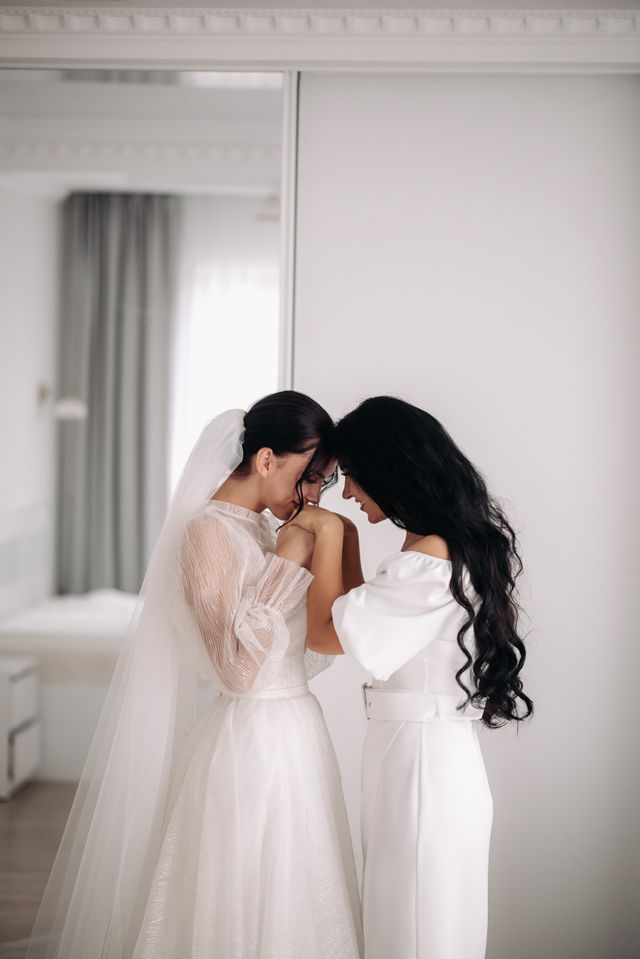
The morning light came through the lace curtains of the bridal suite in soft, watery bands, and I stood in front of a full length mirror at forty eight years old, lacing up a wedding dress I had sworn, twenty years earlier, I would never wear again. My hands remembered the motion better than my heart did, moving through the ribbon and the lace with a kind of muscle memory that felt almost embarrassing, given how long it had been since I’d trusted anything about weddings at all.
I had raised my daughter Emma and her younger brother James alone since Emma was six years old. For years after the divorce, I slept with a kitchen chair wedged under the doorknob, listening for sounds that never came but always, somehow, might. I smiled through my children’s birthdays because they needed at least one steady parent in the room. I learned to fix the water heater myself, to file my own taxes without help, to cry only in the shower where the noise of the water could carry it away before anyone noticed.
Then, two years ago, Andrew walked into my quiet, carefully rebuilt life and made room in it without ever asking me to shrink to fit. He made me feel chosen at an age when I had genuinely stopped expecting that particular feeling from anyone. He remembered that I took my tea with honey. He slowed his pace on the stairs because of my bad knee without ever once calling attention to the accommodation, the way some men make a show of their patience so you’re forced to thank them for it. Andrew simply did it, quietly, the way you’d hold a door for someone without needing them to notice you’d held it.
On our third date he told me I didn’t need to feel embarrassed for wanting a soft place to land after everything I’d survived. I’ve got you, he said, and I hadn’t known how badly I needed to hear exactly those words until the moment they landed. It had been a very long time since anyone had offered to hold anything for me instead of asking me to hold it for them.
When Andrew proposed, Marcy was the first person I called. Twenty five years of friendship had earned her that call before my own daughter even heard the news. I had spent more than half my adult life trusting Marcy with the parts of myself I hid from everyone else, including the parts that remembered exactly what my first marriage had cost me in ways I still hadn’t fully priced out even now. Are you sure, she’d asked, careful in the particular way she got when she loved you enough to ask the hard question anyway. For the first time in a long time, yes, I’d told her, laughing, and I had meant it completely.
Standing in front of the mirror on my wedding morning, I touched the lace at my waist and glanced toward the window. Guests were already gathering downstairs, and Emma was out in the garden checking the flowers, her voice drifting up through the open window, sharp and organized in the particular way it always got when she was nervous on my behalf rather than her own.
Andrew was already downstairs greeting the early arrivals, which struck me as slightly strange, since the night before he’d left the rehearsal dinner early, before dessert, to take a phone call. Business, he’d said, kissing my temple on his way out. I’ll make it up to you tomorrow. He’d been quiet on the drive back to the hotel afterward, quiet in a way I had noticed and cataloged and then, deliberately, chosen not to examine too closely. But today wasn’t a day for examining things, I told myself. Today was a day for lacing ribbons and believing, finally, in soft landings.
I looked at my reflection and tried to see the woman Andrew always said he saw in me. Chosen. Steady. Safe.
A knock came at the door, and I jumped slightly.
“Come in,” I called, expecting Emma with the boutonnieres.
Instead the door opened and Marcy stepped through, still in her regular clothes, jeans and a cream blouse I’d seen a hundred times before. Her pale blue bridesmaid gown hung pressed against her chest, the wire hanger bent under the grip of her fingers. She wouldn’t quite look me in the eye.
“Marcy,” I said, and my voice came out smaller than I’d meant it to. “Why aren’t you wearing your dress?”
She closed the door quietly behind her, the way you’d close a lid on something you could no longer hold steady.
“Please,” she said. “Please don’t ask me to put this on.”
“I tried,” she went on before I could respond. “I put it on this morning, stood in front of my own mirror, and I couldn’t do it. I couldn’t make myself walk down there in it.”
My fingers tightened around the bouquet stems in my lap until I felt the wire beneath the ribbon bite into my skin. “What changed, Marcy?”
She glanced back toward the door. Downstairs, someone laughed, high and bright, and the sound seemed to be arriving from an entirely different life than the one currently unfolding in this room.
“I realized I couldn’t stand beside you at that altar while knowing what I know,” she said. “There was a man with Andrew last night, near the parking lot behind the venue.”
I set the bouquet down slowly, because my hands had started to shake and I didn’t want her to see it happening.
“A man?”
“I couldn’t see his face at first, but I heard enough. I was walking back from my car when I heard voices around the corner, near the dumpsters.” She swallowed hard. “I recognized the voice before I ever saw who it belonged to. It stopped me cold, right there in the parking lot.”
“Whose voice, Marcy?”
She looked toward the door again, as though afraid someone might be listening from the hallway, though Andrew was almost certainly already waiting near the altar by then, checking his watch, entirely unaware his morning was about to change shape.
“Let me tell you what he was saying first,” she said. “Please. I need you to actually hear this part before anything else.”
I sat down slowly on the vanity bench, because my knees no longer felt entirely like mine.
“Okay,” I said. “Go ahead.”
“Andrew was talking about your father’s insurance settlement,” she said carefully, the way people speak around something they know might shatter. “And the house. The one that’s still in your name only.”
“He knows about those things. I told him myself, years ago,” I said, my voice sharper than I intended.
“I need you to hear the rest of it,” Marcy said gently. “Andrew said he only needed to hold steady for a year. Then he could restructure everything jointly. Those were his exact words. Restructure.”
The word landed like a stone dropped into still water, and I felt the ripples of it reach all the way into my ribs.
“That could mean almost anything, Marcy.”
“He laughed,” she said, her own voice breaking slightly on the word. “He laughed, and he said you were lonely enough that you wouldn’t look too closely at any of it.”
I don’t remember exactly what sound came out of me in that moment. I only remember the taste of it afterward, salt mixed with something faintly metallic, as though I’d bitten down on my own tongue without noticing.
“Say that again,” I muttered, not because I hadn’t heard her, but because some part of me needed to hear it fail to make sense a second time.
“I won’t repeat it twice,” Marcy said quietly. “Once was hard enough to get through, and I know you heard me the first time.”
I looked at my own reflection in the mirror, half laced, the back of the dress still hanging open where Emma had run out to check the flower arrangements before finishing the ties. My mascara had already started to go.
“Twenty years,” I whispered. “I slept with a kitchen chair wedged under my doorknob for two of them, Marcy. You know that better than almost anyone alive.”
“I know,” she said.
“He takes such good care of me.”
“I know that too.”
“So why would he say something like that.”
Marcy crossed the room and knelt down in front of the bench, taking the bouquet gently out of my lap and setting it aside on the vanity.
“Because some men learn exactly what a woman needs,” she said, “and hand it to her one careful spoonful at a time, until she’s full enough not to notice the price tag underneath it.”
I stared at her for a long moment, thinking about nearly three decades of Marcy being right about the exact things I never wanted her to be right about.
“You didn’t have to tell me today, of all days.”
“Yes, I did,” she said. “If I let you sign your name next to his without saying anything, I would never once forgive myself for it.”
Downstairs, the string quartet had started tuning their instruments. I could hear Emma’s voice through the floor, warm and hostess bright, telling someone the ceremony was running a few minutes behind schedule. Her voice sounded very close, closer than I expected.
I looked back at my own half laced reflection in the mirror.
“I need to hear it from him,” I said finally. “Before I decide anything at all, I need to hear this from Andrew directly, in his own words.”
There was a knock at the door just then, and Marcy answered it. It was Emma.
“Mom, what’s the delay?” my daughter asked, her face already creased with confusion at finding Marcy still in her street clothes.
I pulled Emma aside gently, the loose lace of the dress trailing behind me like something unfinished.
“I need ten minutes,” I whispered to her. “Please stall everyone downstairs. Tell them I broke a strap. Tell them anything at all.”
She searched my face for a long moment, then nodded without asking a single follow up question, which told me, more than anything else could have, that some part of her had already suspected something was wrong beneath the surface of this particular morning.
I found one of the servers in the hallway a moment later and sent him off with a folded note, asking Andrew to meet me privately in the small library just off the bridal suite.
He arrived within two minutes, worry pulling gently at the corners of his eyes, and kissed my forehead the way he always did, slowly and with apparent care.
“You’re pale,” he said. “Are you all right, love?”
“Who were you with last night, near the parking lot?”
He blinked once, then smiled easily. “My cousin Robert stopped by unexpectedly. Why? Did someone see us together and get worried about something?”
“You don’t have a cousin named Robert who was invited to this wedding.”
“He’s a distant cousin,” Andrew said, rubbing the back of his neck. “From my mother’s side of the family. What exactly is going on here?”
I sat down slowly on the arm of the leather chair across from him, keeping my voice as level as I could manage.
“Tell me about the settlement.”
The color drained out of his face in a way no explanation afterward could quite paint back over.
“What settlement?”
“My father’s. And the house that’s still in my name alone. And the word you used. Restructure.”
Andrew recovered quickly. Too quickly, in a way that told me something important about how often he’d had to recover from moments exactly like this one before.
“Sweetheart, who told you that? Was it Marcy?” His voice softened into something that sounded almost pitying. “She’s been acting strangely for weeks now. You’ve noticed it too, haven’t you.”
I didn’t answer him right away. I let him keep talking, because people like Andrew always kept talking if you simply gave them enough silence to fill.
“She’s been alone for a decade,” he went on, warming to the argument. “Ten years without anyone of her own. And now that you’re finally happy, suddenly she has doubts about me. Think about what that actually looks like, from the outside.”
For one brief moment, I actually did think about it. Marcy had seemed quieter lately, now that I considered it honestly.
The story he was building had just enough shape to hold water, at least for a few seconds. My throat tightened, and I nearly, almost, found myself apologizing to him for even asking.
Then he leaned forward and touched my hand gently.
“She’s been sabotaging this whole thing since the day I proposed,” he said. “She’s the reason your daughter had doubts too, you know.”
The room went very still around me.
I hadn’t told Andrew that Emma had doubts. I had never once said the actual word doubts out loud to him, not in two years together. My daughter and I had discussed it exactly once, over coffee, three months earlier, and I had only ever repeated that particular conversation to one single person afterward.
Marcy.
And Marcy hadn’t been alone with Andrew, not once, since February. No dinners together. No casual drop-ins. No shared errands run on my behalf. I had apparently been counting all of it without ever quite realizing I was keeping score.
My hand slid slowly out from under his on the armrest.
“How did you know Emma had doubts, Andrew?”
He hesitated, just barely, for one single beat. But a beat was more than enough.
“You told me,” he said.
“I didn’t. And Marcy hasn’t spoken to you alone in seven months. So try again. And while you’re working on that, there’s no cousin Robert either, is there.”
“You must have mentioned it,” he said. “When else would I have heard something like that?”
“That,” I said quietly, “is exactly what I’d like to know. Have you been listening in on my private conversations, Andrew?”
He straightened up in his chair, and the careful softness he’d worn like a second skin for two straight years slipped cleanly off his face all at once. What sat underneath it wasn’t cruel exactly. It was calculating, and tired, the particular tiredness of a man who had just realized his running start had finally hit a wall he hadn’t accounted for.
“Please leave the room, Andrew.”
“The guests are all waiting downstairs,” he said.
“I know that.”
“You’ll embarrass us both,” he said, his voice sharpening now. “Do you have any idea what people are going to say? About you, at your age, going through this a second time?”
I stood up slowly, gathering the loose lace of the dress against my hip.
“I understand exactly what people are going to say,” I told him. “And I understand something else now too. The only person who’s actually been honest with me today is the one who refused to put her dress on.”
I stepped past him toward the door, my hand steady on the knob for the first time in what felt like two decades. He reached out as though to stop me, but I shrugged free of his grip easily and walked out of the library, still half laced, the ribbons trailing behind me like loose threads from a life I no longer intended to wear.
“Emma,” I said, catching my daughter at the top of the staircase. “Bring Marcy. Now, please.”
She didn’t question me a second time. The three of us went down together, and I stopped at the top of the aisle, where every single guest could see me clearly in my half finished dress.
“I’m so sorry to have gathered you all like this,” I said, and my voice came out steadier than I expected it to. “There won’t be a wedding today. You all deserve honesty from me, not a performance.”
A murmur moved through the rows of chairs. Andrew pushed forward through the crowd, his face flushed red.
“You’re humiliating us both,” he hissed at me under his breath.
“No,” I said. “I’m saving myself.”
My brother in law and Emma moved quickly to guide him out of the garden before he could say anything further, his protests fading as they walked him firmly toward the parking lot.
Later, once the last guests had finally gone home and the flowers sat wilting untouched on their stands, Marcy sank onto the bench beside me on the porch.
“I sat in my car for a full hour this morning,” she said quietly, “trying to decide whether I could actually go through with telling you. I was so afraid you’d believe him over me if it came down to a choice.”
“Tell me the name now,” I said. “The one you wouldn’t say last night.”
She looked down at her own hands for a long moment.
“It was Daniel. My brother. You know how he’s always tangled up in something he shouldn’t be involved in.”
I stared at her, something cold moving slowly through my chest.
“I introduced the two of them at a dinner last spring,” she admitted. “I swear to you I had no idea they’d end up scheming together, or that any of it would ever be aimed at you. When I recognized his voice out there in that parking lot, I understood the whole shape of it all at once. But I couldn’t bring myself to say his actual name to you until you’d already made your choice for yourself, one way or the other.”
“That’s why you couldn’t put the dress on.”
“I couldn’t stand beside you at that altar carrying that particular guilt without telling you the truth first,” she said. “Even if telling you cost me something too.”
I reached over and took her hand in mine.
“You chose truth over your own comfort, Marcy,” I told her. “That’s the entire friendship, right there in one single decision.”
In the weeks that followed, I learned things in pieces, the way you learn most difficult truths, not all at once in one clean revelation but slowly, through phone calls and quiet conversations and one uncomfortable meeting with a lawyer I hired the Monday after the wedding that never happened. Andrew, it turned out, had done this before, twice actually, under a slightly different name each time, always with women in their late forties or early fifties who owned property outright and carried settlements from something painful in their past. Daniel, Marcy’s brother, had apparently been the one who found me for him in the first place, through some mutual connection at that dinner party none of us had thought twice about at the time. It made me sick to learn how deliberate the whole architecture of it had been, how carefully Andrew had studied exactly which parts of me needed tending and then simply provided that tending on schedule, the way you’d feed a plant precisely enough water to keep it from wilting without ever actually letting it grow past a certain careful height.
I did not press charges, in the end, though my lawyer walked me through what that process would have looked like if I had. There was no clean crime here, nothing a court could easily name and prosecute, just a slow, patient cruelty dressed up for two years as genuine devotion. What I did instead was quieter and, I think now, more useful to me. I changed the locks on the house that was still, and would remain, entirely in my own name. I moved the small joint savings account we’d opened together back into something that belonged only to me. I blocked his number, then blocked it again on a second phone when he tried calling from a friend’s line three weeks later, his voice, according to the voicemail I let play out once before deleting it, still carrying that same careful, practiced warmth, as though none of it had ever actually cracked open in that library.
Emma asked me, a few weeks after everything settled, how I’d known to send that note to Andrew instead of simply confronting him in front of everyone the moment Marcy told me. I thought about the question for a while before I answered her properly. I told her that twenty years of marriage to my first husband had taught me exactly one useful thing above everything else, which was that a person who is about to lie to your face will always lie more convincingly with an audience watching than they will in a small room with just the two of you and nowhere left for either of you to perform. I wanted to see Andrew without the wedding around him, without the guests and the flowers and the string quartet tuning up downstairs, because I needed to know whether the man I’d fallen in love with over two years existed independently of the setting he’d built so carefully around himself, or whether he only existed inside that setting, the way certain flowers only bloom under exactly the right greenhouse conditions and die the moment you take them outside.
He hadn’t existed outside of it. Not really. Stripped down to a small library with no audience and nothing left to gain from performing, Andrew had simply become a tired, calculating stranger explaining away one inconsistency after another until he ran out of explanations entirely.
Marcy and I talked about that morning many times over the following months, turning it over between us the way you turn over a stone you’ve stepped on for years without ever quite noticing what it actually was. She told me once, sitting on my porch on a cooler evening in early autumn, that she had genuinely believed, sitting alone in her car that morning before the wedding, that telling me the truth would cost her our entire friendship. That I would choose Andrew’s version of events, the warmer, easier, more comfortable version, over hers, simply because comfort was so much less painful to believe than betrayal. I told her that twenty five years of friendship had earned her more trust than that, even if some small, frightened part of me had genuinely wavered for a few seconds in that bridal suite while Andrew was building his case against her downstairs in the library. I told her I was grateful, more grateful than I probably managed to properly express in the moment itself, that she had chosen to walk into that room in her regular clothes instead of zipping herself into that pale blue dress and standing silently behind me at the altar with all of it locked inside her.
James, my son, flew in from Chicago two weekends after everything happened, not because there was any particular crisis left to manage by then, but simply because he wanted to sit with me for a while and make sure I was actually eating properly and sleeping through the night. He was quieter about the whole thing than Emma had been, less inclined to ask detailed questions, more inclined to simply show up and cook dinner and sit with me on the porch in comfortable silence. At one point, watching the sun go down over the yard, he told me he’d liked Andrew well enough over the two years, had genuinely believed the man made me happier than he’d seen me in a long time, and that finding out the truth had made him angry in a way he hadn’t quite expected, less because of what Andrew had tried to take and more because of how long he’d apparently been willing to wait to take it. A year, James said, shaking his head slowly. He was willing to just wait a whole year, being kind to you the entire time, purely as an investment. I told James that was, in its own strange way, the part that had actually taken me longest to fully absorb, the sheer patience of it, the fact that kindness itself, something I had trusted my whole life as a fairly reliable signal, could be manufactured and sustained for years at a stretch in service of something that had nothing to do with love at all.
I sold the wedding dress eventually, though not right away. For a while it hung in the back of my closet, still half laced from that morning, because I genuinely couldn’t decide what I felt about it enough to make any decision at all. Then, one Saturday in late October, I took it down, laced it up properly myself in front of the same full length mirror, standing alone in my own bedroom rather than a rented bridal suite, and looked at myself for a long moment. I didn’t cry, which surprised me. I simply looked, taking stock of a woman who had, at forty eight, nearly signed her name and her house and her father’s settlement over to a man who had learned her like a set of careful instructions rather than a person. Then I took the dress off, folded it properly, and donated it to a consignment shop two towns over, one where nobody would recognize either the dress or the story attached to it.
What I kept, instead, was something smaller and considerably more useful. I kept the ribbon from the bouquet Marcy had set aside on the vanity that morning, tied now around a small jar on my kitchen windowsill where I keep loose change for the parking meter downtown. It’s a strange thing to keep, I know, a scrap of ribbon from a wedding that never happened, but it reminds me, every single morning when I reach for a quarter, of the exact moment my best friend walked into that room in her regular clothes and told me a truth that cost her something real to say out loud.
Weeks later, I sat on my porch with a mug of tea and honey warming my palms, the steam curling up into the cooler evening air. Emma sat on one side of me, James on the other, having come back through town again on his way to somewhere else, and Marcy sat across from all of us in the wicker chair she’d claimed as hers years ago, long before any of this happened, back when she was simply my oldest friend rather than the woman who had refused to wear a dress on the worst morning of my adult life.
The dress itself was gone now, sold to strangers who would never know its history, but I didn’t feel the absence of it as any kind of loss. This time, packing away that particular chapter had come not out of fear, the way it had the first time around after my divorce, but out of something closer to freedom, chosen deliberately rather than survived by accident.
At forty eight years old, sitting on my own porch surrounded by the people who had actually told me the truth when it mattered most, I had finally learned the real difference between being chosen by someone else and choosing myself first. It had taken two failed weddings and one very brave friend standing in the doorway in her regular clothes to teach me that particular lesson, but I understood it now in a way I suspected I never would have without every single piece of it happening exactly the way it had. The tea was warm in my hands. The evening was quiet in the good way now, not the watchful way. And for the first time in longer than I could easily measure, the silence around me belonged entirely to me, with nothing wedged under any doorknob, and nobody left to wait for.

Ethan Blake is a skilled Creative Content Specialist with a talent for crafting engaging and thought-provoking narratives. With a strong background in storytelling and digital content creation, Ethan brings a unique perspective to his role at TheArchivists, where he curates and produces captivating content for a global audience.
Ethan holds a degree in Communications from Zurich University, where he developed his expertise in storytelling, media strategy, and audience engagement. Known for his ability to blend creativity with analytical precision, he excels at creating content that not only entertains but also connects deeply with readers.
At TheArchivists, Ethan specializes in uncovering compelling stories that reflect a wide range of human experiences. His work is celebrated for its authenticity, creativity, and ability to spark meaningful conversations, earning him recognition among peers and readers alike.
Passionate about the art of storytelling, Ethan enjoys exploring themes of culture, history, and personal growth, aiming to inspire and inform with every piece he creates. Dedicated to making a lasting impact, Ethan continues to push boundaries in the ever-evolving world of digital content.