Eight Years in Lyon
My daughter’s future in laws flew in from Europe to meet our family, and at dinner they switched into French, certain that I could not understand them. Then I heard what they said about my daughter, and I set down my fork very slowly, because this time I could not stay quiet.
My name is Margaret Doyle. I am sixty three years old, divorced, recently retired, and living alone outside Rochester. For most of my adult life I had become very good at making myself easy to overlook.
That habit formed slowly, over thirty one years of marriage. My ex husband never needed to shout. A raised eyebrow, a tired sigh, a quiet “Do you really think that’s necessary, Margaret,” was usually enough to make me step back and fold up whatever I had been about to say. By the time the divorce was finalized four years ago, I had genuinely forgotten how to take up space in a room without apologizing for the space I took.
My daughter Claire was thirty and working as a graphic designer in Boston. She was thoughtful, practical, and direct, which are qualities I admired in her and which some people mistook for simplicity, because some people cannot tell the difference between a person who lacks depth and a person who simply refuses to perform it. Two years earlier she had met Luca Beaumont, a structural engineer raised in Brussels. He was quiet and kind and clearly, visibly devoted to her, and when he proposed, Claire called me first, before anyone, and I sat in my kitchen and cried after we hung up.
Three months later, his parents flew in to meet us.
Claire and Luca rented a lake house near Lake George for the long weekend. Cedar deck, stone fireplace, wide windows facing the water. I stopped at Wegmans on the drive north and bought flowers and fresh bread and a bottle of Finger Lakes Riesling, because I did not know how to arrive anywhere without carrying something useful in my hands. That was another old habit. Never enter a room without offering something first, so that no one has cause to wonder why you are there.
Claire met me in the kitchen with flour on her apron.
“Mom, I really want this weekend to go well,” she whispered. “Hélène is lovely, but she’s particular. Philippe too. They’re very proud of their family, of where they come from.”
“I’ll behave,” I said.
Claire frowned. “That’s not what I meant.”
But it was what I heard, because it was what I had been trained for decades to hear. I heard, please be small and pleasant and do not embarrass me.
Hélène came out onto the drive while I was still getting my bag from the car. Tall, elegant, in pressed linen and a pale silk blouse, dressed for a gallery opening rather than a weekend by an American lake. She kissed both my cheeks.
“Margaret. We have heard so much about you.”
Her English was excellent. Her smile was warm in the careful, practiced way of a woman who has decided in advance exactly how warm to be.
Philippe shook my hand firmly. Silver hair, a watch worth more than my car, the easy confidence of a man who had never once in his life wondered whether he belonged in a room he was standing in.
We had drinks on the deck before dinner. The late May sun turned the lake to copper and a small flag moved on the neighbor’s porch, and Claire and Luca talked about wedding plans while Philippe shared his opinions on architecture and wine and, it seemed, most other things.
Then Hélène turned to her husband and began speaking French.
I understood every word.
What none of them knew, what even Claire did not really know, was that before I was a wife and a mother and a high school teacher, I had lived in Lyon for eight years. I went at twenty two with one suitcase and no sensible plan at all. I learned French waiting tables, arguing with landlords, shopping at the Saturday market on the Quai Saint Antoine, falling in and out of love in a language that was not my own, building an entire life in a city that had no patience whatsoever for a timid foreigner and therefore did not permit me to remain one.
I almost never spoke about those years. Claire knew, vaguely, that her mother had once lived in France. She had never heard me speak the language, not once, because by the time she was old enough to ask, the woman who had lived in Lyon felt like someone I had read about rather than someone I had been. Thirty one years of marriage had put her away somewhere and closed the drawer.
So I stayed quiet, and I listened.
At first it was almost nothing. Hélène called the house charming but too rustic for her taste. Philippe said Americans sometimes confused nature with culture. I took a sip of my wine and let it go, because letting things go was the great skill of my life.
Then Hélène glanced at Claire, who was laughing at something Luca had said, and remarked, in French, “She is sweet. A little simple, perhaps. But good natured.”
Luca’s face tightened. “Please don’t call the woman I’m marrying simple,” he said, in French, low.
Hélène waved a hand. “I mean uncomplicated. Honest. She does not pretend to be more than she is.”
They still believed I understood nothing. That is the part I keep returning to. Luca knew I had lived in France. He must not have thought to mention it, or must not have known I still had the language, and his parents had simply assumed, the way people assume, that a sixty three year old woman from outside Rochester in a cardigan from Wegmans could not possibly have anything in her head they needed to worry about.
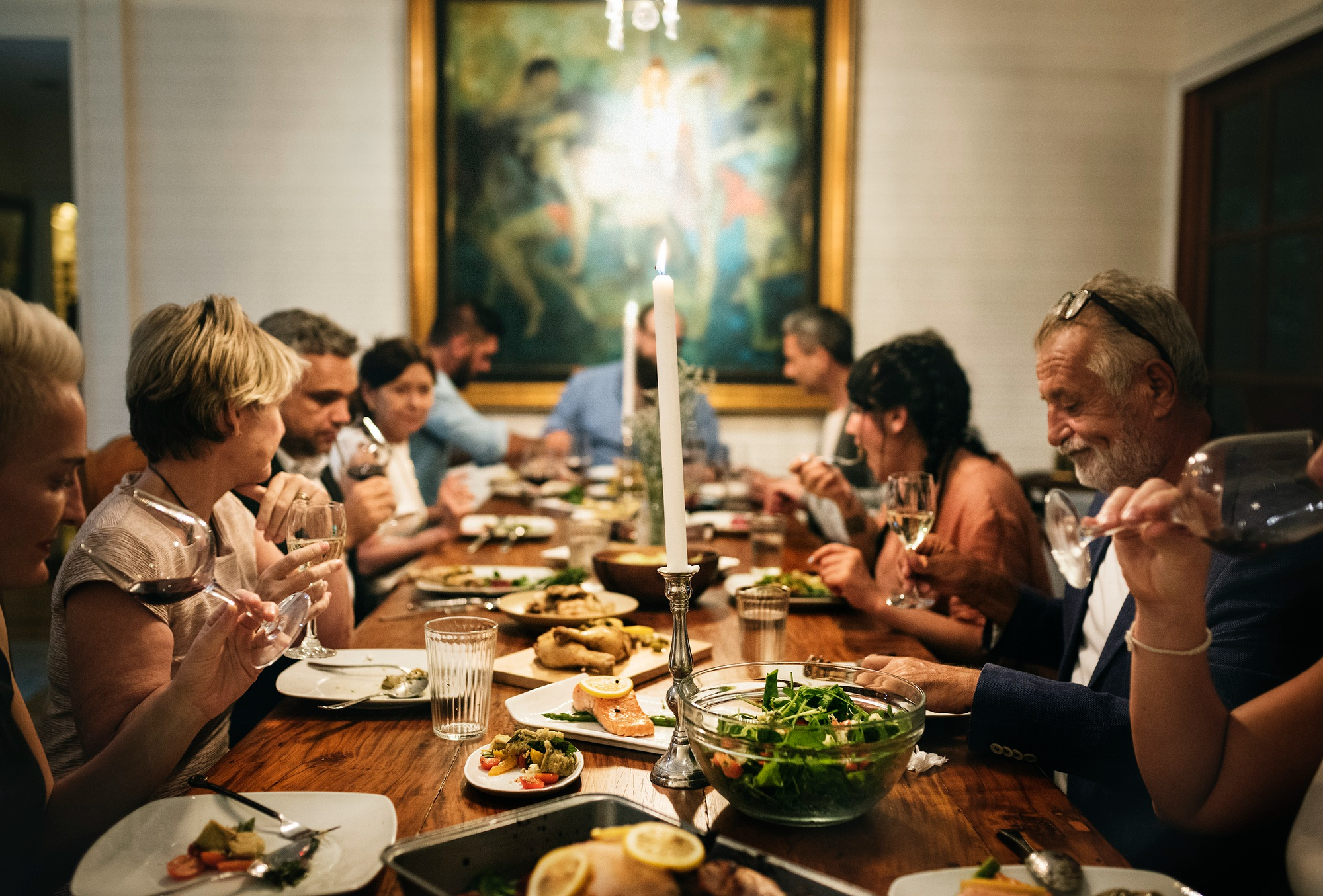
At dinner, Claire served the beef bourguignon she had been practicing for three weeks. I knew she had been practicing because she had called me twice about it, once about the wine and once nearly in tears because the sauce had broken. It had not broken tonight. It was very good. Philippe praised it warmly, in English.
Then he turned to his wife and said, quietly, in French, that he now understood where Claire’s lack of polish came from. Her mother was kind enough, he said, but clearly not a woman who had seen much of the world.
I kept my eyes on my plate.
Hélène answered that there was nothing wrong with a small life. That not everyone possessed ambition, or curiosity, or the courage to build something beyond the ordinary, and that one should not hold it against them.
My hand tightened around my fork.
Claire caught it. She catches everything, my daughter. “Everything okay, Mom?”
“Everything’s fine,” I said.
Then Philippe added, still in French, still perfectly relaxed, that he hoped Luca would not spend his whole marriage carrying a wife with no real cultural foundation. That he wanted his future grandchildren to understand where they came from. Meaning Brussels. Meaning them. Not from here. Not from us.
And that was the moment something inside me that had been folding itself smaller for thirty one years simply stopped.
I looked at my daughter, who had spent an entire day cooking for two people who were quietly grading her against a rubric she did not know existed and could not have seen if she tried. I looked at Hélène and Philippe, who had mistaken my silence for the absence of anything worth hearing.
And I set my fork down beside my plate.
Philippe was still talking when I raised my eyes and answered him.
In French.
I did not raise my voice. I want that understood, because I have told this story a few times now and people always assume I shouted, and I did not. I answered him in the register I had learned in Lyon, which is the register the French reserve for putting someone very firmly in their place while remaining, on the surface, impeccably polite. It is a beautiful and terrible thing to do in French, far more so than in English, and it had been thirty years since I had done it, and it came back to me whole, the way swimming does.
“Forgive me, Philippe,” I said, in French. “I have been enjoying your conversation so much that I did not want to interrupt. But I think, perhaps, there is something you would want to know before you continue.”
The table went silent in a way that dinner tables do not usually go silent. Hélène’s fork stopped in the air. Philippe’s face did something complicated and slow.
“I lived in Lyon,” I said, “for eight years. On the Croix Rousse, and then near the Parc de la Tête d’Or. I waited tables on the Rue Mercière when I was younger than Claire is now, and I learned your language from people who did not slow down for me and did not think me charming. So I have understood every word you have said since you arrived. About the house. About my daughter being simple. About my small life, and my lack of curiosity, and the cultural foundation you are worried I have failed to provide.”
Nobody moved. Claire was looking at me with her mouth slightly open. Luca had put his hand over his eyes.
“I want to be very precise,” I went on, in French, “because I would hate for anything to be lost in translation. You have sat at my daughter’s table, eating a meal she practiced for three weeks to honor your family, and you have used the one language you assumed would protect you to call her uncomplicated and unpolished and beneath your son. You did this in front of her, believing that her ignorance made it safe. That is not the behavior of people with a cultural foundation, Philippe. In Lyon, we would have called it the behavior of people with money and no manners, which is the most common kind of poverty there is.”
Hélène set down her fork. “Margaret—”
“I am not finished, Hélène, and you will let me finish, because you have been talking about my family for two hours and now it is my turn, and I am doing you the courtesy of a language you understand.” I said it pleasantly. That is the trick of it. You must say it pleasantly. “You said not everyone has the courage to build something beyond the ordinary. Let me tell you what my daughter built. She built a career in a difficult field with no help from her father, who did not believe women needed careers, and no money from me, because I did not have any to give after the divorce. She built it herself, in a city that is not her home, and she is very good at it, and she is respected by people who know a great deal more about the world than a nice dinner and a good watch.”
Philippe had gone quite pale.
“And she chose your son,” I said, “who is kind, and who just put his hand over his eyes because he is ashamed of you, which tells me Claire chose well, and tells me you raised him better than you are behaving tonight. You should be relieved. Your son is marrying into a family that will love him without measuring him. Instead you are sitting here worried that my grandchildren might grow up thinking Rochester is as good as Brussels.” I let that sit. “They are going to grow up thinking their grandmother is a woman who lived alone in a foreign country at twenty two with one suitcase, and who at sixty three finally remembered that she could. That is the cultural foundation I intend to provide. I think it will serve them.”
Then I picked my fork back up, and I said, in English, to my daughter, “This is excellent, sweetheart. The sauce is perfect. You should be very proud.”
The silence after that was one of the great pleasures of my life, and I have not had a great many, so I know one when I feel it.
I want to tell you what happened after, because a good scene and a whole story are not the same thing, and the after is the part that actually mattered.
Philippe did not storm out. Hélène did not make a speech. What happened was quieter and, I have come to think, more real than a blowup would have been.
Philippe put down his knife and fork, and he looked at me for a long moment, and then he said, in English, so that Claire would understand him, “Madame Doyle. You are right. I am ashamed.”
I had not expected that. I had braced for defensiveness, for wounded pride, for the long cold sulk of a powerful man corrected in public. Instead he said it plainly, in the language of the table, so that his correction would be as public as his cruelty had been.
“We did a terrible thing,” he said, still in English. “We came to your daughter’s home and we hid behind our language to be unkind, and we did it because it was easy, and because we assumed no one would ever know.” He looked at Claire. “Claire. I am so sorry. What I said about you was not true and I knew it was not true when I said it. You have been nothing but gracious to us and I repaid it with cowardice.”
Hélène was crying, quietly, in the careful way she did everything. But the tears looked real. “I called you simple,” she said to Claire. “You are not simple. You are the least simple person my son has ever brought home, and that frightened me, and I said a small ugly thing because I was frightened, and I am sorry.”
Claire, who is the most direct person I know, said, “Why were you frightened?”
And Hélène, to her enormous credit, answered honestly. “Because Luca loves you more than he has ever loved us, and I did not know where I would fit. So I decided you were beneath us, because that was easier than admitting I was afraid of losing my son to a family that is warmer than ours.”
I have thought about that sentence more than any other from that weekend.
Because it is the truth underneath almost all of this kind of cruelty, and it is worth saying out loud. Hélène and Philippe had not insulted my daughter because they were monsters. They had insulted her because they were afraid, and because contempt is what fear wears when it has good clothes and does not want to be seen trembling. It is very hard to look at your son’s happiness and feel yourself becoming unnecessary. Most people cannot do it without flinching, and the flinch, dressed up, comes out as she is a little simple, perhaps.
That did not excuse it. I want to be clear that I did not decide it excused it. But it changed the shape of the rest of the weekend, because you cannot fully hate people who tell you the true frightened thing under the cruel thing, and they told it.
The four days that followed were among the strangest and best I have had.
Philippe asked me about Lyon. Not politely, not to make amends, but with real hunger, because it turned out he had done his own engineering training in Lyon for two years in the 1980s, and we had, it emerged over the second bottle of wine, almost certainly walked the same streets at the same time, thirty years before either of our children existed. We stayed up until two in the morning that night, the two of us, arguing about whether a particular bouchon near the Rue des Marronniers still existed, and Claire came down for water at one point and found her mother and her fiancé’s father laughing in French over a map drawn on a napkin, and she told me later that she stood on the stairs and cried, because she had never once in her life seen me like that.
Hélène and I did not become close as quickly. She is not a woman who becomes close quickly. But on the last morning she found me on the deck with my coffee, and she sat down, and she said, “I would like to know the woman who lived in Lyon at twenty two. Claire does not know her. I do not think you know her very well anymore either. But I would like to.”
And I said, “I’m getting to know her again myself. You can come along if you like.”
The wedding was the following spring. It was not in Brussels, and it was not a battle to keep it from being in Brussels. Claire and Luca chose the Finger Lakes, and Philippe insisted on paying for the wine and flew in cases of it, and Hélène helped me choose my dress over three video calls in a mix of English and French, correcting my French gently, the way you correct someone you have decided to like.
At the reception, Philippe gave a toast. He gave part of it in French, and then he stopped, and he said, in English, “I will translate that for the American guests, but I will not translate it for Margaret, because Margaret understood every word, as I learned the hard way, over a very good beef bourguignon, that she always does.” And the whole room laughed, and I laughed hardest of all, and I was not making myself small in that room, not for one second of it.
Here is the part I most want to set down, though, because it is not really about Hélène and Philippe at all.
It is about the fork.
I have thought a great deal about the moment I put it down. For thirty one years of marriage, and four years of a quiet retired life after, I had been a woman who kept her eyes on her plate. Who heard the cruel thing and let it go. Who entered every room carrying bread so that no one would ask why she was there. My ex husband did not beat me and did not scream at me. He did something quieter and more thorough. He taught me, over three decades, one raised eyebrow at a time, that the safest thing I could be was silent, and I had learned the lesson so well that I had forgotten it was a lesson and mistaken it for my personality.
And the truth is that Hélène and Philippe did not do anything to me that weekend that had not been done to me a thousand times before. People had been talking over me and around me and about me my entire adult life. The only difference, the only thing that changed everything, was that this time they did it in the one language that reached all the way back to the woman I had been before I learned to disappear.
They spoke French, and French did not belong to my marriage. French belonged to Lyon, to twenty two, to one suitcase and no plan, to the girl who argued with landlords and waited tables on the Rue Mercière and was not, in those years, afraid of anything. When Hélène called my daughter simple in French, she did not reach the woman in the cardigan. She reached past her, by accident, to the woman underneath, and that woman had never learned to keep her eyes on her plate, because she had left America before anyone taught her to.
So when I picked up the fork again, at the end, I was not the same person who had set it down. That is not a figure of speech. The woman who lifted that fork had eight years in Lyon in her, and she has not put them away again since.
Claire and Luca have a daughter now. She is two. Her name is Margaux, which is close enough to my name to make me cry the first time I heard it and every time since. She has four grandparents who adore her, and she is going to grow up moving between two languages and two continents, and she is never, not once in her life, going to sit at a table and be talked about in a language she does not understand, because she is going to understand all of them.
I babysit her when Claire and Luca visit, which is often, and I speak to her only in French, and Claire says her first full sentence, the first time she strung real words together, was in French, to me, and it was mon amie, which means my friend.
Philippe and I email in French. We are, at this late and unlikely date, genuine friends, two people who walked the same streets thirty years apart and found each other over a napkin map at a lake in the Adirondacks. He signs every message the same way. To the woman who understood every word.
I keep meaning to tell him that he has it slightly wrong.
I did not understand every word because I am clever, or because I was hiding some advantage, or because I set a trap. I understood every word because a long time ago, before I let a man teach me to make myself small, I was brave enough to go somewhere alone and become someone, and that someone never entirely left, no matter how quiet I got, no matter how many years I kept my eyes on my plate.
She was in there the whole time. She was in there through the marriage and the divorce and the long silent evenings in the house outside Rochester.
She was just waiting for someone to speak to her in a language my smallness had never learned.
And then, at a dinner table by a copper lake, somebody finally did.

Adrian Hawthorne is a celebrated author and dedicated archivist who finds inspiration in the hidden stories of the past. Educated at Oxford, he now works at the National Archives, where preserving history fuels his evocative writing. Balancing archival precision with creative storytelling, Adrian founded the Hawthorne Institute of Literary Arts to mentor emerging writers and honor the timeless art of narrative.