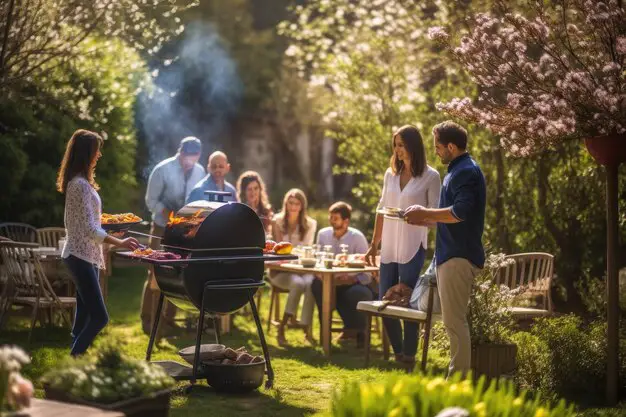
The chair scraped backward so hard the sound cut through the whole backyard.
That’s what I remember. Not the music from the little Bluetooth speaker by the grill. Not the kids screaming around the sprinkler. Not even Patricia’s voice, which had been carrying across that patio all afternoon like smoke off a wet fire.
Just the chair.
My husband stood in front of his entire family with his face red and his back straight, and he pointed one finger at the sliding glass door.
“Apologize,” Evan said. “Right now. Or get out.”
For one second the whole backyard froze.
Patricia, my mother-in-law, held her plastic cup of sweet tea halfway to her mouth. Lauren, Evan’s sister, leaned back in her chair with that small satisfied smile she gets when she thinks I’ve finally been cornered. A cousin near the grill lowered his spatula. Somebody’s toddler started crying over by the fence and not one adult moved toward him.
Every one of them was looking at me.
Waiting.
Not because they were curious about what I’d do. Because they already knew. They’d known for six years.
I had been married to Evan Pierce since I was twenty-six, and in those six years his family had trained themselves to expect one thing from me, and that thing was surrender. I was the one who swallowed it. I was the one who laughed politely when Patricia called my cooking “interesting” at Christmas, twice, in front of nine people. I was the one who said nothing when Lauren told the table that I parented from “doctor websites and fear.”
I was the one who apologized so dinner wouldn’t turn into a war.
Upstairs, in Patricia’s guest room, my three-year-old son was asleep with his stuffed fox tucked under his chin. His little sneakers were lined up next to the bed because he lines them up himself now, both of them pointing the same way, which is a thing he started doing about a month ago and nobody taught him. His dinosaur cup was on the nightstand. He’d passed out around four-thirty from too much sun and too much noise and not nearly enough patience from the adults in that yard.
I looked at the door Evan was pointing at.
Then I looked back at my husband.
And something inside me went quiet.
The whole thing started over fruit.
Miles had been sitting next to me at the patio table eating strawberries and apple slices off a paper plate. The air smelled like charcoal and sunscreen and somebody’s citronella candle. He had juice all down his chin and he was doing that thing where he holds a strawberry up to the light before he eats it, like he’s checking it for something.
Patricia came over. She looked at his plate and her whole face pulled down like I’d served the child a punishment.
“No cupcake?”
“He had one earlier.”
“He’s a child, Claire.” She said my name the way you’d read it off a form. “Children are supposed to enjoy themselves.”
“He is enjoying himself.”
Lauren laughed from across the table. Not a real laugh. The other kind, the one that’s aimed.
“Claire read one article about sugar and now she thinks she’s the Surgeon General.”
Three people chuckled. My husband was one of them. It wasn’t a big laugh, it was barely anything, just enough air to count as agreement, and I heard it.
Normally that’s where I’d smile. I’d say something small and harmless and let the joke land on my skin and slide off.
Except they never slide off. That’s the lie you tell yourself for six years. They don’t slide off, they collect. They stack up somewhere behind your ribs, and you carry the whole pile home in the passenger seat with the radio up while your husband pretends not to notice you’re crying at a red light.
But that day Miles looked up at me.
That’s the part they all missed. He wasn’t crying. He wasn’t confused. He was just watching, with strawberry juice on his mouth, learning how people talk to his mother. Learning what she takes.
So I put my napkin down.
“His pediatrician asked us to cut back,” I said. “Because of his stomach. I don’t think that’s something to make jokes about.”
The table went quiet.
Patricia’s eyebrows went up. Lauren’s smile got tighter. And Evan stared down at the sweating beer bottle in his hand like the label was going to tell him how to be somebody’s husband.
“Oh,” Patricia said. “So now I’m making jokes about your son.”
“That’s not what I said.”
“You implied it.”
Lauren crossed her arms. “You always do this. Every single time. You make everything tense.”
I looked at Evan.
He sighed before he even opened his mouth.
I want to explain about that sigh, because I have thought about it more than I’ve thought about anything else that happened that day. It wasn’t loud. It was the sound of a man being inconvenienced. It said I had embarrassed him. It said his mother’s feelings weighed more than his son’s medical instructions. It said, plainly, without a single word attached: be small again, Claire, you were doing so well at it.
“Can we not?” he muttered.
And that’s where the old version of me stops.
That’s the exact spot. Six years of stopping right there.
Instead I reached into the diaper bag hanging off the back of my chair, and I pulled out the folded paper I’d been carrying around for two weeks.
It was the after-visit summary from Dr. Ruiz’s office. Appointment date at the top. Miles’s name. And under follow-up instructions, printed in plain letters: reduce refined sugar, monitor symptoms, recheck in six weeks.
I unfolded it and set it on the patio table between the paper plates.
“This isn’t about control,” I said. “It’s about him waking up at two in the morning with his stomach hurting.”
Lauren laughed again. This time nobody joined her, and I watched her hear that.
Patricia looked at the paper without touching it. She looked at it the way you look at something a dog dragged in.
“You brought paperwork,” she said. “To a family cookout.”
“I brought my son’s instructions.”
“To a cookout.”
“You’ve asked me about it four times, Patricia. Three times at Easter and once on the phone. I thought if you could see it in writing you’d stop asking.”
The ice in her cup clicked as her hand closed around the plastic. Evan’s jaw was working. The speaker by the grill was playing something with a ukulele in it, and it was so much happier than that table that it started to feel like a joke somebody was playing on all of us.
Then Patricia said it. Loud. Loud enough for the cousins by the fence.
“Maybe if you weren’t so anxious all the time, that little boy wouldn’t be so delicate.”
For one ugly heartbeat I saw myself standing up and putting my hands under the edge of that table and flipping the whole thing over. Red cups bouncing across the concrete. Strawberries rolling under the lawn chairs. Lauren’s face finally, finally changing.
I didn’t do it. I folded my hands in my lap.
“Don’t talk about my son that way.”
And that’s when Evan’s chair scraped back.
So now he’s standing there pointing at the house. His mother has her mouth pressed into a line. His sister looks like somebody just handed her a trophy. The toddler by the fence is still crying and nobody has gone to get him.
“Claire.” Evan’s voice cracked on the second word. “I mean it. Apologize to my mom, or pack your bags and leave.”
The entire patio waited for me to shrink.
I looked at him. Then I looked up at the second-floor window where my son was asleep with his fox.
And I finally understood a thing I should have understood at year two.
They didn’t want peace. Peace was never on the table. They wanted obedience, and they had gotten so much of it, so easily, for so long, that they’d stopped bothering to dress it up.
I pushed my chair back slowly. I picked up the pediatrician’s note off the table, folded it once, and put it in my purse.
“Okay,” I said.
Evan blinked. “Okay what?”
I looked right at him.
“I’ll pack.”
Lauren’s smile went first. It just came off her face.
Patricia set her cup down too hard and sweet tea came over the rim and ran across the glass tabletop toward the potato salad.
And my husband stood there staring at me like I’d started speaking a language he’d never heard in his life.
What he didn’t know, what none of them knew, was that at 6:17 that evening, while they were all still down there telling each other I’d gone upstairs to cool off, I was sitting on the edge of a guest bed buying two one-way tickets on my phone.
One under my name.
One under Miles Pierce.
I need to back up about ten seconds, because Evan said one more thing before I went inside.
He lowered his voice, because by then the cousins had noticed the shape of what was happening and the yard had gotten quiet.
“Claire. Don’t be dramatic.”
That was almost funny.
Six years of eating his mother’s little comments with a smile on. Six years of turning the radio up on the drive home so he wouldn’t have to hear me. Six years of me being the one who said sorry so that everybody could have a nice afternoon.
And the very first time I chose silence over surrender, I was the dramatic one.
I walked past him without answering.
The house was cold inside after the yard. The AC was cranked the way Patricia keeps it. I could hear the ice maker running in the kitchen and somebody’s phone buzzing on the counter.
Upstairs, the guest room smelled like laundry detergent and warm sleeping toddler, which is one of the best smells there is and I hate that I have to remember it in that room.
Miles was curled around his fox with one cheek red from the sun. He had a sock half off. I stood there for a second and just watched him breathe, the way you do, the way I have done every night of his life.
Then I packed.
I did the quiet things first so I wouldn’t wake him. The sneakers. The dinosaur cup. The spare shirt with the tiny paint stain by the collar from daycare in March. His fox went in last and only after I was sure I could do it without him noticing, because that fox is not negotiable and never has been.
Then I opened my own overnight bag.
And I took out everything Evan had bought me.
The cardigan he got me for my birthday. The perfume. The little travel case with my initials on it that he gave me two Christmases ago and that I actually loved. I set all of it on the dresser in a neat pile.
Not to make a point. I want to be honest about that, because I’ve been asked. I did it because I couldn’t stand the idea of carrying one more thing out of that house that felt like a chain.
At 6:31 my phone buzzed.
It wasn’t Evan. Evan didn’t text me once. Not once, the entire time I was upstairs.
It was the airline confirmation.
And when I opened it, underneath, still sitting in my photos from three months earlier, was the picture I’d taken of Miles’s passport the day it came in the mail. Little navy book. His three-year-old face in the photo, deadly serious, because he’d been told not to smile and he takes instructions seriously.
Evan had joked about it when it came. He’d held it up and said we’d finally take that family trip someday, and I’d laughed, and I’d photographed it and put the real one in the fire safe in the hall closet along with mine and his, and I had picked both of ours up on the way to the cookout because I’d meant to drop them at the credit union box on Monday.
They were in my purse. They had been in my purse the entire afternoon.
My hands stopped moving on the zipper.
Downstairs, Patricia’s voice came up through the floor vent, clear as if she were in the room.
“She’ll come down when she’s finished performing.”
Lauren laughed. One short laugh.
And then I heard my husband say, very quietly, in a voice I hadn’t heard him use in years:
“Mom. Where’s Miles’s passport?”
The house went so silent so fast that I could hear the zipper teeth catch on the bag.
Then footsteps.
Patricia came up first. She pushed the guest room door open without knocking and stopped in the doorway with her hand on the frame, and her knuckles went as white as the paint.
She looked at the suitcase on the bed, closed.
Then she looked at Miles, awake now, up on my shoulder with his fox in one fist and his other hand curled into my shirt collar, blinking at his grandmother with the total confusion of a kid who just got picked up out of a dead sleep.
“What do you think you’re doing, Claire?”
Her voice wasn’t sharp anymore. It was tight. She’d figured out she had lost the room and she was three sentences behind.
“I’m leaving,” I said. “Just like Evan asked me to.”
“You are not taking my grandson.”
She took one step in. Her eyes went to Miles and stayed there.
“Evan,” she called down the hall. “Evan! Get up here.”
The footsteps that came up those stairs were nothing like the ones that had come across that patio an hour before. He came fast, and heavy, and when he hit the doorway he stopped dead.
He saw the closed suitcase.
He saw the airline confirmation still up on my phone screen on the bed.
And he saw the small navy passport in my hand, halfway into my coat pocket.
“Claire.” All the color went out of his face at once. I have never seen it happen to a person that fast. “What is that. What are you doing with his passport.”
“Making sure he grows up knowing that love doesn’t mean standing still while people cut you down.”
“You can’t just take him.” He came forward with his hand out, like he was going to take my arm, and then he stopped himself when I took one step back. “We’re married. Claire. We’re married. You’re being crazy, you’re doing this out of spite—”
“I’m not doing it out of spite.”
I looked him in the eye and I felt the last threads of six years of loving that man come apart, one at a time, quietly, like stitches.
“I’m doing it out of survival,” I said. “I spent six years watching you choose your mother’s comfort over my dignity. I’m not going to let him spend the next sixteen watching me teach him that’s what a husband does.”
Downstairs, nobody was moving. I could feel it. Lauren and the cousins and the whole cookout were standing at the bottom of those stairs listening to every word and not one of them said anything.
“Claire, please.”
My husband was crying. First time in six years. Not angry tears. Pure panic.
“Let’s talk. Just put the bag down and let’s go home. Just us. You, me, and Miles.”
“It’s too late for just us,” I said. “You made your whole family the third party in this marriage a long time ago. And today you told me to pack. So I packed.”
Patricia stepped between us. Last play.
“If you walk out that door, Claire, you destroy this family. You’ll be completely on your own.”
I looked at her. At the cold eyes and the shaking hands and all that rigid pride that had already ruined one man in this house and was working on a second.
Then I looked at Evan standing next to her, and he had never looked smaller.
“Patricia,” I said, and I said it gently, because I meant it gently. “I’ve been on my own in this family for six years.”
She opened her mouth.
“At least now the air will be clean.”
I shifted Miles up onto my hip. I picked up the suitcase with my free hand. And I walked right between the two of them and out the door.
Evan didn’t block me. He couldn’t. The weight of his own ultimatum was sitting on his chest and he knew it and everybody downstairs knew it. He had said it in front of his whole family and I had taken him at his word, and there is nothing a man can do with that.
I came down those stairs past Lauren, who was standing on the third step from the bottom and would not lift her eyes off the carpet. Past a cousin holding a paper plate he’d clearly forgotten about. Past the sliding door and the patio and the little speaker still playing that same cheerful nothing by the grill.
The summer air hit my face.
It felt different than it had an hour before. It wasn’t heavy with charcoal and sunscreen and everything nobody was saying.
It felt like space.
I buckled Miles into his car seat and he asked me where we were going and I said on an adventure, and he said okay, and he was asleep again before I got to the end of the street, which is a mercy I’m still grateful for.
At the stop sign I looked in the rearview and Evan was standing on the front lawn. Not running. Not calling. Just standing there in the grass looking at the space where my car used to be, and I think that was the exact moment he understood the thing you only get to learn once.
When you make someone choose between their self-respect and you, you don’t get to act surprised when they pick themselves.
I drove to my sister’s that night, and we flew out at 11:40 the next morning, and I texted Evan the city and the address from the gate before we boarded, because I am not a criminal and I was never going to be one.
He called eleven times before we took off.
I didn’t answer, but I did read the last message, and it said: I should have gotten up out of that chair for you a hundred times and I never did once.
That one was true.
We’ll see what he does with it.
In the meantime, my son was asleep in the seat beside me with his fox under his chin and both his sneakers lined up on the floor pointing the same way, because he does that himself now, and nobody taught him.
The rearview mirror was small.
The road ahead was wide open.
And for the first time in six years, I breathed all the way in.

Lila Hart is a dedicated Digital Archivist and Research Specialist with a keen eye for preserving and curating meaningful content. At TheArchivists, she specializes in organizing and managing digital archives, ensuring that valuable stories and historical moments are accessible for generations to come.
Lila earned her degree in History and Archival Studies from the University of Edinburgh, where she cultivated her passion for documenting the past and preserving cultural heritage. Her expertise lies in combining traditional archival techniques with modern digital tools, allowing her to create comprehensive and engaging collections that resonate with audiences worldwide.
At TheArchivists, Lila is known for her meticulous attention to detail and her ability to uncover hidden gems within extensive archives. Her work is praised for its depth, authenticity, and contribution to the preservation of knowledge in the digital age.
Driven by a commitment to preserving stories that matter, Lila is passionate about exploring the intersection of history and technology. Her goal is to ensure that every piece of content she handles reflects the richness of human experiences and remains a source of inspiration for years to come.