The Weight of What We Carry
A month after I buried my husband, I boarded a six-hour flight with my two children and a carry-on bag that contained, among other things, a blue wool sweater that did not belong to me anymore.
Mark had bought it the winter before he was diagnosed. He wore it on Sunday mornings when he made pancakes, the sleeves pushed up, flour on his forearms, louder and more cheerful than any person had a right to be before nine o’clock. After he died I could not decide what to do with it. I could not put it in the donation pile and I could not hang it back in the wardrobe and I could not throw it away. So I folded it into my carry-on between Noah’s spare onesies and Louise’s library book, and I told myself I was not being irrational, I was simply packing.
Mark died in November, nine months after the diagnosis. He was thirty-seven. He had been certain, with a stubbornness that was both maddening and somehow magnificent, that he was going to outlive everyone in the room. Cancer disagreed. It did so thoroughly, and then it was over, and I was left in the house we had bought together with a five-month-old baby who turned toward the front door every time he heard a man’s voice, and an eight-year-old daughter who had stopped asking when Daddy was coming home, which was worse than if she had never stopped.
The questions I could have answered. The silence I did not know what to do with.
My mother rang on a Wednesday afternoon while I was sitting on the kitchen floor for no particular reason, holding Noah and looking at the tile grout. She did not ask how I was doing, which was the kindest possible thing. She asked whether I could get on a plane by the following Friday. I said I would try. Louise helped me pack without being asked, moving through the house with the quiet efficiency of a child who has understood that practical help is the only kind worth offering. She was eight years old and she already knew that.
The night before the flight I could not sleep. I lay on my side of the bed, which was the only side now, and I thought about the mechanics of the journey: documents, pushchair, gate check, car seat, nursing cover, snacks for Louise, bottles for Noah in case I couldn’t manage on the plane, pacifiers, spare everything, more spare everything. Mark had always handled the passports. He had a system involving a waterproof pouch and a checklist on his phone and a confidence about travel logistics that I had been quietly relying on for years without fully registering the reliance. I checked the documents three times the next morning. Louise watched me do it without saying anything about it, which was how I knew she had noticed.
On the morning we left, she held Noah’s bottle while I did the third document check. She placed her favorite stuffed rabbit next to the blue sweater in my bag, carefully, as if both objects belonged to the same category of necessary things. I did not ask her why. I understood.
The airport was busy and loud and full of the particular indifferent energy of places where everyone is going somewhere and no one has time to notice anyone else. I was grateful for it. Being unnoticed was a relief. I moved through check-in and security in the careful deliberate way I had been moving through everything since November, one thing at a time, not looking too far ahead, concentrating on the immediate task until the immediate task was done and I could move to the next one.
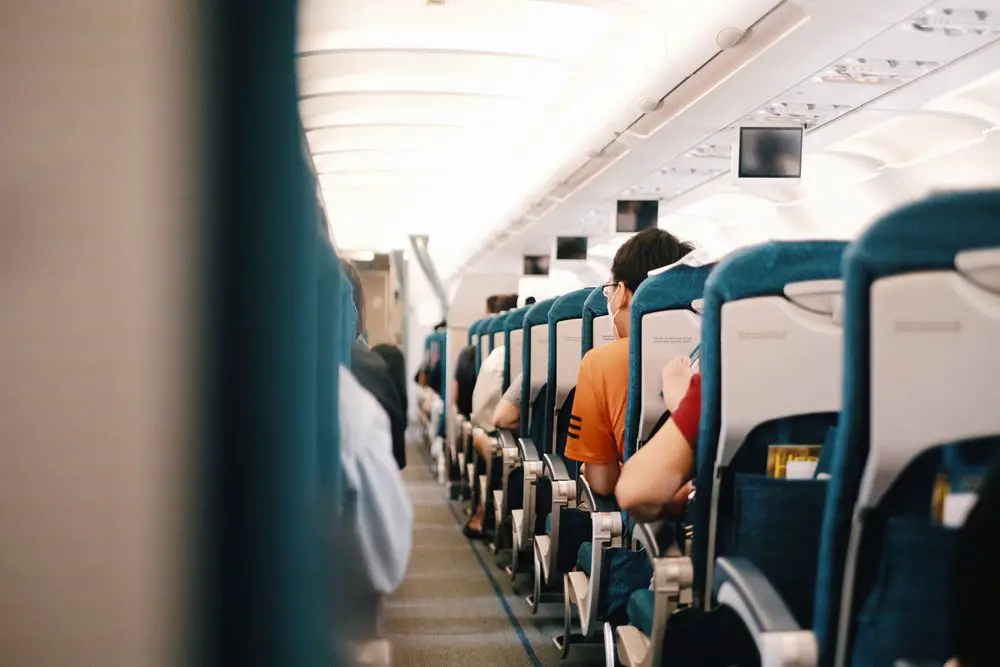
The flight was full. The seats I had managed to book placed Louise one row behind me, which was not ideal but was manageable. She was eight and she had her tablet and she had handled more difficult things than sitting one row back on a plane. I settled into the aisle seat with Noah against my chest and felt her small hand squeeze my shoulder from behind, and I put my hand up and squeezed back without turning around.
The woman beside me was already in her seat. Gray suit, pearl earrings, a magazine open on her tray table. She looked up when I sat down, assessed the baby against my chest, and arranged her expression into something that made clear she had already decided how the next six hours were going to go.
I did not say anything. I concentrated on getting Noah comfortable, checking the position of the nursing cover in my bag, making sure I could reach Louise’s snacks if she needed them.
“I can see you,” Louise said from behind me, head appearing between the seats, “and I know how to press the call button.”
“Only for emergencies,” I told her.
“What counts as bad snacks?”
“Not emergencies.”
She disappeared again. I heard the small sound of her tablet coming on.
The woman beside me watched this exchange without softening.
“If that baby starts screaming,” she said, as if continuing a conversation we had already begun, “I am not going to simply sit here and endure it. I want you to know that upfront.”
“We haven’t taken off yet,” I said, because I could not think of anything that was both honest and polite.
“People say they’ll manage. Then everyone else ends up suffering.”
From behind me, Louise appeared between the seats again. “My brother is usually very quiet,” she said, with the precise measured confidence of someone offering testimony. “It’s only when people are rude to our mum that he gets upset. He can sense it.”
This was not true. Noah was five months old and sensed primarily hunger and temperature. But I appreciated the instinct.
“Louise,” I said.
She retreated. I saw her reflection in the window as she settled back with her tablet, narrow-eyed, composing her thoughts.
The plane pushed back from the gate and Noah startled at the vibration, his whole body tensing against my chest. I waited for the cry the woman beside me was clearly braced for. Instead, Noah blinked twice, curled his fist around my index finger, and went back to sleep. I felt the tension leave my shoulders in a long, slow release.
The woman opened her magazine with a sharp snap and angled it between us like a declared boundary.
For the first two hours, Noah slept. I watched the clouds move beneath us and tried not to think about the empty seat at the kitchen table, about the hospital ward that still appeared in my dreams looking exactly as it had, about the completely ordinary Tuesday afternoon when Mark had been alive and the completely ordinary Tuesday afternoon immediately after when he was not. Grief, I had discovered, was less like drowning and more like learning to walk with something heavy strapped to you, something you eventually stopped noticing and then noticed again suddenly, without warning, in airports and on planes and while doing the washing up.
I was thinking about none of this in particular, which is to say I was thinking about all of it at once, when Noah woke hungry.
He gave the preliminary sounds first, the small escalating complaints that announce intention before committing to it. I had approximately ninety seconds to respond before the announcement became a full declaration. I reached into my bag for the nursing cover and arranged it as quickly and efficiently as I could, the practiced motion of someone who has done this several hundred times in the past five months under varying conditions.
The woman put down her magazine.
“Oh, wonderful,” she said. “Now I have to watch this as well.”
I kept my eyes on Noah. “He needs to eat.”
“I paid for this seat to sit beside someone else’s screaming child, and now I have to watch you do that in front of everyone?”
“I’m covered,” I said. “He’s eating. He’ll stop crying.”
“People with infants should stay home,” she said, as if this were a considered position rather than reflexive cruelty. “Or at the very least, lock themselves in the lavatory for this sort of thing.”
“A bathroom is not where babies eat.” My voice was steady. I was surprised by this. “And we have four more hours of flight. He cannot go without food for four hours.”
“What kind of mother cannot calm her own child without doing this publicly?”
I looked at her. I looked at her directly, the way I had not let myself look at anyone since November because looking at people directly made them ask questions and I did not have the capacity for their questions. She held my gaze for a moment and then looked away first.
“He is calm,” I said quietly. “Because I’m feeding him.”
Noah had latched and his crying had stopped and the immediate vicinity was considerably more peaceful than it had been sixty seconds ago. This did not seem to satisfy her.
She reached for the call button.
“Mom.” Louise was beside us, her tablet held against her chest, appearing from the row behind with the quiet purposeful movement of a child who has been watching and waiting. “Why don’t you take my seat? You can sit there and I’ll sit here so this lady has more room to be comfortable.”
“Louise, no. Go back to your seat.”
“It’s all right, Mom. Really.”
I should have insisted. I should have firmly and calmly sent her back to her seat and handled the situation myself. But Noah stirred against my chest and I had to focus on him for a moment, and in that moment Louise had already slid into the aisle seat and was settling herself with her tablet on her lap.
I moved carefully to Louise’s row, keeping Noah covered and close, and I sat down in the seat she had vacated and I breathed.
As I passed her, she leaned up toward my ear. “She dropped something,” she whispered.
“What do you mean?”
“I’ll show you in a minute.”
She had Mark’s quality of perfect composure before delivering important information. He had been a terrible poker player because he genuinely could not maintain suspense, but he was excellent at the particular calm of someone who knows the relevant facts and is waiting for the right moment. Louise had inherited this.
From the row ahead I could see the tops of their heads, the woman’s silver-streaked hair and Louise’s dark one, and I could see Louise’s tablet screen lighting her face. She was not looking at it. She was looking at the floor near the woman’s feet.
Then she bent forward.
She straightened holding a small photograph between two fingers, holding it carefully by the edge the way you handle something that does not belong to you. She placed it gently on the woman’s tray table, photograph side up.
The sound the woman made was not quite a gasp and not quite a cry. It was something between the two, the sound a person makes when they have been unexpectedly reached, when something that was inside becomes suddenly and involuntarily visible. Every head in the immediate vicinity turned.
The woman rose so quickly she struck her knee on the tray table. She pushed into the aisle and a flight attendant was there immediately.
“Ma’am? Is everything all right?”
The woman pointed at Louise. “Where did you get that?”
Louise held the photograph up. “You dropped it near your bag. I was going to give it back.”
“Give it to me.”
“Of course.” Louise held it out. The woman took it with both hands, too quickly, and pressed it against her chest.
Then she looked down at Louise’s tablet.
Louise had not been watching her film. She had been looking at photographs. Specifically, she had been looking at pictures of me and Noah and Louise from the past few weeks, the ones my mother had taken and sent through, the ones I could not yet look at too directly because they showed a family with a piece missing and the shape of the missing piece was in every frame.
The woman looked at the tablet screen for a long moment.
Her hand was still pressed against her chest, over the photograph.
“I need another seat,” she said to the flight attendant. Her voice had changed.
“I’m so sorry, ma’am, the cabin is completely full.”
“Then I’d like to stand.”
“You’re welcome to step to the galley with me for a few minutes. But I’ll need you to return before descent.”
The woman followed the flight attendant toward the back of the plane without another word.
Louise watched her go, then turned around and found me in the row behind.
I gave her a look that asked several questions simultaneously.
She gave me one that said: wait.
She was eight. She was eight years old and she had her father’s ability to identify the essential thing in a complicated situation and address it before anyone else had finished deciding whether to speak.
The woman returned several minutes later. She stood in the aisle beside Louise’s seat and looked at my daughter with an expression that had shed its earlier armor entirely. Underneath it she looked older and more uncertain than she had before.
“Would you repeat what you asked me?” she said. “In the galley. What you asked me.”
Louise looked toward me. I nodded.
Louise picked up the photograph from where the woman had set it, and she placed it beside the image of Noah and me on her tablet screen, and she looked at the woman.
“I asked whether you would want someone to speak to your daughter the way you spoke to my mum.”
The woman looked at the two images. The photograph was a studio portrait, slightly formal, a young woman holding an infant in a green carrier, both of them looking directly at the camera. The woman in the photograph had the woman’s eyes.
“No,” the woman said. The word came out stripped of everything except its meaning.
“No what?” Louise asked, in the careful neutral tone of someone who understands that partial answers are how people avoid accountability.
An older man two rows forward lowered his newspaper. “The child has asked you a fair and direct question,” he said quietly, without drama. He said it the way people say things when they are not performing but simply stating.
The woman sat down.
She sat down and she folded the photograph along an old crease, carefully, and then smoothed it flat again as if she had not meant to fold it. Her hands were trembling.
“No,” she said again. “I would not want anyone to speak to Jenna that way.”
Louise looked at her for a moment. “Then don’t,” she said, and closed her tablet.
The engines continued. The cabin settled back into its ordinary sounds. I watched from the row behind as the woman sat with the photograph facedown on her lap and said nothing.
After Noah finished eating, I returned to my original seat. As I came level with Louise she looked up at me with the specific expression of a child checking whether they are in trouble, the slight tension around the eyes, the careful stillness. I touched her knee and gave her a small nod. She let out a breath and turned back to her tablet, and within five minutes she was absorbed in her film.
Mark had told her, in one of those final weeks when he was lucid and deliberate about what he wanted to leave her, that bravery was not the absence of fear. Bravery was choosing which fear to obey. The fear of doing nothing, or the fear of doing something. She had chosen, at eight years old, thirty thousand feet above the ground, and she had chosen correctly.
I settled Noah against my shoulder.
The woman beside me kept her eyes on the photograph.
“My name is Evelyn,” she said eventually.
I waited.
“That is my daughter, Jenna. And her son. My grandson.” She paused. “He is five months old. I have never met him.”
“She’s invited me. Several times. She keeps inviting me and I keep…”
“Never met him?”
“She lives a long way. Her partner’s work is complicated. Her schedule…” Evelyn stopped. She tried again. “I have never met him because I have spent the past five months disapproving of nearly everything she does, and finding reasons to make the visit difficult, and telling myself that I would go when things were more convenient or when she was making better choices.” She looked at the photograph. “She nurses him at family gatherings instead of going to another room. Her partner’s job is not what I would have chosen for her. She lives somewhere I don’t think is sensible.” She looked up. “She’s giving me my first grandchild and I have spent the past five months criticizing her by phone from eight hundred miles away. And I booked this flight and I spent the whole journey planning exactly what I was going to tell her she was doing wrong when I arrived.”
I looked at this woman, in her gray suit and her pearl earrings, clutching a photograph of a daughter who was still, despite everything, inviting her to come.
“My husband died a month ago,” I said.
She looked at me.
“This is the first time I have flown with both children alone. I’m still learning how to do things like this without him. Simple things. Document checks and passports and knowing where the nearest pharmacy is in an airport I’ve never been in.” I adjusted Noah. “You sat down next to me and within ten minutes you had decided I was a bad mother. You had decided that before Noah cried, before I fed him, before you knew anything about me at all.”
Evelyn was quiet for a moment. “I know,” she said.
“Feeding my son was not a performance. He was hungry. That’s all it was.”
“I understand that now.” She said it simply, without qualifying it, and I believed her. Understanding, however, was not the same as what she owed. I let the silence sit.
“I need to write to Jenna,” she said. She reached for her phone. She opened a message, typed Jenna’s name, and stopped.
“What do I say?”
“I can’t write it for you.”
“I don’t know how to begin.”
“Then begin with what you did. Not why you did it, not the explanation for it. What you did. And then tell her what will be different.”
Evelyn looked at the blank message for a long time. Then she began typing.
I watched the cloud shapes shift outside the window and did not watch her compose the message, because it was not mine to observe. Noah slept heavily against my chest, the warm comfortable weight of him, and I thought about Mark making pancakes in the blue sweater, and I thought about Louise’s rabbit tucked in beside it in my bag, and I thought about the completely ordinary fact that my daughter was eight years old and had more instinctive moral clarity than most adults I had encountered since November, and I allowed myself, briefly, to feel something adjacent to proud.
Evelyn pressed send.
Several minutes later her phone vibrated.
She read the screen and showed it to me without speaking.
Jenna had written: You may still come. But only if you meant every word of that.
“She’s giving you a chance,” I said. “What you do with it is up to you.”
Evelyn read the message again. And again. Something moved across her face in sequence: relief first, then the recognition of what the relief was conditional upon. An invitation was not forgiveness. It was a door left open. Walking through it and behaving differently once inside was the part that would take the rest of her life.
She put the phone down beside the photograph.
After a moment she turned toward the row behind us, toward Louise, who was watching the exchange over the edge of her tablet with the focused attention she brought to things she considered important.
“Does she look angry?” Evelyn asked, nodding toward the photograph. “My daughter. In the picture.”
Louise considered this with genuine seriousness, the way she considered things that deserved a real answer. “She looks tired,” she said finally. “That’s not the same thing.”
Evelyn received this without argument.
I watched her accept the correction from an eight-year-old with the quiet dignity of someone who has stopped defending the wrong position, and I understood that this was what change actually looked like before it became a story anyone would tell. It looked like accepting the correction. It looked like not arguing back.
We landed in the early afternoon. My mother was waiting near carousel six and when I saw her I experienced the specific relief of someone who has been managing alone and can briefly stop. She took Noah from me and held him against her shoulder with the practiced ease of someone who has held a great many babies, and she looked at me over the top of his head with the expression that meant she knew it had been hard and she was not going to make me talk about it yet.
Evelyn walked beside us through the arrivals hall, clutching her photograph. Her certainty had diminished with every step toward the baggage claim, replaced by the visible anxiety of someone approaching something that matters and knowing that the approaching itself is the easy part.
Jenna was standing near the carousel.
She had Evelyn’s eyes and a green carrier across her chest, a baby in it, a small bundled presence against her sternum. She was watching us come toward her with an expression that contained everything simultaneously: the desire to close the distance and the equally strong instinct not to, the exhaustion of someone who has been hoping for something difficult for a long time and is uncertain whether this is the time it arrives.
Evelyn stopped several feet away.
Jenna waited.
“May I hug you?” Evelyn asked.
The question cost her something. I could hear it. Evelyn was not a person accustomed to asking permission for things she felt entitled to, and asking this particular question in this particular way was a recognition that she had forfeited the entitlement, at least temporarily, and that the forfeiture was appropriate.
Jenna studied her mother. Then she nodded.
Evelyn crossed the distance and put her arms around her daughter carefully, conscious of the baby in the carrier, not reaching for him. Jenna kept one hand on the back of the carrier throughout. The hug lasted only a few seconds. When they separated, Evelyn said something quiet, directly to Jenna’s face, too low for me to hear. Jenna answered equally quietly.
Neither of them smiled. But they turned and walked together toward the luggage belt.
That was enough. Beginnings do not need to be more than that.
Several weeks later, a card arrived at my mother’s house. Plain envelope, neat handwriting. Inside was a photograph, the studio kind, taken recently from the colors and the way the light fell. Evelyn was sitting on a sofa beside Jenna, holding the baby with both hands while Jenna rested one hand on the baby’s back. Nobody in the photograph looked entirely comfortable. Nobody looked ready to leave. They looked like people at the beginning of something that was going to take time, which is the honest way most worthwhile things look at the start.
Beneath the photograph, Evelyn had written: I am learning to ask before helping, and to listen before correcting. Thank you for interrupting the person I was becoming.
Louise pinned it to the cork board in my mother’s kitchen, smoothing each corner carefully.
“Why keep it?” I asked.
She pressed the last pin in and stepped back to look at it. “Because speaking up doesn’t only stop a bad thing,” she said. “Sometimes it helps someone choose a better next thing.”
She said it the way her father used to say the things he meant most: without emphasis, without looking to see if it landed. Just setting it down and leaving it there for whoever needed it.
I left it there.
The blue sweater was still in my bag. I had not worn it. I did not know yet if I ever would. But I had carried it across six hours and an ocean, and it had arrived, and perhaps that was enough for now.
Some things you carry not because you know what to do with them, but because you are not yet ready to put them down. That is not weakness. That is just the weight of what we carry, and the faithful ordinary work of carrying it forward, one day at a time, until the day you find you can set it down gently, and breathe, and go on.
Laura Bennett writes about complicated family dynamics, difficult conversations, and the quiet moments that change everything. Her stories focus on real-life tensions — inheritance disputes, strained marriages, loyalty tests — and the strength people find when they finally speak up. She believes the smallest decisions often carry the biggest consequences.