The Education of Sheldon
I was twenty-six years old when I bought my first house, and I made the mistake that most twenty-six-year-olds make when they buy their first house: I confused wanting peace with having it.
The house was not impressive by any objective measure. Two bedrooms, one bathroom, a kitchen with cabinets that had stopped being fashionable sometime during the previous administration and had not found their way back. But it was mine in a way that nothing had ever been mine before, and that fact made every imperfection feel like a feature. The outdated cabinets were my outdated cabinets. The patch of lawn along the south side where the grass grew in sparse, reluctant tufts was my patch of lawn, and I would nurse it back to reasonable health with the same attention I gave to my savings rate and my mortgage amortization schedule, because I had spent enough time in finance to understand that neglected assets compound in the wrong direction.
I had used my father’s inheritance and four years of disciplined saving to get there. My father had died when I was twenty-two, and he had left me enough to matter but not enough to be careless with, which was probably the most accurate financial advice he ever gave me, delivered without intending to. I was determined to honor it.
The street was quiet and established, populated by people who had been there long enough to have opinions about how things were done. I was the youngest homeowner by at least a decade, and at first this produced a warmth I had not anticipated. Lawson from across the street arrived with banana bread within forty-eight hours of my moving in. Frank, the retired mechanic three houses down, appeared when my lawn mower stopped working and had it running again before I finished making him coffee. Elise, who lived at the corner and served on the homeowners association board, invited me to the neighborhood barbecue while my boxes were still stacked in the hallway.
Then there was Sheldon.
Sheldon lived next door, which meant he was unavoidable in the way that only a next-door neighbor can be, present at the edges of every ordinary morning and evening, occupying the peripheral vision of daily life. He was in his mid-fifties, tall and broad, with the posture of a man who considers himself significant. He dressed with a formality that seemed misaligned with the actual events of his life. Pressed shirt and polished shoes to take out the trash. Pressed shirt and polished shoes to check the mail. It was the wardrobe of someone who expected to be evaluated at any moment and had decided to remain permanently prepared for the assessment.
Our first conversation established the terms of our relationship with remarkable efficiency.
He appeared at the edge of my driveway on my third day in the house and looked over the property with the unhurried attention of a building inspector.
“So you’re the new owner,” he said.
“I am. Amanda.”
He nodded. He did not offer his own name until I asked for it.
“Sheldon.”
Then his eyes moved to my front yard, to the hedges along the property line that I had not yet had time to address.
“The previous owner kept those lower,” he said. “You should do the same.”
I laughed, because the remark was so immediate and so confident that I assumed it was a joke. A dry, slightly odd joke, but a joke.
He was not joking.
I understood this within the week, when the second comment arrived, and then the third, and then the accumulation of them over the following months made a pattern so consistent it became almost predictable. The trash cans were too visible from the street. The porch light bulb was the wrong color temperature. My friends’ cars, parked in front of my own house, on a public street, were apparently an inconvenience to a man who had no particular claim on that stretch of curb. The cardboard box beside my recycling bin two days before collection was an aesthetic offense.
He delivered all of it with a smile. That was the thing about Sheldon that made him harder to address than someone openly aggressive. He had refined his control into something that could pass, in the right light, as neighborly concern. Every comment was calibrated to sound almost reasonable, almost helpful, almost the sort of thing a more experienced homeowner might genuinely offer a younger one finding her way. If I objected, I risked looking like someone who couldn’t take a friendly suggestion. If I didn’t, the friendly suggestions kept arriving.
I chose, for a long time, not to object.
I had spent my childhood in a house where conflict was the default language. My sister treated disagreement as entertainment, and my older brother had never learned to let anything pass, so nothing ever did pass, it just circulated endlessly, gathering speed. I had made a deliberate decision somewhere in my adolescence that I was not going to live that way. When I bought my house, that decision felt more important than ever. This was my space. I was going to fill it with the things I chose, not with the residue of other people’s compulsions.
So when Sheldon told me my grass looked uneven, I said, “Thanks for noticing,” and meant nothing by it. When he complained about the wind chime on my porch, I took it down, not because he was right but because I did not care enough about a wind chime to spend energy defending it. When he moved my trash cans three feet down the curb without asking, I moved them back and said nothing.
I told myself this was maturity. I told myself this was choosing peace.
What I was actually doing was providing Sheldon with a very clear and detailed education in what I would and would not tolerate, and the lesson I was teaching him was that the answer to both questions was the same: anything.
The trespass escalated in the slow way that unchallenged behavior always escalates, each small advance testing whether the previous one had established a new baseline. He began walking onto my driveway to inspect things. I told him directly not to touch my property and went back inside. He left me alone for a few weeks, and I took this as evidence that I had handled it correctly, that a calm but firm response was sufficient, that we had reached some kind of equilibrium.
I was wrong about that too.
The Saturday it came to a head, I had worked late on Friday and intended to spend the morning doing absolutely nothing. I had earned that morning in the specific way that people who work too hard earn their idle hours, through accumulation of effort until the absence of effort becomes its own reward. I made coffee. I put on sweatpants. I walked toward the front room to sit in the good chair by the window and watch whatever was happening on the street with the pleasant vacancy of someone who has no obligations until Monday.
I looked out the window.
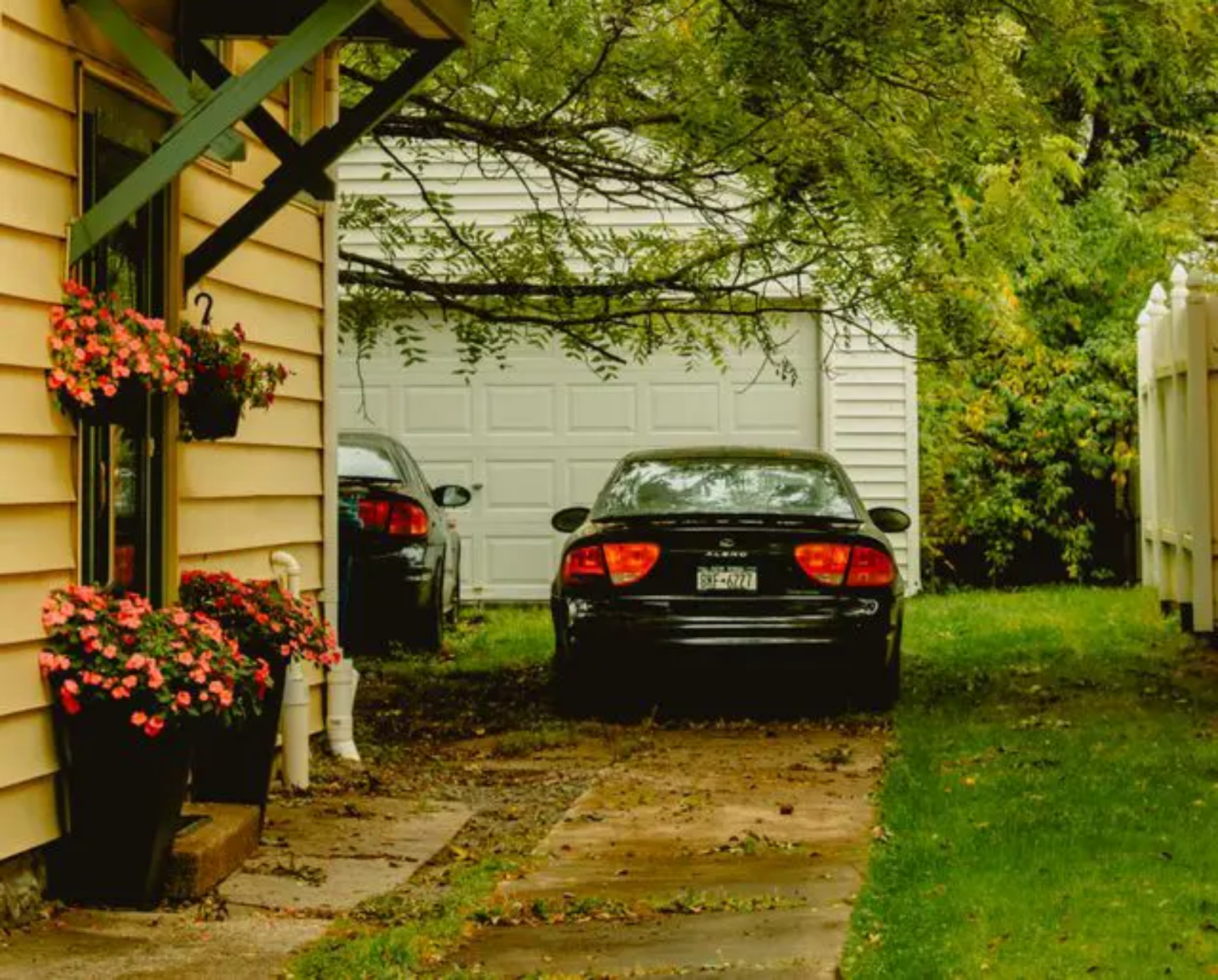
Sheldon’s black SUV was sitting in the middle of my front lawn.
He had driven over the curb, across the corner of my flower bed, and parked between my vegetable garden and the front walkway. The tires had cut deep channels through the grass I had spent months coaxing into something resembling health. The ground, which had been absorbing three days of steady rain, had received the weight of a two-ton vehicle and expressed its opinion of this arrangement clearly in the form of deep, dark ruts that I could see from the window.
I stood there with my coffee mug and looked at it for long enough that the coffee started going cold.
His driveway was empty. The street had available space in both directions. There was no deliverly, no construction, no temporary obstruction of any kind that would explain the decision. He had backed out of his own driveway, driven across the property line, and parked on my lawn because he wanted to see what would happen if he did.
I set the mug down. I put on shoes. I walked across the wet ground, feeling the soil give slightly under each step with the particular softness of earth that has had all the structural integrity rained out of it, and I rang his doorbell.
He opened the door so quickly I wondered if he had been watching for me.
He was smiling.
That smile was its own complete sentence. It said he had thought about this, that he had anticipated this moment, that he was prepared for whatever I brought to the doorstep because whatever I brought was part of the plan.
“Move your car,” I said.
He leaned against the doorframe. He was in no hurry. “Good morning to you too, Amanda.”
“Your SUV is on my lawn.”
“I know where it is.”
“Then you know you need to move it.”
He looked past me toward the vehicle with the mild interest of someone examining a minor curiosity. “I had some work done in my driveway.”
I turned and looked. His driveway was empty, dry, and flawless.
“No, you didn’t.”
“Plans changed.”
“There’s space on the street.”
“I didn’t want the car scratched.”
“So you parked it on my property and drove over my flower bed to protect it from scratches.”
“It’s just grass, Amanda.”
“You drove over my flower bed.”
“Flowers grow back.”
I looked at him. I looked at the smile. I considered everything I had accommodated over the past year, every small concession I had made in the name of not being the kind of person who makes everything a conflict, and I felt something settle in me that was not anger exactly but was the thing that lives just underneath anger when patience has been used up.
He was waiting for the argument. I could see it in his posture, in the slight forward lean of a man who has set a trap and is ready to enjoy watching it spring. An argument would give him something to use. He would call me emotional. He would call me unreasonable. He would make the scene my fault for creating one, and he would do it in front of whoever happened to be walking by, and the story he told afterward would feature a young woman who couldn’t handle a harmless favor.
I smiled.
“Have a nice day, Sheldon.”
Something crossed his face. Not quite confusion, but the disruption of an expectation. He recovered quickly and gave me a small, satisfied nod.
“You too.”
I went back inside and locked the door and stood in my kitchen until the shaking in my hands stopped.
Then I reviewed my security cameras.
I had installed them six months earlier after a package theft on the block, a single camera covering the driveway and front yard that I had mostly forgotten about except as a vague deterrent. I opened the footage now with the focused attention of someone who suddenly has a very specific purpose for a thing they previously owned only out of general caution.
The timestamp read 6:17 in the morning.
Sheldon emerged from his front door. He looked left, looked right, the way you do when you want to know whether anyone is watching, not the casual glance of someone checking for traffic but the deliberate survey of someone checking for witnesses. He got into the SUV. He backed out of his own driveway, which was empty and accessible. He drove across my curb, over the edge of my flower bed, and parked in the middle of my lawn. He got out. He looked directly at my front window. He smiled.
Then he went back inside.
The whole sequence took four minutes. There was nothing accidental in a single frame of it.
I saved the footage to three separate locations. Then I went outside and took photographs: the tire tracks, the crushed flowers, the ruts in the soft ground, the SUV’s exact position, the empty street beyond it with space to park in both directions. I photographed everything with the systematic thoroughness of someone who has spent enough years in finance to understand that documentation is not a precaution, it is the argument.
My first instinct was the police. My second was a tow company. Both were reasonable options, and I turned them over in my mind while I made a fresh cup of coffee and thought about what I actually wanted to achieve.
I did not want Sheldon to receive a fine he would resent and forget. I did not want him simply inconvenienced. I wanted him to understand something that a year of patience had failed to communicate: that my tolerance was a choice, not a capacity, and that choices can be revised.
I called Elise.
She answered on the second ring, and when I explained what had happened, the silence on her end had a specific quality, the silence of someone who is not surprised but is genuinely offended.
“Send me everything,” she said.
I sent the video and the photographs. She called back within five minutes.
“That is absolutely unbelievable.”
“He says it’s just grass.”
“He drove over your landscaping, Amanda. That is not just grass.” She paused. “I can issue a violation for parking on another owner’s lot without permission, but I need a formal complaint in writing.”
“I’ll send it today.”
“Good. And Amanda?” She hesitated. “Don’t damage the vehicle.”
“I wasn’t planning to,” I said.
That was mostly true, in the sense that what I was planning did not involve touching the vehicle at all.
Sheldon did not move the SUV that day. He came outside twice, once to retrieve something from the back seat and once to stand on his porch talking to another neighbor while glancing periodically at my house with the satisfied expression of a man enjoying the anticipation of a reaction he expected to arrive at any moment.
I gave him nothing.
Around nine in the evening, when the street had gone quiet and most of the windows in the neighborhood had gone dark, I went to my garage.
I had four portable sprinklers, the small rotating type that attach to standard garden hoses, purchased during the summer when I reseeded the south side of the lawn. I also had two hose splitters and a programmable timer that allowed me to run separate watering cycles independently. I had bought all of it because I was the kind of person who researched lawn irrigation equipment before purchasing it, which meant I also knew the relationship between saturation levels and soil load-bearing capacity, particularly in clay-heavy ground that had already received three days of continuous rain.
The plan was simple to the point of elegance.
I would water my lawn.
I would water it at intervals throughout the night, low and directed, with the sprinklers positioned to saturate the ground around and beneath the tires rather than to spray the vehicle itself. I would not touch the SUV. I would not block it with anything solid. I would not interfere with it in any way that could be characterized as deliberate damage to another person’s property.
I would simply water my lawn.
What happened to a two-ton vehicle parked on already saturated clay soil that then received six additional hours of intermittent irrigation was not my decision. That was physics. Sheldon had made the physics possible by parking where he parked, after the weather he had weathered, on the ground he had chosen. I was simply tending my property.
At eleven-thirty, most of the street was dark and quiet. I went outside with the unhurried movements of someone doing an entirely ordinary thing, positioned the sprinklers, connected the timer, set the cycles for twenty minutes on and forty minutes off, and went back inside.
I watched the first cycle start from my bedroom window.
The sprinklers swept their low arcs across the ground. The water darkened the soil in an expanding radius around the tires. Small poolings formed in the existing ruts, then connected, then began to spread.
I set an alarm and went to sleep.
By two in the morning, the SUV was measurably lower. The tires had begun to sink as the supporting soil lost its cohesion. By four, they were several inches deep. The ruts had become channels, and the channels had become a network of soft, waterlogged earth that held the tires with the patient, indifferent grip of a substance that does not know or care about neighborly disputes.
At six, I woke to the sound of an engine.
I pulled on a robe and went to the window.
Sheldon was inside the SUV with the engine running. He had apparently come outside to move it and had encountered the results of his decision to park on saturated clay soil during a rainy week and leave the vehicle there through a night of irrigation.
The front tires spun. Mud arced behind them. The vehicle moved less than a foot before settling deeper, the chassis dropping slightly as the tires found no purchase and simply excavated more of the ground beneath them.
He stopped. Got out. Stood in the mud in his pressed trousers and polished shoes and stared at the wheels. Then he looked at my house.
I went to the kitchen and made coffee.
Five minutes later, the pounding started.
I let him knock twice more before opening the door.
His face was flushed the particular red of a man whose blood pressure and sense of personal dignity are both under serious pressure simultaneously. He was breathing harder than the walk across the lawn justified.
“What did you do?” he demanded.
I looked past him toward the lawn with the mild interest of someone observing a minor curiosity. “Good morning, Sheldon.”
“You flooded the lawn.”
“I watered it.”
“You trapped my car.”
“No,” I said. “You parked your car on wet soil after three days of rain. I watered my lawn. The ground did the rest.”
“You did this deliberately.”
I leaned against the doorframe. I took my time about it. “Relax,” I said. “It’s just a car.”
The silence that followed lasted long enough to become something almost physical. He had said those same words to me, in that same tone, less than twenty-four hours ago. He heard the echo of them now. I watched him hear it.
“You need to fix this,” he said, and the authority had gone out of his voice, replaced by something that was trying to sound like authority and wasn’t.
“I don’t,” I said. “You need to call a tow company. And Sheldon, I have video of you driving onto my property and photographs of the damage to the flower bed and lawn, all timestamped before the sprinklers ran. So when you make the call, you might also want to think about what comes next.”
He looked past me toward the camera above the garage as if seeing it for the first time, which he was in any meaningful sense, because until that moment it had been invisible in the way that things are invisible when they are not yet relevant to us.
He turned and walked back across the lawn.
He left footprints in the mud.
The tow truck arrived at eight. Luis, the driver, was a compact, efficient man who examined the SUV with professional seriousness, crouching near each tire in turn, testing the depth of the ruts with his hand, walking the perimeter twice before offering his assessment.
“I can’t hook from the street and drag it straight,” he told Sheldon. “The suction is too strong and the angle’s wrong. I try that, I might tear the rear bumper or damage the undercarriage.”
“Then what do you do?”
“Recovery truck with a winch and ground mats. Takes longer. Costs more.”
Sheldon’s expression suggested that the number Luis quoted was physically painful.
By then, neighbors had assembled. This had happened organically, as neighborhood assemblies always do, someone notices a tow truck and steps outside to confirm that a tow truck is actually there, and then someone else notices the first person and steps outside to see what they’re looking at. Frank stood at the edge of his driveway with a coffee cup. Lawson was on her porch. Elise arrived carrying a folder with the particular purposeful energy of someone who has official business to transact.
Sheldon saw her and his expression shifted. “What are you doing here?”
“I received a formal complaint,” she said, with the calm of someone who holds the folder. “Did you park this vehicle on Amanda’s property?”
“It was temporary.”
“That wasn’t my question.”
He looked at me. Then back at her. “Yes.”
She opened the folder. “Association rules prohibit parking on another owner’s lot without their permission. The complaint includes timestamped video. You’re responsible for restoring the damaged property to its prior condition.”
“She turned the lawn into a swamp.”
Elise looked at the mud with the considered attention of someone who has been paying attention to the weather. “The forecast shows three days of rain before you parked there. The ground was already saturated.”
“She ran sprinklers all night.”
“On her own property.” She looked back at him. “Your vehicle caused the initial damage, and your choice to leave it there overnight extended it. Amanda watered her lawn.”
The recovery truck arrived twenty minutes later with ground mats and a heavy winch. Luis and the second driver worked methodically, placing mats, connecting the cable, proceeding in careful increments while the winch tightened and the mud expressed its reluctance to let go in a series of low, sucking sounds.
Before they began, Luis came to me.
“Ma’am, pulling it out is going to widen the ruts. We’ll minimize it but there will be additional damage.”
“Can you document it? Before and after?”
He nodded. “We photograph every recovery.”
Sheldon had been standing close enough to hear this. “Why does she get to decide?” he demanded.
Luis looked at him with the genuine confusion of a man whose professional world has clear and uncomplicated rules about such things. “Because the vehicle is on her land.”
Frank coughed into his coffee cup. Loudly.
The recovery took almost forty minutes. The SUV moved in increments, each advance preceded by the winch cable going tight and the ground reluctantly releasing its grip. When the rear tires finally broke free, the sound was spectacular, a wet tearing release that made several people wince, and the lawn where the vehicle had sat looked like a disaster relief situation in miniature. Four deep channels across the grass. Mud coating the walkway edge. Two sections of the flower bed flattened, a small shrub leaning at an angle that suggested it had reconsidered its commitment to vertical growth.
Sheldon looked at the invoice Luis handed him. He said the word robbery.
“No,” Luis said. “Recovery.”
Frank’s coffee cup got a lot of use that morning.
The tow company left the SUV in Sheldon’s driveway, where it had always had the option of being. Elise handed him the HOA violation notice. He objected to the landscaping estimate Rosa the landscaper prepared on Monday, retained his own contractor to produce a competing figure, and discovered that his contractor’s estimate was slightly higher than Rosa’s. He paid Rosa.
He also paid the tow. The recovery. The HOA fine.
For two weeks after that, he did not speak to me. The street had never been so quiet or so pleasant. The absence of his commentary on my trash cans and my porch light and the height of my hedges created a silence that I had not known I was missing until I had it, the specific peace of a space that belongs entirely to the person who is supposed to occupy it.
Eventually, we resumed a kind of contact, the minimal, transactional acknowledgment of two people who share a property line and nothing else. When he needed to discuss something relevant to both our properties, he asked. He did not touch my trash cans. He did not walk onto my driveway. He did not offer opinions about my landscaping choices or the color temperature of my light bulbs or the parking decisions of my friends on a public street.
There is no warmth between us and I have no interest in manufacturing any. What I have is the use of my own property without interference, which is what I was owed from the beginning and what no amount of patient smiling had managed to produce.
Here is what I learned, which I offer not as advice but as the honest record of my own education in the matter: patience is a virtue when it is applied to things that deserve patience. Applied to things that do not, it is not patience at all. It is instruction. Every time I smiled at Sheldon’s comments and retreated to my house, I was teaching him a lesson about the range of behaviors that produced no consequence. He was an attentive student.
The sprinklers were not revenge. I want to be precise about this. Revenge requires disproportionate response, escalation beyond the original injury. I watered my lawn. The ground did what saturated clay soil does when you add weight and then add water. I did not damage his vehicle. I did not touch his property. I imposed no cost beyond what his own choice to leave a two-ton machine on my ground through a wet night had made available to impose.
What I did was stop teaching him the wrong lesson and start teaching him the right one.
The property line between our houses is exactly where it always was.
It just took some water to make it visible.

Laura Bennett writes about complicated family dynamics, difficult conversations, and the quiet moments that change everything. Her stories focus on real-life tensions — inheritance disputes, strained marriages, loyalty tests — and the strength people find when they finally speak up. She believes the smallest decisions often carry the biggest consequences.