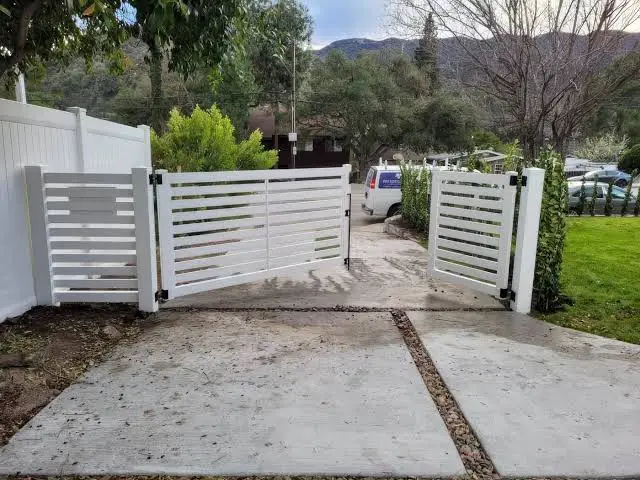
For six months, the new HOA president treated my grandfather’s forty-acre Montana property like her personal beautification project.
Every weekend, her white BMW idled near the iron gate my grandfather welded himself back in 1987, while she wrote me citations for “rustic styling.” She told me — smiling, always smiling — that my gate was an eyesore that belonged to the community now.
I had the original deed, the land survey, and my grandfather’s surveyor case that said otherwise.
And that was when I stopped explaining myself to her. And started letting her build, brick by arrogant brick, the legal trap that would cost her everything she had.
My name is Marcus. Let me tell you the whole thing from the beginning, because the ending doesn’t hit the way it should unless you understand exactly how much rope this woman was handed, and exactly how enthusiastically she wove it into a noose.
I inherited forty acres of Montana wilderness from my grandfather. The property came with a rustic cabin he built board by board, a workshop that still smells like cedar shavings fifty years later, and that iron gate — his gate — welded in his own shop in 1987, with hinges he machined himself because store-bought ones “had no soul.” He was that kind of man. He measured twice, cut once, and filed every piece of paper that ever crossed his desk, a habit that would turn out to matter more than anyone could have guessed.
After my wife Sarah passed from lung cancer two years ago, those weekend retreats to the cabin were what kept me breathing. I don’t say that poetically. I mean there were weeks where the only reason I got out of bed on Saturday was because the cabin was waiting. I’d spend the day working with my grandfather’s old tools, restoring what needed restoring, and then I’d sit on the porch as the light went down and listen to the creek and let the quiet do what quiet does. Sarah’s lavender candle sat on the windowsill. I lit it every visit. Still do.
That peace lasted exactly fourteen days after Delilah Peyton became president of the Pine View Estates HOA.
You need to understand the geography here, because the geography is the whole story. Pine View Estates is a development of forty-seven McMansions built in 2019 — built, and I cannot stress this enough, completely around my property. The developers marketed it as “luxury mountain living.” Granite countertops, three-car garages, a gated entrance with a waterfall feature that freezes solid every November.
What the glossy brochures left out was one crucial detail: the only road connecting their entire development to the main highway runs directly through my private land.
My grandfather had allowed the original builders to use that gravel road on a handshake. He was a neighborly man, and in 1987 a handshake in that county meant something. But handshakes are not legal documents, and when the developers sold out and the HOA took over, the paperwork formalizing that arrangement was never executed. The HOA simply assumed they owned the asphalt. For four years, nobody questioned it, and frankly, neither did I. Cars drove through, I waved, they waved back. That’s how neighbors are supposed to work.
Then Delilah bought the biggest house in the development.
At forty-nine, Delilah Peyton embodied every single thing I dislike about suburban power. She drove a white BMW that she washed more often than some people shower. She wore designer yoga pants that cost more than my monthly grocery bill. And she carried a clipboard — everywhere, always, like a scepter. Within six months of moving in, she had campaigned her way to HOA president on a platform of “elevating community standards,” which is HOA language for “finding new things to fine people for.”
Her first target was my grandfather’s gate.
She appeared in my driveway one Saturday morning, heels crunching on gravel that had clearly personally offended her, flashing a condescending smile that didn’t reach anywhere near her eyes.
“We need cohesive design elements,” she announced, tapping manicured nails against the clipboard. “That gate is aesthetically incompatible with the community’s vision. The HOA has pre-approved contractors who can upgrade your fencing to approved materials. We expect compliance by the end of the month.”
I was polite. I want that on the record. I explained, calmly, that my gate sat on my private property, that my forty acres predated her development by three decades, and that I was not now, nor had I ever been, a member of her HOA.
Her smile never wavered, but her eyes went dead cold, like a doll’s.
“Oh, sweetie,” she said. “Geographic proximity creates mutual responsibilities. You’ll comply, or we’ll enforce.”
Sweetie. I was fifty-four years old, a widower, and a twenty-year Army Corps engineer, and this woman called me sweetie in my own driveway.
Two weeks later, a county inspector showed up at my cabin investigating “reports of illegal structures.” Someone had filed an anonymous complaint. The inspector — a decent guy named Walt — walked the property, found nothing, apologized for wasting my Saturday, and admired the workshop on his way out. But the message had been sent. The harassment had officially begun.
It escalated the way these things always escalate: sideways first, then head-on. Delilah began telling the neighborhood that I was a “difficult, unstable military veteran” who was “purposely dragging down property values.” She weaponized the word veteran the way only a certain kind of person can — as if service made me a threat instead of a neighbor. She formed a “beautification committee,” which in practice meant a rotating cast of bored spouses who would stand near my property line on weekends with actual measuring tapes, measuring nothing, photographing my fence, my truck, my woodpile.
Then came the formal letters. Heavy, expensive paper. The HOA’s mountain-silhouette logo embossed at the top like a royal seal. They demanded my attendance at “mandatory community meetings.” They cited me — cited me, with reference numbers — for “unauthorized rustic styling” and “failure to maintain aesthetic harmony.” One of them fined me two hundred dollars. A fine. From an organization I did not belong to, for a gate on land they did not own.
I ignored all of it, which enraged her more than any argument could have. Silence, to a woman like Delilah, is intolerable. She needed the fight. So she escalated again, filing another county complaint — this time claiming my gate violated “an existing easement agreement” for the road.
And that was the moment I stopped playing defense.
Because here’s the thing about me that Delilah never bothered to learn: I spent twenty years as an Army Corps of Engineers officer. Twenty years of contracts, surveys, rights-of-way, environmental compliance, and jurisdictional disputes. Twenty years of dealing with people who mistook volume for authority. She had picked, out of the entire county, possibly the single worst opponent available for a property-rights fight.
That night, with Sarah’s lavender candle lit and pine needles ticking against the window, I opened my grandfather’s old leather surveyor case for the first time since the funeral. Brass instruments gleamed in the lamplight — his transit, his plumb bobs, tools he’d taught me to use when I was nine. And underneath them, in careful folders, yellowed with age but organized like a man who knew paper outlives people: forty years of deeds, plats, surveys, and county records.
I read for six hours. Somewhere around one in the morning, my pulse started to climb.
The original 1987 deeds and every recorded document since proved it beyond ambiguity: my family had never granted a permanent easement to anyone. Not to the original ranch neighbors, not to the developers, not to the HOA. The handshake had never been formalized. The gravel road — every inch of it, ditch to ditch — was mine. Which meant every vehicle from Pine View Estates had been crossing my private land, at my family’s silent pleasure, for four years.
I faxed the whole stack to my old Army buddy Jake, who’d gone into property law after his discharge. He called me back the next evening, and I could hear him grinning through the phone. “Marcus,” he said, “I’ve been doing this nineteen years. This is the cleanest chain of title I’ve ever seen. Your grandfather documented like a paranoid librarian. That road is bulletproof private property. They have nothing. Less than nothing.”
Now — and I want to be honest about this part — I did not want a war. I’m not built for pettiness, and Sarah would have hated it. Forty-seven families lived in that development, and forty-six of them had never done anything to me worse than driving too fast past my gate. So I did the neighborly thing. I typed up a formal easement agreement: one dollar per year, renewable indefinitely, requiring exactly two things — mutual respect, and an end to the harassment campaign. Essentially, I offered to give them the road for free, forever, in exchange for being left alone.
I printed it, put on a clean shirt, and brought it to their next board meeting in person.
Delilah didn’t even read past the first page. She held my agreement up between two fingers like I’d handed her roadkill, and she scoffed — audibly, into the microphone.
She told the board I was “manufacturing a fake crisis.” She accused me of “attempting to extort the neighborhood.” And then she delivered the sentence that told me exactly how this was all going to end: she announced that four years of the community driving on that road gave the HOA legal ownership through — and I quote — “established community rights.”
That is not a thing. I want to be clear. That is not a legal doctrine. That is a phrase a person invents when they have decided reality is negotiable.
She promised the board she would “escalate enforcement” against me. And she kept that promise. Within two weeks, motion-activated security cameras appeared on poles at the edge of the development, aimed not at the road, not at the entrance — at my cabin. My porch. My windows. I was officially under surveillance by a homeowners association I didn’t belong to, on land they didn’t own.
But her desperation did me one final favor. It sent me back to the county records office one more time, digging deeper, looking for anything I’d missed. And in a box of microfilmed developer filings from 1987, I found the ultimate weapon.
The original developer agreement. The document the Pine View builders had signed with my grandfather when they first sought permission to route their access through his land. The agreement the HOA had legally assumed, in full, when they took over the development’s obligations.
I read Section 14, Subsection C, four times. Then I laughed out loud, alone, in the records office, loud enough that the clerk looked over her glasses at me.
I made certified copies, sealed them in a manila folder, set the folder on my kitchen table, and waited. I knew Delilah. I’d known a dozen Delilahs across twenty years of government work. She was arrogant enough to hang herself — all I had to do was stop interrupting her while she tied the knot.
I did not have to wait long.
Saturday morning. 6:47 a.m.
The sound that yanked me from sleep wasn’t my alarm. It was the rumble of diesel engines rolling down my private road like mechanized thunder — a sound I knew intimately from two decades of job sites. Heavy trucks. Multiple. Loaded.
I stumbled to the kitchen window with my coffee mug rattling in my hand, and I witnessed what I can only describe as the most audacious act of attempted property theft in modern suburban history.
Three full-size cement mixers. A crew of six in hard hats. Portable barriers. And one supremely satisfied HOA president in designer athleisure, directing the whole operation with her clipboard like Patton at the Rhine.
Delilah Peyton was pouring concrete around my gate posts. She was sealing my property shut.
I pulled on my boots, stepped onto the porch, and started recording on my phone — old habit: document everything, always, first. The morning smelled like wet concrete and diesel exhaust. When Delilah spotted me, that predatory shark smile stretched across her face, and she actually waved.
“Good morning, Marcus!” she sang out over the mixers. “Don’t worry about the little construction project! Just some temporary safety measures while we sort out your attitude problem!”
I later obtained the HOA minutes, so I can tell you precisely how this happened: she had called an emergency board meeting at midnight — midnight — and convinced three half-asleep board members that my refusal to upgrade my gate constituted a “security vulnerability” to the community. They voted 4–0 to install “temporary concrete barriers” around my property “for neighborhood protection.” No permits. No survey. No lawyer consulted. A midnight vote and a dawn concrete pour.
I walked down my driveway, boots crunching, and addressed the crew foreman directly, calm as a Sunday. “You fellas have county permits for this pour?”
The foreman’s eyes flicked nervously to Delilah. He knew. Crews always know.
Delilah flapped her hand. “HOA maintenance doesn’t require individual county permits, sweetie. Everything’s been properly authorized through legitimate community governance — you know, the kind of authority you’ve been ignoring.”
I understood her plan perfectly. It wasn’t even a bad plan, by bully logic. Seal the gate, panic the stubborn old widower, force me to hire my own crew to demolish the concrete at my own expense — and in my desperation, drag me to the negotiating table underneath her. Checkmate, in her mind.
So here is what I did. I did not yell. I did not threaten. I did not call Jake, yet.
I pulled three twenty-dollar bills out of my wallet, walked over to the confused concrete crew, and handed them out. “You men are doing fine work on a cold morning,” I said. “Coffee’s on me.”
Then I walked back up to my cabin, got a lawn chair, set it on the porch with a fresh cup, and sat down to watch.
Because Delilah’s master plan had one catastrophic, beautiful, geometrically perfect flaw. A mistake so stupid it deserves to be preserved in a museum of stupid, behind velvet ropes, with a plaque.
My grandfather’s gate doesn’t sit beside the road. It sits at the choke point of the road — the narrow throat where the gravel passes between two rock outcroppings before opening toward the highway. He built it there on purpose; it’s the natural place for a gate. Which meant Delilah’s concrete barriers, poured “around my gate posts,” did not merely seal my gate.
They sealed the entire width of the only road connecting forty-seven houses to the outside world.
Delilah Peyton had just built, at HOA expense, the world’s most expensive suburban prison. And she had locked herself inside it.
Reality claimed its first victim at 7:30 a.m. Mrs. Patterson from unit 23 came down the hill in her Honda Civic, headed for her Saturday shift at the hospital, and stood on her brakes ten feet from a wall of wet concrete. The gap left on either side measured maybe fourteen inches. You could walk a bicycle through sideways. A car had no prayer.
At 7:45, the yellow county school bus arrived for the weekend robotics club run. Air brakes hissed like an angry dragon. The driver sat there a moment, then his radio crackled clear across the morning air: “Dispatch, Route 47 is blocked. I’ve got thirty kids and no way through.”
By 8:00 a.m., my private road looked like the evacuation scene from a disaster movie, if the disaster were exclusively affecting luxury SUVs. Seven of them stacked up nose to tail, honking in a rising symphony of suburban panic. A UPS truck attempted a twelve-point turn on a nine-point road. Somebody’s teenager was filming everything vertically for the internet, bless him, creating evidence I would never even need.
And that is when I watched — from my lawn chair, with my coffee — the truth finally penetrate Delilah’s delusional bubble. I watched her stride toward the barrier to manage the situation, clipboard raised. I watched her stop. I watched her head turn slowly toward the neighborhood side of the wall, where her own white BMW sat gleaming in her driveway.
Trapped. With everyone else. Inside the wall she built.
Emergency vehicles arrived within the half hour — county fire marshal, building inspector, sheriff’s deputy, lights strobing against the pines from the highway side of the concrete. Delilah rushed the barrier, waving her clipboard at them through the fourteen-inch gap like a prisoner negotiating through bars of her own installation.
“Officers! We have community protocols!” she shrieked, her styled hair coming apart in the wind. “These are temporary community protection measures!”
Fire Marshal Rodriguez — a barrel of a man with zero patience remaining from a career of exactly this — was unmoved. “Ma’am, you have illegally obstructed an emergency access route. If a house catches fire in there right now, this morning, my engine cannot reach it. Do you understand what you’re standing next to?”
While Delilah discovered that fire marshals are immune to clipboards, I went inside my cabin. The smell of sawdust and old paper settled my pulse the way it always does. I picked up the manila folder from the kitchen table — the one that had been waiting there, patient as my grandfather’s ghost, for exactly this morning.
Time to drop the bomb.
I walked down my driveway through the crowd. The stranded residents had formed a loose, furious mob around Delilah — missed flights, missed shifts, a canceled medical appointment, thirty robotics kids going nowhere. When I approached, the crowd parted on its own. Something in my face, I suppose, communicated that the game had just changed hands.
“Delilah,” I said. Calm. It cut through the panic like a blade through drywall.
She spun, wild-eyed. I could see her expecting one of two things: begging, or threats. Those were the only two languages she spoke.
Instead, I handed her a photocopy of the 1987 developer agreement.
“Section 14,” I said, loudly enough for every neighbor to hear. “Subsection C.”
She snatched it and read. And I had the distinct pleasure of watching her lips move slightly as she reached the operative sentence — the one my grandfather’s lawyer, God rest them both, had insisted on:
Emergency access easement requires explicit written permission of the original landowner. In the event said access is obstructed, the obstructing party shall pay a penalty of ten thousand dollars ($10,000) per day to the landowner until access is fully restored.
Here’s the delicious history: the developers themselves demanded that clause in 1987, terrified that my grandfather might someday arbitrarily block the road and strand their investment. It was written to protect them from him. But contracts, unlike Delilah, are impartial. Every obligation in that agreement transferred to the HOA when they assumed the development’s rights. And the penalty ran to the landowner.
Me.
“You are currently obstructing emergency access,” I said, nodding toward Rodriguez’s rig idling on the highway side. “Penalty assessment as of this morning: ten thousand dollars. Compounding daily until my road is clear.”
“That’s impossible!” Her voice cracked down the middle. “We have the authority to—”
“You have the authority,” I said quietly, “to bankrupt every family standing on this road. I’ve reviewed your association’s public filings. Your operating and reserve funds total roughly forty thousand dollars. By Tuesday, your HOA is insolvent.”
The silence on that gravel road was so complete you could hear pine needles moving in the wind. Forty-some people did the arithmetic simultaneously, and I watched forty-some faces arrive at the same sum.
“And it gets better,” I said, turning to the crowd, because they deserved to know. “Under your own bylaws — the ones your board adopted — members who vote for actions causing financial damage to the association forfeit their liability protection. The four people who approved this at a midnight meeting? Once the reserves run dry, the balance is personal.”
Delilah’s face went through a transformation I will remember on my deathbed. The arrogance didn’t fade — it collapsed, all at once, like a failed retaining wall, and what stood behind it was pure, mathematical terror.
The concrete had to cure for forty-eight hours before county equipment could safely demolish it, which meant the neighborhood spent a full weekend walking groceries through a fourteen-inch gap while the meter ran. By Monday morning the penalty stood at thirty thousand dollars. Jake filed the formal demand letters and — his idea, and a beautiful one — liens against the HOA’s assessed properties. A lien is a wonderful instrument: it meant no one in Pine View Estates could sell or refinance until the debt cleared. I effectively held a mortgage on their president’s ego.
Any rational person folds there. Delilah was not that person. On Tuesday, cornered and unraveling, she called county building inspector Walt — the same decent man who’d walked my property months earlier — and offered him five thousand dollars cash to manufacture code violations so the county would condemn my land.
Walt wears a body camera. He recorded every word, thanked her for her time, and drove directly to the District Attorney’s office.
By Wednesday the neighborhood was in open revolt. Eleanor Vasquez, a retired paralegal from unit 31 who had been quietly documenting Delilah’s abuses for a year, organized a coalition; thirty-four families signed a demand for immediate resignation. Thursday, Channel 8 arrived with a drone. The evening broadcast featured aerial footage of luxury SUVs trapped behind a concrete wall, furious homeowner interviews, and my $10,000-per-day clause displayed full-screen in seventy-two-point font. Delilah, ambushed in her driveway, melted down on live television — shrieking that she had a “constitutional right” to protect the neighborhood from my “rustic aesthetic,” thereby confessing to intentional obstruction in front of a six-county viewing audience. Her lawyer, I’m told, watched it live with his head in his hands.
The final act came the following Monday: a mandatory town hall in the elementary school gymnasium. Two hundred people in the bleachers. Cheap coffee and nervous sweat in the air. News cameras in the back. Delilah arrived in a designer suit, looking like she hadn’t slept since the concrete trucks, flanked by two board members with the eyes of hostages.
Before she reached the microphone, Fire Marshal Rodriguez took it.
“Over the past week,” his voice boomed off the gym rafters, “these illegal barriers delayed emergency medical response three separate times and blocked fifteen federal postal deliveries. Authorities are now evaluating criminal charges for endangerment of public safety.”
Delilah slammed her palms on the podium. “This is government overreach! We are protecting our community from a hostile veteran!”
I stood up from the second row.
“Mrs. Peyton.”
Two hundred people went silent at once.
“You’ve had over a week to end this,” I said, holding up my own clipboard — I’d bought one specially for the occasion, and I don’t regret the pettiness. “The offer I made you six months ago still stands. One dollar a year for the road. Mutual respect. That’s the whole contract. Your ego wouldn’t take it then.” I looked around the gym, at the families whose only crime was electing her. “Current penalty assessment: one hundred thirty-seven thousand dollars. Your association is bankrupt, and your board is personally exposed. You can have your road back today. It costs exactly what your president’s pride has cost this community. Everything.”
Delilah opened her mouth to scream — and was interrupted by heavy footsteps on the hardwood as the county sheriff walked the length of that gymnasium floor, straight to the podium.
“Delilah Peyton. You are under arrest for attempted bribery of a public official and conspiracy to obstruct emergency services.”
The handcuffs clicked with a sharp metallic finality, and two hundred witnesses — plus three news cameras — watched the precise moment suburban authoritarianism met actual law.
Three months later, the concrete was gone, ground up and hauled off, the road regraded better than before at HOA expense.
The association paid me the full $137,000 in penalties plus legal fees, funded by an emergency special assessment of about $3,400 per household — payment plans available, and Eleanor made sure hardship cases got extensions. Delilah’s house went into foreclosure and sold at auction for pennies on the dollar. Her real estate license was permanently revoked. She is currently awaiting trial on the bribery charge, residing in her sister’s spare bedroom two states away, where I sincerely hope the aesthetic harmony meets her standards.
The money never felt like mine to keep — it was my grandfather’s clause, after all, and Sarah would have had opinions. So I used the $137,000 to endow a property-rights scholarship at the state university law school, for students studying HOA reform. First recipient starts this fall. She wants to write model legislation. God help the Delilahs of the future.
Pine View elected Eleanor president by acclamation. She published transparent budgets, abolished aesthetic fines entirely, and had the surveillance cameras taken down her first week — she hand-delivered them to me in a box, with a pie.
My grandfather’s iron gate still stands exactly where he welded it in 1987, at the choke point of a road that is now covered by a properly recorded, one-dollar-per-year easement, signed by me and Eleanor at my kitchen table. I did add one new clause to the contract, though. Non-negotiable.
An annual neighborhood barbecue. On my forty acres. Attendance strongly encouraged.
Last summer, sixty families came. We grilled burgers, the kids dammed the creek and got gloriously muddy, and the adults drank beer on my porch while the light went down gold over the pines. Nobody measured my fence. Nobody photographed my truck. Mrs. Patterson brought a casserole and an apology I told her she never owed me.
The gate stays open now, most days. But every time I walk past it and run my hand along that cold iron my grandfather bent to his will almost forty years ago, I smile the same smile.
Because bullies only win when good people don’t know their rights. So do your homework. Keep your grandfather’s files. Document everything.
And when the clipboard comes for you — stay calm, buy the work crew a round of coffee, pull up a lawn chair, and let the mathematics handle the revenge.

Specialty: Quiet Comebacks & Personal Justice
David Reynolds focuses on stories where underestimated individuals regain control of their lives. His writing centers on measured decisions rather than dramatic outbursts — emphasizing preparation, patience, and the long game. His characters don’t shout; they act.