No tires rolled across planks before breakfast. No resort trucks idled near the approach, engines ticking as drivers checked their phones for a shortcut that no longer existed. No confused GPS voices drifted out of open windows, some clipped robotic tone insisting turn left in two hundred feet onto a bridge that was now just splinters and river rock. No delivery driver leaned out to ask if this was the fastest route to Blue Fern.
There was only river sound. Water sliding over stone beneath the empty air where my bridge used to stand. A pair of crows arguing from a sycamore on the far bank. Somewhere upstream, too far off to bother me now, some piece of resort machinery beeping in reverse.
I stood on the bank with coffee cooling in my hand and looked at the two cut approaches. They ended cleanly. Safely. Legally. Completely, on my land, and nowhere else.
For the first time since Evan Callaway had first said the words historical usage rights to me over the phone, in that easy, reasonable tone men like him practice in a mirror, the problem was no longer expanding.
It was gone. Or at least my part of it was.
I want to back up and tell this properly, because a bridge doesn’t just get torn out of the ground over nothing, and if I skip to the end you won’t understand what it actually cost me to get there.
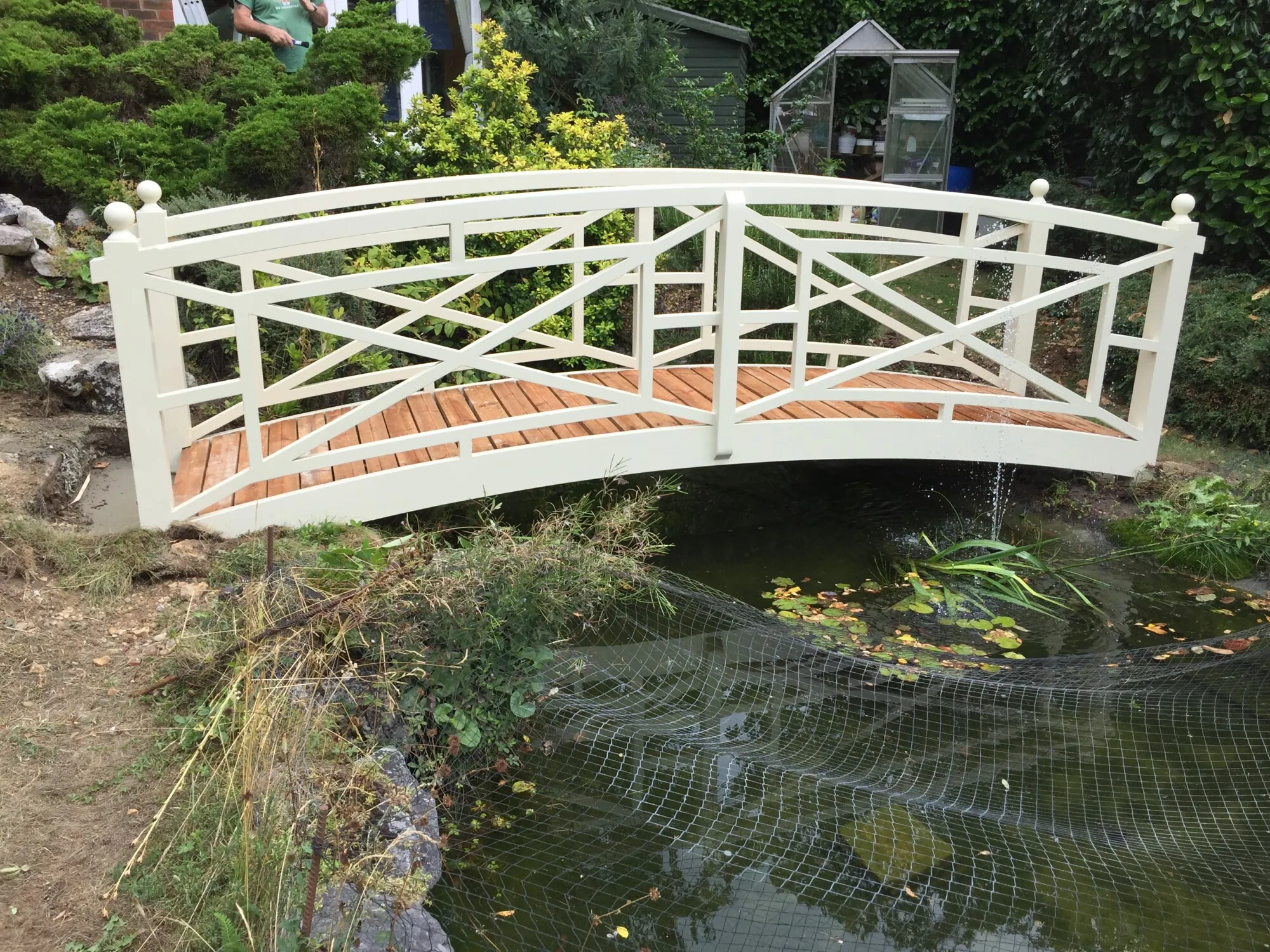
I built that crossing myself, six years earlier. Oak planks I milled from trees on my own property, dropped and squared and planed over a whole winter in the barn while the wood cured. Steel stringers I priced for months before I could afford them, hauled in on a flatbed, and set with a rented crane over three brutal weekends in April, my hands raw from the cold and the cable. It ran from my south field across a narrow bend of the river to forty acres I’d inherited from my uncle Ray, land that was otherwise only reachable by a two-mile drive around on gravel roads that flooded every spring and turned to soup for a week after any real rain. I built it to save myself time checking cattle on that back parcel. That was the whole reason. Nothing grander than that. I wasn’t thinking about legacy or property values. I was thinking about not losing another calf to a washed-out crossing the way I had the year before I started building.
Martha was still alive then. She used to bring me lemonade down to the bank on the hot days, sit on an overturned bucket, and tell me I was building a monument to my own stubbornness. She wasn’t wrong. But she loved that bridge too, in the end. She’d walk out to the middle of it some evenings just to stand there and watch the water, long after I’d finished the railings, and she’d call it her thinking spot. After she passed, three years later, I kept walking out there myself some evenings for the same reason, though I never told anyone that. It felt like the one place on the whole property where I could still feel her nearby without the ache of walking past her garden or her chair on the porch.
Blue Fern Resort broke ground three years after I finished the bridge, half a mile upstream, all glass and cedar siding and a marketing budget that made my little valley look, in their brochures, like something out of a travel magazine. For the first year they were good neighbors. Evan Callaway, their general manager, came by once with a bottle of wine to introduce himself, shook my hand, admired the bridge honestly, called it a fine piece of work. I liked him, that first year. I want that on the record, because it makes what came after harder to explain, and harder to forgive.
Then their east entrance road, the one that actually belonged to them, turned out to add nearly four miles to the drive from the highway, winding through switchbacks that guests apparently complained about in their online reviews. And somebody on Blue Fern’s staff noticed my bridge sitting there, quiet and private, cutting that trip down to almost nothing if you didn’t mind crossing land that wasn’t yours.
At first it was just a guest here and there, lost, apologetic, easy to wave off with a smile and a point in the right direction. I didn’t mind that. Anybody can get turned around on a country road with a bad signal. Then it was resort shuttle vans, twice a day, then four times, then delivery trucks for the kitchen rumbling across at six in the morning while I was still in bed, then, one Saturday in June, an entire wedding party in a line of luxury SUVs, crossing my private bridge like it was a public thoroughfare, because somebody at the front desk had started telling guests it was “the scenic shortcut, ask about it.”
I put up a sign. Reflective, professional, PRIVATE BRIDGE — NO RESORT TRAFFIC, mounted on a post I sank in concrete myself. They ignored it within the week. I called the resort. Evan apologized smoothly on the phone, said he’d speak to the front desk staff, and did nothing. The traffic got worse instead of better. I started keeping a log, dates and times, out of pure frustration, the way you keep a log of anything that’s slowly driving you out of your mind. Fourteen crossings in one week that August. Nineteen the next.
And then, instead of an apology, instead of even a phone call, I got a letter.
The letter was six pages, on resort letterhead, embossed, the kind of paper that costs somebody real money. It informed me that due to established historical usage patterns, my bridge had effectively become shared infrastructure serving Blue Fern’s operations, and that, given the increased load their own guests and vendors had put on it, safety codes required a full commercial-grade upgrade. Attached was an engineering estimate from a firm two counties over. One hundred eighteen thousand dollars. They proposed I cover the difference beyond what they were, generously, willing to contribute, since I would, after all, retain personal use of the crossing too, once it was upgraded to code.
I read that letter three times standing in my own kitchen, coffee going cold on the counter, and somewhere around the third read I stopped being confused and started being calm in the specific, dangerous way I get when I’ve already decided what I’m going to do and I just haven’t told anyone yet, not even myself in so many words.
I didn’t sue. I didn’t call Evan back screaming, though God knows some part of me wanted to. I drove to the county building the next morning and pulled a demolition permit for a private structure on private land, which, as it turned out, was entirely within my rights, no easement on file, no recorded shared-use agreement, nothing but a resort’s assumption dressed up as history. I hired a small crew out of the next town, four men and a foreman named Curtis who didn’t ask a single question about why, and over four days we took that bridge apart plank by plank, the same way it had gone together, and let the river erase the access route Blue Fern had decided, somewhere in a boardroom, belonged to them.
I kept every plank. I want to say that now, because it matters for later. I had Curtis’s crew stack them under the barn eave instead of hauling them to the dump, and I couldn’t have told you why at the time. Something in me wasn’t ready to call it garbage.
Blue Fern did not collapse, despite what Evan implied it might in that first angry phone call after the demolition. Resort guests simply had to use the longer paved county route from the east, the route Blue Fern had always technically had but never advertised, because it added nearly four miles. Four miles. That was what my bridge, the thing I built with my own hands out of my own trees, had been reduced to in their minds. Not a structure I built. Not a private crossing on private land. Four inconvenient miles in a guest experience.
People will do strange things to save four miles when they’ve decided someone else should pay the cost of it.
A few days after the demolition, Evan called.
“This isn’t over,” he said.
I was sitting on the porch sharpening a pocketknife, watching the river move through late-afternoon light, the same light that used to catch the top rail of the bridge and turn it gold for about twenty minutes every evening. I missed that light show already, though I wasn’t going to tell him that.
“It is for me.”
“We’re reviewing options.”
“Do what you need to do.”
“Daniel, removing the bridge doesn’t erase the access history.”
“No,” I said. “But it makes tomorrow’s crossing pretty difficult.”
He did not appreciate that.
His attorney requested a mediation session a week later. I went, mostly out of curiosity, partly because my own lawyer, a sharp, patient woman named Ruth Alvarez who’d handled my uncle’s estate years back, said showing up made me look reasonable to anyone watching from a distance, and that mattered if this ever ended up in front of a judge. The meeting was held in a beige conference room above an insurance office in town, the kind of room with a water stain shaped like Florida on the ceiling tile and a carafe of coffee that had clearly been sitting there since the office opened. Evan arrived with his attorney, his measured smile back in place like he’d never lost it, like the last six months hadn’t happened at all.
Their proposal was predictable. Blue Fern would fund most of a new commercial-grade bridge if I granted a permanent, recorded easement allowing resort traffic across my land, forever, attached to the deed, running with the property even after I was gone.
“Long-term stability for both parties,” the attorney said, sliding a folder across the table like it was a gift.
“Long-term for whom?” I asked.
“For the broader community,” Evan said.
That phrase made me tired in a way six days of chainsaw work hadn’t.
Broader community. Regional growth. Shared access. Safety collaboration. Improved infrastructure. Every phrase was just another way of saying they wanted my property to solve their business problem, dressed up in language soft enough that refusing it would sound selfish to anyone who hadn’t lived it.
The mediator, a calm woman named Helen Marsh who’d clearly sat through a hundred meetings exactly like this one, asked if there was any compromise I could consider.
I thought about it. I really did, sitting there under that water-stained ceiling tile with Ruth’s hand resting lightly on the folder in front of her, waiting to see what I’d say. Money was on the table. A new bridge would have been stronger than the old one, engineered by professionals, safer in a hundred small ways mine, hand-built and a little crooked in places, never quite managed. Blue Fern would maintain it at their own expense. I’d get an upgraded crossing without covering most of the cost. On paper, it was the sensible answer, the one an accountant would circle in red pen.
But then I pictured the next twenty years. Weekend traffic passing within sight of my porch, headlights sweeping across my living room windows at eleven at night after some late checkout. Wedding vendors crossing at dusk with vans full of flowers, strangers walking my fence line to get a better photo of the sunset. Guests slowing down to take pictures of what used to be my quiet stretch of river, waving at me like I was part of the scenery. Delivery trucks grinding over new boards before dawn while I was still asleep, my dog barking himself hoarse every single morning. Resort signage pointing toward my own private road. Legal language allowing commercial use where private quiet used to live, permanently, on paper, forever attached to my name in the county records, outliving me, outliving anyone who might inherit this place after me and never once get to know what quiet used to feel like here.
A bridge can connect land. It can also invite the world in, and once you invite the world in, it does not politely leave when you change your mind.
“No,” I said.
Helen nodded like she’d expected exactly that answer, like she’d seen this exact moment play out before in other beige rooms with other stubborn landowners.
Evan leaned forward. “You’re refusing a substantial improvement.”
“I am refusing to become your access corridor.”
Ruth didn’t say a word through any of it. She didn’t need to. She just closed her folder, quiet and final, the way you close a book you’ve already decided how ends.
The meeting ended shortly after that.
Back home, I began restoring the riverbank properly. Curtis’s crew came back for two more days, removed the old concrete footings down to grade, filled the disturbed ground, and shaped both approaches so rain wouldn’t cut new channels through the loosened soil. I spread native grass seed along the old path myself, walking it back and forth with a hand spreader the way my uncle taught me forty years ago, back when I was a boy following him around this same property, thinking he knew everything worth knowing. Walt, my nearest neighbor and about the only person in the county who never once asked me to reconsider, helped me set a steel gate at the entrance. Not because anyone could still physically cross there. Just because some people need to see a boundary before they remember one exists at all.
Within weeks, grass softened the edges. Within months, the old approach looked less like a road and more like a memory, the kind of thing you’d walk past without a second glance if you didn’t already know what used to be there.
People in town talked, of course. They always do. Some said I was stubborn, that I should have let Blue Fern pay for the upgraded span and enjoyed a nicer bridge for free, taken the win and stopped complaining. Others said I’d protected every small landowner in the county by refusing to let a developer turn convenience into precedent, that if I’d caved, every resort and subdivision within twenty miles would start eyeing their neighbors’ driveways the same way, sending their own letters, hiring their own engineers to draw up their own six-figure demands.
At the feed store one Saturday, a man I barely knew told me I’d hurt local jobs.
I asked him whether Blue Fern had laid anyone off since the bridge came down.
He said no.
“Then I guess they found the other road,” I said.
He didn’t have much to say after that. Bought his feed and left.
The county inspector came by once after everything was finished, walked the bank in his rubber boots, checked the final grading with a level, and signed off on the closure without much comment. Before he left, he stood with me near the water a minute, looking at the gap in the trees where the bridge used to be.
“For what it’s worth,” he said, “this was cleaner than most disputes I see.”
“Didn’t feel clean.”
“Clean doesn’t mean painless.”
That stayed with me longer than I expected it to, turning over in my head at odd hours for weeks afterward.
Because he was right. The demolition hurt more than I’d admitted to anyone, including myself, in the moment. For days after the bridge came down, I kept catching myself turning toward it out of pure muscle memory. If I needed to check the back field, my body still expected the old route, my truck already halfway into the turn before my brain caught up and I had to correct course, add the extra twenty minutes around by gravel. If I heard an engine near the road, part of me still listened for tires on planks, that particular hollow drumming sound that used to mean somebody was crossing. In the evenings I found myself walking down to the bank out of sheer habit, coffee in hand, stopping right where the bridge used to begin, looking across at land I could still technically reach, just not the easy way anymore, not the way that had felt, for six years, like the most natural thing in the world.
Removing a problem does not mean you don’t miss what it used to be, before other people changed its meaning for you.
That bridge had been useful. It had been mine. It had been Martha’s thinking spot. It had also become a handle someone else was trying to grab and pull my whole life through, and eventually those two facts couldn’t coexist anymore. One of them had to give.
I’ve learned that sometimes the hardest boundary to protect is the one attached to something you actually love.
Evan eventually stopped calling. Somewhere around the third month I heard, through Walt, that Blue Fern’s insurance carrier had quietly advised against pursuing the easement claim any further once they saw how clean my paperwork was, how thoroughly I’d documented every unauthorized crossing in that log I’d kept out of frustration. Turns out frustration is good for something after all. Blue Fern adjusted their signage and started promoting the eastern entrance as a “scenic forest approach.” That made me laugh out loud the first time I saw it online, alone in my kitchen with a cup of coffee, scrolling through their new website on my phone like some kind of spy. The same four miles they’d treated like a full-blown operational disaster became a feature the moment their marketing department got hold of it.
The resort still operates. Weddings still happen there most weekends from May through October. Kayaks still line the shore upstream on summer afternoons. Couples still pose on the restaurant deck at sunset, the same sunset that used to catch my bridge rail gold for those twenty minutes every evening. Now and then, when the air’s still, I can hear music drifting downstream on Saturday nights, some string quartet or a DJ’s bass line carrying further than it has any right to over water. It doesn’t bother me much anymore. Sound crosses water whether you grant it permission or not.
Traffic doesn’t.
One evening that first fall, I sat on the porch while the hardwoods turned rust and gold along the river, that particular light that makes even an ordinary evening feel like something worth remembering. Walt came by with a jar of muscadine jelly his sister had put up that week. We walked down to the bank together and stood quietly where the bridge used to be, the gap in the trees still looking a little raw against the surrounding green, like a scar that hadn’t fully faded yet.
“Miss it?” he asked.
“Sometimes.”
“Regret it?”
I watched the river move through the open space where the bridge used to cast its shadow across the water every afternoon.
“No.”
He nodded slowly, the way Walt nods when he’s actually thinking something through rather than just being polite. “Those are different things.”
They are. I missed driving across it at dawn, coffee in the cup holder, pausing halfway over just to watch the water move underneath me before I started my day. I missed the sound of tires on oak planks, the little summer creaks and winter pops in the wood, the way the top rail held the day’s warmth long after the sun went down, so that even in October you could rest your forearms on it and feel August still living in the grain. I missed Martha teasing me because I used to inspect every single bolt on that bridge like I was sending it off to war, walking the length of it with a wrench in my back pocket every spring whether it needed checking or not.
But I did not regret removing it. Regret belongs to choices you’d undo if someone handed you the chance to do it all again. I would not undo this one, not even on the hardest evenings, not even missing Martha’s thinking spot as much as I did.
Because the moment Blue Fern tried to bill me six figures to upgrade a private bridge for their own commercial shortcut, the bridge stopped being just a bridge. It became leverage. It became liability. It became an argument waiting to be dressed up in the language of access rights. A structure I loved, that I’d built plank by plank with my own two hands out of trees I’d watched grow on this land my whole life, was being used to pull that same land into somebody else’s business plan without ever once asking if I wanted to be part of it.
They wanted me to believe my only options were upgrade, negotiate, or fight forever, three doors that all led to the same room, where the resort got what it needed and I got the bill.
There was another option.
Let the river be a river.
The next spring, the grass came in thick where the approach used to run. Wildflowers took root along the old bank, black-eyed Susans and some kind of purple aster I never planted and couldn’t name. I started leaving that stretch alone except for trimming a narrow path down to the water so I could still get to my fishing spot. Deer crossed there sometimes in the early mornings, unbothered, the way they never had been when trucks were rumbling through at dawn. Once, I watched a fox drink from the edge right where the bridge’s shadow used to fall across the water at that hour, its reflection sharp and still in the current for just a second before it startled and vanished into the brush.
Nature accepts change faster than people do. I’ve come to believe that’s just about the truest thing I know.
That summer, I built a small bench out of three of the old oak planks, the ones Curtis’s crew had stacked under the barn eave, the ones I couldn’t explain why I’d saved. I sanded them lightly, not enough to erase every mark the years had left in the wood. A few nail holes remained, dark little punctuation marks in the grain, and I left them exactly where they were. One board still carried a dark stain from the year my tractor sprung a hydraulic leak right on top of it, back when the bridge was only two years old and I was still learning its quirks. I set the bench on my side of the river, facing the water, facing the gap where the crossing used to be, so I could sit and look right at the empty space and not flinch from it.
Now, when I sit there at dusk, I can still hear the boards creak faintly under me when I shift my weight. Not as a crossing anymore. As proof.
Proof that I built something useful with my own two hands. Proof that I was the one allowed to decide when its usefulness had curdled into a risk. Proof that ownership isn’t just the right to have a thing. It’s the right to remove it the moment everyone else starts acting like it already belongs to them.
Evan once told me my land value would increase with improved infrastructure. Maybe he was right, in the narrow way developers measure value on a spreadsheet, dollars per acre, comps down the road, the kind of number that fits neatly in a column. But not all value shows up in an appraisal.
There’s value in quiet. Real, measurable-in-your-own-chest value in never seeing a stranger’s headlights sweep across your own private road at midnight while you’re trying to sleep. Value in knowing the liability tied to your name can’t be pulled under somebody else’s wheels while you’re not even watching. Value in standing where a bridge used to be and understanding, all the way down in your bones, that saying no sometimes means taking away the very thing everyone else wanted to use against you, even when it costs you something you loved to do it.
People ask me sometimes whether I hate Blue Fern.
I don’t. Hate would give them more room in my life than they’ve earned, more room than I’m willing to spend on people who were never going to lose a minute of sleep over what they were asking of me. They saw an opportunity, the way companies do, and they pushed it further than they had any right to. That’s what happens when a spreadsheet meets a person who happens to own something useful. They call it partnership. They call it regional access. They call it safety compliance. They call it progress.
But progress paid for with someone else’s rights isn’t progress. It’s just trespass with a better vocabulary and a nicer letterhead.
If Evan had come to me first, honestly, before the trucks and the letters and the implied legal threats, I might have listened. I might have allowed some limited access during certain hours for light vehicles. I might have negotiated an emergency-only crossing, something reasonable, something with real boundaries we both agreed to over a handshake instead of a courtroom. I might even have said no anyway, in the end. But at least the conversation would have started with respect, instead of ending with a hundred-and-eighteen-thousand-dollar bill for traffic I never once invited across my own land, never once agreed to, never once got so much as a thank-you for tolerating.
Instead they sent trucks. Then they sent guests. Then they sent a bill.
So I sent the bridge away.
Sometimes the strongest move isn’t building something bigger to prove a point. Sometimes it’s deciding you don’t owe anyone a road left open, not for people who only learn to respect a boundary after you’ve shown them, plainly, in the clearest language there is, that you’re willing to take it away completely.
The river runs free now.
So do I.

Laura Bennett writes about complicated family dynamics, difficult conversations, and the quiet moments that change everything. Her stories focus on real-life tensions — inheritance disputes, strained marriages, loyalty tests — and the strength people find when they finally speak up. She believes the smallest decisions often carry the biggest consequences.